
Nanu Nanu, Prime Time
Under hot studio lights and in front of a live audience, an alien in rainbow suspenders turned a sitcom set into comic lift-off. Mork & Mindy still glows as one of television’s warmest, wildest hits.
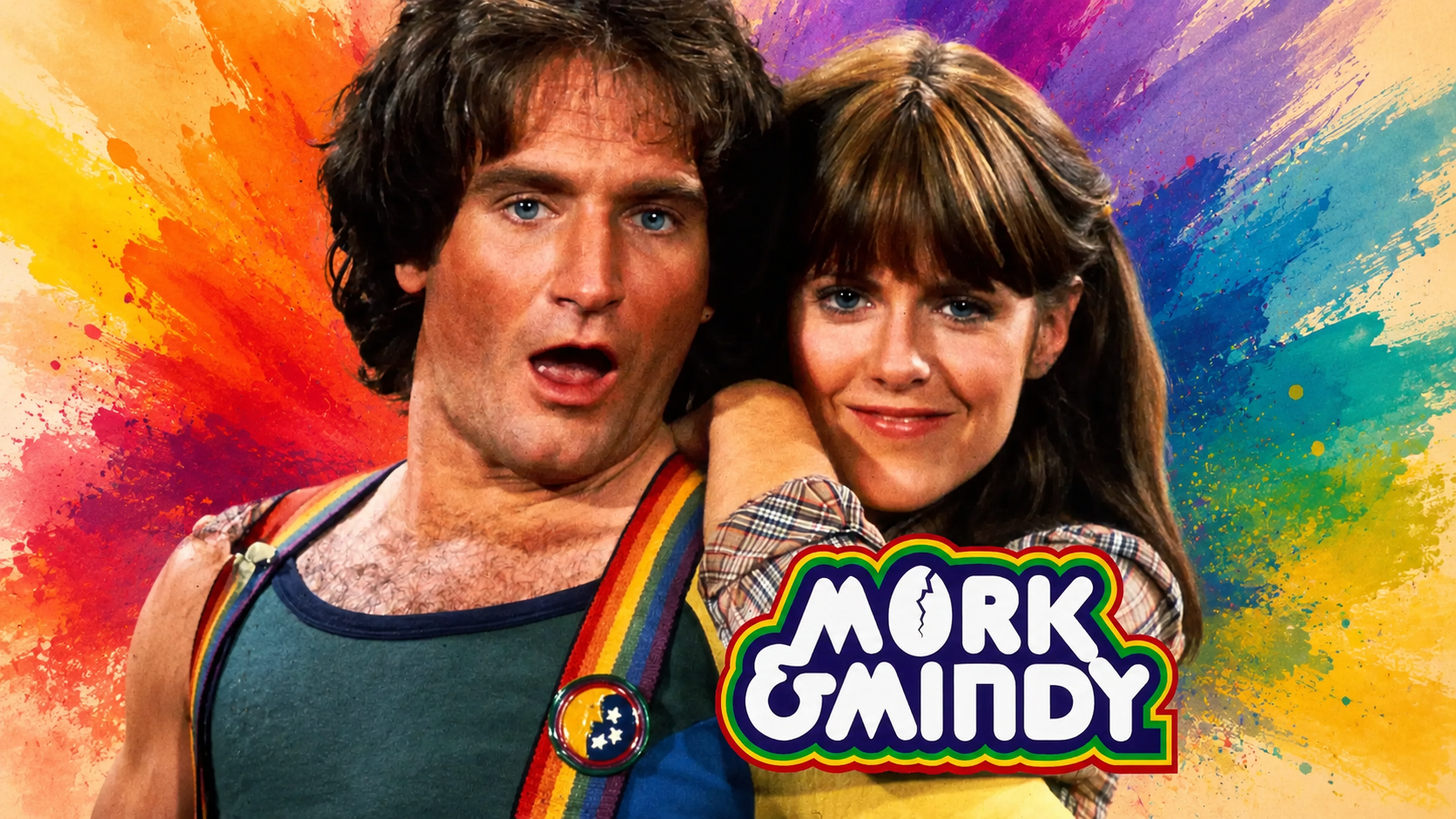
Bright studio lights, a burst of laughter, and one electric entrance from another planet — Mork & Mindy arrived on television with the kind of energy you could almost feel through the screen. For audiences in the late 1970s and early 1980s, it was not just another sitcom. It was a weekly jolt of mischief, heart, and comic invention, powered by a performer who seemed to be making the whole thing up in real time.
Looking back now, Mork & Mindy feels like a wonderful collision of eras. It spun out of the comfortable world of Happy Days, yet it belonged to a stranger, freer comic universe all its own. There were suspenders, rainbow-bright costumes, and cosy apartment scenes, but there was also Robin Williams — fast, fearless, and gloriously unpredictable. That combination gave the show its very special spark.
A sitcom beamed in from another world
Premiering in 1978, Mork & Mindy began with a premise that sounded delightfully simple: an alien from the planet Ork lands on Earth and tries to understand human life with the help of the warm-hearted Mindy McConnell, played by Pam Dawber. But simple premises sometimes leave the most room for magic, and this one certainly did.
Mork was not like any visitor television had seen before. He was childlike and curious, oddly formal one moment and wildly absurd the next. He drank through his finger, sat upside down, greeted people with “Nanu Nanu,” and reported back to his unseen superior, Orson, with observations about human behaviour. Those reports became one of the show’s clever devices: a way to turn ordinary everyday habits into comedy by looking at them through alien eyes.
That idea gave the writers plenty to play with, but the real fuel was Williams himself. He took Mork beyond a quirky concept and made him unforgettable. His performance was elastic, musical, and full of sudden left turns. One second he was innocent and sweet; the next he was racing through impressions, voices, and physical gags with astonishing speed.
Robin Williams changed the temperature of the room
There are television stars, and then there are performers who seem to alter the air around them. Robin Williams did that. Even in scenes built around a standard sitcom setup, he made everything feel spontaneous. Co-stars had to stay alert because a line reading, a glance, or a bit of improvised business could arrive from absolutely nowhere.
That freshness became the show’s signature. Viewers tuned in not only for the story, but for the thrill of wondering what Williams might do next. In many ways, Mork & Mindy captured the same excitement as hearing a favourite song on the radio and waiting for that one moment you love — except here, the surprise was often brand new each week.
Pam Dawber played the perfect counterbalance. Her Mindy was grounded, kind, and believable, giving the show a human centre. She never fought the chaos with bigger chaos. Instead, she anchored it. That balance mattered. Without Mindy’s warmth and patience, Mork’s antics might have floated away into pure sketch comedy. With her there, the show had emotional shape.
The chemistry that kept it all in orbit
Dawber and Williams had a rhythm that made the series work. She gave scenes structure; he filled them with fireworks. It is one of those pairings that reminds us how important comic balance can be. The biggest laugh often lands harder when someone on screen is trying very hard to keep things normal.
Behind the scenes, Dawber also had the difficult task of sharing scenes with one of the quickest comic minds in entertainment. By all accounts, she met that challenge with grace and timing. Watching the show now, you can see how often she keeps the emotional line of a scene steady while Williams takes it somewhere joyfully unexpected.
How a spin-off became a sensation
It is easy to forget just how quickly Mork & Mindy became a hit. The character first appeared on Happy Days, in an episode that introduced Mork as a visitor from outer space. That might have been a one-off novelty, but audiences responded immediately. The idea clearly had legs — or perhaps rocket boosters.
Once the spin-off launched, it connected fast. Part of that success came from timing. Television in the late 1970s had room for broad family comedy, and Mork & Mindy arrived with a concept that felt playful and fresh. It also tapped into the era’s fascination with space, science fiction, and futuristic imagination. Yet for all its cosmic trimmings, the show remained reassuringly down to earth. At its heart, it was about friendship, belonging, and trying to make sense of a confusing world.
That is probably why it still holds affection today. Under the suspenders and catchphrases, there was a gentle idea: maybe we are all a little strange, and maybe that is what makes us lovable.
Behind the scenes, a high-wire act
One of the most enjoyable things about revisiting Mork & Mindy is knowing how much of its magic came from the set itself. Williams was famous for improvising, and the production had to build around that energy. Writers created a framework, but everyone knew that once the cameras rolled, something unexpected might happen.
That could be thrilling, but it also demanded flexibility. Directors, editors, and fellow actors had to shape episodes around a performer who was capable of turning a short exchange into a miniature comic symphony. The result was a show that often felt looser and more alive than many of its sitcom contemporaries.
Of course, that same unpredictability could be difficult to sustain over several seasons. Like many hit series, Mork & Mindy experimented with format changes and supporting characters as it went along. Not every adjustment landed perfectly, and the show’s later years never quite matched the lightning strike of its earliest run. Still, even when the structure wobbled, Williams remained a reason to watch.
At its best, Mork & Mindy felt like a live wire hidden inside a cosy sitcom set.
The catchphrases, the clothes, the feeling
Some television shows leave behind plots. Others leave behind a mood. Mork & Mindy did both, but it especially excelled at creating instantly recognisable details. “Nanu Nanu.” The rainbow suspenders. The egg-shaped spacecraft. Mork sitting on his head. These were not just gimmicks. They became part of the show’s identity, the visual and verbal hooks that made it easy to remember and impossible to confuse with anything else.
For viewers of a certain generation, hearing the title alone can bring back the whole atmosphere of that era: the family gathered around the television, the opening credits beginning, and the expectation that something silly and sweet was about to happen. That is the kind of memory classic television does so well. It does not simply remind us of a programme; it reminds us of where we were when we watched it.
A look back at the magic
The clip above is a lovely reminder of why the show still inspires such affection. Even in brief glimpses, you can see that unique blend of innocence, speed, and comic invention. It also highlights something easy to miss when we talk only about Robin Williams: Mork & Mindy was carefully built to showcase its star while still delivering the warmth of a mainstream sitcom.
Why it still matters
Today, Mork & Mindy stands as more than a successful sitcom. It is an early showcase for one of entertainment’s most beloved talents, and a snapshot of a moment when television was willing to let something genuinely odd become hugely popular. It was broad enough for family viewing, but strange enough to feel exciting. That is a difficult balance to achieve.
It also remains a touching example of comedy with heart. For all the manic energy, there is kindness running through the series. Mork may have been studying humanity, but the show itself was often doing something similar — observing our habits, our vanity, our confusion, and our capacity for care. It laughed at people without turning cruel.
Final thoughts
If you revisit Mork & Mindy now, some elements will feel wonderfully of their time. The fashion, the pacing, the set design — all of it carries the glow of late-70s and early-80s television. But the central charm still comes through loud and clear. Robin Williams was a one-man burst of comic electricity, Pam Dawber gave the series its heart, and together they made a show that could be zany, tender, and memorable all at once.
In radio terms, Mork & Mindy was a hit record with an unforgettable opening hook. The moment it came on, you knew exactly what it was — and you were happy to stay with it until the end.
- Best remembered for: Robin Williams’ breakthrough television role
- Secret ingredient: The contrast between wild improvisation and a warm sitcom structure
- Why revisit it: For the laughs, the nostalgia, and a front-row seat to a rare comic talent taking flight