The Wraith (1986): The Forgotten ’80s Movie of Fast Cars, Rock Music and Revenge
Fast cars, supernatural revenge, Charlie Sheen and a soundtrack packed with ’80s rock—The Wraith (1986) was made for the VHS era. Take a ride back to one of the decade’s most unforgettable forgotten movies.
There are certain movies that could only have existed in the 1980s. They may not have won awards or become blockbuster franchises, but put them on late at night and within a few minutes you know exactly what decade you are visiting. The cars are fast, the music is loud, the villains wear sunglasses, and nobody seems particularly concerned about whether any of it makes sense.
The Wraith is one of those movies.
Released in November 1986, The Wraith combined street racing, teenage romance, science fiction, supernatural revenge and MTV-era rock music into 104 minutes of wonderfully excessive ’80s entertainment. It starred a young Charlie Sheen alongside Sherilyn Fenn, Nick Cassavetes and Randy Quaid, and while it never became one of the decade’s defining hits, it found exactly the kind of second life that so many forgotten ’80s movies did: cable television, video stores and word of mouth.
For anyone who discovered it that way, the sight of that mysterious black car coming down an Arizona highway is difficult to forget.
Welcome to Brooks, Arizona
The story takes place in an Arizona town essentially controlled by Packard Walsh, played with wonderfully unpleasant intensity by Nick Cassavetes. Packard leads a gang of young street racers who have developed a rather effective business model: intimidate other drivers into racing them and take their cars when they lose.
Packard is also obsessively possessive of Keri, played by Sherilyn Fenn. Keri had previously been involved with Jamie Hankins, a young man who was mysteriously murdered.
Then a stranger arrives.
His name is Jake Kesey, played by Charlie Sheen, and almost immediately there is something unusual about him. He becomes friendly with Jamie’s younger brother Billy and attracts Keri’s attention, which naturally puts him on a collision course with Packard.
But Jake isn’t the only stranger who has appeared.
A futuristic black automobile begins challenging members of Packard’s gang to races. Behind the wheel is a mysterious figure dressed completely in black. One by one, Packard’s racers discover that racing this particular car can have deadly consequences.
And after every spectacular crash, something impossible happens.
The mysterious car returns.
So does its driver.
Gradually, the movie reveals that Jake, the strange driver and the murdered Jamie are connected, turning what initially looks like a street-racing movie into a supernatural revenge story.
It is an absolutely ridiculous premise.
It is also incredibly entertaining.
The Car That Stole the Movie
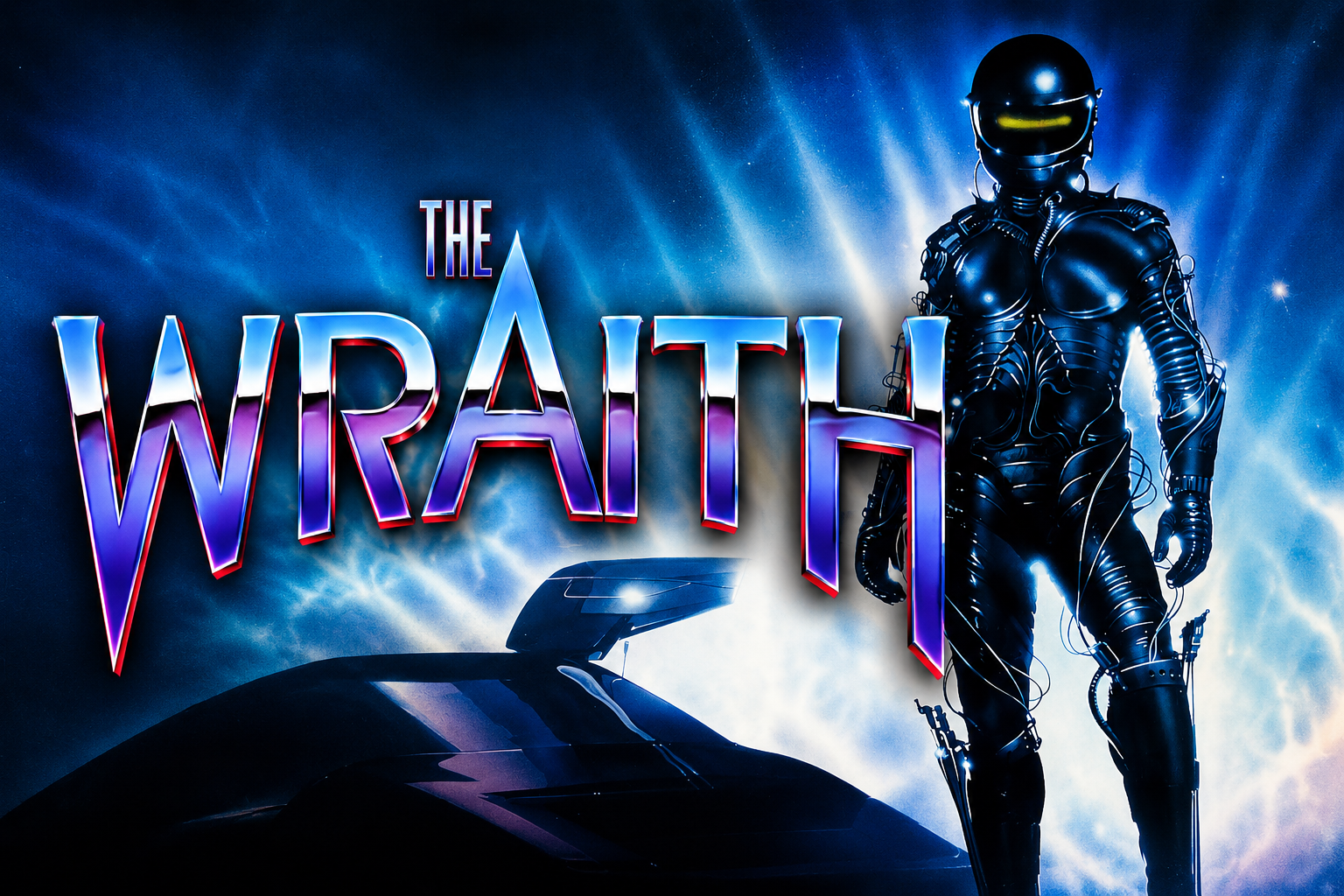
Charlie Sheen may have received top billing, but the real star of The Wraith was arguably the Turbo Interceptor.
The futuristic automobile seen in the movie was based on the Dodge M4S, an experimental prototype developed through Dodge and PPG Industries. According to the American Film Institute, seven versions of the automobile were used during production. The original prototype was reserved for close-ups, while stunt versions were built on dune-buggy chassis and hollow bodies were used for the movie’s crashes.
And in 1986, the thing looked like it had arrived from another planet.
Low, black and almost impossibly sleek, the Turbo Interceptor didn’t resemble the ordinary cars filling American parking lots at the time. Even compared with exotic sports cars of the era, there was something futuristic about it.
The movie understood that.
Mike Marvin, who both wrote and directed The Wraith, frequently treats the car less like a vehicle and more like a supernatural creature. It appears unexpectedly, waits silently for its opponent and then disappears down the highway.
For a generation of kids watching the movie on VHS, the Turbo Interceptor was probably the part they remembered long after they had forgotten the plot.
An Extremely 1986 Soundtrack
If the Turbo Interceptor provides the visual identity of The Wraith, the soundtrack tells you exactly when the movie was made.
Billy Idol’s “Rebel Yell.”
Ozzy Osbourne’s “Secret Loser.”
Mötley Crüe’s version of “Smokin’ in the Boys Room.”
Robert Palmer’s “Addicted to Love.”
The soundtrack also included music from Bonnie Tyler, Honeymoon Suite, Stan Bush, Ian Hunter, Nick Gilder and others.
It is difficult to imagine a more perfectly mid-1980s collection.
The songs aren’t simply playing quietly in the background, either. They become part of the movie’s personality. Combined with desert roads, customized cars, leather jackets and neon-lit hangouts, the music makes The Wraith feel almost like an extended rock video interrupted occasionally by dialogue.
And that’s part of its charm.
This was the era when movies and popular music were becoming increasingly intertwined. MTV had changed how teenagers experienced music, and Hollywood enthusiastically adopted the same visual language. Top Gun had arrived earlier in 1986, and countless movies were being constructed around montages, pop songs and images that wouldn’t have looked out of place in a music video.
The Wraith embraced that style completely.
Charlie Sheen Before He Became Charlie Sheen
Watching the movie today also provides an interesting glimpse of Charlie Sheen just before his career exploded.
The Wraith opened on November 21, 1986. Only weeks later, audiences would see Sheen in Oliver Stone’s Platoon, the film that transformed him into a major young Hollywood star.
His performance here is very different.
Jake isn’t particularly talkative or complicated. Sheen spends much of the movie being mysterious, riding a motorcycle, staring knowingly at people and generally behaving like someone who already knows how everything is going to end.
But that actually works for the character.
Sherilyn Fenn is another familiar face who was still several years away from the role that would make her famous. Four years later, she would become Audrey Horne on Twin Peaks.
Then there’s Randy Quaid as Sheriff Loomis, the increasingly confused lawman attempting to understand why Packard’s friends keep dying under circumstances that don’t appear to obey the normal laws of physics.
And for cult-movie fans, there is Clint Howard as Rughead, the eccentric mechanic of Packard’s gang.
It is one of those casts that becomes more interesting with time.
The Arizona Desert Was the Perfect Setting
Although the movie’s story takes place in Arizona, this wasn’t Hollywood pretending that Southern California was somewhere else. The Wraith was actually filmed in and around Tucson.
Production began there in January 1986, with locations including areas around Saguaro National Monument and Sabino Canyon. Even the movie’s burger restaurant had an unusual history: production notes described the location used for Big Kay’s Burgers as a former barber shop that had once been located atop an air traffic control tower.
The Arizona landscape gives The Wraith much of its distinctive appearance.
Long stretches of desert highway disappear toward mountains in the distance. The bright daytime scenes have a sun-bleached quality, while the nighttime sequences transform those same roads into dark racing strips.
It feels isolated.
That’s important because the movie almost exists in its own universe. Packard and his gang seem able to terrorize the town largely without consequence, teenagers settle disagreements with illegal road races, and an otherworldly sports car can appear on the highway without attracting the attention one might reasonably expect.
You simply have to accept the world of The Wraith.
Once you do, it’s a lot of fun.
A Production Marked by Tragedy
Behind the movie’s escapist story, however, is a genuinely tragic piece of its history.
During filming of a chase sequence near Tucson, a camera truck carrying members of the production crew lost traction on a mountain road. Several crew members were seriously injured.
Camera operator Bruce Ingram suffered severe injuries and died on March 2, 1986.
The production temporarily suspended second-unit photography following the accident, and the finished film was dedicated to Ingram’s memory.
It is a sobering part of the history behind a movie otherwise remembered for fantasy, cars and rock music, and one worth acknowledging when looking back at its production.
The Kind of Movie We Used to Discover by Accident
Perhaps the most nostalgic thing about The Wraith isn’t actually anything that happens in the movie.
It’s the way people discovered movies like this.
You might have seen the VHS box sitting on the shelf at the local video store. Maybe the futuristic black car on the cover convinced you to rent it without knowing anything else about it. Or perhaps you stumbled across the movie halfway through one Saturday afternoon while flipping through cable channels.
That kind of accidental discovery was an important part of movie culture during the 1980s and 1990s.
There was no recommendation algorithm telling you that because you watched one movie you might enjoy another. Sometimes you picked a movie because the box looked interesting. Sometimes your friend told you about something strange he’d watched the night before. Sometimes HBO simply happened to be showing it.
Movies like The Wraith benefited enormously from that world.
It didn’t need to be Back to the Future or Top Gun. It didn’t need to dominate the box office. It simply needed to be sitting on that video-store shelf waiting for the right teenager to notice it.
Why The Wraith Is Still Worth Remembering
Nobody needs to pretend The Wraith is a forgotten cinematic masterpiece.
That’s not why movies like this matter.
It is memorable because it captures a particular kind of filmmaking that flourished during the 1980s: take several things teenagers like, combine them without worrying too much about genre, add a killer soundtrack and an unforgettable car, and see what happens.
Is it a science-fiction movie?
Sort of.
A supernatural revenge movie?
Definitely.
A street-racing movie?
Absolutely.
A teenage romance?
Somehow, yes.
And that wonderfully strange mixture is precisely why The Wraith has survived in the memories of the people who encountered it decades ago.
Nearly forty years later, the hairstyles, clothes, music and attitude have turned the movie into something its creators probably never intended it to be: a time capsule.
Put it on today and suddenly it’s 1986 again.
There’s a Billy Idol song playing somewhere in the background. The Arizona sun is setting over an empty highway. A group of kids are hanging around their cars with nowhere particularly important to be.
And somewhere in the distance, a mysterious black Turbo Interceptor is coming over the hill.
For anyone who remembers discovering The Wraith during the VHS and cable-TV era, that’s probably all the invitation they need.