60 Years of Star Trek: How a 1960s TV Show Boldly Went Where No Show Had Gone Before
Sixty years ago, the U.S.S. Enterprise began a journey nobody could have imagined would last this long. From a struggling 1960s television series to one of the most beloved franchises in popular culture, Star Trek survived cancellation, found a new generation through reruns and ultimately became part of our shared imagination. As Star Trek celebrates its 60th anniversary, we look back at Kirk, Spock, the Enterprise and the wonderfully optimistic vision of the future that started it all.
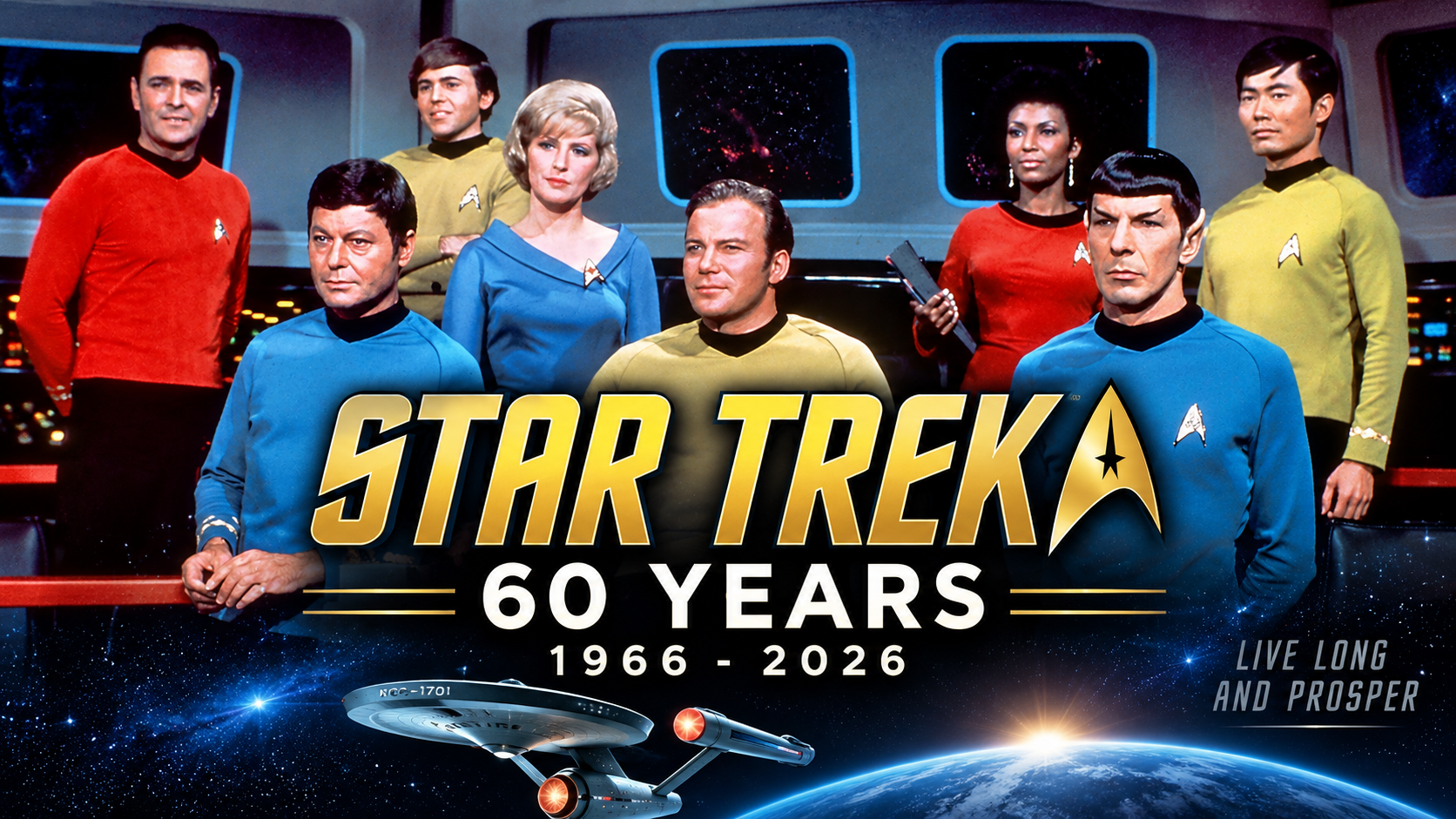
On September 8, 1966, American television viewers encountered something rather unusual. There was a spaceship called the Enterprise, commanded by Captain James T. Kirk and crewed by people who were traveling through space not simply to fight aliens or conquer new worlds, but to explore them. Beside Kirk stood the logical, pointy-eared Mr. Spock, the wonderfully irritable Dr. Leonard McCoy, communications officer Uhura, helmsman Sulu, engineer Scotty and the rest of a crew that would eventually become some of the most recognizable characters in television history.
Nobody watching Star Trek that evening could possibly have known where the journey would lead. The original series would struggle in the ratings, survive for only three seasons and disappear from NBC in 1969. By almost any conventional measure of television success at the time, that should have been the end of the story. Instead, sixty years later, Star Trek has become a cultural institution spanning television series, movies, books, conventions, toys and generations of fans. Perhaps even more remarkable is that the optimistic future it imagined in the turbulent 1960s still feels like a future worth dreaming about.
September 8, 1966
The first Star Trek episode broadcast by NBC was “The Man Trap,” although it wasn’t the first episode produced. It introduced television audiences to Gene Roddenberry’s vision of the 23rd century, where the U.S.S. Enterprise traveled among the stars on a mission of exploration. Science fiction was hardly new to television, but Star Trek approached it differently. The Enterprise wasn’t merely racing from one weekly monster to another; its adventures were often ways of examining very contemporary questions about prejudice, war, power, morality and what it meant to be human.
That idea was reflected in the Enterprise crew itself. William Shatner’s Kirk commanded a bridge that included Nichelle Nichols as Uhura, George Takei as Sulu and Leonard Nimoy as Spock, while James Doohan’s Scotty and DeForest Kelley’s McCoy became equally essential parts of the show’s personality. At a time when the United States was living through enormous racial, political and social upheaval, Roddenberry was presenting a future in which people from different backgrounds were working together. The message wasn’t that humanity had always been enlightened. It was that perhaps, someday, we might become better than we were.
A Future That Looked Wonderfully Like the 1960s
Watching the original Star Trek today is also a wonderful trip back into the world of 1960s television. There are brightly colored uniforms, blinking control panels, dramatic lighting, painted planets and alien landscapes that occasionally look suspiciously like somewhere in Southern California. The Enterprise can travel faster than light, yet apparently requires hundreds of physical buttons, switches and flashing lights to accomplish it.
None of that diminishes the experience. In fact, six decades later, it has become part of the show’s charm. There is something wonderfully tactile about that original Enterprise bridge. Kirk settles into his captain’s chair, Spock bends over his strange viewer, Uhura wears that distinctive communications earpiece, Scotty worries about the engines and someone inevitably announces that the shields are failing at exactly the wrong moment. It doesn’t resemble the sterile, seamless technology imagined by much of today’s science fiction. It looks like a future dreamed up in 1966, and that’s precisely why returning to it can feel so comforting.
Kirk, Spock and McCoy
Special effects could provide the planets and spaceships, but the characters were what made audiences care about Star Trek. At the center of the original series was one of television’s great character combinations: Kirk, Spock and McCoy. Kirk represented instinct and action, Spock approached the world through logic, while McCoy brought emotion and humanity into almost every argument. Put the three of them together and even a straightforward mission could become a debate about morality, responsibility or human nature.
Their relationship gave Star Trek an emotional foundation that went far beyond science fiction. Episodes could involve time travel, artificial intelligence, alien civilizations, parallel universes or entire planets facing destruction, but underneath the fantastic situations were recognizable human questions. What is the right thing to do? When should rules be broken? Is pure logic enough? Can emotion cloud judgment, or is it part of what makes us human? Kirk was often caught between the competing voices of Spock and McCoy, and that triangle became one of the defining elements of the series.
Then It Was Gone
One of the strangest things about the Star Trek story is that the original series was never the enormous television hit we might assume it was today. Ratings problems followed it through much of its original run, and although a famous fan letter-writing campaign helped convince NBC to give the program a third season, the network finally canceled it in 1969. Only 79 episodes had been produced.
There was every reason to believe that Star Trek would simply become another remembered television curiosity of the 1960s. Television history is filled with programs that attracted loyal audiences, disappeared after a few seasons and gradually faded from popular memory. Star Trek, however, was about to benefit from something enormously important to television culture in the 1970s: reruns.
The Reruns That Changed Everything
Anyone who grew up watching television in the 1970s or early 1980s understands how powerful syndication could be. There was no streaming service where you could choose any episode whenever you wanted, no complete-series DVD collection sitting on a shelf and, for much of the period, not even a practical way to record a program yourself. Local television stations filled afternoon, evening and weekend schedules with reruns, and suddenly Star Trek began reaching people who had never watched it during its original NBC run.
Children discovered the Enterprise after school. Teenagers became fascinated by its universe. Adults who had overlooked the series in the 1960s encountered it for the first time, while existing fans could watch favorite episodes again and again. The show that hadn’t attracted enough viewers to survive on network television was quietly becoming more popular after its cancellation.
More importantly, those viewers didn’t merely watch. They organized conventions, collected memorabilia, wrote fan fiction, produced newsletters, debated favorite episodes and kept demanding more Star Trek. The term “Trekkie” became part of popular culture, and what had once looked like a failed television series began demonstrating just how devoted a television audience could become.
The Enterprise Goes to the Movies
By the late 1970s, science fiction had changed dramatically. The enormous success of Star Wars in 1977 demonstrated that audiences were ready for large-scale adventures in space, and Paramount finally brought the original Enterprise crew back together for Star Trek: The Motion Picture in 1979. For fans who had spent a decade keeping the series alive through reruns and conventions, simply seeing Kirk, Spock, McCoy, Scotty, Uhura, Sulu and Chekov together again was an event.
The movie was slower and more contemplative than some audiences expected, but the important thing was that Star Trek had returned. Three years later, Star Trek II: The Wrath of Khan gave the franchise what many fans still regard as one of its finest stories. The familiar characters were older now, and the story allowed Star Trek to deal with friendship, regret, aging, sacrifice and mortality alongside its spaceships and battles. The crew that had seemingly disappeared forever in 1969 was suddenly carrying a successful movie franchise.
Then Came Captain Picard
Perhaps the greatest gamble in the franchise’s history came in 1987. Could there really be Star Trek without Kirk, Spock and the original Enterprise crew? Star Trek: The Next Generation attempted exactly that, moving the story decades into the future and placing a completely new crew aboard a new Enterprise. Patrick Stewart’s Jean-Luc Picard was deliberately different from Kirk: thoughtful, diplomatic and reserved, surrounded by characters such as Riker, Data, Worf, Geordi La Forge, Beverly Crusher and Deanna Troi.
Longtime fans understandably approached the new series with some skepticism, but something remarkable happened. The characters gradually established identities of their own, the stories became increasingly ambitious, and another generation developed its own relationship with the Enterprise. For millions of viewers who grew up in the late 1980s and early 1990s, Picard wasn’t the captain who replaced Kirk. He was simply their captain.
The success of The Next Generation opened the door even wider. Deep Space Nine arrived in 1993, Voyager followed in 1995 and Enterprise premiered in 2001. For much of the 1990s, Star Trek wasn’t merely an old show that had somehow survived. It was an enormous television universe, with new episodes appearing week after week and feature films continuing in theaters.
When Star Trek Became Part of Everyday Culture
Perhaps the clearest sign of Star Trek’s success is how much of it became recognizable even to people who never considered themselves fans. The Vulcan salute, the Enterprise, Klingons, transporters and warp speed escaped the boundaries of science-fiction fandom long ago. Phrases such as “Live long and prosper,” “Set phasers to stun” and “Resistance is futile” became cultural shorthand, while calling someone “Spock-like” requires almost no explanation.
Very few television programs ever reach that level. Characters have to become more than characters, and fictional ideas have to become references shared by people who may never have watched an entire episode. Captain Kirk and Mr. Spock eventually joined that small group of television figures who are instantly recognizable across generations.
When Science Fiction Started Looking Familiar
There’s another pleasure in revisiting Star Trek after sixty years: watching yesterday’s imaginary technology gradually resemble everyday life. The crew spoke directly to computers, carried handheld communicators, used electronic tablets and held conversations with people appearing on large video screens. None of those ideas was invented entirely by Star Trek, and the real technologies don’t work exactly as the show imagined them, but the similarities are still difficult to ignore.
Pulling a smartphone from your pocket while watching Kirk flip open his communicator is one of those little reminders of how dramatically the world has changed since 1966. A video call that would once have looked futuristic enough to belong aboard the Enterprise became something grandparents routinely use to talk to their grandchildren. We haven’t reached warp speed, and Scotty still can’t beam us home after a long day, but some pieces of the future stopped looking futuristic a long time ago.
The Technology Was Never Really the Point
For all its spaceships, transporters, phasers and alien worlds, the most enduring idea behind Star Trek was never technological. Gene Roddenberry’s universe asked viewers to imagine what humanity might become if we managed to survive our own worst tendencies. Could cultures learn to live together? Could curiosity become stronger than fear? Could humanity move beyond some of the divisions that seemed permanent in the 1960s?
The Federation wasn’t presented as a perfect society, and Star Trek’s characters continued to make mistakes, disagree and encounter moral contradictions. Yet underneath the stories was a stubborn optimism that became increasingly distinctive as the franchise grew older. Humanity could improve. Tomorrow didn’t necessarily have to be darker than today. Progress could mean more than building faster machines; it could also mean becoming wiser about how we used them.
That optimism may ultimately be Star Trek’s most important invention.
Sixty Years Later
On September 8, 2026, Star Trek reaches its 60th anniversary, six decades after “The Man Trap” introduced television audiences to the Enterprise. Think about everything contained within those sixty years. Children who watched Kirk and Spock in the 1960s grew up and watched The Next Generation with their own children. Those children discovered Deep Space Nine and Voyager, while later generations encountered the franchise through movies, streaming and newer television series. Actors grew older, some beloved members of the original cast left us, television itself changed almost beyond recognition, and yet the Enterprise somehow kept flying.
Maybe that’s why those familiar opening words still carry such power after all these years. In 1966, “Space, the final frontier” introduced viewers to a strange new television program whose future was anything but certain. Nobody could have imagined that people would still be talking about the Enterprise sixty years later, still raising their hands in a Vulcan salute and still debating which captain was the best.
Star Trek began by asking us to imagine the future. Six decades later, part of its magic is that it also reminds us of our past: evenings in front of the television, afternoon reruns, model Enterprises hanging from bedroom ceilings, conventions, movie premieres and generations discovering the same characters for the first time.
The mission was supposed to last five years.
The journey has lasted sixty.
Happy 60th anniversary, Star Trek. Live long and prosper. 🖖