Remember Saturday Morning Wrestling?
Before wrestling became a massive national spectacle, Saturday mornings belonged to colorful heroes, sneaky villains, wild interviews and matches that felt completely real. From regional TV studios to the early days of cable wrestling, we look back at a time when a bowl of cereal, a television set and an hour of wrestling were all you needed to start the weekend.
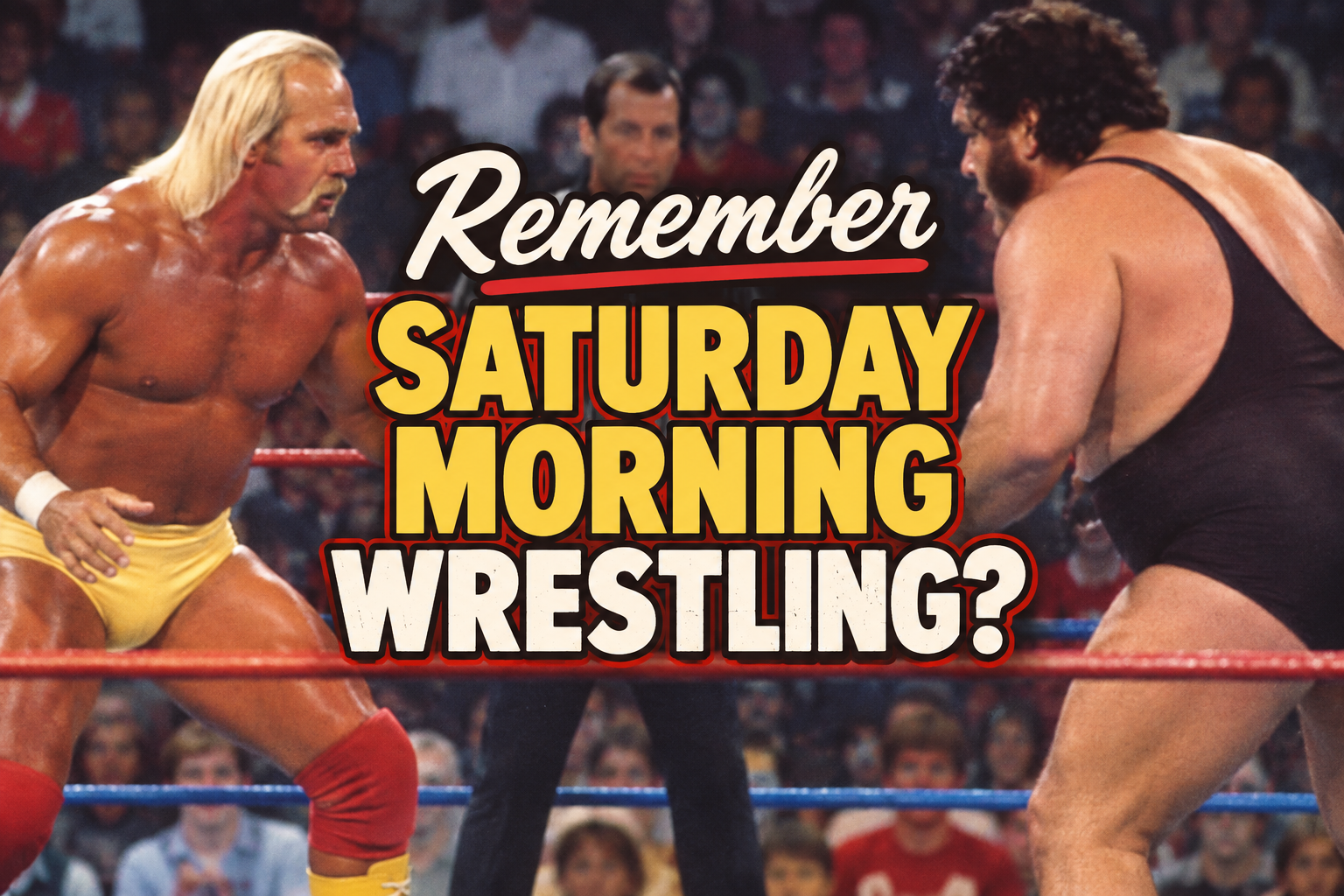
There was a time when Saturday morning television didn’t belong only to cartoons.
After the superheroes, talking animals and cereal commercials had begun to disappear from the screen, another strange cast of characters often took their place. They wore colorful robes, enormous championship belts and expressions that suggested whatever had happened last week was a matter of life and death.
For a generation of kids, Saturday morning wrestling was part of the weekend ritual.
You didn’t need streaming. You didn’t need pay-per-view. You didn’t even need to know exactly what wrestling promotion you were watching. You turned on the television, sat down in front of it and suddenly found yourself in a world of heroes, villains, outrageous interviews and matches that seemed far more important than anything happening outside.
And depending on where you lived, the wrestling you watched might have been completely different from what another kid was watching a few states away.
When Wrestling Was Local
Before professional wrestling became the polished national television spectacle most people recognize today, much of American wrestling was regional.
Different territories had their own television programs, their own arenas and, most importantly, their own stars. Fans in Georgia might grow up watching different wrestlers from fans in Texas, Tennessee, Florida or the Northeast.
That made wrestling feel surprisingly local.
The television studio might not have been glamorous. The crowd could be small. The lighting sometimes looked like it belonged in a high-school gymnasium. But none of that mattered.
In fact, it was part of the charm.
Shows such as Georgia Championship Wrestling, Mid-Atlantic Championship Wrestling, World Class Championship Wrestling and programs from other regional promotions introduced viewers to wrestlers who could become enormous celebrities within their territory long before much of the rest of the country knew who they were.
Then there was the WWF in the Northeast, which was already building its own television presence before the national wrestling boom transformed everything in the 1980s.
The Interviews Were Half the Fun
Sometimes the match wasn’t even the best part.
A wrestler would finish competing and suddenly there he was in front of a microphone, staring directly into the camera and delivering a warning to his next opponent.
There was shouting. There were threats. Fingers pointed toward the camera. Jackets came off. Managers interrupted. Somebody inevitably promised that revenge was coming.
To a kid watching at home, it could seem completely spontaneous.
That was one of wrestling’s great strengths during the era. The presentation wasn’t always slick, and because of that it sometimes felt more real. The wrestlers weren’t separated from the audience by elaborate entrances, giant video screens and massive productions.
They were standing a few feet from the ring telling you exactly why they hated the other guy.
And you listened.
The Good Guys and the Bad Guys
Saturday morning wrestling usually made things wonderfully simple.
There were wrestlers you loved.
And there were wrestlers you absolutely could not stand.
The heroes shook hands, respected the fans and tried to win fairly. The villains cheated when the referee wasn’t looking, argued with the crowd and somehow always found a way to escape just when they were about to get what they deserved.
Managers made everything even better.
A great manager could make you dislike a wrestler before the bell even rang. They interfered, distracted referees, waved foreign objects around and loudly insisted that their wrestler had been treated unfairly.
Of course, as children, many of us weren’t analyzing any of this as entertainment.
We were simply furious.
The Matches You Usually Saw
Saturday television wasn’t necessarily where you saw the biggest matches.
Quite often, a recognizable star would wrestle someone you had never heard of. You already had a pretty good idea who was going to win.
That wasn’t really the point.
Those matches were there to build the stars, demonstrate their finishing moves and prepare viewers for the bigger confrontation coming at the local arena. Television gave you just enough to make you want more.
And then the announcer would tell you that your favorite wrestler was finally going to face his hated rival this Saturday night at the arena.
Suddenly you wanted tickets.
It was an extraordinarily effective system. Television wasn’t the final product. Television was partly the invitation.
Wrestling Looked Different Then
Watch some of those old broadcasts today and one of the first things you notice is how modest everything looks.
There might be a simple curtain behind the interview area. The ring could be surrounded by folding chairs. The graphics were basic. The cameras weren’t constantly moving.
There was no enormous entrance stage.
No wall of LED screens.
No elaborate pyrotechnics.
Sometimes there wasn’t even entrance music.
Yet somehow a wrestler simply walking toward the ring could feel like an event.
The personalities had to do much of the work themselves. A distinctive robe, a particular way of walking, a catchphrase or even a certain expression could tell the audience everything it needed to know.
And when the crowd reacted, you heard it.
Then Cable Changed Everything
As cable television spread, wrestling began escaping its regional boundaries.
One of the most important examples was Georgia Championship Wrestling on WTBS, which allowed viewers far beyond Georgia to discover Southern wrestling personalities and storylines. Suddenly wrestling from another part of the country could appear in your living room.
During the 1980s, that transformation accelerated dramatically.
The WWF expanded aggressively under Vince McMahon, syndicated television reached more markets, national stars were created and professional wrestling increasingly became part of mainstream pop culture. Hulk Hogan became a household name. Wrestlers appeared in music videos, cartoons and toy aisles.
The little regional television world was becoming something much bigger.
For kids watching at the time, it was exciting.
But something was disappearing too.
When You Weren’t Quite Sure If It Was Real
Perhaps one of the greatest differences was simply how little information we had.
There was no internet waiting to explain what happened backstage. There were no social-media accounts showing wrestlers traveling together. There weren’t thousands of videos analyzing every match and storyline five minutes after the program ended.
You knew what television told you.
And when two wrestlers appeared to genuinely despise one another, there was always that wonderful childhood question:
Do they really hate each other?
Maybe an older brother told you it was fake.
Maybe your father laughed when you insisted it was real.
But then somebody got hit with a chair when the referee wasn’t looking, and suddenly you weren’t so sure anymore.
That uncertainty was part of the magic.
When Saturday Morning Meant Wrestling
For many people, the memories aren’t necessarily about championship histories or who won a particular match.
They’re about the setting.
A television glowing in the family room. A bowl of cereal that had gone soggy twenty minutes earlier. The sound of an announcer getting increasingly excited. Your brother sitting beside you. Your father walking through the room and stopping for a moment because he recognized one of the wrestlers.
Outside, an entire Saturday was waiting.
There would be bicycles, errands, chores, friends knocking on the door and perhaps a trip somewhere with the family.
But first, there was wrestling.
Today’s professional wrestling is bigger, brighter and technologically astonishing compared with those old studio broadcasts. Fans can watch events from virtually anywhere in the world and learn more about the performers than Saturday morning viewers could ever have imagined.
But sometimes more access doesn’t necessarily create more mystery.
Those old broadcasts had plenty of imperfections: inexpensive sets, predictable matches, exaggerated characters and production values that could occasionally be downright primitive.
We didn’t care.
For an hour on Saturday morning, the good guys were good, the bad guys cheated, the referee somehow missed everything important…
…and we couldn’t wait to see what happened next.