A Dagger on the Bridge Floor — Revisiting Star Trek’s Mirror, Mirror
Here's what made Star Trek’s "Mirror, Mirror" such a lasting television thrill: one transporter mishap, one wickedly clever premise, and a cast clearly enjoying every dangerous minute. It is still impossible to turn off when that darker Enterprise comes into view.
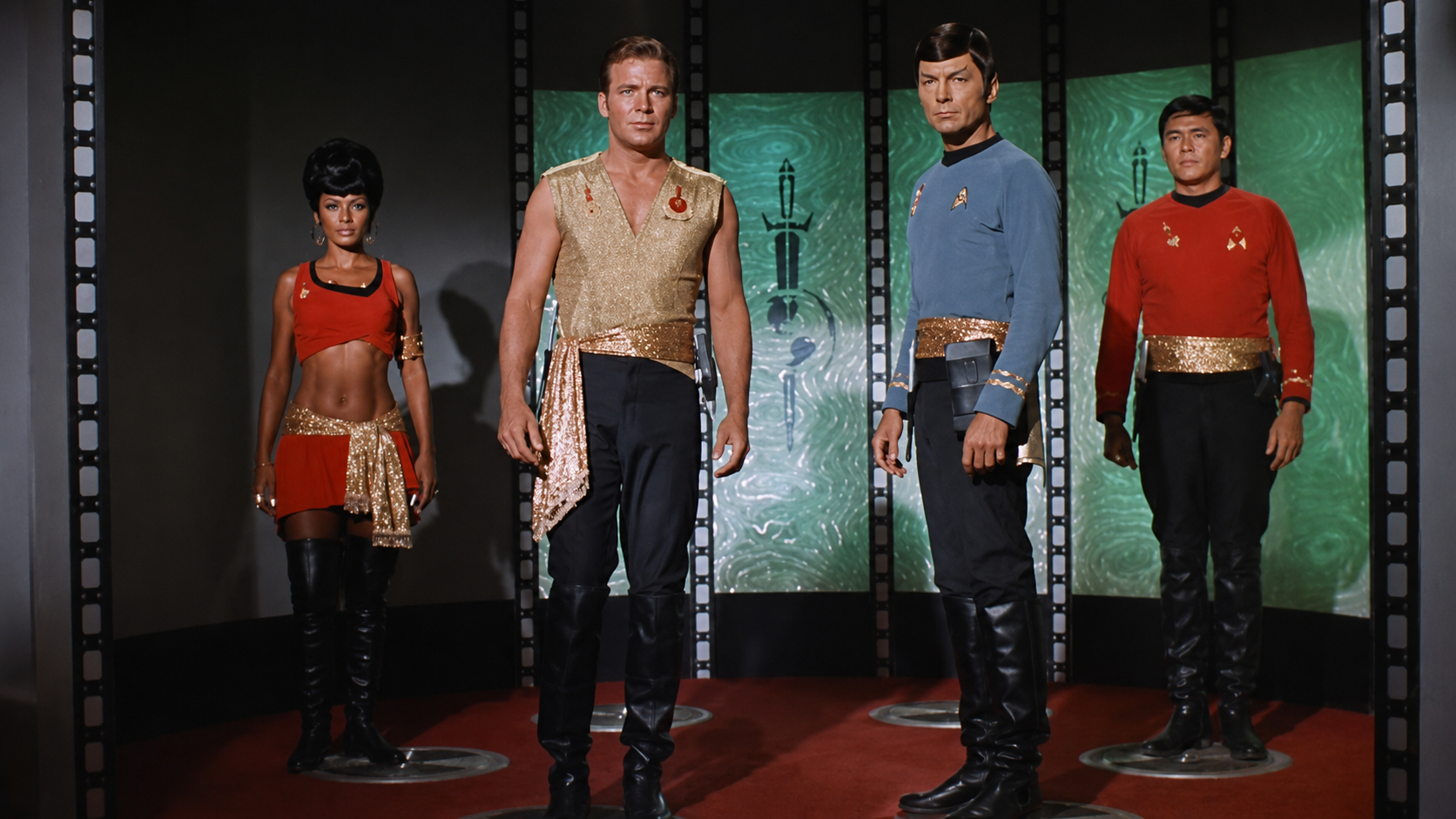
One flash of lightning, one transporter accident, and Star Trek gave television one of its most enduring ideas. First broadcast in 1967, “Mirror, Mirror” is the episode that introduced the Mirror Universe: a place where familiar faces wear harder expressions, loyalty is a dangerous luxury, and Captain Kirk’s crew discover that the Enterprise can look very different when fear is running the ship.
For many viewers, this is the episode that arrives and immediately changes the temperature in the room. The sets are the same, the actors are the same, the music still hums with that unmistakable 1960s adventure energy — but everything feels sharpened, darker, and just a little dangerous. It is clever science fiction, yes, but it is also a wonderfully theatrical hour of television, full of sly performances, memorable costume choices, and a premise so strong it echoed across decades of Star Trek.
A simple idea with a spectacular payoff
The plot is beautifully direct. During a transporter malfunction caused by an ion storm, Kirk, McCoy, Uhura, and Scotty are exchanged with their counterparts in a parallel universe. In that reality, the peaceful Federation is replaced by the brutal Terran Empire, where officers rise through intimidation and assassination. Suddenly, our heroes are trapped aboard an Enterprise where a friendly conversation can be a test, a wrong glance can be fatal, and every decision has to be made at high speed.
That is part of why “Mirror, Mirror” remains so irresistible. It does not need pages of explanation. The episode throws the audience into the deep end and trusts us to keep up. One moment Kirk is the familiar captain we know; the next, he is expected to act like a tyrant while trying not to get killed by his own senior staff. It is a marvellous dramatic engine, and it never stops humming.
When the Enterprise turned dangerous
There is a special thrill in watching a beloved series flip its own rules. In the regular Star Trek universe, the Enterprise is a place of order, curiosity, and disciplined optimism. In the mirror version, it becomes a pressure cooker. The corridors seem narrower. The bridge feels colder. Even routine interactions carry a charge.
And then there is the most famous visual flourish of all: Mirror Spock’s goatee. It has become one of popular culture’s great shorthand signals for an alternate self, and with good reason. It is bold, slightly mischievous, and instantly readable. But the episode’s appeal goes beyond that famous beard. The mirror uniforms, the imperial insignia, the agonizer devices — all of it gives the story a heightened, almost swashbuckling menace.
What makes the design work so well is that it never tips too far into parody. The episode understands that a little goes a long way. A dagger in a belt, a harder stare, a cruel command delivered without hesitation — those details do the heavy lifting.
The performances are half the fun
This is one of those episodes where the cast clearly relishes the chance to play against type. William Shatner gets to turn Kirk into a man performing a role within a role: our Kirk pretending to be a ruthless imperial captain. That gives him a wonderful balancing act, shifting from authority to calculation to sudden improvisation.
Leonard Nimoy, meanwhile, is superb. His mirror Spock is not a cartoon villain. He is logical, watchful, and dangerous in a very controlled way. Nimoy gives him a reserve that makes him more interesting, not less. You believe this is a man who has survived in a violent system by staying ten steps ahead.
Nichelle Nichols also shines. Uhura often had too little to do in many episodes of 1960s television, but here she gets a sharper, more active role in the tension of the story. James Doohan and DeForest Kelley bring urgency and nerve, helping sell the idea that one wrong move could collapse the whole plan.
Behind the scenes, speed and imagination
One of the pleasures of revisiting classic television is remembering just how much had to be achieved on tight schedules and practical budgets. Star Trek in the 1960s was ambitious television made at speed, and episodes like “Mirror, Mirror” show how imagination can outpace money.
The episode was directed by Marc Daniels and written by Jerome Bixby, whose script deserves real credit for its efficiency. Bixby takes a high-concept science fiction premise and keeps it playable, visual, and brisk. There is no wasted motion. Every scene either deepens the danger or reveals another crack in the mirror world.
That economy matters. The production did not need entirely new starships or giant alternate-universe sets. Instead, it transformed what was already there through performance, props, lighting, and attitude. That is old-school television craftsmanship at its best: make the audience see a new world without rebuilding the whole studio.
And there is something wonderfully 1967 about that ingenuity. This was an era when television science fiction often had to sell cosmic ideas with painted sets, practical effects, and actors who knew exactly how to make a close-up count. Mirror, Mirror is a fine example of that magic trick.
Why it still crackles today
Some episodes are admired because they are historically important. Others are loved because they are simply fun to watch. “Mirror, Mirror” manages to be both.
Its central question is timeless: what separates civilisation from cruelty when power is on the line? Yet the episode never becomes heavy-handed. It moves like an adventure. There are secret plans, narrow escapes, loaded conversations, and that delicious suspense of seeing whether Kirk can outthink a system built on fear.
It also plants a seed that later Star Trek series would return to again and again. Without this hour, the franchise loses one of its richest recurring ideas. Later visits to the Mirror Universe would become bigger, stranger, and in some cases even more flamboyant, but the original remains elegant because it is so focused. It knows exactly what kind of story it wants to tell.
Classic television often lasts because of one unforgettable twist. In Mirror, Mirror, the twist was not just an alternate universe — it was the shock of seeing familiar ideals tested in a world that had abandoned them.
Three clips worth revisiting
If you want to relive some of the atmosphere around this classic episode, these clips make a fine companion piece while you read.
Clip one
Clip two
Clip three
The lasting image
Ask a longtime fan what they remember, and you will likely hear about a handful of images at once: the transporter storm, the imperial salute, the agonizer, Spock’s goatee, and Kirk trying to stay one step ahead in a universe where decency looks like weakness. That is a powerful collection of memories for a single television hour to leave behind.
Seen now, “Mirror, Mirror” feels like the kind of episode classic radio listeners appreciate instinctively. It is smart without showing off, dramatic without losing its sense of fun, and packed with the sort of bold, memorable detail that stays with you long after the credits roll. Like a great three-minute hit single, it gets in, makes its mark, and never really leaves your head.
Nearly six decades on, it remains one of Star Trek’s most entertaining adventures — a brisk, stylish reminder that sometimes the most exciting trip a series can take is into its own dark reflection.
Why fans still treasure it
- A legendary concept: the first Mirror Universe story set a template the franchise would revisit for years.
- Playful performances: the cast clearly enjoys exploring darker versions of familiar characters.
- Iconic visuals: from the goatee to the imperial styling, the episode created images that entered pop culture history.
- Fast pacing: it wastes very little time and keeps the tension high throughout.
- Classic 1960s ingenuity: a big idea delivered with smart writing and economical production.