
Before YouTube: How We Learned to Fix Things Ourselves
Before YouTube tutorials, we learned to fix things with dog-eared repair manuals, Popular Mechanics, Chilton guides, advice from the hardware store and a little trial and error. Remember when fixing something meant opening the toolbox and figuring it out yourself?
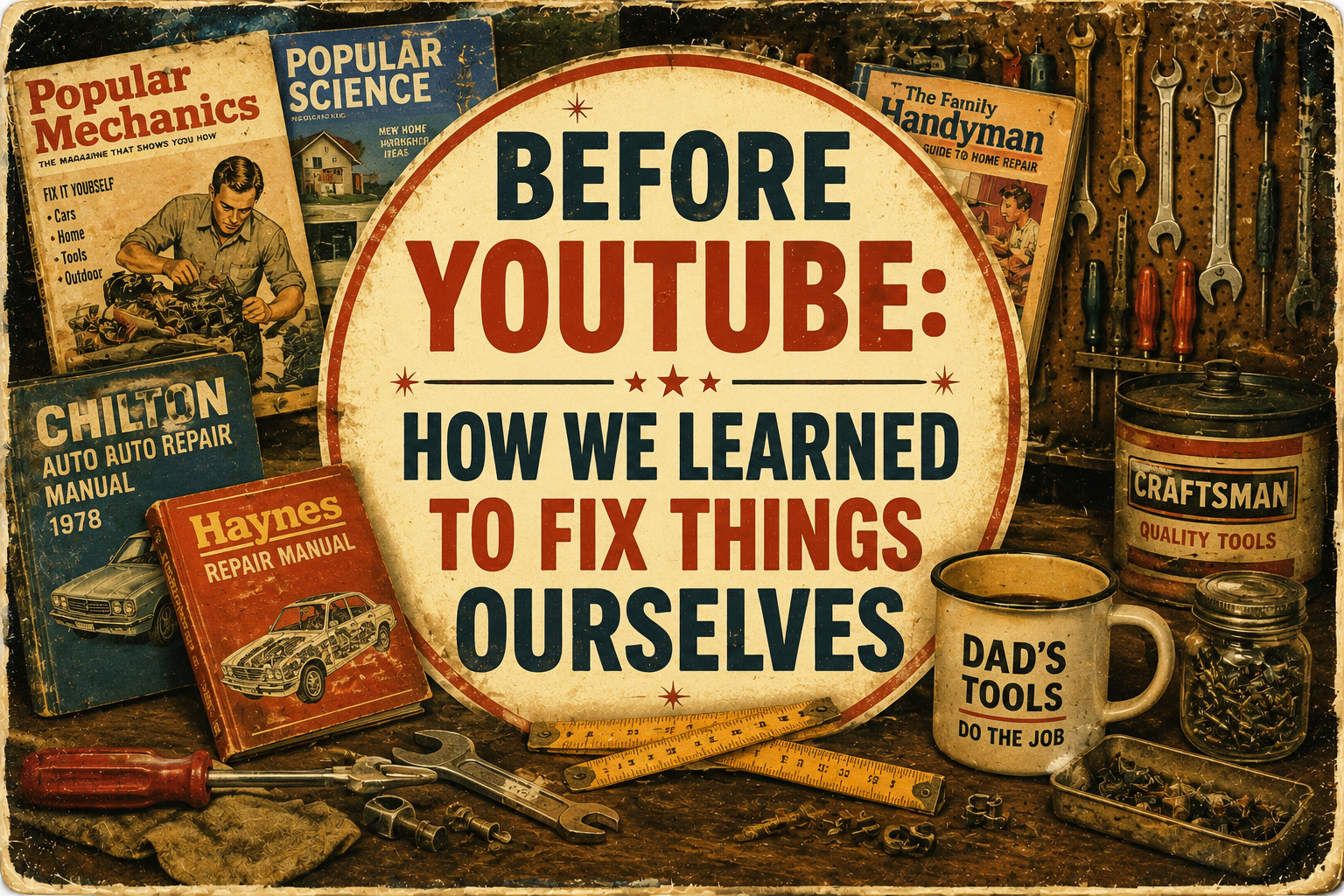
Today, when something breaks, one of our first instincts is to reach for a phone.
The washing machine is making a strange noise? Search YouTube. The lawn mower won’t start? There’s probably a video showing the exact model and the exact problem. Need to replace a faucet, patch drywall, change the brakes on a car or figure out why the toilet won’t stop running? Somewhere online, someone has already filmed the entire repair from beginning to end.
It is difficult to remember just how different things were before all of that information was available at the touch of a screen.
Back in the 1960s, ’70s and ’80s, there was no YouTube expert waiting in the garage with you. There wasn’t a search box where you could type a model number and immediately find somebody who had already solved the problem. If something broke, you had a few choices.
You could read about it. You could ask someone who knew how to fix it.
Or you could take it apart and hope for the best.
And somehow, we managed to fix an awful lot of things.
The Magazines That Taught America How Things Worked
Long before the internet became the world’s instruction manual, magazines filled part of that role.
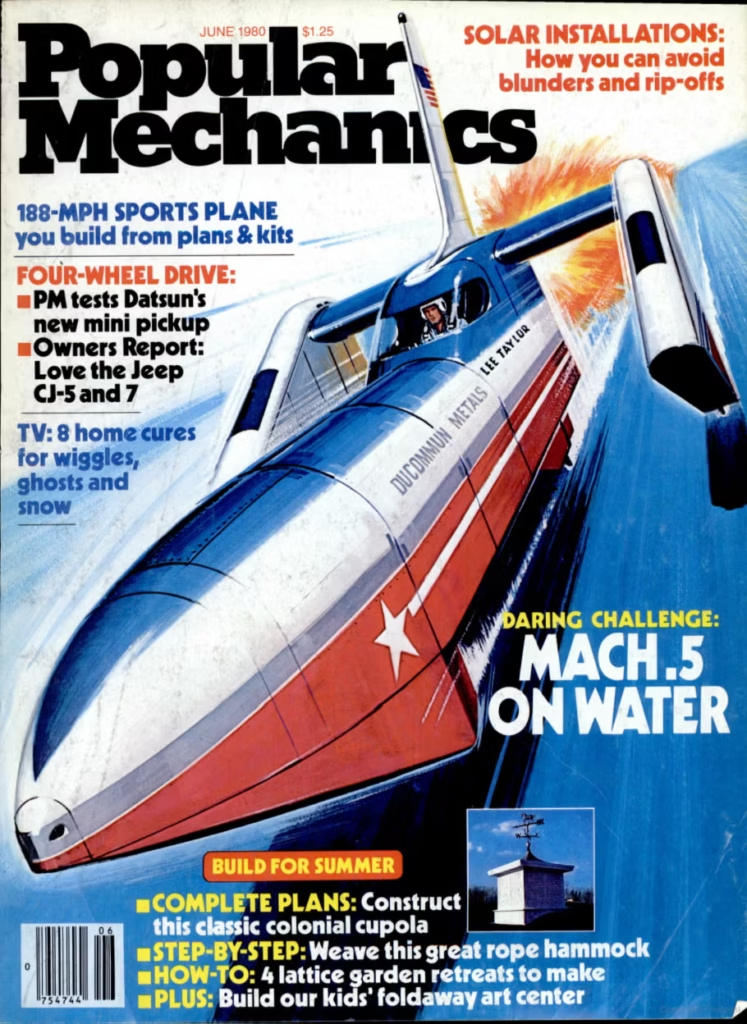
Popular Mechanics was one of the giants. For generations, its pages were filled with cars, tools, home projects, electronics, workshops and explanations of how machines worked. A copy of Popular Mechanics sitting on a workbench or beside a favorite chair was a familiar sight in many American homes.
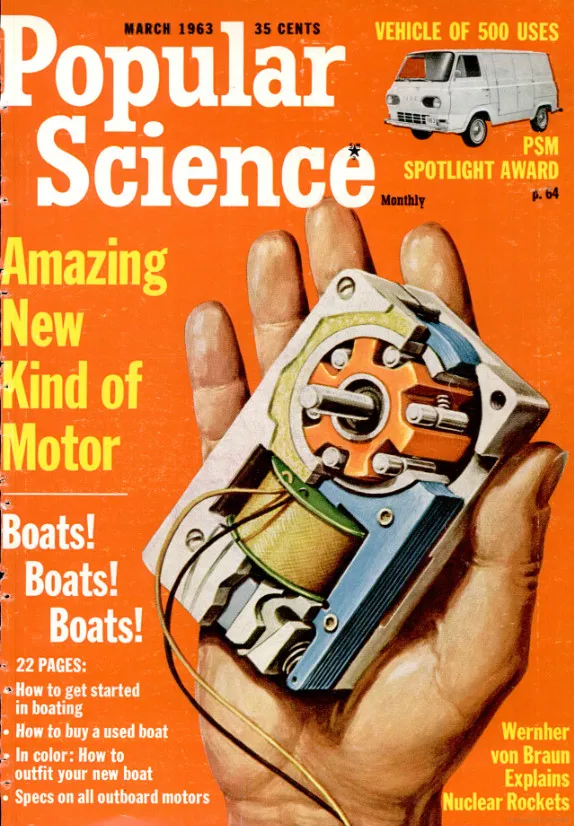
Popular Science approached things from a slightly different direction, mixing science and new technology with practical projects and fascinating glimpses of what the future might bring. Even if you bought an issue because of some fantastic machine pictured on the cover, you could easily end up reading about tools, automobiles, electronics or something you suddenly wanted to build yourself.
Then there was Mechanix Illustrated, another familiar name for generations of mechanically curious readers. Cars were a major attraction, but its pages also ventured into home workshops, gadgets, construction projects and the kind of hands-on ingenuity that defined the do-it-yourself culture of the era.

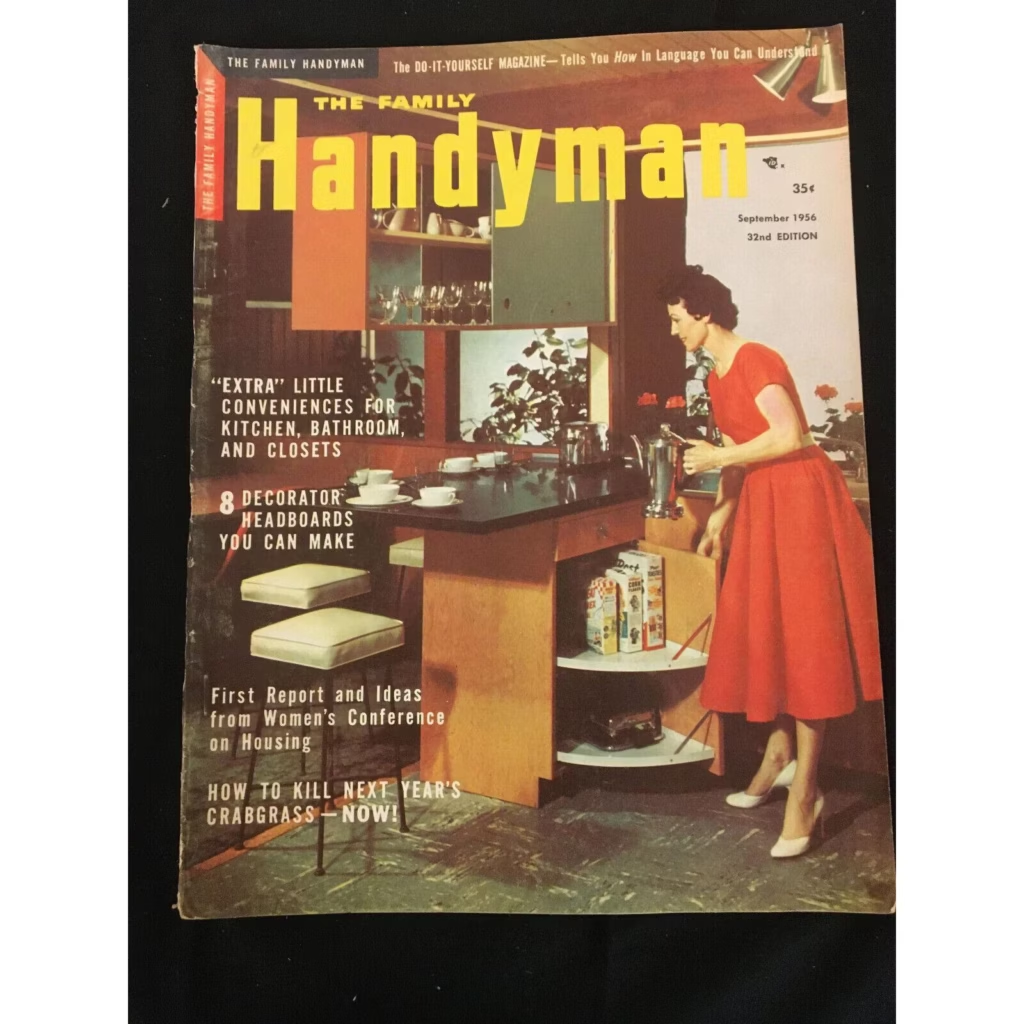
For home repairs, The Family Handyman became especially valuable. Plumbing, carpentry, electrical projects, painting, storage, remodeling and everyday household repairs were explained for people who weren’t necessarily professional tradesmen. Later publications such as Fine Homebuilding expanded that world for readers interested in more ambitious construction and renovation projects.
And many people didn’t throw these magazines away.
They kept them.
There might be a stack in the basement, another pile in the garage or several years’ worth carefully arranged on a shelf. You never knew when that old article about repairing a screen door, building garage shelves or troubleshooting a lawn mower might suddenly become useful.
In an age before search engines, keeping information was sometimes almost as important as finding it.
The Books That Never Left the Workbench
Magazines weren’t the only teachers.
Home-improvement books were enormously useful, particularly the large illustrated guides designed to cover seemingly everything that could go wrong around a house. Reader’s Digest published comprehensive do-it-yourself and home-repair guides that became fixtures in many households.
These weren’t books you necessarily sat down and read from beginning to end.
They were reference books.
When something went wrong, you pulled one off the shelf, found the appropriate chapter and tried to determine whether the job was something you could handle yourself.
The pages might explain how a household electrical circuit worked, how to repair a leaking faucet, how to hang a door, how to patch plaster or how to build a simple piece of furniture.
The illustrations mattered enormously.
Without a video showing you what to do, a good exploded diagram could be worth a thousand words.
And Then There Were Chilton and Haynes
If the problem was sitting in the driveway rather than inside the house, an entirely different collection of books came out.
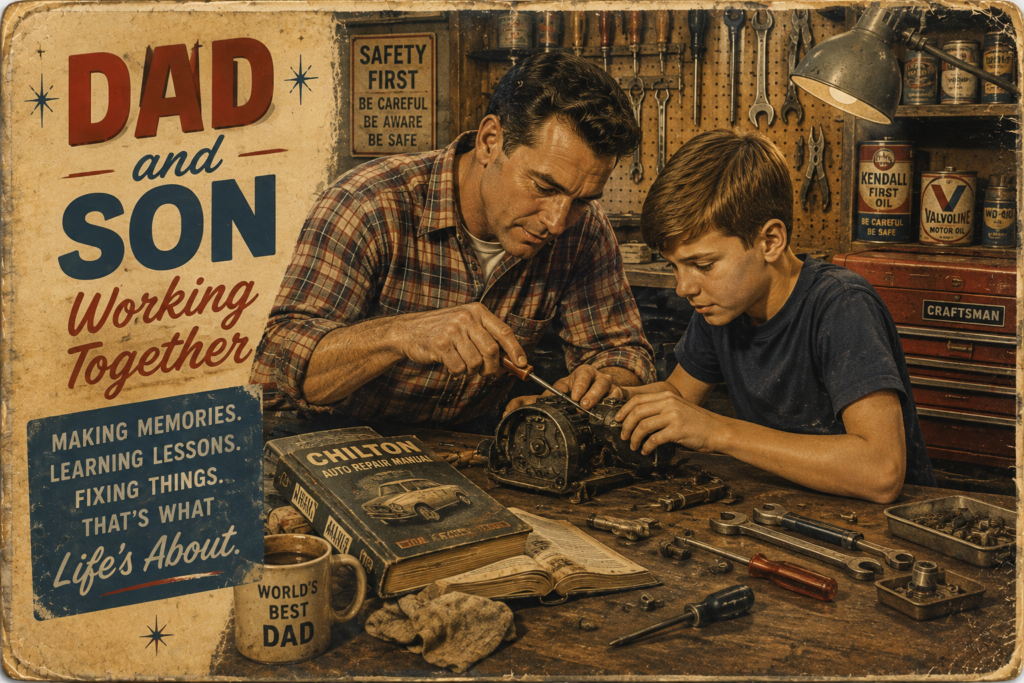
Chilton repair manuals became familiar companions to generations of people who worked on their own cars. Later, Haynes manuals became equally recognizable.
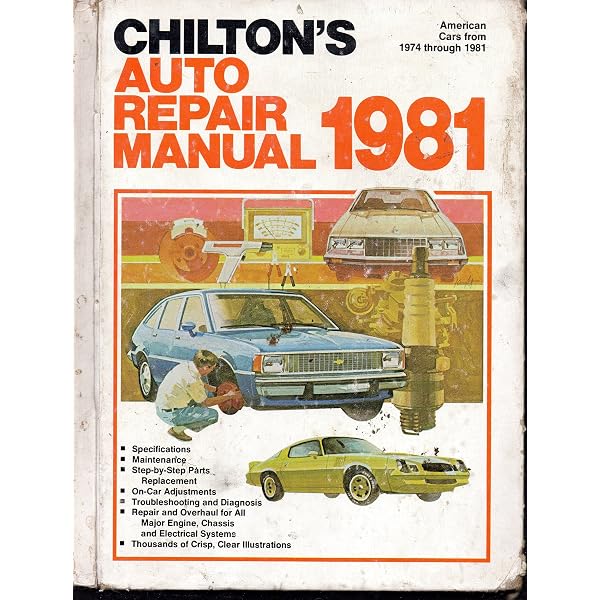
These books could take you deep inside a particular vehicle, explaining everything from relatively simple maintenance to complicated mechanical repairs. There were photographs, diagrams, specifications and step-by-step instructions.
And the manuals that were actually used looked like it.
The cover might be bent. Pages were dog-eared. There could be fingerprints along the edges, handwritten notes in the margins and grease stains across the page explaining the very part you were currently trying to remove.
You might have been underneath a car while someone else stood nearby holding the manual and reading the next step.
There was no pause button.
You just yelled, “What does it say next?”
The Guy at the Hardware Store
Of course, not everything could be learned from a book.
Sometimes the best search engine in town was standing behind the counter of the local hardware store.
You could walk in carrying a broken piece of plumbing, a strange screw, a worn belt from a lawn mower or some mysterious piece of hardware and place it on the counter.
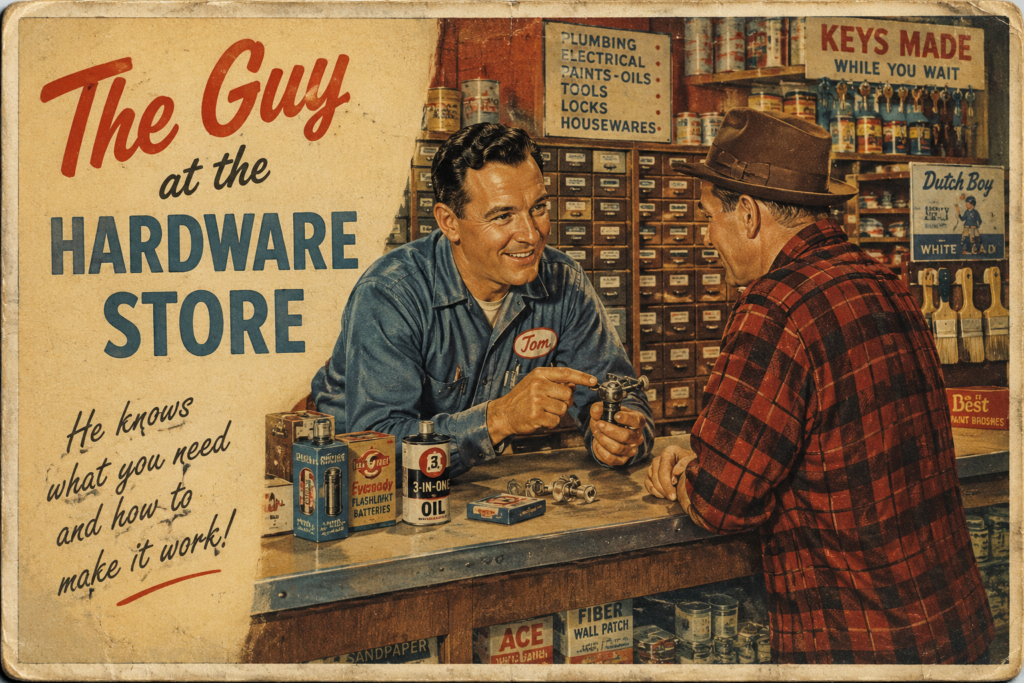
“I need one of these.”
Very often, the person behind the counter knew exactly what it was.
He might disappear into an aisle, open one of dozens of tiny drawers and return with the replacement. Better yet, he might explain how to install it, which tool you needed and what mistake you were about to make before you made it.
Local hardware stores were more than places that sold things. They were repositories of practical knowledge.
The same was true of auto-parts stores, lumber yards and neighborhood repair shops. Advice was part of the transaction.
You didn’t leave with just a part.
Sometimes you left with a lesson.
Dad Usually Knew Someone
There was another information network that didn’t require electricity at all.
Family, friends and neighbors.
If your father didn’t know how to fix something, chances were he knew someone who did.
Maybe Uncle Joe knew cars. The neighbor across the street understood electrical work. Somebody at work had just replaced the same water heater. Grandpa had been repairing lawn mowers since Eisenhower was president.
Knowledge traveled from person to person.
“Call Frank. He’ll know.”
Those four words probably solved millions of household problems.
And when Frank arrived, you didn’t just hand him the broken object and walk away. You watched.
That was how a great deal of practical knowledge was passed from one generation to another. Children watched parents. Younger workers watched older workers. Neighbors helped neighbors.
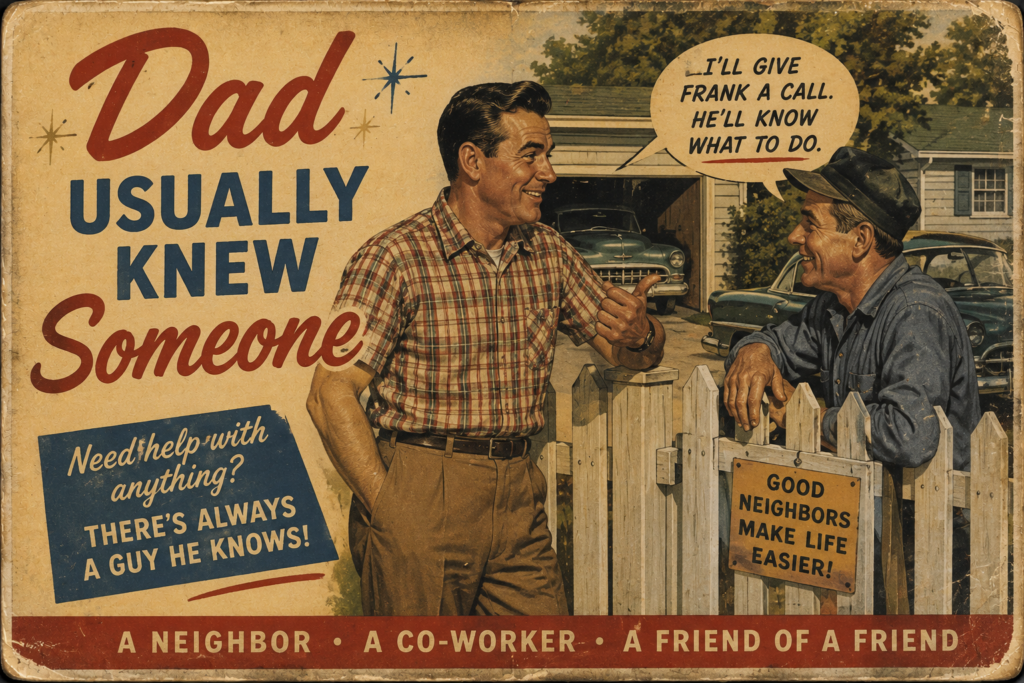
Nobody called it a tutorial.
It was simply how you learned.
The Basement Workbench Was Its Own Little World
Many homes had a place where all this fixing happened.
Sometimes it was the garage. Sometimes it was a corner of the basement.
There might be a heavy wooden workbench against the wall with a sheet of pegboard above it. Hammers, pliers, screwdrivers and wrenches hung from hooks. A vise was bolted permanently to one corner.
There were Craftsman tools that seemed as though they had always been there. Stanley hammers and screwdrivers. Black & Decker drills. An old metal toolbox that was far heavier than it looked.
And then there were the containers.
Coffee cans filled with nails.
Baby-food jars filled with screws.
Old cigar boxes containing electrical parts.
Mason jars full of nuts, bolts and washers whose original purpose had been forgotten decades earlier.
Nothing was thrown away if there was even the slightest possibility that it might someday be useful.
That odd bracket?
Keep it.
Three feet of leftover electrical wire?
Put it on the shelf.
A handful of screws left over from assembling something in 1974?
Those were practically an investment.
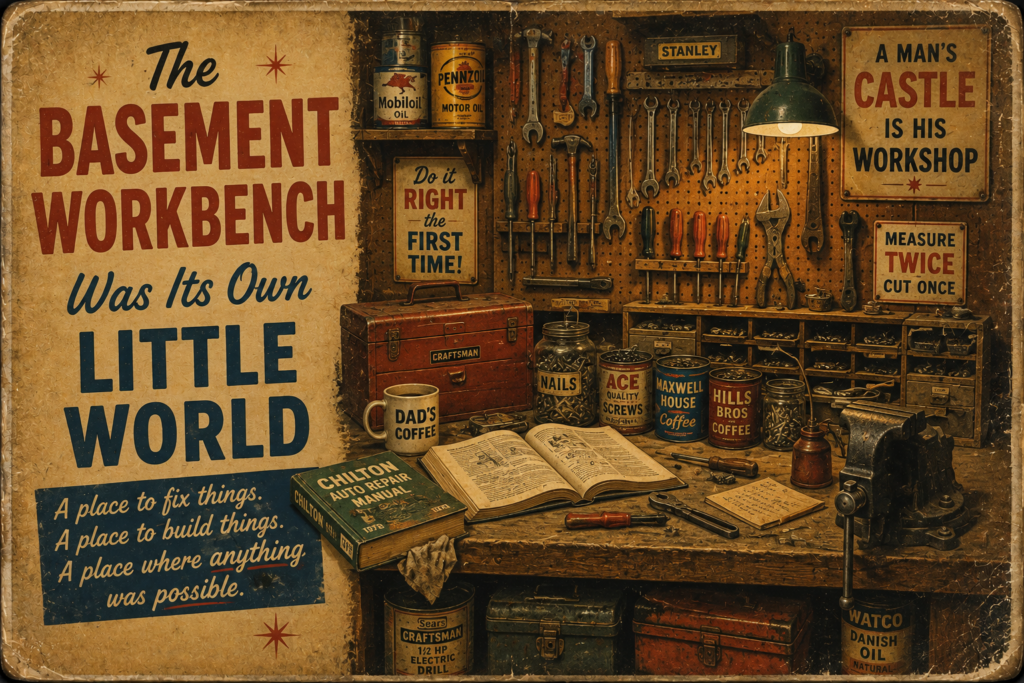
Years later, when you needed one strangely specific screw on a Sunday afternoon, Dad would disappear into the basement and somehow return holding exactly the right one.
Sears Craftsman and the Tools That Lasted Forever
For many families, the name Craftsman was inseparable from the home workshop.
A trip to the Sears tool department could be an event of its own. Rows of gleaming sockets, wrenches, screwdrivers, power tools and enormous rolling tool chests offered almost everything a home mechanic could imagine.
Tools were also popular gifts.
A socket set for Christmas. A new drill for Father’s Day. A toolbox for the teenager who had just bought his first used car.
Over time, the collection grew.
You didn’t necessarily buy everything at once. A home workshop could represent decades of accumulated tools, each purchased because some project required it.
And because many of those tools lasted so long, plenty of them eventually passed from one generation to the next.
Shop Class Taught Things You Could Actually Use
Schools played a role too.
For generations of students, shop class provided an introduction to tools and practical skills that many would use for the rest of their lives.
Wood shop might teach students how to measure properly, operate a saw, use a drill press or build something square enough that it didn’t wobble.
Metal shop introduced another set of skills.
Some schools offered automotive programs where teenagers learned about engines, brakes, electrical systems and routine maintenance.
Not every student became a carpenter or mechanic, of course. That wasn’t really the point.
The important lesson was that machines and objects weren’t mysterious sealed boxes.
Things could be understood.
And if you understood how something worked, there was a reasonable chance you could repair it.
Sometimes You Just Took the Thing Apart
Then there was the final method.
Trial and error.
A broken toaster, radio, lawn mower or bicycle could become an educational project whether anyone intended it to or not.
You removed a few screws.
Then a few more.
Eventually the kitchen table was covered with parts and you began wondering whether taking it apart had been such a good idea.
This was particularly educational when you discovered one mysterious spring remaining after everything had supposedly been reassembled.
But that experimentation taught people something important.
You became less afraid of objects.
If something was already broken, what did you have to lose?
Sometimes the repair worked.
Sometimes you carried a box full of parts to somebody who actually knew what he was doing.
And sometimes you quietly threw the entire thing away.
But you learned something every time.
We Repaired More Because Things Were Worth Repairing
There was another important difference between then and now.
Many household items were expected to be repaired.
Televisions went to television repair shops. Shoes went to cobblers. Vacuum cleaners could be serviced. Small appliances could be opened. Radios, stereos and lawn equipment were repaired rather than automatically replaced.
Even the neighborhood had its specialists.
The TV repairman might arrive carrying a case full of tools and components. The appliance repairman knew exactly what sound your washing machine was making. The local garage knew your car almost as well as you did.
Products were expensive, and replacing them wasn’t always the easiest option.
So repairing something made sense.
That helped create an entire culture in which knowing how things worked had genuine value.
Then the World’s Biggest Instruction Manual Arrived
Today, we have something people standing at those old basement workbenches could scarcely have imagined.
Type almost any repair into YouTube and somebody will probably show you exactly how to do it.
Not just “how to replace a water pump.”
You can often find someone replacing the water pump on the exact year, make, model and engine sitting in your driveway.
That’s extraordinary.
In many ways, we have more opportunity to fix things ourselves today than ever before.
The old Chilton manual has become a searchable video library. The knowledgeable hardware-store clerk has been joined by thousands of tradespeople, mechanics, woodworkers and hobbyists willing to demonstrate what they know to anyone who wants to watch.
Something was gained.
But something changed, too.
Before YouTube, Knowledge Had a Face
Maybe that’s the part we remember.
Before YouTube, learning how to fix something often meant interacting with another person.
You stood beside your father while he changed the oil.
You held the flashlight for Grandpa.
You asked the man at the hardware store what part you needed.
You borrowed a manual from a neighbor.
You watched someone use a tool and eventually asked if you could try.
The information wasn’t always perfect. The repair didn’t always work. And plenty of people probably would have welcomed a five-minute YouTube tutorial after spending an entire Saturday trying to figure out why the lawn mower wouldn’t start.
But those old methods created memories along with knowledge.
Somewhere in an old garage there is probably still a shelf holding a grease-stained Chilton manual. Somewhere else is a basement workbench with coffee cans full of screws that haven’t been touched in 30 years. And in countless toolboxes are old Craftsman wrenches that once belonged to somebody’s father or grandfather.
Today, when something breaks, we search for a video.
Back then, we searched the bookshelf, opened the toolbox, walked down to the hardware store or called the one person we knew who could fix anything.
And if none of that worked?
We took it apart anyway.