Search: The Forgotten 1970s Spy Series That Predicted the Future
Long before smartphones, wireless earbuds and wearable cameras, Search imagined secret agents connected to a futuristic command center that could see and hear everything they did. The forgotten 1972 spy series lasted only one season, but much of the technology it dreamed about eventually became reality.
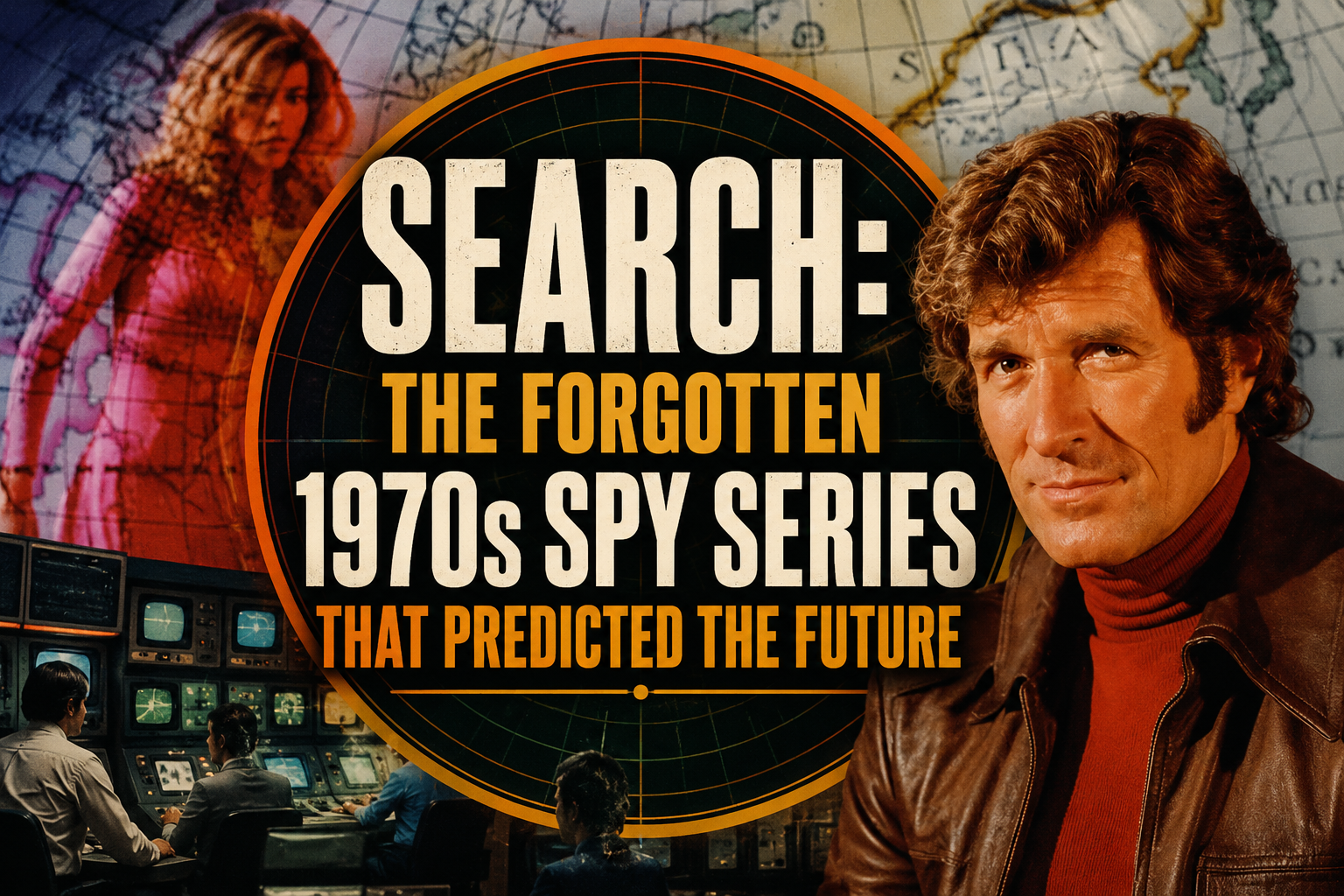
Long before smartphones could stream live video, before tiny wireless earbuds let us talk to someone miles away, and before GPS and wearable technology became part of everyday life, a short-lived television series imagined secret agents using remarkably similar technology.
It was called Search, and it arrived on NBC in 1972.
At first glance, Search looked like another entry in the long line of television spy adventures inspired by the success of James Bond, Mission: Impossible and The Man from U.N.C.L.E. But there was something different about this one. Its agents didn’t simply disappear into dangerous situations with a gun, a clever disguise and a few gadgets.
They were connected.
Everywhere they went, a room full of specialists could see what they saw, hear what they heard, monitor their physical condition and feed information directly back to them.
For audiences watching in 1972, it was science fiction.
More than fifty years later, much of it doesn’t seem quite so impossible.
It Started as Probe
The story of Search actually began before the weekly television series.
On February 21, 1972, NBC broadcast a television movie called Probe, created by Leslie Stevens, who had previously created the classic science-fiction anthology series The Outer Limits. The movie starred Hugh O’Brian, already well known to television audiences from The Life and Legend of Wyatt Earp, as an investigator named Hugh Lockwood.
Lockwood worked for an organization called the World Securities Corporation, an enormously sophisticated private investigation company whose operatives were known as Probes.
The pilot proved successful enough for NBC to order a weekly series. There was only one problem: Probe was already being used as the name of a PBS program. The new series therefore became Search, although its agents continued to be called Probes.
Search premiered on NBC on September 13, 1972.
And from the beginning, viewers were introduced to a spy show that looked unlike almost anything else on television.
The Secret Agent Who Was Never Really Alone
The basic idea behind Search was wonderfully futuristic.
World Securities agents carried miniature electronic equipment that kept them in constant contact with headquarters. A tiny scanner incorporating a television camera and other sensors could be disguised as something as innocent as a ring or piece of jewelry.
Meanwhile, an implanted receiver allowed information from headquarters to be transmitted directly to the agent.
Think about what that meant to someone watching television in 1972.
An agent could walk into a room thousands of miles away, point his tiny camera at something suspicious, and specialists back at headquarters could examine what he was seeing. They could search for information, translate languages, analyze clues and communicate their findings back to him.
Today we might think of smartphones, body cameras, wireless earbuds, biometric monitors and instant access to enormous databases.
In 1972, it looked like the future.
And perhaps the most memorable part of the entire show was the place where all that information ended up.
Welcome to Probe Control
Back at World Securities headquarters was Probe Control, a command center filled with monitors, computers, communications equipment and technicians.
It looked a little like NASA Mission Control had decided to enter the private-detective business.
At the center of it all was V.C.R. Cameron, played by the wonderful Burgess Meredith. Cameron supervised the operations while a team of specialists monitored the agent in the field.
There were experts in electronics, medicine, languages, codes and data. The team could even keep track of an agent’s physical condition while a mission was underway.
For a 1970s television audience, Probe Control was part of the show’s magic.
Rows of screens glowed in the darkness. Technicians studied incoming information. Computers processed data while Cameron watched events unfold from thousands of miles away.
It was the kind of room that made you want to push buttons even if you had absolutely no idea what any of them did.
And unlike many television gadgets of the period, the basic concept behind Probe Control has aged remarkably well. Modern military operations, security centers and even television newsrooms routinely receive live information from people and equipment scattered around the world.
Search simply imagined it decades earlier.
Three Different Probes
Another unusual element of Search was that there wasn’t just one regular field agent.
The series rotated among three different Probes, with one generally taking the lead in each episode.
Hugh O’Brian played Hugh Lockwood, designated Probe One, the agent introduced in the original television movie.
Tony Franciosa played Nick Bianco, who headed the Omega division and specialized in cases involving organized crime.
And Doug McClure, familiar to millions of viewers from The Virginian, played C.R. Grover, initially introduced as a standby or backup Probe.
The three leads brought noticeably different personalities to their episodes, giving the series an almost anthology-like quality. Instead of following exactly the same hero every week, viewers never quite knew which Probe would be heading into danger next.
Interestingly, the three principal agents did not operate together as a team. They rotated as the featured character rather than sharing adventures with one another.
Behind all of them, however, was Cameron and the familiar crew at Probe Control.
That became the thread connecting the series.
Espionage Meets Science Fiction
The cases themselves combined the international intrigue of a spy series with the technology of science fiction.
There were missing government officials, counterfeit money, assassins, organized crime, stolen valuables and international conspiracies.
The very first regular episode, “The Murrow Disappearance,” sent Lockwood undercover to investigate the disappearance of a State Department official. Another early episode involved a counterfeit operation producing nearly flawless $100 bills, while “Moonrock” revolved around the disappearance of an extremely valuable specimen brought back from the Moon.
It wasn’t science fiction in the traditional sense.
There were no spaceships traveling to distant planets and no aliens arriving on Earth.
Instead, creator Leslie Stevens took the world of the early 1970s and pushed its technology just far enough forward to make viewers wonder whether something like this might actually be possible.
That distinction is one of the reasons Search remains so interesting today.
The Technology Was the Real Star
Watch an old episode now and you’ll certainly notice the unmistakable 1970s computers, enormous control panels and blinking lights.
But look beyond the hardware and consider what the show was actually predicting.
A miniature camera transmitting live pictures.
A tiny wireless device connecting someone in the field with a remote command center.
Real-time monitoring of a person’s vital signs.
Instant access to information stored electronically.
Remote experts examining a situation through the eyes of someone thousands of miles away.
Automatic access to language and technical specialists while an operation is happening.
Individually, these ideas weren’t necessarily unique to Search. Science fiction had been imagining advanced communications for decades.
What made the series unusual was how casually it put all of them together into a world that otherwise looked like 1972.
The future wasn’t happening aboard a spaceship.
It was happening inside a man’s ring.
Even the Cast Felt Like Classic Television
Beyond the technology, Search had an impressive collection of familiar television faces.
Hugh O’Brian had already spent years playing Wyatt Earp. Doug McClure was coming off his long run as Trampas on The Virginian. Tony Franciosa had starred in The Name of the Game.
And then there was Burgess Meredith.
Long before a new generation would know him as Mickey in the Rocky movies, Meredith had accumulated decades of stage, film and television work. His presence gave Probe Control an authority that helped sell the show’s sometimes extraordinary technology.
There were also plenty of recognizable guest performers. One early episode, for example, featured Stefanie Powers, herself already closely associated with the spy craze thanks to The Girl from U.N.C.L.E.
For viewers who love spotting familiar actors in old television programs, Search offers plenty of those moments.
So Why Didn’t Search Last?
Unfortunately, being ahead of your time doesn’t guarantee television ratings.
Search aired Wednesday nights at 10 p.m. on NBC and struggled in the ratings during the 1972–73 season. The series ultimately produced 23 regular episodes, in addition to the original Probe television movie.
There would be no second season.
And gradually, Search became one of those television programs that seemed to disappear into the enormous attic of 1970s pop culture.
It wasn’t remembered on the same level as Mission: Impossible. It didn’t develop the enormous afterlife of The Avengers. It wasn’t endlessly repeated and reinvented for new generations.
For many people, it simply became a vague memory.
A strange control room.
Burgess Meredith staring at monitors.
A secret agent with a tiny camera.
And perhaps that memory of thinking, “Wouldn’t it be incredible if we could really do that someday?”
Yesterday’s Science Fiction Became Everyday Life
That’s what makes returning to Search more than fifty years later so much fun.
The computers look ancient.
The clothes are unmistakably 1970s.
The electronics that were supposed to represent cutting-edge technology now belong in a museum.
Yet the central idea behind the series feels strangely modern.
Today, someone can wear a tiny camera capable of broadcasting live video around the world. A smartwatch can continuously monitor a person’s heart rate. Wireless earbuds can quietly deliver instructions. A phone can identify a location, translate languages, search enormous databases and connect instantly with specialists thousands of miles away.
We don’t call any of that science fiction anymore.
We just call it technology.
And perhaps that’s the best reason to remember Search.
It was a television spy adventure created during an era when computers still seemed mysterious, electronic gadgets were becoming increasingly fascinating, and the future felt as though it might be just around the corner.
The series lasted only one season.
But some of the future it imagined lasted much longer.
In fact, we’re living in it.