The Buzz of the Alarm Clock at 6:30
Monday used to begin with a buzz, a brew, and a bus ride soundtrack you chose yourself.
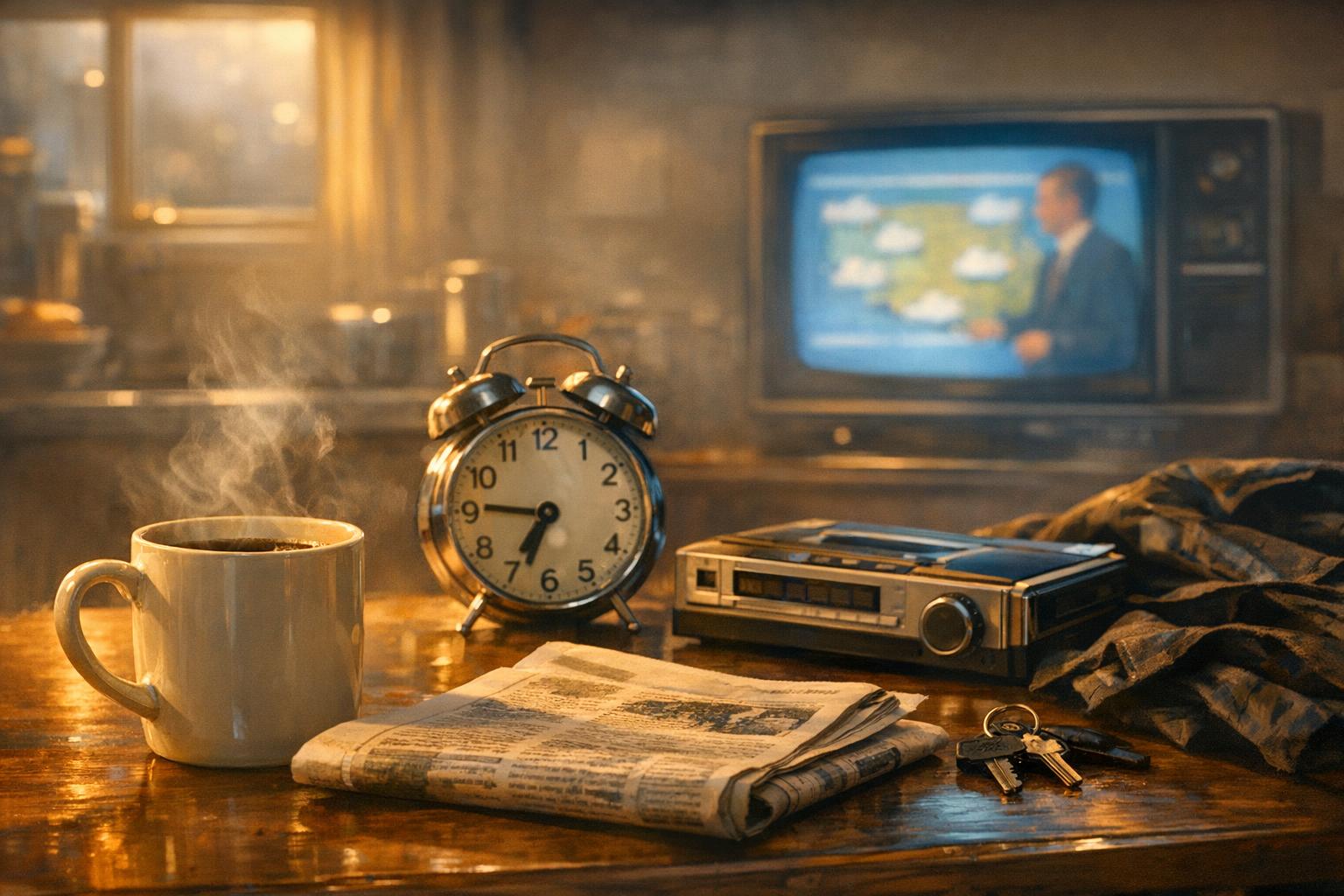
Before smartphones lit up bedside tables and filled the first quiet minutes of the day, Monday mornings had their own familiar rhythm. It was a routine built from simple objects and small rituals: the sharp rattle of an alarm clock, the rustle of a newspaper, the glow of the television weather report, and the reassuring weight of a cassette player in a coat pocket.
For anyone who lived through the 1970s, 1980s, or 1990s, the start of the week was not guided by notifications. It was guided by habit. And somehow, for all the rushing around, it often felt a little more human.
That first sound of the week
There was nothing gentle about many old alarm clocks. They did not ease you into the day with birdsong or a gradually brightening screen. They announced Monday with a mechanical buzz, a beeping digital chirp, or a radio alarm snapping to life with a presenter already sounding far too awake.
You hit the button, or missed it and fumbled around half asleep, and that was it: the week had begun.
There was a strange honesty to those wake-up calls. No scrolling in bed. No checking messages before your feet touched the floor. You got up because the clock said so, and because Monday was waiting whether you liked it or not.
For plenty of households, the radio was part of that moment too. A familiar breakfast show voice could make the morning feel less lonely, like a cheerful companion keeping everyone company while kettles boiled and toast popped up.
Newspaper, coffee, and a few quiet minutes
If there is one image that captures a pre-smartphone Monday, it might be this: a mug of coffee sending up steam beside a folded newspaper on the kitchen table.
That newspaper was more than a quick headline check. It was a morning ritual. You turned the pages properly. You glanced at the front page, skimmed the local stories, checked the sports results, and maybe read a column while finishing breakfast. Ink sometimes rubbed onto your fingers. Pages crackled. The whole thing felt physical and real in a way that a glowing screen never quite matches.
And coffee seemed to taste different when it arrived with that little pocket of calm before the rush. Even in busy homes, there was often a brief moment when the day had not fully accelerated yet. Just coffee, paper, and the sense that the world was slowly waking up around you.
The kitchen as Monday headquarters
The kitchen was command central. Lunches were packed, school bags were checked, keys were hunted down, and someone was always asking what time it was. In many homes, the newspaper sat in the middle of it all like a shared bulletin board for the day ahead.
One person wanted the front page, another grabbed the entertainment section, and someone else was already looking for the television listings. It was not always peaceful, but it was wonderfully familiar.
The weather report mattered
Before weather apps lived in every pocket, the television forecast had real authority on a Monday morning. You watched because you genuinely needed to know. Was rain coming? Would it be cold by afternoon? Did the children need coats? Could you risk leaving without an umbrella?
There was something comforting about those TV forecasts. The map, the symbols, the presenter pointing at cloud and sunshine with calm certainty: it all felt like part of the weekly launch sequence.
And of course, there was always room for a bit of hopeful interpretation. If the presenter said there might be light showers later, many people heard, It will probably stay dry until I get where I am going. Monday optimism has always been a brave thing.
The landline and the famous sick-day call
Calling in sick before mobile phones was a very different performance. There was no discreet text message sent from under the blankets. You had to make the call properly, usually from a landline in the hallway or kitchen, with that coiled cord stretched as far as it would go for a little privacy.
And if you were a teenager trying to sound convincingly ill before school, or an adult attempting your best weak voice before work, it could feel like live theatre.
“Hello… I do not think I will be able to make it in today.”
You had one chance to sound believable. Too cheerful, and the game was up. Too dramatic, and it sounded suspicious. Somewhere in the middle was the perfect Monday-morning croak.
Even for those who were genuinely unwell, the landline call had a certain ceremony to it. You spoke to a real person. You explained yourself. Then you gently placed the receiver back down, and the decision felt official.
A Walkman, a bus seat, and a private concert
If the house was the first act of Monday morning, the journey out into the world was the second. And for many people in the 1980s and 1990s, that journey came with a Walkman.
There was magic in clipping on those lightweight headphones, pressing play, and hearing your favourite cassette turn a grey bus ride into something cinematic. Suddenly the windows looked more dramatic, the streets seemed to move in time, and Monday felt just a little easier to face.
A mixtape could be a lifeline. Maybe side one was full of upbeat songs to wake you up, while side two leaned more reflective for the ride home. Either way, you chose the mood. No algorithm guessed for you. No endless skipping. You lived with the sequence, and often grew to love songs because they were part of the journey.
The small skills we hardly think about now
The Walkman era came with its own tiny acts of expertise:
- Checking you had fresh batteries
- Untangling headphone wires
- Fast-forwarding to the right song and stopping at exactly the right moment
- Turning the cassette over with one hand
- Using a pencil to rescue chewed tape if disaster struck
It sounds almost charmingly complicated now, but at the time it was just normal life. And perhaps that is why it remains such a fond memory. The effort was part of the enjoyment.
Do not forget the TV Guide
Long before streaming menus and reminder alerts, there was another important Monday task: checking the TV Guide.
That little booklet or magazine had real power. It told you what was on, what time it started, and whether the evening held a favourite sitcom, a big drama, a music show, or a film worth staying up for. Monday morning was often when people planned the reward waiting at the other end of the day.
For children before school and adults before work, a quick look at the listings could be a small burst of motivation. A favourite programme at 8 o’clock made the long Monday ahead feel manageable. It was a promise sitting quietly in the background.
And there was something delightful about how shared those plans could be. Families often watched the same things, talked about them the next day, and built little weekly traditions around what was on television. The Guide was not just information. It was anticipation.
Why those Mondays still glow in memory
Of course, retro Monday mornings were not perfect. People still overslept, missed the bus, spilled coffee, forgot homework, and dreaded the week ahead. Nostalgia can polish the edges.
But even so, there is a reason these memories still feel warm.
Those routines had texture. You could hear them, hold them, and share them. The alarm clock buzzed. The newspaper rustled. The weather report flickered on the television. The landline rang. The Walkman clicked. The TV Guide pages turned. Monday morning was made up of real objects and repeated habits, and each one played its part.
There was also less pressure to be instantly available. The day began more slowly, even when it was busy. You were not yet carrying the whole world in your pocket before breakfast.
Maybe that is what makes the memory so appealing now. Not just the objects themselves, but the pace. A Monday that unfolded step by step. A Monday that asked you to wake up, get ready, head out, and trust the day to reveal itself as it went along.
One retro Monday, just for the fun of it?
It is easy to imagine trying it again. Set a proper alarm clock. Leave the phone in another room. Put on the television for the weather. Read a newspaper with your coffee. Play an album on the bus or in the car without skipping every track. Check an old-fashioned listing for the evening, even if it is just for the spirit of the thing.
You might not want every Monday to work that way. Modern life has its conveniences, and some of them are genuinely wonderful. But there is a strong case for borrowing a little of that earlier rhythm now and then.
Because sometimes the nicest memories are not the grand ones. They are the ordinary weekly moments that once seemed completely unremarkable: the alarm at 6:30, the smell of coffee, the weather on TV, a cassette clicking into place, and the feeling that the week was starting in a way you understood.
Would you trade one modern Monday for a retro one?