The Land Unknown (1957): The Forgotten Sci-Fi Adventure Beneath the Antarctic Ice
A scientific expedition to Antarctica discovers the impossible—a hidden prehistoric world beneath the ice. We revisit The Land Unknown (1957), a wonderfully atmospheric adventure filled with dinosaurs, lost-world mystery and classic 1950s sci-fi charm.
There is something irresistible about 1950s science fiction.
It was a time when movie screens were filled with giant insects, visitors from other planets, mysterious radiation, lost civilizations and prehistoric monsters. Scientific discovery seemed capable of revealing almost anything—and filmmakers were more than happy to imagine what might still be hiding in the unexplored corners of the Earth.
Few films capture that sense of adventure quite like The Land Unknown.
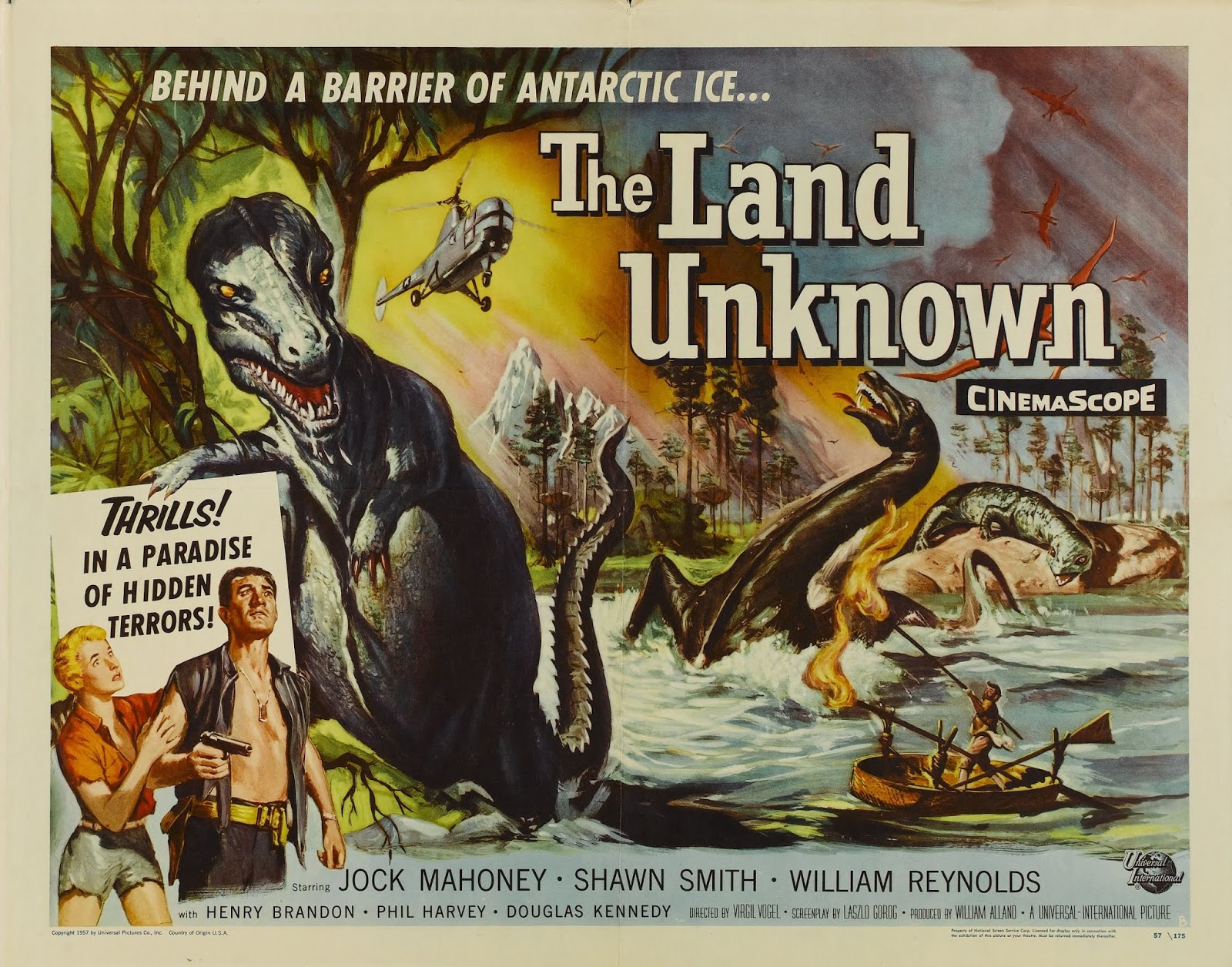
Released by Universal-International in 1957 and directed by Virgil W. Vogel, The Land Unknown takes audiences to one of the most remote places imaginable: Antarctica.
But beneath the frozen landscape lies something nobody expected.
A warm, prehistoric world where dinosaurs still walk the Earth.
An Expedition Into the Unknown
The story begins with a United States Navy expedition investigating reports of unusually warm water in Antarctica.
Commander Roberts, played by Jock Mahoney, travels by helicopter with pilot Lt. Jack Carmen, machinist Steve Miller and journalist Maggie Hathaway, played by Shirley Patterson, who was credited in the film as Shawn Smith.
What begins as a scientific mission quickly becomes something much stranger.
While flying through dangerous weather, the helicopter encounters a flying prehistoric creature. The aircraft is damaged and forced to descend into an enormous volcanic crater hidden beneath the surrounding Antarctic landscape.
What they discover below seems impossible.
Instead of ice and snow, there is heat.
Mist.
Dense vegetation.
Swamps.
And creatures that should have disappeared from the Earth millions of years ago.
The explorers haven’t simply become lost.
They have entered another world.
A Prehistoric Jungle Beneath Antarctica
This is where The Land Unknown becomes pure 1950s adventure.
The enormous crater has apparently remained isolated from the frozen world above, allowing a tropical prehistoric ecosystem to survive.
The expedition encounters everything from a Pteranodon and an Elasmosaurus to Stegosaurus-like creatures, a giant carnivorous plant and, inevitably, a Tyrannosaurus rex.
By modern standards, the effects are obviously primitive.
And that’s part of the fun.
The filmmakers used a wonderfully strange combination of techniques to create their prehistoric creatures. Some were puppets. Monitor lizards were photographed and made to appear enormous. And the Tyrannosaurus rex was portrayed by a performer inside a dinosaur suit.
Nobody watching The Land Unknown today is going to mistake these creatures for the dinosaurs of Jurassic Park.
But judging the film that way misses the point.
There is a handmade quality to everything on screen that gives the movie enormous nostalgic charm.
The Atmosphere Is Better Than the Dinosaurs
The real star of The Land Unknown may actually be its atmosphere.
The black-and-white photography works surprisingly well.
Fog hangs over the jungle. Strange plants fill the frame. Pools of water and rocky cliffs surround the explorers. Steam seems to rise everywhere.
The characters feel genuinely isolated from civilization.
Even though we know we’re looking at studio sets, the film creates the wonderful illusion that somewhere beneath the Antarctic ice there really could be a forgotten valley untouched by time.
And that’s the fantasy that makes the movie work.
1950s science fiction didn’t always need to convince us that something was scientifically possible.
It only needed to make us wonder:
What if?
It Was Supposed to Be a Much Bigger Movie
Perhaps the most fascinating thing about The Land Unknown is that Universal originally had considerably bigger ambitions for it.
The studio planned the movie as a lavish Technicolor production.
Those plans changed after Universal’s expensive 1955 science-fiction film This Island Earth failed to perform as strongly at the box office as the studio had hoped.
The budget for The Land Unknown was reduced.
Technicolor was abandoned in favor of black and white. Plans for extensive outdoor filming were dropped, and the prehistoric world was instead created almost entirely on interior sound stages.
Yet Universal kept one important piece of spectacle:
CinemaScope.
So despite its reduced budget, The Land Unknown was still presented in widescreen, giving its artificial prehistoric jungle a surprisingly large sense of scale.
Creating a Lost World on a Sound Stage
The production team had to become creative.
A massive cyclorama surrounded the sound stage to create the illusion of an enormous landscape.
Even ordinary tropical plants were reportedly hung upside down in places to make them appear strange and prehistoric.
It’s exactly the kind of movie-making ingenuity that makes these old science-fiction films so enjoyable today.
The illusion isn’t perfect.
It isn’t supposed to survive frame-by-frame examination nearly seventy years later.
But when the fog rolls through the jungle and the characters disappear among the giant vegetation, the movie has a dreamlike quality that expensive digital effects couldn’t necessarily reproduce.
The Man Who Came Before Them
The dinosaurs aren’t the expedition’s only problem.
Deep inside the lost valley they discover Dr. Carl Hunter, played by Henry Brandon.
Hunter was a member of an earlier expedition and has been trapped in this prehistoric world for roughly a decade.
Years of isolation have changed him.
His presence adds something darker to the story. Suddenly the explorers aren’t simply struggling against prehistoric animals and an unforgiving environment—they must also deal with what prolonged isolation has done to another human being.
It gives the movie a slightly more serious edge than its dinosaur-suit reputation might suggest.
The lost world isn’t merely dangerous because of the monsters living inside it.
It can change the people trapped there as well.
Inspired by the Real Exploration of Antarctica
One reason the premise must have seemed particularly exciting to audiences in 1957 was that Antarctica still represented genuine mystery.
Large portions of the continent remained unfamiliar to the general public, and expeditions to the South Pole carried an aura of enormous danger and discovery.
The filmmakers even received permission from the U.S. Department of Defense to incorporate footage connected with Rear Admiral Richard E. Byrd’s 1947 Antarctic expedition.
The movie’s story was also associated with reports of unusually warm water discovered in Antarctica.
From that small piece of scientific curiosity came a wonderfully enormous Hollywood question:
What if the warmth came from a hidden tropical world beneath the ice?
And what if that world had remained isolated for millions of years?
That’s all a 1950s science-fiction writer needed.
Jock Mahoney: A Perfect Old-School Adventure Hero
Jock Mahoney fits comfortably into the role of Commander Roberts.
Mahoney had been a stuntman before becoming a leading actor, and there is an unmistakably physical quality to his screen presence.
He looks like someone who belongs in an adventure movie.
Mahoney would later become even more closely associated with old-fashioned screen adventure when he played Tarzan in Tarzan Goes to India (1962) and Tarzan’s Three Challenges (1963).
In The Land Unknown, however, he is exactly what a 1950s expedition needs: calm, capable and seemingly prepared to deal with anything—including dinosaurs beneath Antarctica.
A Perfect Saturday Afternoon Movie
It’s easy to laugh at The Land Unknown today.
Yes, there’s a man inside a Tyrannosaurus rex costume.
Yes, some of the dinosaurs are obviously real lizards photographed to look enormous.
And yes, the science becomes increasingly questionable the longer you think about it.
But that’s also why the movie remains so much fun.
Movies like this weren’t designed to be documentaries.
They were adventures.
Imagine seeing The Land Unknown at a neighborhood theater in 1957.
You buy your ticket.
The lights go down.
The Universal-International logo appears.
And for the next 78 minutes you’re transported beneath the Antarctic ice into a steaming jungle filled with prehistoric monsters.
That’s the experience these films were selling.
A Forgotten Piece of 1950s Sci-Fi
The Land Unknown never became one of the defining science-fiction films of its decade.
It doesn’t have the reputation of The Day the Earth Stood Still.
It doesn’t have the spectacle of Forbidden Planet.
And it certainly doesn’t have the lasting monster fame of Creature from the Black Lagoon.
But perhaps that’s exactly why rediscovering it today is so enjoyable.
It’s a reminder of an era when science-fiction movies could begin with a scientific expedition and, within minutes, take audiences into a prehistoric jungle hidden beneath Antarctica.
The effects may be dated.
The science may be questionable.
The dinosaurs may occasionally look more charming than terrifying.
But somewhere between the fog, the jungle, the CinemaScope photography and that wonderfully determined man in the Tyrannosaurus suit, The Land Unknown still manages to do what a good Saturday-matinee adventure is supposed to do.
It takes us somewhere impossible.
And for 78 minutes, it asks us to believe that somewhere beneath all that Antarctic ice…
there might still be a land unknown.