Why This Star Trek Story Still Stuns
On a Manhattan street from the 1930s, Captain Kirk finds a kind of happiness he was never meant to keep. That bittersweet twist is just one reason many viewers still rank The City on the Edge of Forever as Star Trek's finest hour.
There are television episodes that entertain, and then there are episodes that seem to grow larger with every passing year. Star Trek‘s 1967 classic The City on the Edge of Forever belongs firmly in that second group. Ask longtime viewers to name the finest hour from the original series, and this title comes up again and again, with the kind of affection usually reserved for a favourite song that still sounds fresh decades later.
It has everything that made Star Trek special at its peak: big ideas, emotional stakes, wit, danger, and a lingering sadness that catches you off guard. It is science fiction with heart, and perhaps more importantly, it is television that trusts its audience to feel something complicated.
The episode many fans place at number one
First broadcast on 6 April 1967 during Star Trek‘s first season, The City on the Edge of Forever begins with a crisis aboard the Enterprise and quickly opens into something far more haunting. After Dr Leonard McCoy accidentally injects himself with a powerful drug, he becomes delirious and escapes through a mysterious time portal on a distant planet. The moment he passes through, history changes. Suddenly, the Enterprise never existed.
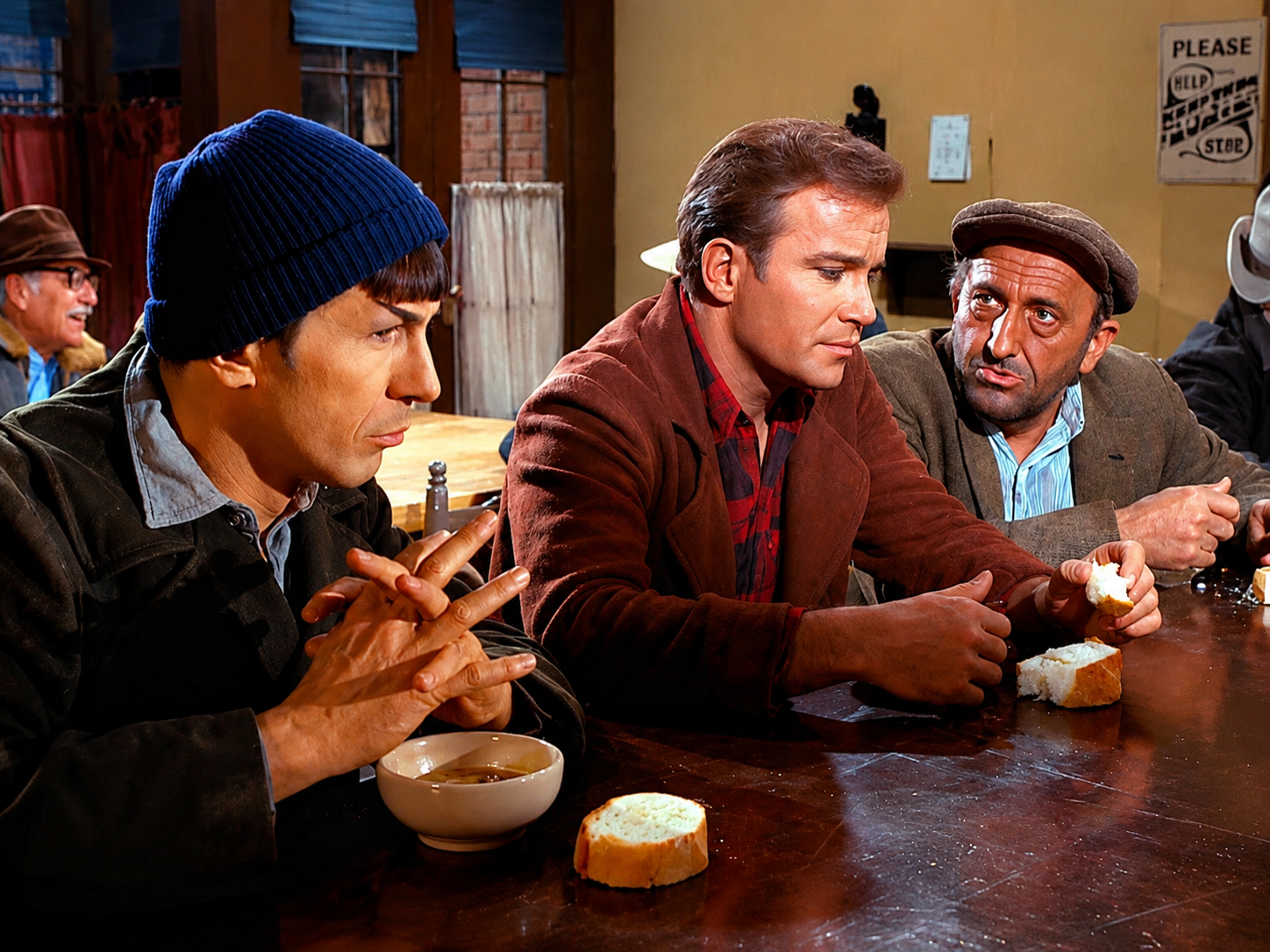
Captain Kirk and Mr Spock follow him into 1930s New York, where they must repair the timeline before the future is lost forever. It is a marvellous setup, but what makes the episode unforgettable is not just the science-fiction puzzle. It is the human story waiting for them on the other side.
There, in Depression-era Manhattan, Kirk meets Edith Keeler, played with luminous warmth by Joan Collins. She runs a mission, feeds the hungry, speaks with idealism, and carries a sense of hope that lights up every scene she enters. Kirk falls for her. The audience does too. Then comes the cruel twist: for history to unfold correctly, Edith must die.
That is the kind of premise that turns a strong episode into a legendary one. It asks a painful question at the heart of the series: what happens when duty and compassion point in opposite directions?
A love story wrapped in a time-travel drama
Kirk at his most vulnerable
William Shatner had many modes as Captain Kirk: commanding, charming, playful, defiant. Here, he reveals something quieter. His scenes with Edith Keeler are tender and unforced, and because of that, the ending lands with extraordinary force. Kirk is not simply saving history. He is sacrificing a future he wants.
That emotional weight gives the episode its lasting power. Plenty of Star Trek adventures are clever. This one hurts a little, and that is why people remember it so vividly.
Spock as the clear-eyed realist
Leonard Nimoy is magnificent here, giving Spock both dry humour and deep moral gravity. While Kirk is drawn toward Edith, Spock becomes the one piecing together the terrible truth. His improvised efforts to build equipment in the 1930s also add a touch of classic series ingenuity, reminding viewers that Star Trek could make technology feel thrilling even on a modest budget.
The balance between Kirk and Spock is especially strong. One is pulled by love, the other by logic, and neither is reduced to a simple stereotype. Their friendship gives the episode its spine.
McCoy brings the soul
DeForest Kelley, meanwhile, gives McCoy a vital role in the story’s emotional machinery. His accidental leap through time triggers the entire chain of events, and his compassion in the final moments intensifies the tragedy. When Kirk stops McCoy from saving Edith, the shock on McCoy’s face says almost everything. It is one of those unforgettable television beats that needs no speech to explain it.
Behind the scenes, the story was nearly as dramatic
If the finished episode feels charged, part of that energy comes from its famously turbulent creation. The story was written by celebrated screenwriter Harlan Ellison, one of the boldest and most imaginative voices in science fiction. His original script was ambitious, dark, and expensive, featuring elements that the production team felt could not be filmed within the realities of 1960s television.
That led to rewrites, arguments, and years of debate. Ellison was deeply unhappy with the changes, while producer Gene Roddenberry and the production staff argued that the episode had to be reshaped to fit the series and the budget. It became one of the most talked-about creative clashes in television science-fiction history.
Yet the fascinating part is this: out of that struggle came something remarkable. The broadcast version keeps Ellison’s grand emotional idea while fitting beautifully into the world of Star Trek. It feels literary, but also accessible. Poetic, but never slow.
Classic television is full of stories like this, where friction behind the camera somehow sharpens what appears on screen. In music terms, it is a little like a recording session full of tension that still produces a timeless hit. However heated the process may have been, the result can still be magic.
Why it still feels so modern
It trusts the audience
One reason The City on the Edge of Forever continues to connect with viewers is that it does not overexplain itself. It presents a moral dilemma and lets it breathe. There is no easy escape hatch, no last-minute loophole to soften the blow. The ending is brave because it is final.
That kind of storytelling feels strikingly modern, even now. Contemporary prestige television often aims for emotional ambiguity and bittersweet consequences, but Star Trek was already doing it here in 1967.
The period setting gives it a special glow
The 1930s setting adds another layer of charm. There is a romantic, old-Hollywood atmosphere to the city streets, mission house, and quiet conversations between Kirk and Edith. It gives the episode a dreamlike quality, as though the characters have stepped into another film entirely for a little while. Then the science-fiction frame closes around them again, and the dream turns tragic.
That contrast is beautifully handled. The episode never loses its sense of adventure, but it also allows room for warmth, humour, and longing. It feels expansive in a way many hour-long television dramas never quite manage.
The ending that sealed its reputation
By the time the final moments arrive, the story has tightened like a drum. Edith moves toward her fate. McCoy tries to save her. Kirk knows what must happen. In a few seconds, the episode delivers one of the most devastating choices in the history of the franchise.
Then comes the famous closing line from Kirk: “Let’s get the hell out of here.” It is abrupt, exhausted, and deeply human. No grand speech. No celebration. Just grief and the need to leave.
That final note lingers. It is one of the reasons the episode has remained so highly regarded for generations. It does not simply end. It echoes.
A landmark for Star Trek and television
For Star Trek, this was proof that the series could do far more than space adventure. It could tell intimate stories with philosophical depth and genuine heartbreak. It could pair cosmic ideas with personal loss. In many ways, this episode helped define what the franchise could aspire to be.
Its influence can be felt across later Star Trek series, where time travel, ethical dilemmas, and impossible choices became recurring themes. But even among all those later adventures, The City on the Edge of Forever remains hard to top because it gets the fundamentals exactly right:
- A memorable science-fiction concept built around time, fate, and consequence
- Superb character work for Kirk, Spock, and McCoy
- A guest performance of real grace from Joan Collins as Edith Keeler
- An ending with emotional courage that refuses to take the easy path
That is a powerful combination in any era of television.
Still worth the trip through the Guardian of Forever
Nearly six decades on, The City on the Edge of Forever still feels like an event when it comes on. For older fans, it is a cherished return to one of the original series’ finest moments. For first-time viewers, it is often a revelation: this is what people were talking about all along.
There is nostalgia here, certainly, but not the dusty kind. This episode is alive. It moves quickly, sparkles with character, and lands with emotional force. Like a classic record that keeps finding new listeners, it has outlasted changing fashions because it was built on something solid and true.
Some episodes are admired. This one is remembered.
And that is why so many fans still call it the greatest Star Trek episode ever made. Not simply because it is famous, or important, or often repeated on best-of lists, but because it delivers that rare blend of intelligence and feeling that television at its best can achieve. It takes us across time, breaks our hearts, and leaves us quietly amazed.