10 Classic Sci-Fi TV Shows That Predicted the Future.
Long before smartphones, AI, and video calls became everyday reality, classic sci-fi television imagined them first. Discover 10 groundbreaking TV shows that predicted the future decades before it arrived—and see just how accurate they really were.
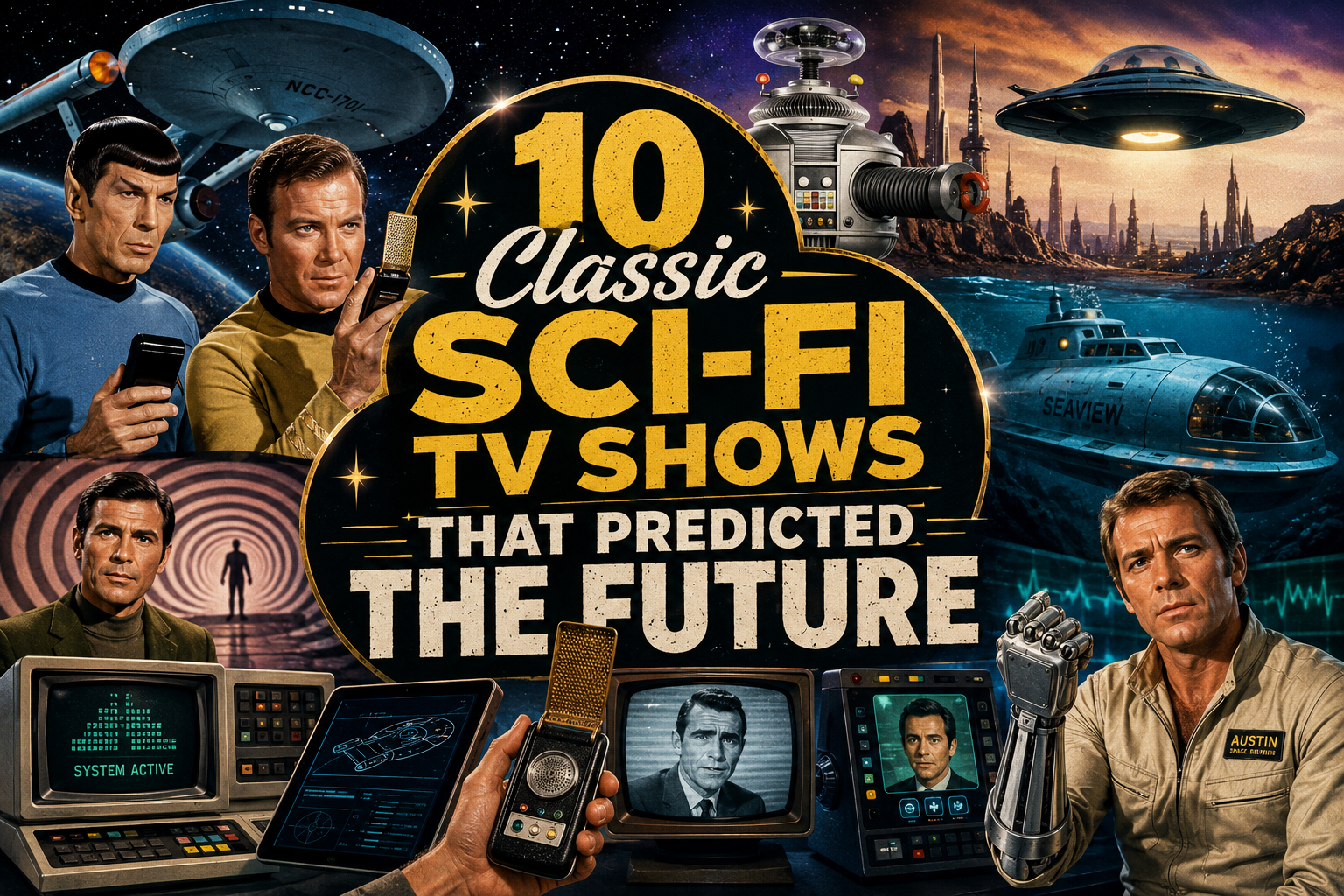
Long before smartphones, artificial intelligence, video calls, and smart homes became part of everyday life, classic science-fiction television was imagining a world filled with incredible technology.
Working with little more than imagination—and often modest special effects—writers in the 1960s and 1970s dreamed up inventions that seemed impossible at the time. Decades later, many of those ideas have become reality.
Were these creators simply lucky, or did they have an extraordinary vision of what the future might hold?
Here are ten classic sci-fi shows that predicted the future in surprising ways.
1. Star Trek (1966–1969)
Few television series have influenced real-world technology as much as Star Trek.
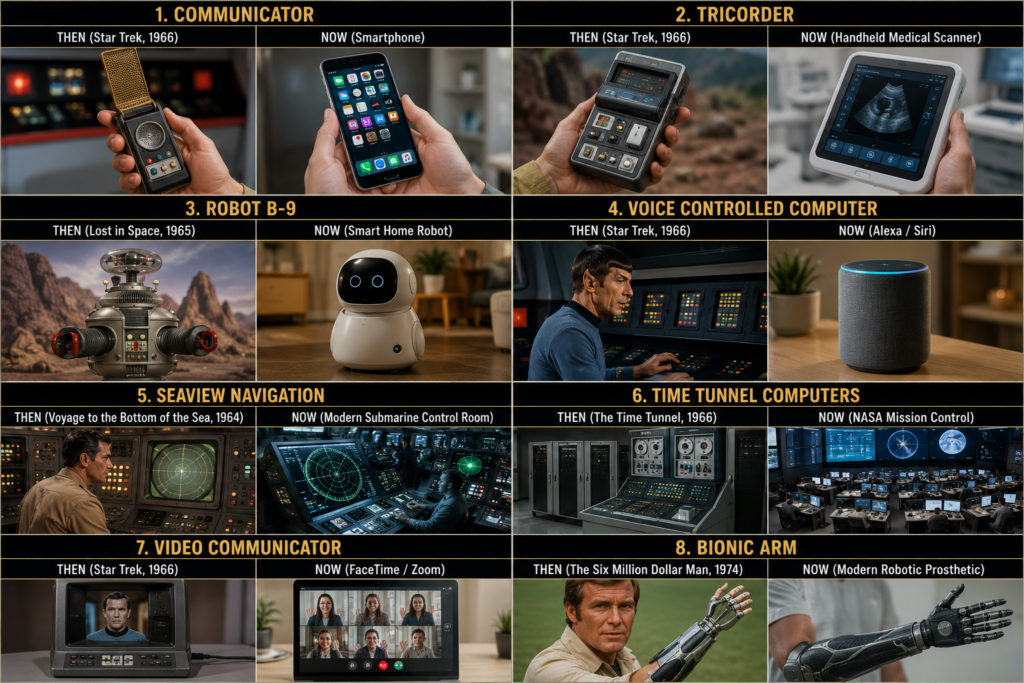
Gene Roddenberry’s groundbreaking series introduced viewers to handheld communicators that look remarkably similar to today’s smartphones. Crew members also carried tricorders, portable devices capable of scanning people, analyzing environments, and diagnosing medical conditions—ideas that continue to inspire modern engineers.
The Enterprise also featured video calls, voice-controlled computers, wireless communication devices, automatic doors, and touchscreen-like displays decades before they became common.
Predictions That Came True
- Smartphones
- Video calling
- Voice assistants
- Wireless earbuds
- Tablet computers
- Portable medical scanners
Today, many scientists and engineers openly credit Star Trek as one of their biggest inspirations.
2. The Twilight Zone (1959–1964)
Although best known for supernatural stories and psychological twists, The Twilight Zone often explored themes that feel incredibly modern.
Rod Serling warned viewers about technology replacing human connection, artificial intelligence making moral decisions, and societies becoming increasingly dependent on machines.
Episodes like “The Lonely” imagined emotional relationships between humans and lifelike robots decades before AI companions became a real topic of discussion.
Predictions That Came True
- Artificial intelligence
- Smart surveillance
- Social isolation through technology
- Ethical questions surrounding AI
More than sixty years later, many of its stories feel surprisingly relevant.
3. The Outer Limits (1963–1965)
Every week, The Outer Limits challenged viewers with stories about advanced science and the unknown.
The series explored genetic engineering, cybernetic enhancements, artificial intelligence, mind control, and biological experimentation long before these subjects became everyday headlines.
Many episodes questioned whether science should always push beyond ethical boundaries—a conversation we’re still having today.
Predictions That Came True
- Genetic engineering
- Human enhancement
- Brain-computer interfaces
- Artificial intelligence
Its ideas often seem less like fiction and more like tomorrow’s news.
4. Lost in Space (1965–1968)
The Robinson family may have been lost in the universe, but they were surrounded by futuristic technology.
The most famous example was Robot B-9, the loyal mechanical companion who warned the family of danger, answered questions, and interacted naturally with humans.
While today’s robots aren’t quite as expressive, home assistants like Alexa, Siri, and Google Assistant have brought us surprisingly close.
Predictions That Came True
- Home robots
- AI assistants
- Smart homes
- Voice-controlled computers
Robot B-9 remains one of television’s most beloved robots.
5. The Time Tunnel (1966–1967)
Time travel remains science fiction, but the technology inside the Time Tunnel complex was remarkably forward-thinking.
Massive computers monitored historical events in real time while scientists tracked the travelers’ locations through giant electronic displays and complex data systems.
Today’s mission control centers and data visualization systems look surprisingly similar.
Predictions That Came True
- Real-time computer monitoring
- Digital mapping
- Data visualization
- High-performance computing
The technology may have been fictional, but the concepts were decades ahead of their time.
6. Voyage to the Bottom of the Sea (1964–1968)
Admiral Nelson’s futuristic submarine, the Seaview, featured advanced sonar systems, sophisticated navigation computers, underwater drones, and cutting-edge scientific equipment.
Many of these once-fantastical ideas are now standard tools aboard modern research vessels and military submarines.
Predictions That Came True
- Underwater drones
- Advanced sonar
- Computerized navigation
- Ocean exploration technology
The future beneath the sea turned out to be closer than anyone imagined.
7. The Invaders (1967–1968)
No, aliens haven’t secretly infiltrated Earth—but the show’s central idea feels surprisingly modern.
David Vincent’s struggle to convince people that hidden enemies were living among them mirrors today’s concerns about cyberattacks, misinformation, deepfakes, identity theft, and foreign interference.
The technology changed, but the fear remained the same.
Predictions That Came True
- Identity deception
- Information warfare
- Hidden infiltration
- Public distrust fueled by unseen threats
Sometimes science fiction predicts ideas rather than inventions.
8. Land of the Giants (1968–1970)
At first glance, Land of the Giants appears to be simply an adventure series set in a world of oversized objects.
But the show’s giant computers, advanced laboratories, futuristic transportation systems, and highly sophisticated technology reflected the growing belief that science would continue transforming everyday life.
Predictions That Came True
- Advanced electronics
- Highly automated laboratories
- Sophisticated transportation systems
Its vision of a technologically advanced civilization still feels impressive today.
9. The Six Million Dollar Man (1974–1978)
Although it arrived after the 1960s, The Six Million Dollar Man deserves recognition for predicting one of today’s fastest-growing fields.
Steve Austin’s bionic limbs once seemed impossible. Today, powered prosthetic arms, robotic exoskeletons, neural interfaces, and advanced artificial limbs are helping thousands of people regain mobility.
Predictions That Came True
- Robotic prosthetics
- Bionic limbs
- Human-machine integration
- Medical robotics
Science has steadily moved closer to fiction.
10. Buck Rogers in the 25th Century (1979–1981)
Like The Six Million Dollar Man, this late-1970s classic expanded on ideas first explored during the previous decade.
Buck Rogers featured voice-controlled computers, wearable displays, artificial intelligence, autonomous vehicles, and advanced communication systems that resemble many technologies currently under development.
Predictions That Came True
- Wearable technology
- AI companions
- Voice-controlled computers
- Autonomous transportation
Many of Buck Rogers’ futuristic gadgets no longer seem so futuristic.
Science Fiction Inspired the Future
Classic science-fiction television didn’t simply entertain audiences—it inspired generations of engineers, inventors, astronauts, and scientists.
Many of today’s everyday technologies first appeared as fictional gadgets on television decades earlier. Smartphones, video calls, robotic assistants, wearable devices, portable scanners, and artificial intelligence all owe at least a small debt to the dreamers who imagined them first.
Perhaps the greatest achievement of classic sci-fi wasn’t predicting the future.
It helped inspire people to build it.
Which classic sci-fi invention amazed you the most? Is there another television show that deserves a place on this list? Let us know in the comments!