Neon Menus, Paper Hats, and Vanished Drive-Thrus
One line everyone still shouts is, “There used to be one right here.” Across the United States, fast food chains that once lit up family nights and road trips in the 1970s and 1980s quietly disappeared, leaving behind memorable buildings, signature sandwiches, and a lot of hungry nostalgia.
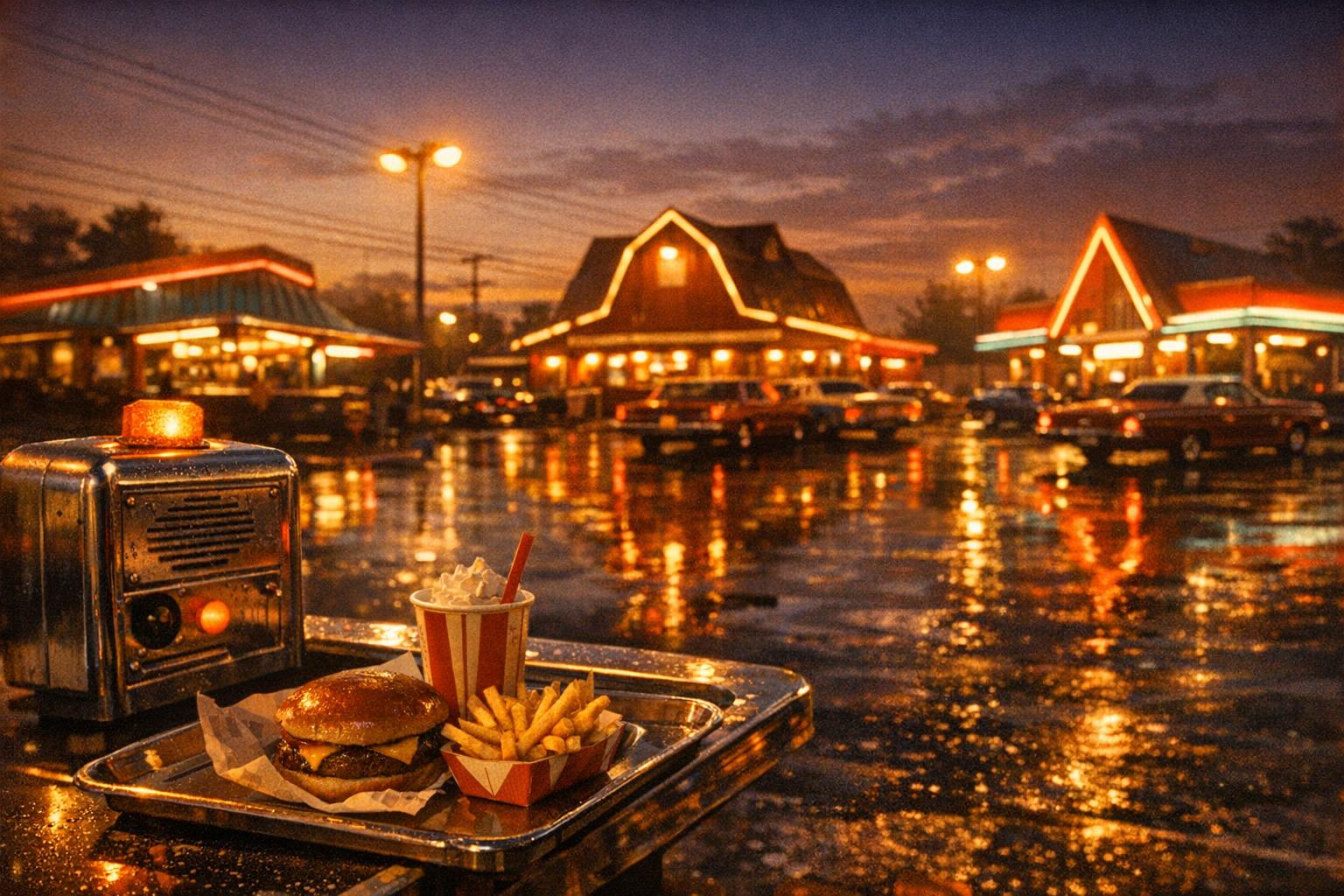
There was a time in America when a family car could pull into a brightly lit parking lot, a speaker box would crackle to life, and dinner came with a paper placemat, a mascot, and a little bit of showmanship. The fast food world of the 1970s and 1980s was crowded, colourful, and fiercely competitive. Alongside the giants that survived, dozens of chains burned brightly for a while and then slipped away, leaving behind memories as vivid as a jukebox glow.
For anyone who remembers those weekends on the road, those quick lunches between shopping trips, or those after-school stops for fries and a shake, these vanished chains still have real emotional pull. And for younger readers, consider this a buyer’s guide to the lost flavours, signature gimmicks, and unforgettable looks of fast food America when the burger wars were loud and the dining rooms were full of personality.
The chains that once seemed everywhere
Gino’s Hamburgers
Backed by American football star Gino Marchetti, Gino’s Hamburgers had the kind of confident, all-American image that fit perfectly with the era. It grew across the eastern United States and became well known for fried chicken as well as burgers. In many communities, Gino’s was not just another stop for a quick meal. It was a local fixture, the kind of place where teams celebrated after games and families knew exactly what they were ordering before they got to the counter.
What made it memorable: celebrity ownership, dependable burgers, and a broad menu before broad menus became standard everywhere.
If you would have loved it: this was for diners who liked the familiar comfort of a burger chain but wanted a little more variety than the standard burger-fries-drink trio.
Red Barn
You could spot Red Barn from a distance, and that was the whole point. Its barn-shaped buildings turned the chain itself into a roadside advertisement. In an age before every major brand had settled into a polished corporate look, Red Barn leaned into visual theatre. The architecture was fun, family-friendly, and impossible to confuse with anything else.
The menu included burgers, fried chicken, and fish, but what people often remember first is the building. Red Barn felt like a place designed for children to find exciting and adults to find convenient.
What made it memorable: one of the most distinctive restaurant designs of its time, plus a menu aimed squarely at families on the move.
Buyer’s guide verdict: if atmosphere matters as much as the meal, Red Barn would have been a winner.
Burger Chef
For a while, Burger Chef was a genuine heavyweight. It expanded rapidly and challenged the biggest names in the business. It is especially fondly remembered for its family-focused marketing and children’s meals, helping shape ideas that later became standard across the industry.
There was something charmingly optimistic about Burger Chef. It felt built for the suburban boom, for growing families, for a country in love with convenience and choice. Its branding was bright, cheerful, and very much in tune with the television-commercial energy of the 1970s.
What made it memorable: a major player that helped define the family fast food experience.
If you were choosing where to stop: Burger Chef was the place for families who wanted a chain that felt fun without being chaotic.
Henry’s Hamburgers
Henry’s Hamburgers had one of those names that sounds almost too simple to fail. For a time, it did very well, offering low prices and straightforward food in an increasingly crowded market. It reached impressive numbers in the 1960s and still lingered into the 1970s in some areas, but the chain gradually faded as larger rivals tightened their grip.
That is often how these stories go. A chain can be successful, even beloved, but if it cannot keep pace with changing advertising, real estate costs, and national expansion, it starts to disappear one location at a time.
What made it memorable: affordability and no-nonsense burgers in a period when value mattered enormously.
Best for: anyone who believes fast food should be simple, quick, and satisfying.
Pizza, roast beef, and everything in between
VIP’s
Not every vanished chain was about burgers. VIP’s was a casual dining chain that many Americans remember from the West, especially for dependable family meals and a broad menu. It sat in that comfortable middle ground between fast food and full-service dining, where breakfast, lunch, and dinner all felt equally at home.
Chains like VIP’s remind us that the 1970s and 1980s were full of regional favourites that built deep loyalty without always becoming permanent national institutions.
What made it memorable: reliability, comfort, and the feeling that everyone could find something they liked.
Pup ‘N’ Taco
This one has become almost mythical for fans of regional fast food. Pup ‘N’ Taco mixed hot dogs, tacos, and other quick-service staples in a way that now feels wonderfully unconventional. It was especially associated with Southern California, where car culture and quick meals were natural partners.
The name alone tells you a lot about the era. Chains were often less polished, more playful, and willing to throw together menu ideas that would make a modern branding consultant nervous. That unpredictability is part of the charm.
What made it memorable: a quirky menu and strong local identity.
Buyer’s guide verdict: perfect for adventurous eaters who liked a little variety on one tray.
Rax Roast Beef
Rax did survive beyond the 1980s in limited form, but as a major chain it belongs firmly to the vanished-landmark category. At its peak, it offered a real alternative to burger-heavy menus, focusing on roast beef sandwiches and later expanding into salad bars and broader options.
That made Rax feel slightly different from the louder burger chains. It had a touch of grown-up appeal, especially for customers who wanted something warm, savoury, and a little less predictable than a standard hamburger.
What made it memorable: roast beef at scale, plus an attempt to offer more choice before “choice” became the industry’s favourite word.
Why so many chains disappeared
The battle for sameness
One of the great ironies of American fast food is that the chains people remember most fondly were often the ones with the strongest personalities. Yet personality alone was not enough. National advertising became more expensive, distribution systems more complex, and competition more brutal. The biggest brands learned how to deliver near-identical food and branding from one coast to the other, and that consistency became a powerful selling point.
Smaller or regional chains often had charm, but charm is difficult to scale.
Changing tastes and expectations
By the 1980s, customers expected more speed, more convenience, and stronger brand recognition. Drive-thru service became even more important. Menus evolved. Interiors changed. Marketing to children became more sophisticated. Some chains adapted; others looked suddenly old-fashioned.
And sometimes the problem was simply timing. A chain could be good, even profitable, but still get squeezed out if a larger rival arrived with deeper pockets and bigger television campaigns.
Mergers, sales, and quiet endings
Not every chain failed in dramatic fashion. Some were bought, absorbed, or converted into other brands. One day the sign was there; then one day it was not. For customers, that kind of ending can feel especially strange. There is no grand farewell tour for a neighbourhood burger stand. It just becomes something else, and eventually only the memory remains.
The history of fast food is not only about the winners. It is also about the places people still describe by saying, “There used to be one right here.”
If you could bring one back, which would be worth the trip?
That is where the buyer’s guide spirit really comes alive. If these chains returned tomorrow, which ones would feel most exciting to modern diners?
- Best for pure nostalgia: Red Barn, because the building itself was half the experience.
- Best for family appeal: Burger Chef, with its cheerful, kid-friendly identity.
- Best for regional cool: Pup ‘N’ Taco, the kind of chain that would thrive on curiosity and retro charm.
- Best for menu variety: Gino’s, which offered more than just one lane of comfort food.
- Best for a modern comeback twist: Rax, because roast beef and broader menu options could easily find an audience again.
The taste of a lost roadside America
What makes these vanished chains so fascinating is not just the food. It is the whole scene around them: the backlit signs, the trays and wrappers, the bright booths, the promise of a quick meal during a long drive or a busy Saturday. They belonged to an America of station wagons, shopping malls, family outings, and radio songs pouring through dashboard speakers.
In that sense, these restaurants are a little like classic hits. Some names stay in heavy rotation forever, while others drift out of the spotlight. But when you hear them mentioned again, they come rushing back with surprising force. A logo, a mascot, a paper cup, a certain kind of fry, and suddenly you are there.
And maybe that is why people still talk about them. These chains were not merely places to eat. They were part of the rhythm of everyday life in the 1970s and 1980s, as familiar as a favourite chorus on the radio. Gone, yes. Forgotten? Not a chance.