Why I.G.Y. Still Glows
Why does “I.G.Y.” still sound like tomorrow? Donald Fagen’s sleek 1982 gem blends studio perfection, sly humour and space-age optimism into a classic hits favourite that has never lost its glow.
Few records capture the polished promise of the early 1980s quite like “I.G.Y.”. Released in 1982 as the lead single from Donald Fagen’s debut solo album The Nightfly, it arrived with a bright electric shimmer, an immaculate groove, and lyrics that looked backward and forward at the same time. On the surface, it sounds sleek, optimistic and almost breezy. Listen more closely, though, and there is a sly smile behind every line.
That blend of warmth, wit and precision is exactly why the song has lasted. “I.G.Y.” is not just a beautifully made record; it is also a clever meditation on the future people once imagined for themselves. For classic hits listeners, it remains one of those tracks that feels instantly transportive: the first notes come on, and suddenly the room is lit with neon, chrome and possibility.
The idea behind the song
A future imagined in 1957
The title stands for International Geophysical Year, a real scientific initiative that ran from July 1957 to December 1958. It was a period of international cooperation in research, involving fields such as meteorology, seismology and space science. For Donald Fagen, that phrase carried the glow of a particular mid-century optimism: a world that believed science, technology and modern design would lead humanity into a cleaner, smarter, better tomorrow.
That spirit runs through the song’s unforgettable opening lines, with their promises of “a just machine to make big decisions” and “a gleaming alloy air car”. Fagen was not simply writing a nostalgic tribute. He was doing something more interesting: revisiting the future as it was once advertised, with affection but also irony. The song smiles at those grand promises even as it hints that reality turned out to be messier.
Donald Fagen steps out alone
By 1982, Fagen was already known as one half of Steely Dan, the famously meticulous duo he formed with Walter Becker. Steely Dan had built a reputation for sophisticated songwriting, jazz-inflected harmony and studio perfectionism. When the group went quiet after Gaucho in 1980, Fagen began work on what became The Nightfly, his first solo album.
Although Becker was not a co-writer on “I.G.Y.”, the song clearly shares some Steely Dan DNA: elegant chord changes, immaculate rhythm, and lyrics that reward repeated listening. But there is also something more personal and direct about The Nightfly. Fagen has described the album as reflecting his youth, especially the world of late-night radio, suburban aspiration and post-war American modernity. “I.G.Y.” became one of the clearest expressions of that vision.
Building the record in the studio
A perfectionist production
Donald Fagen produced the track himself, and that matters. He was deeply involved in every detail, shaping the arrangement with the same exacting standards that had defined Steely Dan. The Nightfly became famous in audio circles for its pristine sound, and “I.G.Y.” is one of the album’s great sonic showpieces.
The recording was made during a moment of technological transition. The Nightfly is widely celebrated as one of the first major pop albums recorded almost entirely digitally, using the 3M digital recording system. At a time when many artists were still rooted in analogue methods, Fagen embraced a cleaner, more modern approach. That decision suited the material perfectly. A song about the future needed to sound futuristic, and the finished track has a glossy clarity that still turns heads on good speakers.
The musicians who gave it life
As with many Fagen and Steely Dan-related sessions, the personnel list reads like a roll call of top-tier studio talent. Among the key players on “I.G.Y.” were:
- Donald Fagen – lead vocals, keyboards, songwriter, producer
- Greg Phillinganes – keyboards and synthesizer textures
- Larry Carlton – guitar, bringing tasteful, fluid lines
- Anthony Jackson – bass, adding depth and precision
- Rick Marotta – drums, with the supple groove the track depends on
- Ralph MacDonald – percussion
- Michael Brecker – tenor saxophone, adding that polished jazz-pop glow
- Valerie Simpson and Zachary Sanders – backing vocals
That combination of players helps explain why the record feels so effortless. Nothing is overcrowded. Every part is placed with care. The rhythm section glides rather than pushes, the keyboards add sheen without clutter, and the saxophone lines give the track warmth and sophistication. It is a masterclass in restraint.
An atmosphere of polished optimism
One of the song’s greatest tricks is that it sounds cheerful without being naive. The arrangement is bright and inviting, but there is a faintly wistful quality in Fagen’s vocal delivery. He does not belt the song; he guides it. That cool, slightly detached style allows the lyric’s irony to breathe.
In other hands, “I.G.Y.” might have become a novelty about retro-futurism. Instead, it feels human. You can hear admiration for the old dream, but also a grown-up awareness that no era ever quite delivers the paradise it promises.
How it performed when it was released
Chart success and strong album support
“I.G.Y.” was released as the lead single from The Nightfly in September 1982. It was not a massive blockbuster in the mould of the biggest pop smashes of the era, but it performed respectably and found exactly the kind of audience that appreciated craft, musicianship and intelligent songwriting. In the United States, the song reached the Billboard Hot 100 and also performed strongly on adult contemporary and radio-oriented formats, where its sophisticated sound was a natural fit.
More importantly, it helped establish The Nightfly as a major artistic statement. The album was critically acclaimed and commercially successful, eventually becoming one of the defining sophisticated pop records of the early 1980s. While some listeners first came to it expecting another Steely Dan record, many stayed because Fagen offered something distinct: personal, cinematic and deeply polished.
Critical reception
Critics responded warmly to both the single and the album. Reviewers praised the immaculate production, the clever lyric writing and the way Fagen balanced accessibility with complexity. “I.G.Y.” in particular stood out as an ideal introduction to The Nightfly: catchy enough for radio, but layered enough to reward serious listening.
The album also earned multiple Grammy nominations, and over time it became an audiophile favourite. That reputation has only strengthened the song’s standing. For many listeners, “I.G.Y.” is one of those rare records that works equally well as a pop song, a studio benchmark and a piece of cultural commentary.
Behind-the-scenes details worth knowing
A title that puzzled some listeners
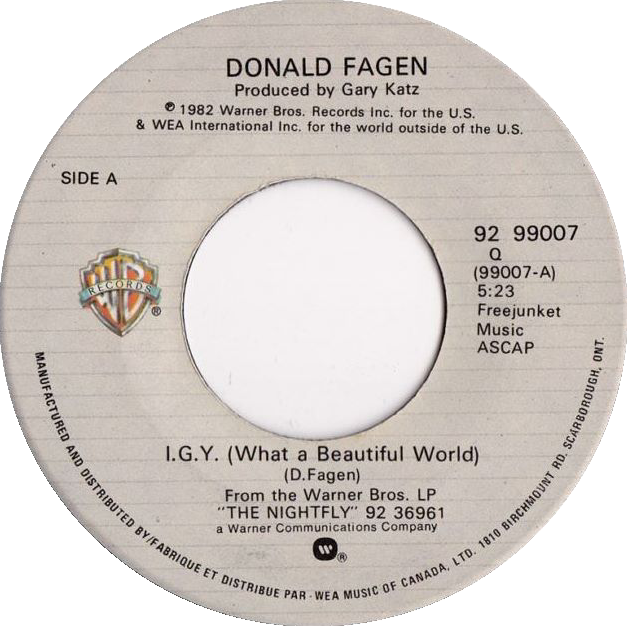
One charming detail about the song’s release is that many casual listeners had no idea what “I.G.Y.” meant at first. It looked cryptic on the label, and that mystery added to its appeal. Once people learned that it referred to a real international scientific programme from the late 1950s, the song opened up in a new way. Suddenly the lyric’s references to solar-powered cities and undersea railroads felt like pieces of a larger dream.
A digital landmark
The Nightfly became famous as a demonstration disc in hi-fi shops for good reason. Engineers and audio enthusiasts admired its extraordinary clarity, and “I.G.Y.” was often one of the tracks used to show off stereo systems. The crisp drums, the separation between instruments, the smooth bass and the airy vocal all made it ideal for that purpose.
That technical reputation has become part of the song’s story. It is not often that a single can claim both emotional resonance and engineering prestige, but “I.G.Y.” manages it.
The smile beneath the lyric
Fagen’s writing has always had an observational sharpness, and this song is a fine example. The bright promises in the lyric are not there by accident. They reflect the language of magazines, exhibitions and post-war imagination, when science was marketed almost like a lifestyle brand. The clever part is that Fagen never over-explains the joke. He lets the images do the work.
“Ninety minutes from New York to Paris” sounds thrilling, but in Fagen’s hands it also feels like a postcard from a future that never quite arrived.
Its place in the music of the early 1980s
Not quite new wave, not quite yacht rock
In 1982, pop music was full of change. New wave, synth-pop, post-disco production and the early MTV era were reshaping the charts. “I.G.Y.” did not fit neatly into any one box, and that is part of its charm. It used modern studio technology and sleek production, yet it was grounded in jazz harmony, classic songwriting and session-player finesse.
That put the song in a fascinating space within the era. It sounded contemporary, but it also felt mature. It shared the clean surfaces of the early 1980s without chasing youth trends. In many ways, it pointed toward the sophisticated adult pop that would flourish throughout the decade, while still carrying the musical intelligence associated with 1970s studio craftsmanship.
A bridge between eras
There is also a deeper historical connection at work. The song itself looks back to the late 1950s and early 1960s, while its production is firmly rooted in 1982. So “I.G.Y.” becomes a bridge between two moments of technological excitement: the space-age optimism of post-war America and the digital sheen of the early computer age.
That double vision gives the record unusual depth. It is nostalgic, but not trapped in nostalgia. It is modern, but not cold. It remembers the old dream while asking us to think about how every generation imagines tomorrow.
Why the song still matters
A classic hits favourite with brains and beauty
Decades later, “I.G.Y.” still sounds fresh on the radio. Part of that is simple craft: the melody is strong, the groove is inviting, and the production remains gorgeous. But the song’s staying power also comes from its perspective. It understands that hope can be sincere and slightly bittersweet at the same time.
For listeners today, that may be more relatable than ever. We still live among promises of miraculous technology, cleaner futures and better living through innovation. Fagen’s song reminds us that people have always dreamed that way.
The glow never quite fades
What makes “I.G.Y.” special is the way it wraps intelligence inside pleasure. You can dance to it, admire the musicianship, smile at the lyric, or simply let it wash over you. It works on every level. That is a rare achievement.
On classic hits radio, it remains a perfect late-evening jewel: polished, wistful, urbane and quietly joyful. Donald Fagen took a forgotten scientific acronym and turned it into one of the most elegant pop records of its era. More than forty years on, that imagined tomorrow still shines.