By the Power of Grayskull
Loud, colourful, and unexpectedly heartfelt, He-Man still swings like a champion of 1980s television.
A toy shelf thunderbolt that became after-school television gold
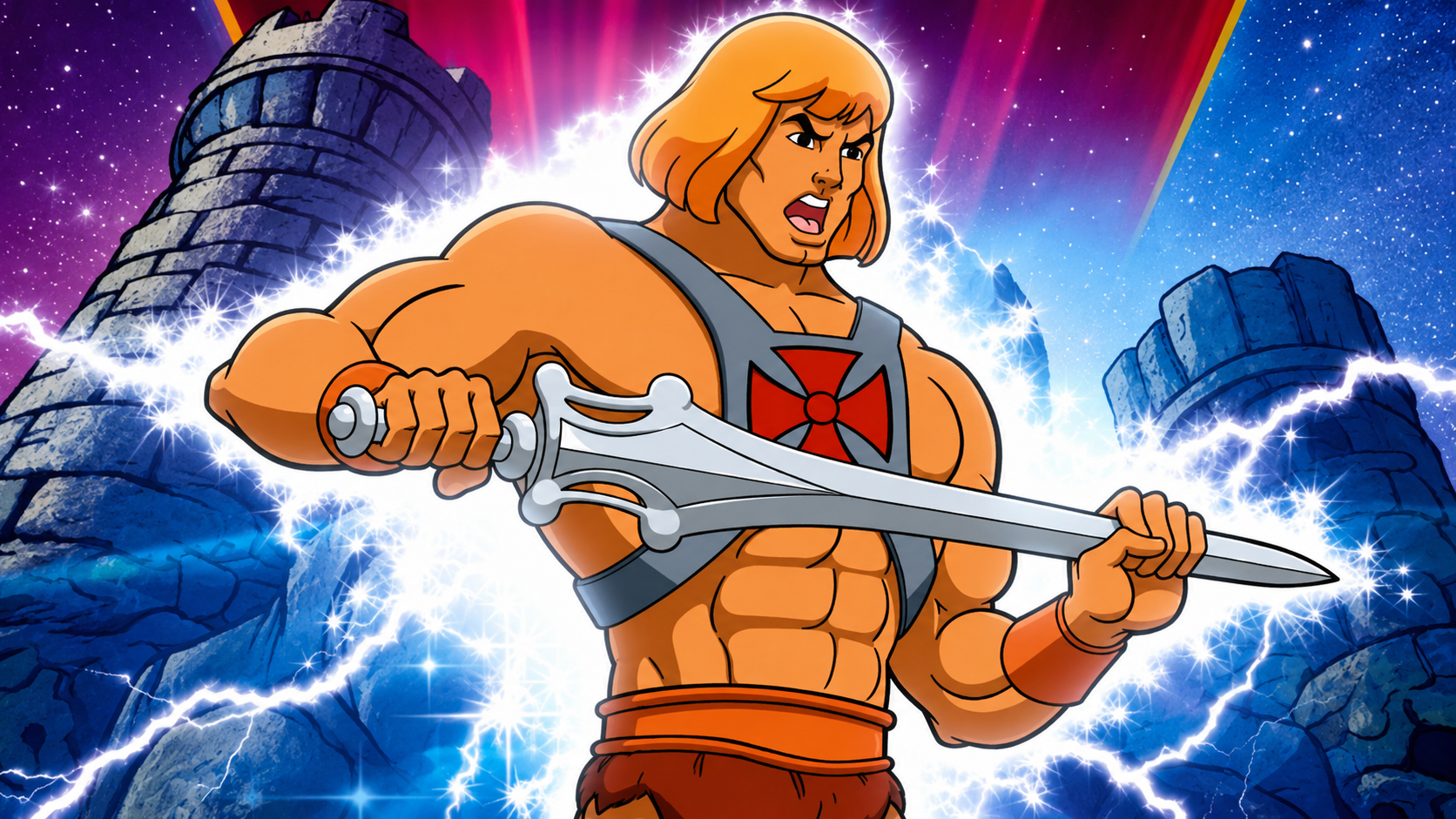
Some cartoons arrive quietly. He-Man and the Masters of the Universe arrived like a battle cry. Debuting in 1983, Filmation’s fantasy adventure was bold, bright, and impossible to ignore: a square-jawed hero, a cackling skull-faced villain, magical swords, strange creatures, and a kingdom called Eternia that felt as if a heavy metal album cover had sprung to life.
For a generation of viewers, this was not just another animated series. It was appointment television. The transformation sequence alone was enough to make young fans sit up straight. Prince Adam, mild and almost comically relaxed one moment, suddenly raising the Sword of Power and calling out, “By the power of Grayskull… I have the power!” — that was pure small-screen electricity.
What made He-Man so memorable was its unusual recipe. It mixed sword-and-sorcery fantasy with science fiction hardware, superhero action, monster-movie visuals, and a very 1980s sense of colour and confidence. One minute you were in a royal palace, the next you were staring at laser cannons, battle vehicles, and a villain’s lair shaped like a snake mountain. It was gloriously over the top, and that was exactly the point.
Why the cartoon hit so hard
There was a wonderful simplicity to the series. He-Man stood for courage and decency. Skeletor stood for chaos, vanity, and theatrical evil. Around them swirled a cast of instantly recognisable characters: the fierce Teela, wise Man-At-Arms, nervous but lovable Orko, and the mighty Battle Cat, who transformed from the timid Cringer into one of animation’s great feline sidekicks.
Filmation’s animation style has often been described as limited, and yes, modern viewers will notice repeated movement cycles and familiar poses. But that misses part of the charm. The studio knew how to make images stick. He-Man looked heroic in every frame. Skeletor looked as if he relished every wicked line. Castle Grayskull itself, with that unforgettable skull-face entrance, was one of the great visual hooks in cartoon history.
There was also a curious warmth beneath the action. However wild the battles became, the series usually ended with a gentle moral message. In a decade often remembered for noise and excess, He-Man quietly reminded children about honesty, friendship, patience, and responsibility. It could be funny, strange, and loud, but it also wanted to be kind.
Behind the scenes of a phenomenon
Part of the magic came from how cleverly the whole world was assembled. Mattel had created the toy line first, and the cartoon helped turn those figures into personalities children could imagine long after the television was switched off. That connection between toy box and TV screen was not entirely new, but He-Man helped define the model for the decade.
Filmation, meanwhile, gave the property a surprisingly rich identity. The voice work did a lot of heavy lifting. John Erwin’s He-Man had calm authority, while Alan Oppenheimer’s Skeletor delivered villainy with a delicious sneer. Listen closely and you can hear why fans still quote him today. Skeletor was threatening enough for adventure, but flamboyant enough to be endlessly entertaining. He did not simply scheme; he performed.
And that may be the secret of the show’s longevity. It understood spectacle. Every episode promised danger, magic, and a showdown, but it also offered personalities big enough to fill the room. That is exactly the kind of energy classic hits radio listeners know well: a little larger than life, instantly catchy, and impossible to mistake for anything else.
The 1980s movies kept the power flowing
Although the original cartoon remained the centrepiece, the 1980s brought more animated adventures for Eternia fans. In 1985, The Secret of the Sword arrived, effectively introducing She-Ra to a wider audience and launching She-Ra: Princess of Power. That was a major moment, not just as an expansion of the franchise, but as proof that this fantasy universe had room to grow. She-Ra was not a side note. She was a star in her own right, and the film gave the mythology a stronger emotional heartbeat through the revelation that Prince Adam had a twin sister, Princess Adora.
Then came the 1987 live-action film Masters of the Universe, starring Dolph Lundgren as He-Man and Frank Langella as Skeletor. It is one of those wonderfully ambitious 1980s studio swings that remains fascinating even when it gets messy. Budget limitations pulled much of the action away from Eternia and into contemporary Earth, which disappointed some fans hoping for wall-to-wall fantasy. But time has been kind to the film’s oddball sincerity.
Lundgren certainly looked the part: towering, heroic, and physically imposing. Langella, meanwhile, understood the assignment completely. He gave Skeletor grandeur, menace, and a surprisingly committed theatrical style. Even viewers who find the film uneven usually agree on one thing: he did not phone it in. He attacked the role with real relish, and that gives the movie much of its cult appeal.
A franchise that never really went away
That is the thing about He-Man. Even when it slipped from the very front of popular culture, it never disappeared. Reruns, action figure revivals, comics, collector culture, and affectionate parody kept the sword raised. New animated versions have come and gone, each trying to capture a little of that original lightning while speaking to a different generation.
But the 1983 series still has the strongest nostalgic pull because it is such a perfect time capsule. It carries the pulse of the era: bright colours, moral certainty, simple heroism, and a willingness to go absolutely huge with names, designs, and stakes. It is a cartoon that trusts the audience to enjoy a world where a man can ride a giant green tiger into battle against a skull-faced sorcerer and somehow make it all feel perfectly natural.
What still works today
- The iconography: Castle Grayskull, the Power Sword, Battle Cat, and Skeletor are unforgettable visual creations.
- The voice acting: Big, clear performances gave the series its personality.
- The pace: Episodes move quickly and know how to build to a showdown.
- The heart: Beneath the fantasy chaos, the stories are often sincere and surprisingly wholesome.
- The music and mood: The series has that unmistakable 1980s adventure pulse, full of urgency and wonder.
The new movie on the horizon
And now, after years of rumours, stalled plans, and fan wish lists, a new live-action Masters of the Universe film is on the way. That alone is enough to make longtime fans lean closer to the radio speaker. Every generation seems to take a fresh run at He-Man, but a new movie carries special excitement because the tools finally exist to bring Eternia to life on a grand scale. Modern visual effects can deliver the creatures, the castles, the cosmic magic, and the sheer scale that earlier productions could only suggest.
The challenge, of course, is tone. Go too serious and you lose the joyful strangeness. Go too jokey and you weaken the mythic power. The best version will likely remember what made the cartoon beloved in the first place: sincerity, high adventure, vivid characters, and a world that feels dangerous but fun. He-Man works when it plays the fantasy straight while letting the imagination run wild.
That is why anticipation remains strong. Fans are not just waiting for another reboot. They are hoping to feel that old thrill again — the sense that an ordinary afternoon can suddenly open into a larger, louder universe where heroes are heroic, villains are deliciously wicked, and courage really can change the story.
Still powerful after all these years
Rewatching He-Man and the Masters of the Universe today is a little like hearing a classic hit return to the airwaves. You remember the hook instantly. You smile before the chorus even arrives. And then, to your surprise, you notice details you had forgotten: the voice work, the design choices, the gleeful weirdness, the earnest moral centre.
It may have started as a cartoon built to help sell toys, but it became something more enduring than that. It became a shared cultural memory, a burst of 1980s imagination that still has enough power to light up a room. For anyone who grew up with Eternia, the appeal is easy to understand. For anyone discovering it now, the invitation remains simple: step through the jaw-like gates of Castle Grayskull and enjoy the ride.
Some heroes fade with time. He-Man still knows how to make an entrance.