Those Infamous Television Popeye Cartoons!
During the late 1960’s, from 7:00am to 7:30am weekdays, my brother and I would watch Popeye and The Three Stooges on WPRI-TV, Providence Rhode Island. The program consisted of one Three Stooges short followed by a theatrical Popeye cartoon from either the Fleischer or Famous Studios. The show’s second format would be to air four Popeye cartoons produced for television. It was this show which introduced me to the sailor’s exploits produced for the small screen. As a child I never noticed any glitches in the animation. To myself and other children it was just more Popeye to enjoy.
Years later I skipped school one morning and found myself watching Popeye and the Giant (1960). The plot revolved around Brutus giving Wimpy grow pills. Once he was giant size the brute wanted to sell him to a circus. I certainly remembered watching this on Popeye and The Three Stooges. What I didn’t remember was how poorly this cartoon was animated. It begins with Popeye walking which was actually footage of him pulled from another cartoon. Brutus would be indoors one minute then, via stock footage, seen laughing at a window the next. The character’s mouths didn’t move but mainly their heads bobbed back and forth. This was followed by one poorly animated cartoon after another. Yet, many in the series featured fine animation. What happened? To learn this, we have to trace Popeye’s history from comic strips to animation.
The beloved character initially made his debut on January 17, 1929, in E.C. Segar’s Thimble Theatre comic strip. Despite all of Popeye’s success in the print medium, his fame skyrocketed when Fleischer Studios featured him in a series of black & white theatrical cartoons. These became both a critical and financial success for their distributor, Paramount Pictures. Fleischer Studios began the series in 1933 and Famous Studios resumed control in 1942. By late 1943, the sailor’s films were being produced in full color. When the theatrical series ended in 1957, two hundred and thirty- four cartoons had been completed. Popeye still holds the record for starring in the longest running animated short series originally seen in theaters.
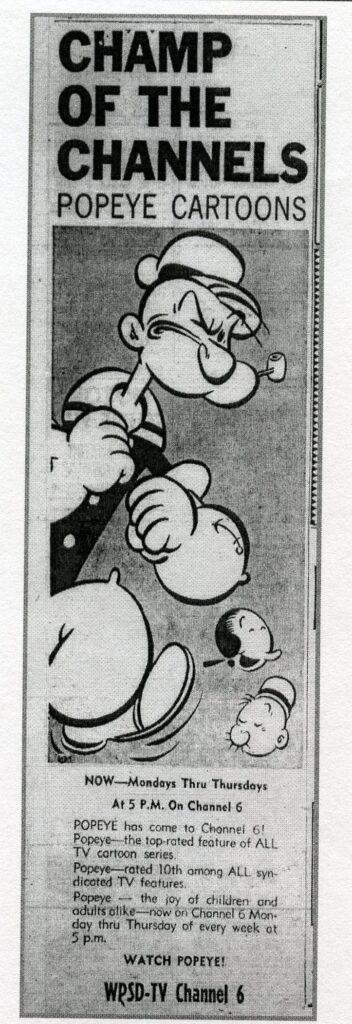
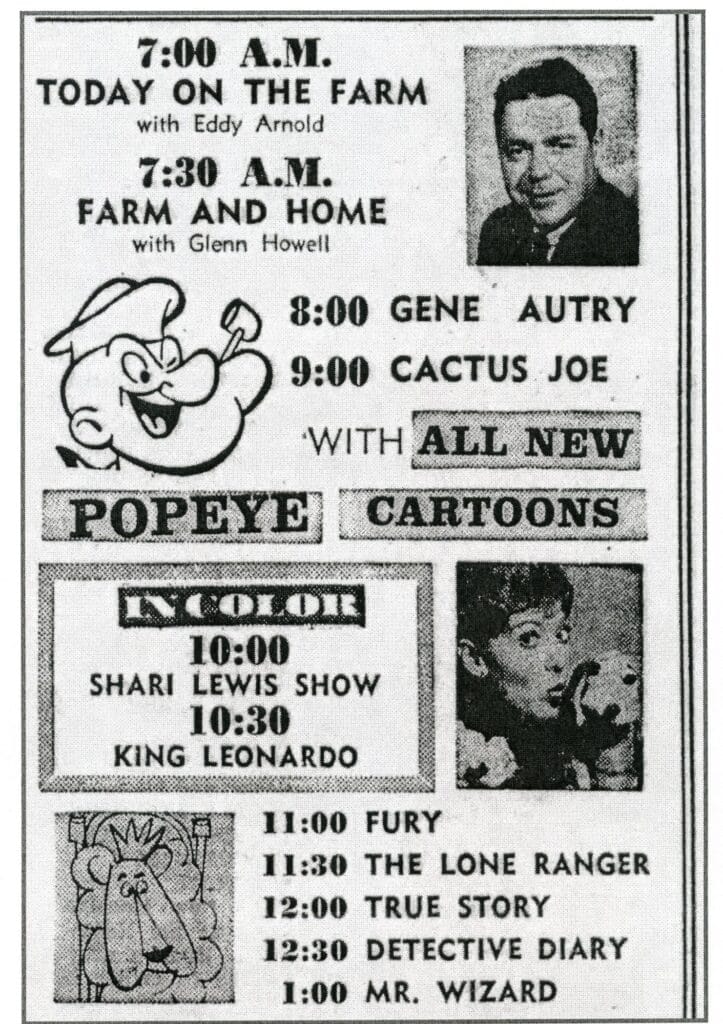
In September of 1956, these same cartoons debuted on the small screen and were a smashing success! All over the country, adults dressed as captains, cowboys and sailors hosted their own programs airing Popeye’s antics.
In 1959, King Features Syndicate, who owned the rights to the characters but not to the theatrical cartoons, wanted to cash in on this Popeye mania. After all no one at the time knew how long it would last. The decision was made to crank out new Popeye episodes, which they would syndicate. Al Brodax became executive producer of these color cartoons. His initial goal was to produce two hundred and ten episodes. When the series finished production the number of episodes totaled two hundred and twenty. The films were produced in 1960, 1961 and a few carry a 1962 copyright. Full page advertisements were placed in both Variety and Broadcasting Magazine promoting these new cartoons.
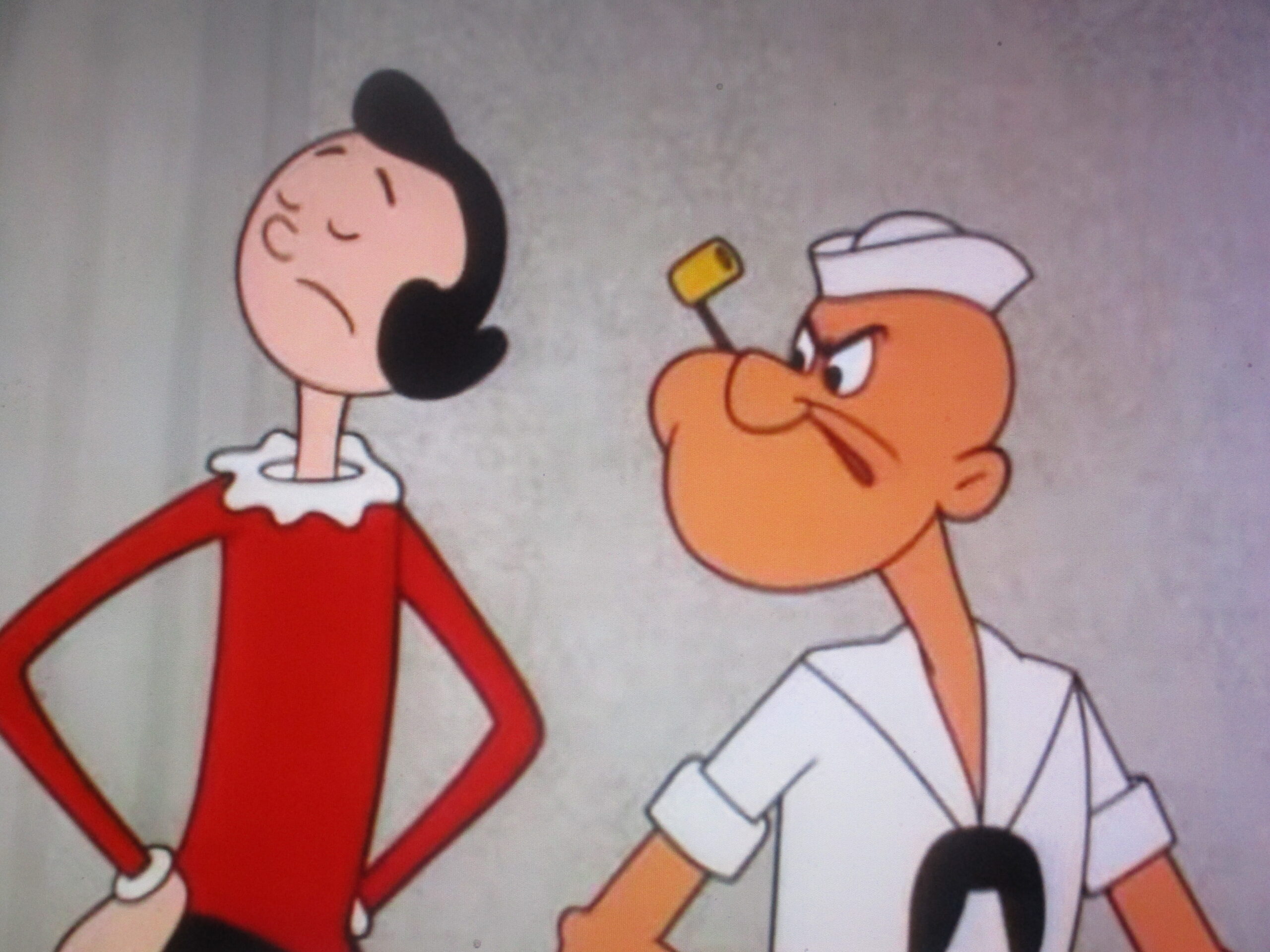
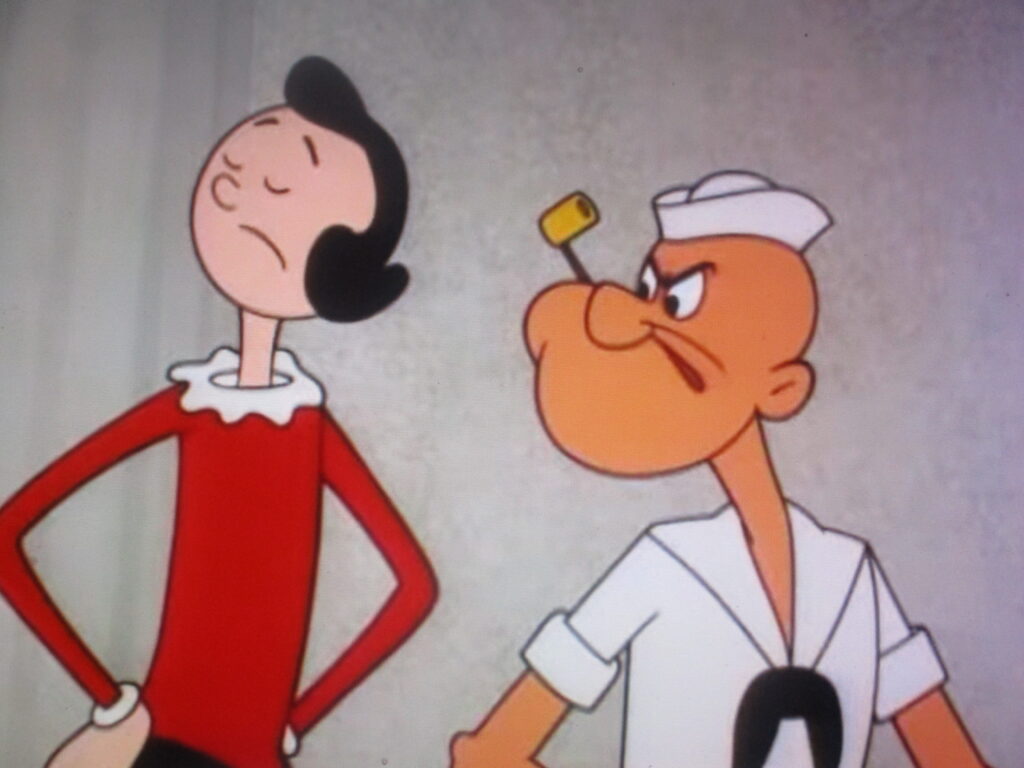
One of the pilot cartoons, Barbecue For Two, featured the characters as they appeared in the comic strip. However, it was decided to retain the modernized designs from the Famous Studios period. While Olive Oyl wore her comic strip attire, she kept the prettier facial design given to her in the late 1940’s throughout the 1950’s. Popeye kept his white sailor’s suit and, as in the color theatricals, often appeared with two opened eyes.
Unlike the theatrical films, several characters from the Thimble Theatre comic strip made their animation debut. These included: The Sea Hag and her vulture, Rough House, King Blozo, Toar, Geezil, Alice the Goon and The Wiffle (also referred to as Whiffle) Bird or Hen. Old favorites, Olive Oyl, J. Wellington Wimpy, Swee’pea, Poopdeck Pappy and Eugene the Jeep also appeared. In these new cartoons Popeye battled a fat bearded bully named Brutus. Despite being billed as a newcomer he resembled and sounded a lot like Popeye’s enemy in the theatrical cartoons, Bluto. King Features Syndicate was mistakenly informed by Paramount Pictures that Bluto was created for animation by Fleischer Studios. However, the brute first appeared in Segar’s strip in 1932. To avoid any legal problems Brodax simply renamed the character Brutus after Julius Caesar’s assassin. It should be noted: Jackson Beck, who provided Bluto’s voice in the color theatrical Popeye films, voiced Brutus. Jack Mercer and Mae Questel, both of whom provided voice work in the sailor’s earlier screen appearances, also returned for these new cartoons.
The November 1, 1961 issue of Variety noted;
500G INT’L GROSS ON POPEYE SERIES.
King Features Syndicate has begun Spanish dubbing of its made for TV Popeye series following the sale of the cartoons in Spain. With the Spanish sale, KFS has set the new Popeyes in a total of seven countries outside the U.S. over the past six months bringing their total international gross to $5oo,ooo.
The June 10th, 1964 issue of Variety featured a huge headline;
POPEYE’S $20,000,000 GROSS!
Popeye cartoons now occupy the Ft. Knox of video cartoon land. The gross of all Popeye cartoons to date is estimated at $20,000.000 with more dollars waiting in the wings as stations ride with renewals.
The total figure also included the theatrical Popeyes but the article noted King Features TV Popeyes had grossed some $6,000.000 in syndication.
Stations normally purchased the series for five years with an option for renewal. This was noted in the August 5th, 1964 edition of Variety;
90% RENEWAL PLEDGE ON KING’S POPEYE
A renewal rate of 90% on King Features Syndicate’s Popeye cartoons was reported by Al Brodax, KFS director of TV. Major stations inking for the made for TV Popeye skein include WBKW, Buffalo, N.Y., WISN-TV, Milwaukee and WSB-TV, Atlanta. Meanwhile small markets continue to sign on for first runs of the KFS Popeye. A total sale of 137 markets has been made in the past month.
With all of this financial success King Features Syndicate was more than pleased. However, as Popeye fans grew older faults in the quality of several episodes were hard to overlook.
Unfortunately, the quickness in production of these Popeye cartoons led to a lot of mistakes in the animation. The concept of producing animation for the small screen was still a relatively new field. Many animators, who were used to working on films for theaters, had difficulty adapting to less time and smaller budgets. The Popeye series was worked on by six different studios with wildly varying results.
Larry Harmon Productions-Harmon is best known for bringing Bozo the Clown to the small screen in both live action and animated form. The character designs of the cast, from his animation studio, were rather simplistic and stories featured primarily Popeye, Olive Oyl and Brutus. They were fast moving, and some of the plots were imaginative, but the animation was lazy in its execution. It did improve as production moved along. Harmon’s personnel also worked on Mr. Magoo and Dick Tracy cartoons for UPA.
William Snyder/Gene Deitch
These cartoons, produced outside of the United States, also featured simplistic character designs which, sometimes, got in the way of the witty stories. However, many were highlighted by lighthearted and eerie musical scores. Al Brodax said the cartoons produced overseas were less costly than episodes done in the U.S. He also noted the animation was better.
John Halas & Joy Batchelor
This animation team were credited on the cartoons from the Snyder/Deitch output. Their episodes have fluid movement and entertaining stories.
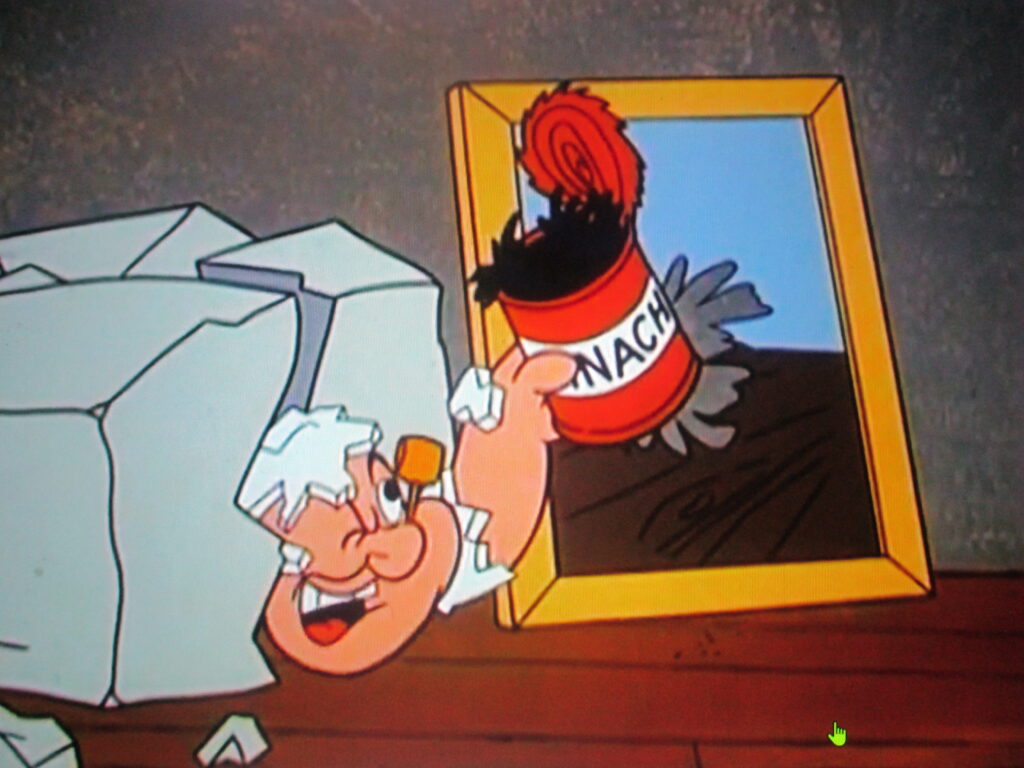
Gerald Ray
He, and his studio, are best known for producing the adventures of King Leonardo and his Short Subjects, and sadly produced only ten Popeyes. Ray’s cartoons captured the quirkiness of the characters and moved along at a fast pace. Each episode ended with lyrics relating to the story, sung to Popeye’s theme music. For example, Wimpy would sing; “It’s bad to be tardy to a hamburger party says Wimpy the Burger Man!” Wimpy’s song would be followed by two of his shirt buttons popping off similar to Popeye’s double tooting his pipe.
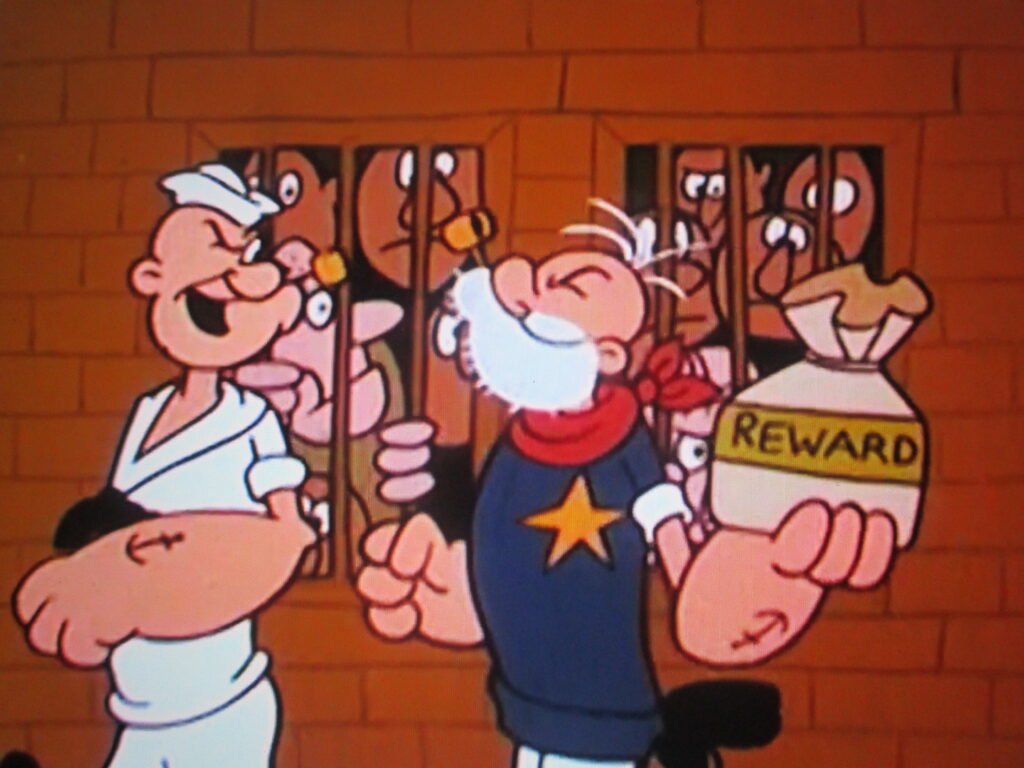
Paramount Cartoon Studios
This studio was previously known as Famous Studios. Much of the same personnel which worked on Popeye’s theatrical cartoons had a hand in these. That’s not to say they were all free of animation errors. However, the mistakes were minor and didn’t distract the viewer. For the most part the animation was well above the TV fare being produced during this same period. Paramount’s cartoons utilized composer Winston Sharples’ musical scores, heard in Popeye’s color theatrical films. These episodes were more all-out adventure stories. Many were written by Seymour Kneitel who used E.C. Segar’s Thimble Theatre stories as source material. Jack Mercer, the voice of both Popeye and Wimpy, contributed to the scripts.
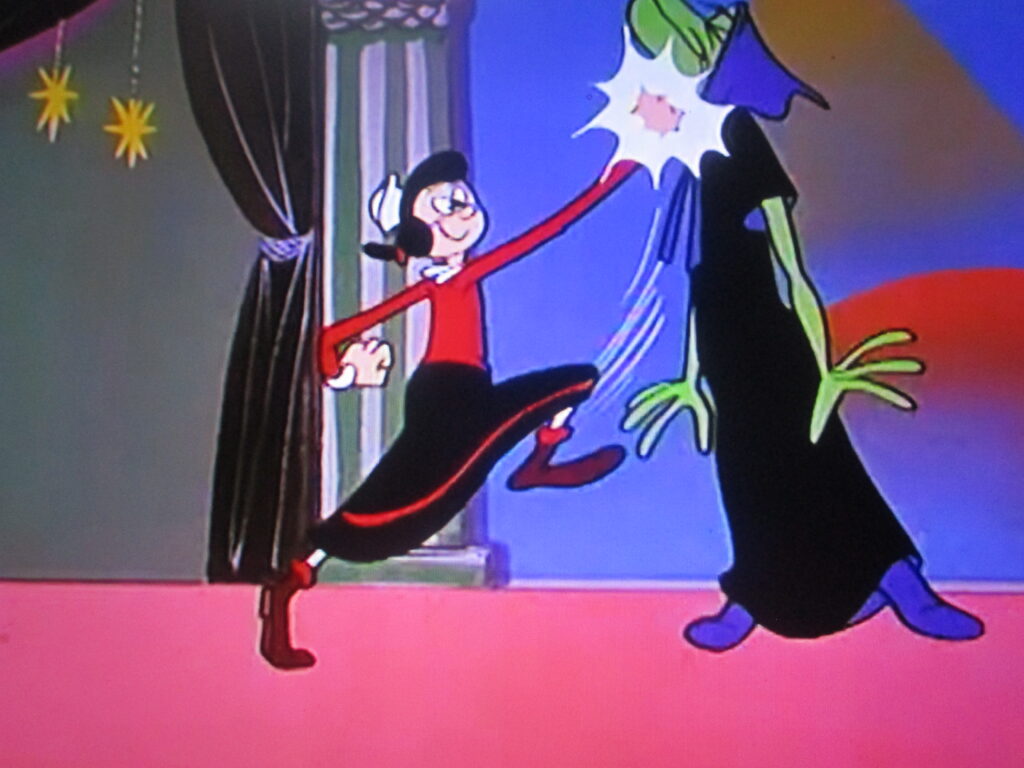
Jack Kinney
Kinney’s studio produced the most of the TV Popeyes. The stories were often witty, with puns over the heads of the kiddies. The quality of animation in a Kinney episode depended upon who was credited as the animation director. As previously noted, some had more experience with limited animation than others. As Hal Erickson stated in his book, Television Cartoon Shows, An Illustrated Encyclopedia 1949 through 1993: “The most appalling aspect of the Kinney Popeyes was the series’ sloppiness. Even allowing [for] the fact that Kinney was denied the luxuries of time, budget and large staff, many of his Popeyes were so clumsily made as to be unwatchable. Alas, the very abundance of the Kinney Popeyes reflected badly on the rest of the series. Viewers tended to forget the good moments and recall only the bad.”The aforementioned Popeye and the Giant came from his studio. As a teen I learned to read who was the animation director on Kinney’s Popeyes. This would ultimately decide if it was one worth watching or if I would cringe all the way through it.
Thanks to these Popeye cartoons King Features Syndicate developed a touring physical fitness act. A ‘live’ Popeye and Brutus entertained audiences which emphasized the importance of staying healthy. The November 22, 1961 issue of Variety noted several cartoons, from Jack Kinney’s studio, featured themes dealing with “public service”. For example, the episode, Uncivil War, has Olive Oyl, Wimpy and Brutus demonstrating unsafe driving techniques. Another was Popeye in the Woods, where Wimpy starts a fire while the pair are camping. Prints of the Civil War were sent to public school systems. This edition featured fine animation from Jack Kinney’s studio but had Popeye singing a safety song, at the end, animated by Paramount Cartoon Studios.
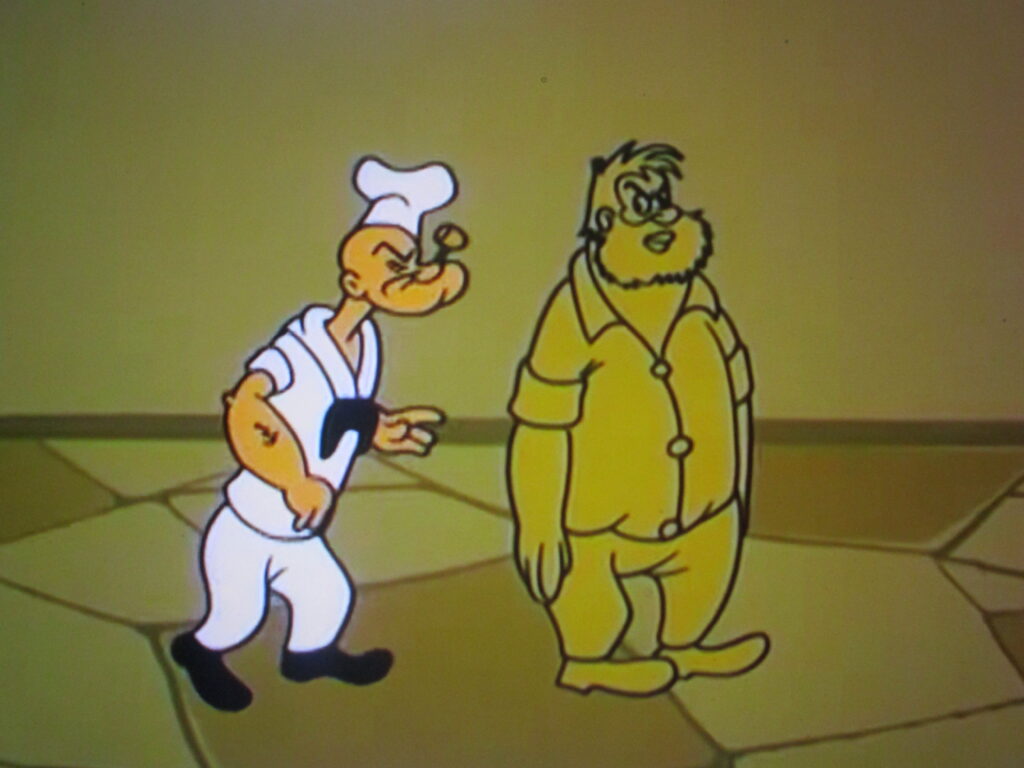
These cartoons played on independent television stations well into the 1990’s. Today they all can be watched on King Features Popeye and Friends Official Page on YouTube. They do get a lot of views. For example, as of May 29th, 2026, William Snyder/Gene Deitch’s See No Evil, has 52K views despite having extremely simplified animation. I recall first watching this cartoon on Rex Trailer’s Boomtown on WBZ, channel four, from Boston, Massachusetts.
There is a book I wrote on this series published by BearManor Media. It’s called Popeye the Sailor, The 1960’s Television Cartoons. The episode guide will reveal to the reader which cartoons to avoid and contains a best of section. The best of section spotlights cartoons based on E.C. Segar’s comic strip and other fun trivia. It can be ordered by going to:
While many continue to hate this series of cartoons others enjoy them. For many these were there first introduction to the one-eyed sailor’s animated adventures. The cartoons helped keep Popeye in the public eye, increased the production of merchandise, and provided children a lot of pleasure.