
Saturday Night 1975 — Three Networks, One Living Room

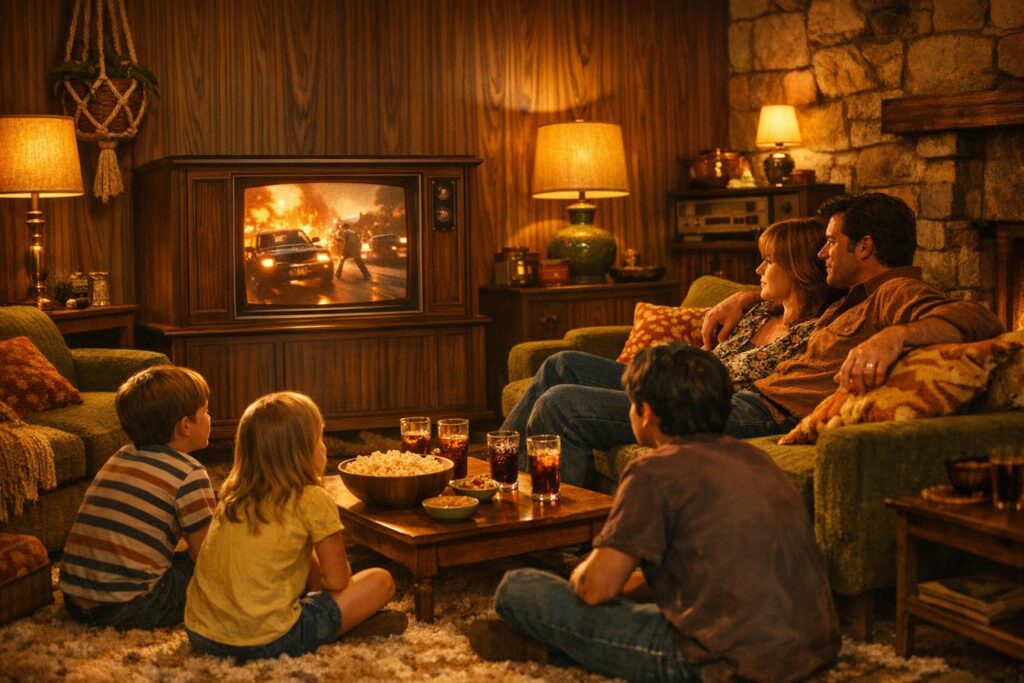
What did a typical Saturday night in America look like in 1975? Picture a glowing television set in the corner, a bowl of popcorn on the coffee table, children on the floor, parents on the sofa, and three big networks battling for attention with a line-up built to keep the whole household in the room.
It was a different rhythm of entertainment. There were no endless menus, no scrolling guides, no second screens stealing the moment. ABC, CBS, and NBC were programming for families, not niches, and on a fall Saturday evening in 1975, the choices said a great deal about the country: action heroes, sharp sitcoms, dependable dramas, and the kind of variety-show sparkle that could still stop a room.
For classic hits fans, it is a familiar kind of memory. Just as a great radio station can bring everyone together with songs that cross generations, Saturday night television in 1975 aimed for the same shared experience. The result was a line-up that felt like a weekly national ritual.
Three networks, one big contest
By the mid-1970s, American television was still shaped by the dominance of ABC, CBS, and NBC. Each network wanted the broadest possible audience on Saturday night, when families were home and advertisers knew they had a captive crowd. The strategy was simple: offer something exciting at 8, something reliable at 9, and a big finish before the late local news.
At 7:00 PM, many viewers were still seeing local programming, news, sports, reruns, or syndicated favourites depending on the station. But by 8:00, the national prime-time battle was fully under way.
ABC goes for speed and swagger
ABC had one of the hottest titles on television at 8:00 PM with The Six Million Dollar Man. Lee Majors, playing Steve Austin, brought a cool, controlled heroism to the role, and the series had a concept that sounded futuristic and irresistible in 1975: a man rebuilt with bionic technology, stronger and faster than ordinary people.
It was exactly the kind of programme that made children stare wide-eyed at the screen while adults enjoyed the polished action and gadget-driven plots. The famous slow-motion running scenes became part of popular culture almost instantly. On the playground, plenty of children were trying to imitate that sound effect with their own voices by Monday morning.
At 9:00 PM, ABC kept the pulse high with Starsky & Hutch, a police drama with style, speed, and a strong buddy chemistry. Paul Michael Glaser and David Soul gave the show personality beyond the car chases, and the now-iconic red Ford Gran Torino became a star in its own right. By 10:00 PM, ABC rolled into Matt Helm, another detective series, keeping the evening aimed squarely at viewers who wanted action with a little glamour.
CBS builds a night of familiar faces
CBS, meanwhile, played a slightly different hand. At 8:00 PM, audiences could settle in with The Jeffersons, one of the sharpest and most culturally significant sitcoms of the decade. Sherman Hemsley’s George Jefferson was loud, proud, funny, and impossible to ignore. The show was smart enough to tackle social change while still delivering the fast laughs that made it a Saturday night staple.
That was followed by Doc, giving the network a warm and character-driven bridge into the later evening. Then came a one-two punch at 9:00 PM: The Mary Tyler Moore Show and The Bob Newhart Show. Few hours in television have ever felt so effortlessly classy. Mary Tyler Moore brought wit, independence, and workplace comedy into the mainstream, while Bob Newhart mastered the art of the dry pause and the beautifully timed understatement.
At 10:00 PM, CBS turned to The Carol Burnett Show, and this is where Saturday night could become a real event. Carol Burnett, Harvey Korman, Tim Conway, Vicki Lawrence, and the rest of the cast created the kind of sketch comedy that families quoted to each other for days. There was polish, yes, but also a sense that anything might happen. When Conway pushed Korman into barely controlled laughter, viewers at home felt like they were in on the joke.
That was part of the magic of 1975 television: even the slickest shows still left room for spontaneity, and audiences loved them for it.
NBC leans on drama and the big movie
NBC’s Saturday strategy often included Emergency! or special programming at 8:00 PM, followed by The NBC Saturday Night Movie at 9:00 and 10:00 PM. That movie slot had real weight in the era before home video became common. If a network advertised a notable film, it could feel like a major attraction. Families did not just watch a movie; they planned around it.
The network movie also gave NBC a different identity on the night. While ABC and CBS were offering tightly packaged episodic entertainment, NBC could present something larger and more cinematic. It was a reminder that television and film still had a strong crossover relationship, especially for viewers who might not have gone out to a cinema every weekend.
The living room as a social space
One of the most charming things about Saturday night in 1975 is how collective it all was. Families often watched together, negotiating choices in real time. Teenagers might push for the action of Starsky & Hutch, parents might prefer the comfort and intelligence of CBS comedy, and someone in the room almost certainly wanted to stay up for Carol Burnett.
There was also a next-day effect that is easy to forget now. These shows fed conversations at church, at school, in diners, at work, and over backyard fences. A joke from The Carol Burnett Show, a dramatic moment from The Six Million Dollar Man, or a line from George Jefferson could become part of the weekend’s shared language.
That is one reason this era still matters to classic hits radio. The 1970s were full of big communal experiences. Hit songs, blockbuster films, and top television shows all moved through the culture together. If you loved the records of Elton John, Fleetwood Mac, or the Eagles, chances are you were also sitting in that same living room, hearing the opening theme to one of these programmes as the weekend rolled on.
Then came a late-night jolt
In October 1975, Saturday night television changed in a way nobody could fully predict. NBC launched NBC’s Saturday Night, the programme that would soon become known everywhere as Saturday Night Live. The first host was George Carlin, already a bold and distinctive comic voice, and the original cast included John Belushi, Chevy Chase, Gilda Radner, Dan Aykroyd, Jane Curtin, Garrett Morris, and Laraine Newman.
This was not simply another network show. It felt younger, looser, stranger, and more daring than what had come before. Late-night television suddenly had a pulse that matched the restless energy of the decade. The sketches were uneven at times, the atmosphere could be gloriously chaotic, and that was exactly the point. It did not feel manufactured. It felt alive.
Why the premiere mattered
The arrival of Saturday Night Live signalled a shift in American comedy and television culture. Variety television had long been polished and carefully controlled, but this new show brought an edge that reflected changing tastes. It spoke more directly to younger adults who wanted satire, music, absurdity, and a little danger in the mix.
And yet it still belonged to the same Saturday-night tradition. People stayed up for it because they sensed something was happening. That is the thread connecting the older network line-up to the new arrival: television as an occasion.
- It broke the late-night mould with live sketch comedy that felt immediate.
- It introduced major comic talent who would shape film and television for years.
- It gave Saturday nights a second act after the family-friendly prime-time hours were over.
Why 1975 still glows in memory
Looking back, the appeal of a Saturday evening in 1975 is not only the programmes themselves. It is the feeling around them. Television was more limited, but in that limitation there was a kind of unity. Millions of people were watching the same shows at the same time, laughing at the same sketches, and humming the same theme tunes.
That is a feeling classic hits radio understands very well. A great old song does more than sound good; it opens a door to a room you remember. Saturday night television in 1975 does the same thing. It brings back the glow of the set, the family debate over what to watch, the comfort of familiar stars, and the thrill of seeing something new arrive in real time.
Three networks. A handful of hours. An entire country tuning in. For one Saturday night in fall 1975, that was more than enough.