The Rise and Fall of ALF: How Television’s Favorite Alien Captured the World
He crashed into our TV screens in 1986... and quickly became one of the biggest stars of the decade. 👽📺 From toys and lunchboxes to sold-out merchandise and millions of fans around the world, ALF was everywhere. But behind the laughs were long filming days, behind-the-scenes struggles, and one of television's most shocking cliffhanger endings. What really happened to TV's favorite alien? Take a trip back to Melmac and discover **The Rise and Fall of ALF**.
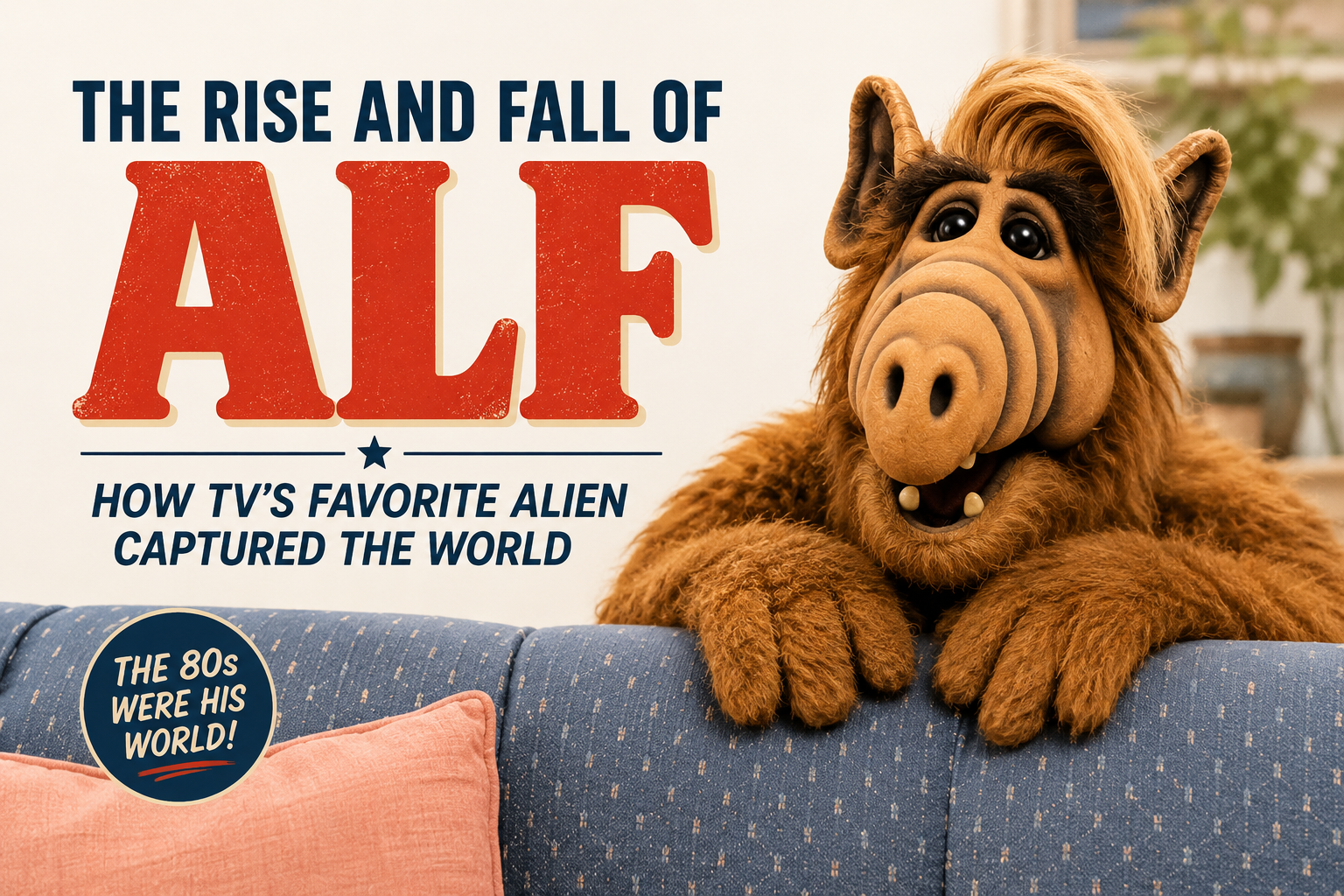
There weren’t many television stars in the 1980s who could steal every scene without ever showing their legs.
But ALF wasn’t an ordinary television star.
The wisecracking alien from the planet Melmac became one of the biggest pop culture icons of the decade, appearing on lunchboxes, toys, comic books, video games, and television screens in more than 80 countries.
For four seasons, millions of viewers tuned in each week to watch the lovable extraterrestrial turn the Tanner family’s quiet suburban life upside down.
Yet despite its enormous popularity, ALF disappeared almost as quickly as it arrived.
Here’s the story behind the rise—and fall—of one of television’s most unforgettable characters.
An Alien Crash-Lands Into Television
When ALF premiered on NBC on September 22, 1986, audiences had never seen anything quite like it.
The series followed Gordon Shumway—better known simply as ALF (Alien Life Form)—after his spaceship crash-landed into the garage of the Tanner family. To keep him hidden from the government, the Tanners secretly welcomed him into their California home, where his endless curiosity about human life led to one hilarious disaster after another.
Whether he was eating everything in the refrigerator, accidentally destroying household appliances, or constantly plotting to eat the family cat, ALF quickly became one of television’s most memorable sitcom characters.
The show’s unique blend of family comedy and science fiction made it unlike anything else on television.
Meet the Tanner Family
Part of the show’s success came from its wonderful cast.
Max Wright starred as Willie Tanner, the patient and level-headed social worker who constantly found himself cleaning up ALF’s latest mess.
Anne Schedeen played Kate Tanner, Willie’s practical wife, who was often the first to question whether hiding an alien was really such a good idea.
Their children were played by Andrea Elson as teenager Lynn Tanner and Benji Gregory as young Brian Tanner. Brian quickly became ALF’s closest human friend, and their scenes together became favorites among younger viewers.
The household was completed by Lucky, the family cat—who spent much of the series trying to avoid becoming ALF’s next meal. ALF’s running joke about eating cats became one of the show’s most recognizable gags, though he never actually carried it out.
The Puppet That Felt Alive
One of the biggest reasons for the show’s success was ALF himself.
Created by puppeteer Paul Fusco, ALF was remarkably expressive for a television puppet. Fusco not only operated the puppet but also supplied ALF’s instantly recognizable voice, giving him a personality that was sarcastic, mischievous, curious, and surprisingly lovable.
Unlike many puppet characters of the era, ALF didn’t simply deliver punchlines—he felt like a genuine member of the Tanner family.
That emotional connection helped audiences forget they were watching a puppet.
A Worldwide Pop Culture Phenomenon
By the late 1980s, ALF was everywhere.
Children collected ALF plush toys and action figures.
There were lunchboxes, trading cards, comic books, board games, puzzles, clothing, calendars, and several video games. An animated Saturday morning series, ALF: The Animated Series, even explored life on Melmac before the planet’s destruction.
The character also made appearances on talk shows, television specials, and commercials, becoming one of NBC’s biggest merchandising successes of the decade.
At its peak, ALF was broadcast around the world, introducing the sarcastic alien to millions of viewers far beyond the United States.
Few sitcom characters of the 1980s generated that level of popularity.
Life Behind the Cameras Wasn’t So Funny
While viewers saw a cheerful family sitcom, filming ALF was notoriously difficult.
Because the puppet was operated from beneath the set, nearly every room in the Tanner house was built with removable floors and trap doors. Puppeteers spent hours underneath the stage bringing ALF to life, making even simple conversations incredibly time-consuming to film.
A scene that looked effortless on television often required numerous takes and careful coordination between the actors, puppeteers, camera operators, and crew.
Several cast members later admitted that production could be exhausting.
Max Wright, who played Willie Tanner, reportedly found the long filming days particularly challenging. Although stories of tension behind the scenes have circulated for years, many cast and crew members later acknowledged the extraordinary effort required to make ALF appear so lifelike.
Paul Fusco has often said that creating ALF was one of television’s most technically demanding productions of its era.
Why Was ALF Canceled?
By 1990, ALF was still a recognizable hit, but its ratings had begun to decline as audiences gravitated toward newer sitcoms.
NBC decided not to renew the series for a fifth season.
What shocked fans was the way the show ended.
The writers had no idea the series was about to be canceled. Believing another season was likely, they ended the fourth-season finale with one of television’s biggest cliffhangers.
After finally making contact with survivors from Melmac, ALF prepared to leave Earth aboard a rescue spacecraft. Just as he reached the rendezvous point, military helicopters surrounded him, and he was captured by the U.S. government’s Alien Task Force.
Then the screen faded to black.
Viewers expected to learn what happened next the following season.
Instead, the cancellation meant the story simply stopped.
For years, fans wondered whether ALF had escaped—or if that final image would be the character’s last.
The Movie That Tried to Finish the Story
Six years later, NBC attempted to provide some closure with the 1996 television movie Project ALF.
The film revealed that ALF had survived military captivity and was still trying to find freedom.
However, there was one major problem.
None of the Tanner family appeared in the movie. Their absence left many longtime fans feeling that the heart of the original series was missing, and the film never achieved the popularity of the sitcom.
Even so, it finally answered the question that had lingered since 1990.
Why ALF Slowly Disappeared
Despite being one of the biggest television stars of the late 1980s, ALF gradually faded from mainstream television.
Several factors contributed to the decline:
- Television audiences shifted toward newer family sitcoms in the 1990s.
- The complicated puppetry made producing the show expensive and time-consuming.
- Merchandise sales slowed after the series ended.
- Few networks continued airing the show as heavily as other classic sitcoms.
Still, ALF never completely disappeared.
A New Generation Discovers Melmac’s Funniest Alien
In recent years, ALF has enjoyed a nostalgic revival.
Classic television channels continue airing reruns, while streaming platforms and social media have introduced the series to younger audiences who never saw it during its original run.
Collectors actively search for vintage ALF toys, lunchboxes, and memorabilia, many of which have become valuable collectibles.
There have also been occasional rumors of a reboot, although no new television series has officially moved forward.
The affection for the character, however, has never really faded.
Where Are They Now?
Many of the people behind ALF went on to very different paths after the show ended.
- Paul Fusco has continued to voice ALF and remains closely involved with the character’s legacy through guest appearances and licensing projects.
- Anne Schedeen stepped away from acting and has largely remained out of the public spotlight.
- Andrea Elson retired from acting during the 1990s to focus on family life.
- Benji Gregory left Hollywood, later served in the U.S. Navy, and sadly passed away in 2024.
- Max Wright continued acting on stage and television before passing away in 2019. Despite the challenges of producing the series, he will always be remembered by fans as the endlessly patient Willie Tanner.
Why We Still Love ALF
At its heart, ALF wasn’t really about an alien.
It was about family.
Despite his terrible manners, endless appetite, sarcastic jokes, and constant ability to create chaos, ALF slowly became part of the Tanner household.
The show reminded viewers that family isn’t always about where you come from—it’s about who accepts you.
That timeless message is one reason the series continues to resonate nearly four decades later.
Final Thoughts
Few television characters capture the spirit of the 1980s quite like ALF.
He was funny, unpredictable, lovable, and unlike anyone else on television. While his time in the spotlight lasted only four seasons, his impact on pop culture was enormous.
For those who grew up in the 1980s, ALF wasn’t just another sitcom character—he was part of the family.
And perhaps that’s why, all these years later, we still smile whenever we hear the words:
“No problem!”
Did you watch ALF during its original run? Do you remember being shocked by the cliffhanger ending? Share your favorite ALF memories in the comments below!