The Greatest Movie Soundtracks of the 1980s
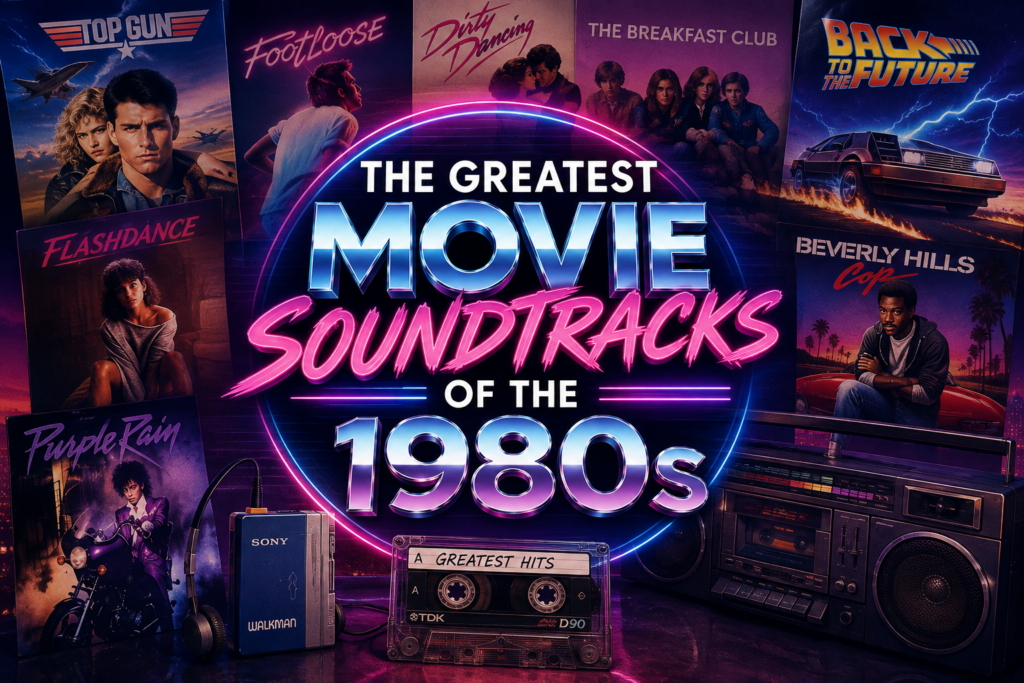
There was something special about movie music in the 1980s.
A great song didn’t simply play behind a scene. It became part of the movie. Sometimes it became even bigger than the movie itself.
Turn on “Footloose,” “Take My Breath Away,” or “(I’ve Had) The Time of My Life” today, and chances are you don’t just hear a song. You see the movie. You remember the scene. And if you were there at the time, you might even remember where you were when you first heard it.
The 1980s were arguably the golden age of the blockbuster soundtrack, when Hollywood and pop radio became perfect partners. Movies created hit singles, hit singles sold movie tickets, and soundtrack albums became records we actually wanted to own.
Here are some of the movie soundtracks that defined the decade.
Flashdance (1983)
Few movies demonstrate the power of an ’80s soundtrack better than Flashdance.
Irene Cara’s “Flashdance… What a Feeling” became one of the defining songs of 1983, while Michael Sembello’s “Maniac” provided another enormous hit.
The music, the dancing, the leg warmers and that unmistakable early-’80s visual style all blended together perfectly.
The soundtrack wasn’t simply successful—it helped establish the formula that Hollywood would repeatedly use throughout the decade: combine a stylish movie with contemporary pop songs and send both to the top of the charts.
Footloose (1984)
If Flashdance helped establish the formula, Footloose perfected it.
Kenny Loggins’ title track is practically impossible to separate from the movie, while Deniece Williams’ “Let’s Hear It for the Boy” became another huge hit.
But the soundtrack went much deeper.
Bonnie Tyler gave us “Holding Out for a Hero,” Shalamar contributed “Dancing in the Sheets,” and Mike Reno and Ann Wilson teamed up for “Almost Paradise.”
It feels almost like a greatest-hits collection from 1984.
Purple Rain (1984)
Calling Purple Rain a soundtrack almost seems inadequate.
Prince created an album that could stand entirely on its own, producing classics including “When Doves Cry,” “Let’s Go Crazy,” “I Would Die 4 U” and, of course, “Purple Rain.”
The movie and album became part of the same cultural moment, turning Prince into one of the biggest stars on the planet.
Few soundtrack albums from any decade have had such a lasting musical legacy.
Beverly Hills Cop (1984)
Sometimes a movie soundtrack becomes famous without even needing lyrics.
Harold Faltermeyer’s electronic instrumental “Axel F” became instantly recognizable thanks to Beverly Hills Cop. Those opening synthesizer notes alone can transport you straight back to 1984.
The soundtrack also included Glenn Frey’s “The Heat Is On” and Patti LaBelle’s “New Attitude.”
It was cool, energetic and unmistakably ’80s—just like the movie.
The Breakfast Club (1985)
One song was enough to make this soundtrack immortal.
Simple Minds’ “Don’t You (Forget About Me)” became forever connected with The Breakfast Club, particularly its unforgettable closing moments.
It’s difficult to hear the song today without picturing Judd Nelson walking across the football field and raising his fist into the air.
There may be no better example of a song and movie scene becoming permanently linked in popular culture.
Back to the Future (1985)
Back to the Future had something for two generations.
Huey Lewis and the News supplied the contemporary ’80s sound with “The Power of Love” and “Back in Time,” while Marty McFly’s trip to 1955 brought rock and roll’s early years into the story.
And then there was Alan Silvestri’s magnificent orchestral score.
Together, they created a soundtrack that felt both nostalgic and completely modern in 1985—which was exactly what Back to the Future needed.
Top Gun (1986)
Few soundtracks scream “1980s” quite like Top Gun.
Kenny Loggins’ “Danger Zone” gave the movie its adrenaline, while Berlin’s “Take My Breath Away” provided its romantic centerpiece.
The soundtrack also featured Cheap Trick, Loverboy and Miami Sound Machine.
Put it on today and suddenly there are fighter jets, aviator sunglasses, motorcycles and sunsets everywhere.
That’s the power of a great movie soundtrack.
Ferris Bueller’s Day Off (1986)
Interestingly, Ferris Bueller’s Day Off didn’t receive a conventional soundtrack album when the movie originally appeared.
But its music became an enormous part of its identity.
Yello’s “Oh Yeah” became synonymous with the film, while Ferris’ unforgettable parade performance brought “Danke Schoen” and the Beatles’ “Twist and Shout” to a new generation.
It’s a perfect reminder that a great movie soundtrack doesn’t necessarily need an official album.
Sometimes it’s simply about choosing exactly the right song for exactly the right moment.
Dirty Dancing (1987)
By 1987, the soundtrack phenomenon had reached another level.
Dirty Dancing mixed contemporary songs with classics from the early 1960s, perfectly complementing the movie’s 1963 setting.
“(I’ve Had) The Time of My Life” by Bill Medley and Jennifer Warnes became the movie’s signature song, while Eric Carmen’s “Hungry Eyes” and Patrick Swayze’s “She’s Like the Wind” became major hits.
Older recordings including “Be My Baby” and “Do You Love Me” found new audiences as well.
The result was one of the most successful soundtrack albums of the decade.
The Lost Boys (1987)
For anyone who likes the darker side of the ’80s, The Lost Boys has one of the decade’s most atmospheric soundtracks.
INXS and Jimmy Barnes delivered “Good Times,” while Echo & the Bunnymen recorded a memorable version of “People Are Strange.”
But the song most closely associated with the movie may be Gerard McMann’s haunting “Cry Little Sister.”
It perfectly captures the film’s mixture of vampires, teenage rebellion and late-night California cool.
Good Morning, Vietnam (1987)
This soundtrack took a different approach.
Because the movie was set during the 1960s, its soundtrack became a wonderful collection of music from that era, featuring artists including Martha and the Vandellas, The Beach Boys, James Brown and Louis Armstrong.
Louis Armstrong’s “What a Wonderful World” became particularly memorable because of the powerful way it was used in the film.
For audiences in the late 1980s, the soundtrack also helped introduce—or reintroduce—a younger generation to the music of the ’60s.
Cocktail (1988)
Few soundtracks capture the carefree, sunny side of the late ’80s better than Cocktail.
The Beach Boys scored a huge comeback hit with “Kokomo,” while Bobby McFerrin’s “Don’t Worry, Be Happy” became one of the most recognizable songs of the era.
Add tracks from John Mellencamp, Starship and Ry Cooder, and you have a soundtrack that practically sounds like summer vacation in 1988.
Batman (1989)
The decade ended with one of its most unusual soundtrack collaborations.
For Tim Burton’s Batman, Prince created an entire album inspired by the movie, including “Batdance,” “Partyman” and “Scandalous.”
Meanwhile, Danny Elfman provided the dramatic orchestral score that became one of the most recognizable superhero themes ever written.
The combination of Prince’s pop-funk and Elfman’s dark cinematic score shouldn’t necessarily have worked.
Somehow, it did.
And it could hardly have been more 1989.
When Movies and Radio Were Connected
What made the soundtracks of the 1980s so memorable wasn’t simply the number of hit songs they produced.
It was how completely movies, MTV and radio fed into one another.
You’d see the movie on Saturday night. Hear the song on FM radio Sunday afternoon. Watch the video on MTV during the week. Then maybe head to the record store and buy the cassette.
The movie kept the song alive, and the song kept reminding you of the movie.
That’s why these soundtracks remain so powerful decades later.
Sometimes all it takes is the opening synthesizer of “Axel F,” the first notes of “Take My Breath Away,” or that unmistakable beginning of “Don’t You (Forget About Me).”
And suddenly, it’s the 1980s again.