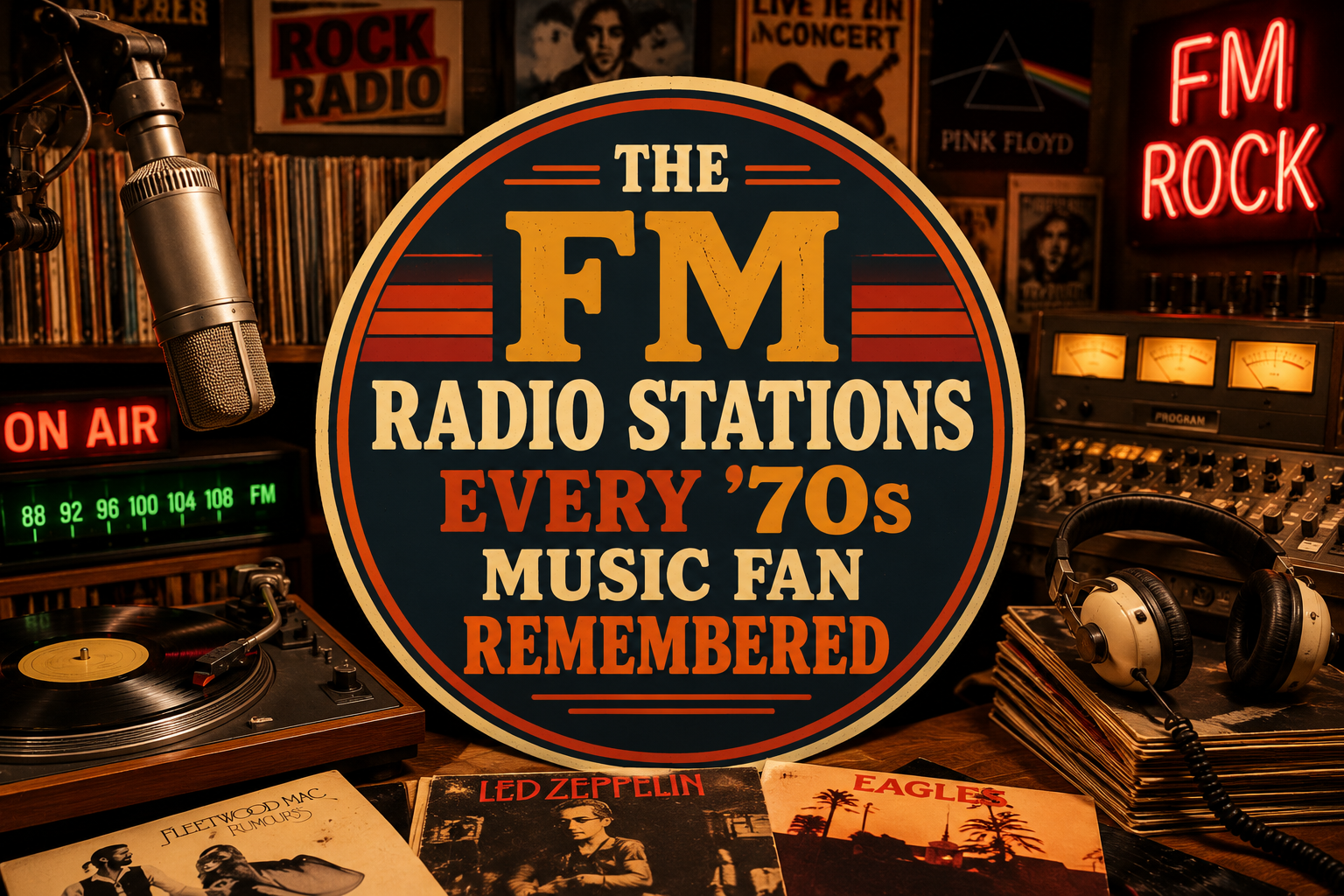
The FM Radio Stations Every ’70s Music Fan Remembered
Before playlists and streaming, FM radio was where music came alive. From WNEW-FM and KMET to WBCN and WMMS, revisit the legendary stations, DJs, and sounds that made 1970s radio unforgettable.
There was something different about FM radio in the 1970s.
You could turn the dial late at night and hear a DJ play a seven-minute album track that would never have made it onto Top 40 AM radio. There were fewer rigid playlists, fewer interruptions, and personalities behind the microphone who seemed to genuinely love the records they were playing.
The DJ might tell you about a new band, play an entire side of an album, broadcast a concert live, or follow a Led Zeppelin track with something completely unexpected.
For many listeners, the station itself became almost as important as the bands.
And while every city had its own favorites, a handful of FM rock stations became legendary far beyond their local markets.
Here are some of the stations that helped define what rock radio sounded like in the 1970s.
WNEW-FM 102.7 — New York City
If one station represents the golden age of progressive FM rock, it may be WNEW-FM.
Beginning its progressive-rock era in 1967, WNEW-FM became one of America’s most influential rock stations during the 1970s. Its famous slogan said it all:
“Where Rock Lives.”
But what really made WNEW special was its personalities.
Scott Muni, Alison Steele, Pete Fornatale, Dennis Elsas, Dave Herman and others weren’t simply voices announcing the next record. They were knowledgeable music fans who helped listeners discover artists and albums they might never have encountered otherwise.
WNEW also became closely associated with Bruce Springsteen, giving him significant airplay early in his career and broadcasting important Springsteen concerts during the 1970s.
For a generation of New York listeners, 102.7 wasn’t just another frequency.
It was where rock lived.
KMET 94.7 — Los Angeles
On the other side of the country, Los Angeles had its own FM powerhouse.
KMET became one of the stations that helped establish the possibilities of FM rock radio in the late 1960s and early 1970s.
The station developed a personality perfectly suited to Southern California: adventurous, slightly rebellious and deeply connected to the rock culture surrounding Los Angeles.
Imagine cruising through L.A. at night in 1975—the dashboard glowing, windows down, and KMET coming through the speakers.
That was FM radio at its best.
And listeners still remember the famous identification:
“A little bit of heaven… 94.7 KMET.”
KSAN 94.9 — San Francisco
If any city was made for free-form FM radio, it was San Francisco.
KSAN grew out of the counterculture surrounding the Bay Area music scene and became one of America’s great free-form rock stations.
The philosophy was wonderfully simple: let knowledgeable DJs play interesting music.
That could mean psychedelic rock, blues, folk, emerging punk, local bands or something listeners had never heard before.
By the later 1970s, KSAN was even giving airtime to emerging punk and new-wave artists. The station’s willingness to take chances reflected the musical personality of San Francisco itself.
You didn’t necessarily know what the DJ would play next.
That was the point.
WBCN 104.1 — Boston
Boston had WBCN.
Like several legendary FM stations of the era, WBCN embraced progressive rock and became deeply connected with the city’s youth and music culture.
Boston was a tremendous rock town, and WBCN developed the kind of loyal audience that didn’t simply listen to the station—they identified with it.
It was part music source, part cultural meeting place and part soundtrack to growing up in New England.
WBCN would remain an important rock station for decades, but its reputation was built during the era when progressive FM radio was rewriting the rules.
WMMS 100.7 — Cleveland
Then there was The Buzzard.
WMMS became one of the most powerful rock stations in America during the 1970s.
After settling permanently into rock programming in 1970, the station developed an unusually close relationship with Cleveland’s rock audience. Under program director John Gorman, WMMS became known for championing emerging artists and treating rock music as something worth taking seriously.
Its support helped introduce American audiences to artists including Bruce Springsteen and Rush.
In fact, Rush’s breakthrough in the United States is closely tied to Cleveland radio. WMMS music director Donna Halper began playing “Working Man” in 1974, helping create an early American audience for the Canadian band.
WMMS didn’t just play rock.
It helped Cleveland earn its reputation as a Rock and Roll Capital.
WMMR 93.3 — Philadelphia
Philadelphia’s WMMR became another major force in progressive FM radio.
By the end of 1969, the station had evolved into a full-time progressive-rock format, and by the 1970s it was becoming essential listening for Philadelphia rock fans.
One of its most influential personalities was Ed Sciaky.
Sciaky became known for supporting new artists—including Billy Joel, Yes and Bruce Springsteen—and is credited with helping introduce Springsteen to Philadelphia audiences.
That relationship between DJ, artist and audience is something difficult to reproduce today.
A DJ could hear something special in a new record, put it on the air and potentially change an artist’s career.
KSHE 95 — St. Louis
St. Louis rock fans had KSHE.
The station switched to progressive rock in 1967 and by the end of the decade had already developed a reputation as one of America’s important underground FM stations.
KSHE built the kind of intensely loyal audience that every great rock station wanted.
And unlike many of the legendary FM stations of the period that eventually disappeared or changed formats, the KSHE name has endured.
For generations of St. Louis listeners, the station became inseparable from the city’s rock culture.
And There Were So Many More
The beauty of 1970s FM radio was that the story wasn’t limited to New York, Los Angeles or San Francisco.
Chicago had WXRT.
Cincinnati had WEBN.
Minneapolis had KQRS.
Phoenix had KDKB.
Dallas had KZEW.
Washington had WHFS.
Sacramento had KZAP.
Across America, local FM stations were developing their own personalities, DJs and musical identities. Many became important progressive-rock and album-oriented stations in their respective cities.
And listeners were fiercely loyal to them.
When the DJ Chose the Music
Perhaps this is what people miss most.
FM radio in the early 1970s could feel unpredictable.
You might hear the new Eagles single followed by an obscure album cut. A DJ might introduce you to a band you’d never heard before. At night, the music could become stranger, longer and more adventurous.
Sometimes an entire album side might find its way onto the air.
The person behind the microphone wasn’t merely announcing songs.
The DJ was your guide.
And when you discovered a great record through that person, you remembered it.
The Magic of Late-Night FM
There was also something almost magical about listening after dark.
The house was quiet.
Maybe you were lying in bed with a small stereo beside you, or driving down an empty highway with the dashboard lights glowing.
Then the opening notes of Pink Floyd, Fleetwood Mac, Supertramp, Led Zeppelin or Steely Dan came through the speakers.
There was no screen.
No playlist displayed in front of you.
Sometimes you didn’t even know what song was playing until the DJ returned several minutes later and told you.
You simply listened.
When Radio Belonged to Your City
Today’s streaming services can give us almost every song ever recorded within seconds.
What they can’t easily recreate is the feeling that thousands of people around your city were listening to the same thing at the same moment.
Your station had its own jingles.
Its own personalities.
Its own concerts.
Its own inside jokes.
Its own favorite bands.
And sometimes its own records that became enormous locally before the rest of America caught on.
That’s why people still remember those old call letters decades later.
WNEW.
KMET.
KSAN.
WBCN.
WMMS.
WMMR.
KSHE.
They weren’t simply radio stations.
For millions of music fans, they were part of growing up.
What Was Your Station?
Every city had one.
Maybe yours isn’t on this list.
What FM station did you listen to during the 1970s—and who was the DJ you still remember?
Tell us in the comments. We’d love to hear which station provided the soundtrack to your ’70s.