Land of the Lost: The Saturday Morning Adventure That Was Stranger Than We Remember
Step back into Saturday mornings of the 1970s with Land of the Lost, the unforgettable adventure filled with dinosaurs, Sleestaks, mysterious pylons and surprisingly ambitious science fiction. Discover why this strange and imaginative series remains a beloved piece of Saturday morning television history.
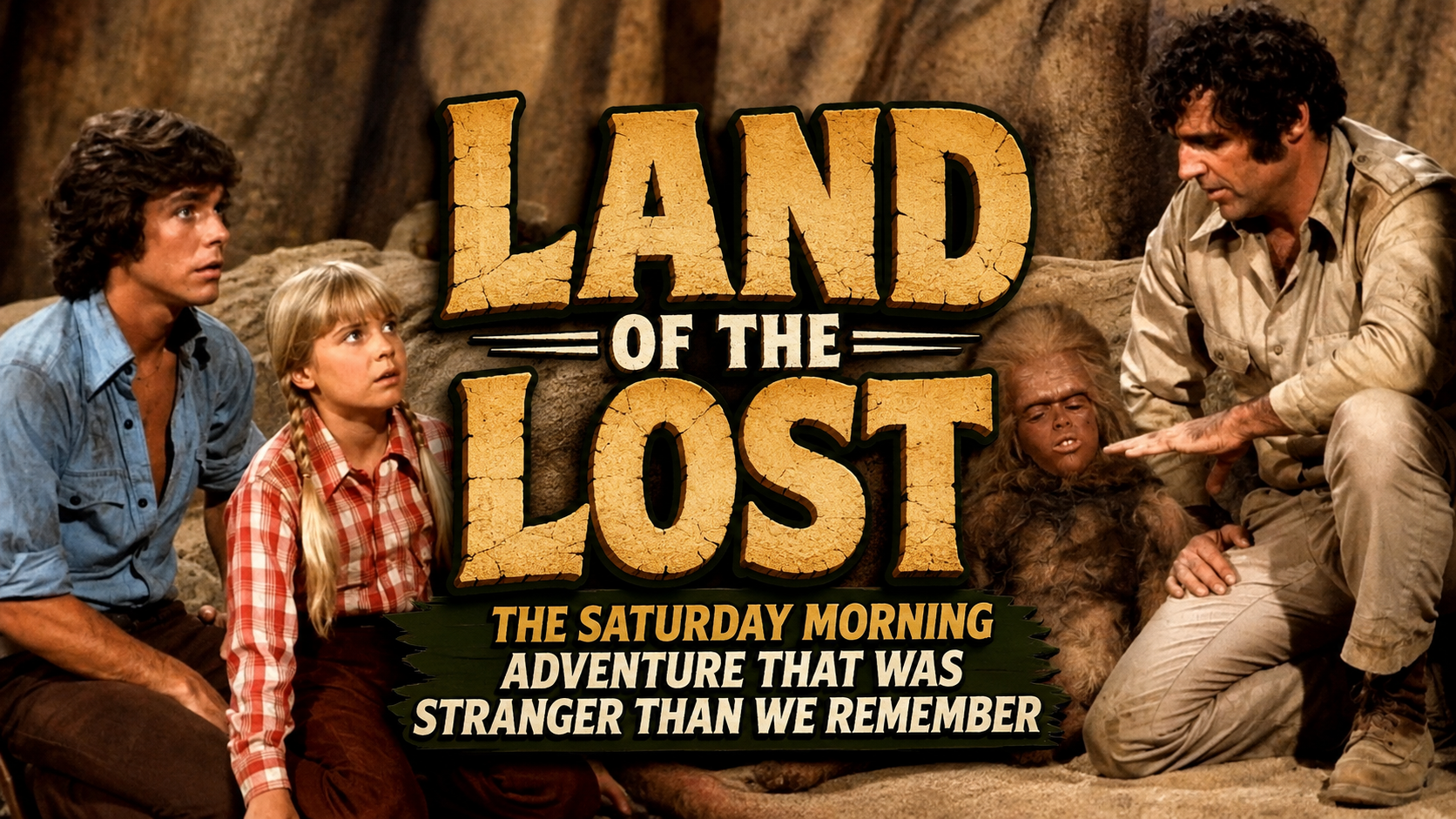
For kids growing up in the 1970s, Saturday morning television could take you almost anywhere. One minute you were watching superheroes or talking animals, and the next you were following a family trapped in a mysterious world filled with dinosaurs, primitive creatures, glowing crystals and some of the creepiest beings ever to appear on children’s television. That was Land of the Lost, a show that looked like a colorful dinosaur adventure on the surface but turned out to be something much stranger — and much smarter.
Premiering on NBC in September 1974, Land of the Lost was created by Sid and Marty Krofft, the brothers behind some of the most imaginative children’s television of the era. The series followed Rick Marshall and his children, Will and Holly, who were swept over a waterfall during a rafting trip and somehow transported into a bizarre alternate world. There was no easy road home. Instead, the Marshalls found themselves surrounded by prehistoric creatures and the remnants of a mysterious civilization whose technology they barely understood.
And then there were the Sleestaks.
A Saturday Morning World Unlike Any Other
The opening sequence explained the basic premise with wonderful 1970s efficiency. Rick, Will and Holly were on a routine expedition when an earthquake sent their raft plunging over a tremendous waterfall. Somehow, they emerged in the Land of the Lost, a place where different periods and worlds seemed to collide.
The Marshalls made their home in a cave they called High Bluff and quickly discovered that survival meant learning the rules of their strange new surroundings. Dinosaurs wandered nearby, including the frequently troublesome Tyrannosaurus rex they nicknamed Grumpy. Holly developed an unusual relationship with a young dinosaur named Dopey, while the family also befriended members of the Pakuni, a primitive humanoid species.
For a child watching in 1974, the dinosaurs alone were enough to make Land of the Lost irresistible. Stop-motion effects brought the creatures to life, and although those effects can look charmingly dated today, they had tremendous personality. More importantly, the dinosaurs weren’t the whole story.
The longer you watched, the stranger the Land became.
The Sleestaks Were Pure Nightmare Fuel
If you watched Land of the Lost as a child, chances are you remember the Sleestaks even more vividly than the dinosaurs.
Tall, green, reptilian humanoids with enormous black eyes, the Sleestaks moved slowly through dark caves while communicating with an eerie hissing sound. They didn’t need elaborate dialogue or dramatic music to be frightening. Their appearance alone was enough.
The Sleestaks lived in the Lost City, a collection of ancient ruins that hinted at a much larger history behind the world. Whenever Will or Holly wandered too close to their territory, the show suddenly felt less like a children’s adventure and more like a miniature horror movie.
What made them particularly unsettling was how little young viewers initially understood about them. Who were they? Where had they come from? Why did this strange civilization exist in a world populated by dinosaurs?
Land of the Lost gradually supplied answers, but every answer seemed to reveal another mystery.
It Was Surprisingly Serious Science Fiction
This is the part of Land of the Lost that is easy to forget.
Behind the dinosaurs, colorful sets and Saturday-morning production budget was some genuinely ambitious science fiction. The series dealt with dimensional portals, time loops, alternate realities, ancient technology and questions about the nature of the Land itself.
The mysterious pylons scattered throughout the landscape were particularly important. Inside these strange structures were crystals and control systems capable of affecting different aspects of the environment. Manipulating them could open dimensional doorways or produce consequences the Marshalls didn’t fully understand.
The Land wasn’t simply an unexplored prehistoric valley. It appeared to operate according to its own rules.
That complexity wasn’t accidental. The series employed writers with genuine science-fiction credentials, including David Gerrold, Larry Niven, Theodore Sturgeon, Ben Bova and Norman Spinrad. Gerrold, already known for writing the famous Star Trek episode “The Trouble with Tribbles,” played an especially important role in developing the show’s mythology.
That helps explain why Land of the Lost often feels different when revisited as an adult. Beneath the children’s television trappings was a carefully constructed science-fiction world.
Enik Changed Everything
One of the show’s most fascinating characters was Enik, an intelligent humanoid creature who initially appeared to be very different from the primitive Sleestaks.
Enik was sophisticated, articulate and capable of understanding the advanced technology surrounding him. His presence opened the door to one of the show’s most memorable ideas: the relationship between Enik’s people, the Altrusians, and the Sleestaks.
Suddenly those hissing monsters weren’t simply monsters.
They had a history.
That kind of revelation gave Land of the Lost a depth rarely expected from a Saturday-morning children’s program. The show trusted young viewers to follow an ongoing mythology rather than resetting everything at the end of every episode.
There were clues scattered throughout the series suggesting that the Land had existed for an enormous amount of time and that different creatures and people had become trapped there just as the Marshalls had.
Finding a way home therefore wasn’t simply a matter of locating the right road. The Marshalls had to understand the strange machinery of the world itself.
The Effects Were Cheap — And Somehow That Didn’t Matter
Nobody watching Land of the Lost today is going to mistake it for Jurassic Park. The miniature sets, chroma-key backgrounds, costumes and stop-motion dinosaurs unmistakably belong to 1970s television.
But judging the series entirely by its effects misses much of its charm.
Kids supplied the missing production budget with their imaginations.
When Grumpy appeared outside High Bluff, he was a Tyrannosaurus rex. When the Marshalls entered a mysterious pylon, it really did feel as though they had discovered technology from another civilization. And when a Sleestak emerged from the darkness of the Lost City, nobody was worrying about the zipper on a costume.
The limitations may actually be one reason the show remains so memorable. Land of the Lost had a handmade quality that gave its world a personality of its own. Nothing looked quite like it.
Things Changed After Rick Marshall Left
For the first two seasons, Spencer Milligan played Rick Marshall, with Wesley Eure as Will and Kathy Coleman as Holly. Their family dynamic provided the emotional center of the series. No matter how bizarre the world became, the basic story was about a father trying to protect his children while all three searched for a way home.
That changed at the beginning of the third season.
Rick Marshall finally escaped through a dimensional doorway, while his brother Jack Marshall, played by Ron Harper, entered the Land. Jack then became the adult figure accompanying Will and Holly for the remainder of the series.
The third season also changed the show’s atmosphere in other ways, and for many fans the first two seasons remain the classic era. The original combination of family survival story, dinosaurs, Sleestaks and mysterious science fiction had created something difficult to duplicate.
The original series ultimately ran for three seasons, from 1974 through 1976, producing 43 episodes.
Why Kids Couldn’t Stop Watching
Part of the appeal was simply that Land of the Lost offered nearly everything a kid could want from Saturday morning television.
There were dinosaurs. There were monsters. There were caves to explore, mysterious ruins, strange creatures, dangerous adventures and a continuing mystery about how the heroes might ever return home.
But there was something else.
The Land itself felt enormous.
You never had the sense that the Marshalls had discovered everything. Somewhere beyond the familiar locations might be another pylon, another creature or another doorway leading somewhere completely unexpected. The series created the feeling that its characters were living inside a world much larger than what could be shown on screen.
That feeling is difficult to manufacture, even with modern visual effects.
More Than Just Another 1970s Kids’ Show
Land of the Lost ended in 1976, but the idea never completely disappeared. A new television version appeared in the early 1990s, and Hollywood eventually transformed the concept into the 2009 feature film starring Will Ferrell.
Yet for those who encountered the original show on Saturday mornings, neither version quite replaced the peculiar atmosphere of the 1974 series.
The original Land of the Lost belonged to a particular moment in children’s television when wonderfully strange ideas could somehow make their way onto Saturday morning schedules. It could be goofy, frightening, imaginative and surprisingly intelligent within the same half hour.
Today, the stop-motion dinosaurs may bring a smile, and the sets may look considerably smaller than we remembered them. But then a Sleestak slowly appears from a dark tunnel, or someone steps inside one of those mysterious pylons, and something familiar comes rushing back.
For a little while, it’s Saturday morning again.
The cartoons are on, the rest of the weekend is still ahead of you, and somewhere beyond that waterfall lies the Land of the Lost.