If You Turned on the TV in 1966, This Is What You Would Have Seen
What was it really like to watch television in America in 1966? From Saturday morning cartoons and afternoon game shows to Batman, Bonanza, Star Trek, Mission: Impossible and Johnny Carson, take a nostalgic trip through an entire day of TV when three networks, one family television and a turn of the dial were all you needed.
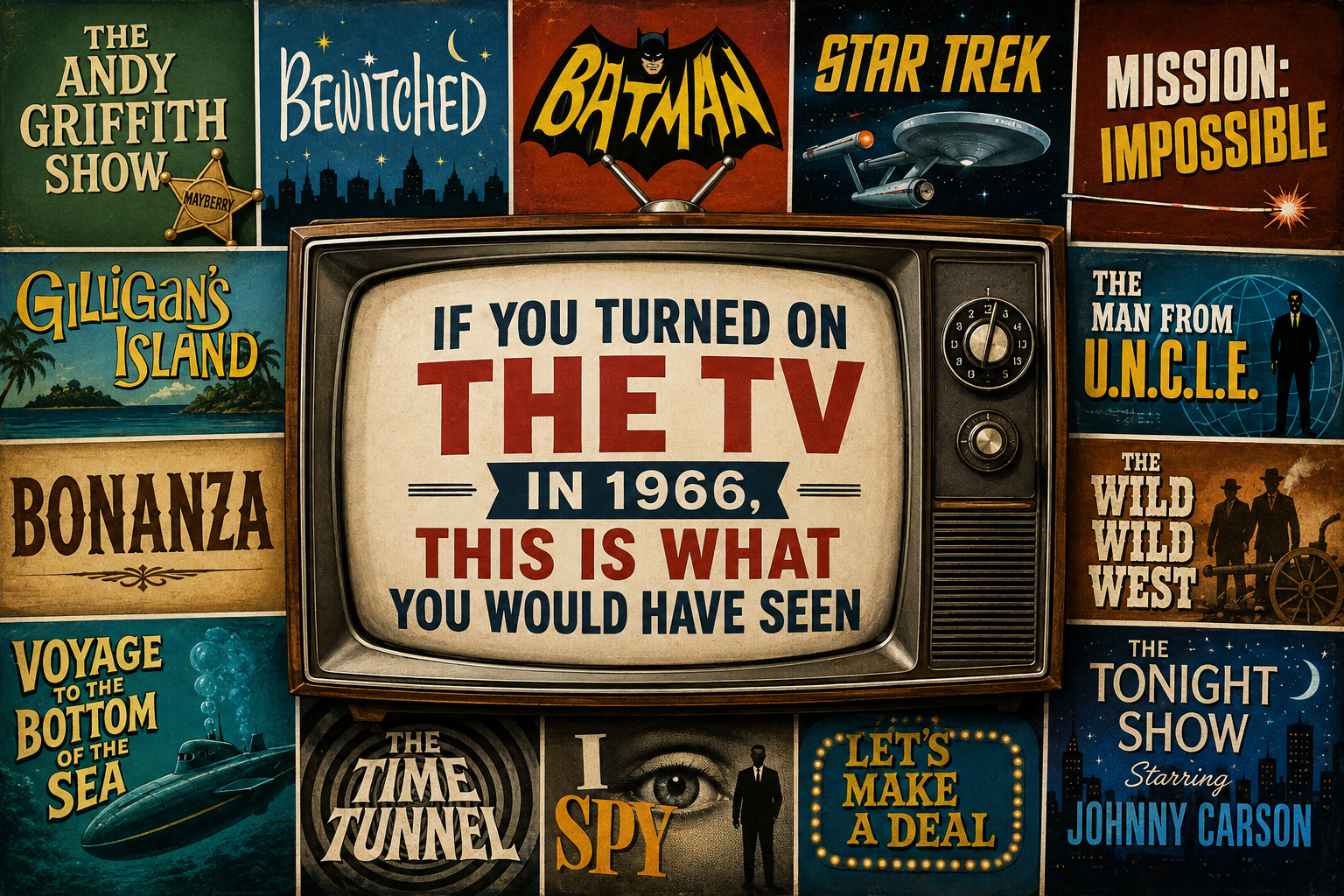
Imagine waking up one morning and discovering that somehow you have been transported back to 1966. You walk into the living room, where a large wooden television console occupies a prominent place among the furniture. There is no streaming menu waiting for you, no cable box with hundreds of channels, and probably no remote control sitting on the coffee table. If you want to watch television, you walk over to the set, turn the knob, hear the familiar click, and wait a few moments while the picture slowly appears.
For Americans in 1966, television had already become an essential part of everyday life, but the experience was remarkably different from the way we watch today. Most viewers depended primarily on the three major networks — CBS, NBC and ABC — along with whatever local or independent stations happened to be available in their area. Programs aired when the networks scheduled them, and if you missed an episode, there was no recording waiting for you and no streaming service where you could find it the following morning.
Yet despite having far fewer choices, American television in 1966 was extraordinarily rich. Westerns still commanded huge audiences, secret agents were everywhere, situation comedies filled prime time, science fiction was entering an exciting new period, and a brightly colored new series called Batman had become a cultural sensation almost overnight. Meanwhile, a little science-fiction program called Star Trek was about to begin a journey that would last far longer than anyone watching in 1966 could possibly have imagined.
What would it actually have been like to spend an entire day watching television that year? Turn the dial, adjust the antenna, and give the picture a moment to settle. We’re going back to 1966.
Morning Television Was Already Becoming a Ritual
By 1966, television was beginning to establish itself as part of the American morning routine. NBC’s Today, which had debuted in 1952, had already demonstrated that people were willing to begin their day with a mixture of news, interviews, weather reports and lighter features. The idea of having television playing while the household prepared for work or school was no longer unusual.
Morning television, however, was considerably more local than what viewers experience today. Local stations had much more freedom to fill portions of their schedules with their own programming, syndicated shows, children’s entertainment and reruns. What someone watched before school in New York could be very different from what a child saw in Chicago, Boston or Los Angeles.
Local television personalities were also genuine celebrities in their communities. Children’s hosts, weather personalities and local news anchors could become familiar faces who were watched every day for years. Some stations surrounded cartoons with elaborate locally produced segments, creating programs that children remembered long after the cartoons themselves had faded from memory.
Once the children left for school and many adults headed to work, television shifted its attention toward the daytime audience.
Daytime TV Had Its Own World
If you turned on the television during the middle of a weekday in 1966, you would enter a world of soap operas, game shows, talk programs and familiar reruns. Daytime television had developed its own rhythm, and viewers who were home regularly could arrange parts of their day around programs that appeared at the same time every afternoon.
Game shows were particularly important. Password, hosted by Allen Ludden, turned a remarkably simple word-guessing concept into addictive television with the help of celebrity guests and ordinary contestants. Let’s Make a Deal offered something completely different, with Monty Hall tempting contestants to trade prizes for the mysterious contents hidden behind doors, curtains and boxes.
There was also Jeopardy!, although viewers in 1966 would have encountered a very different version from the one most people know today. The original Jeopardy! had premiered in 1964 with Art Fleming as host, establishing the answer-and-question format that would eventually become one of television’s most enduring institutions.
Soap operas occupied another important part of the daytime schedule. As the World Turns and Guiding Light were already long-running favorites, while NBC’s Days of Our Lives, which had premiered only the previous year, was beginning to build its audience. These weren’t shows designed for occasional viewing. Their continuing stories encouraged viewers to return every day, creating the kind of loyal relationship between audiences and television characters that would define daytime programming for decades.
After School, the Television Belonged to the Kids
The mood changed again in the afternoon. Children returned home from school, dropped their books, found something to eat and often headed straight toward the television. This was another period when local stations played an enormous role in determining what Americans actually watched.
Depending on where you lived, the afternoon schedule might include The Three Stooges, old Warner Bros. cartoons, Popeye, The Little Rascals, reruns of The Adventures of Superman, adventure serials or programs introduced by a local children’s host. Long before children’s entertainment became available around the clock, these afternoon blocks were an important part of growing up.
Then there was Batman.
When ABC premiered Batman in January 1966, the series became one of the year’s great television sensations. Adam West played Batman with absolute seriousness while the world around him became increasingly outrageous. Burt Ward joined him as Robin, and together they faced a parade of colorful villains including the Joker, Penguin, Riddler and Catwoman.
The show’s exaggerated comic-book style was unlike almost anything else on television. Fight scenes erupted with giant POW!, BAM! and ZAP! graphics, while villains constructed increasingly ridiculous traps from which the Dynamic Duo somehow had to escape.
What made the experience even more exciting was the schedule. During its early run, Batman aired on consecutive evenings, with the first episode often ending on a cliffhanger and the conclusion arriving the following night. Children went to school wondering whether Batman and Robin would survive the latest impossible predicament, only to race back to the television when the next installment arrived.
In 1966, Batmania wasn’t confined to television. Toys, costumes, lunch boxes, records and other merchandise appeared everywhere. For a period, the Caped Crusader seemed almost impossible to escape.
Early Evening Brought the Real World Into the Living Room
As afternoon became evening, television’s tone changed dramatically. Children’s programs and reruns gave way to local news and then to the national network broadcasts that millions of Americans relied upon to understand what was happening beyond their communities.
There was certainly no shortage of news in 1966. The Vietnam War was escalating, the civil rights movement continued to transform American society, the Cold War remained a constant presence, and the United States and Soviet Union were racing toward achievements in space that only a decade earlier would have sounded like science fiction.
CBS viewers turned to Walter Cronkite, whose calm and authoritative delivery made him one of the most recognizable journalists in the country. NBC countered with Chet Huntley and David Brinkley, whose Huntley-Brinkley Report had become another enormously influential source of national news.
These broadcasts were much shorter than the many hours of television news available today, but their cultural impact was enormous. Americans across the country were frequently seeing the same reports and the same images at approximately the same time. Television had become the nation’s window onto events occurring thousands of miles away.
The contrast could be striking. A television that had entertained children with Batman only a few hours earlier could now be showing soldiers fighting in Vietnam. After the news ended, however, families settled in for the centerpiece of the television day: prime time.
Prime Time Was Packed With Shows We Now Call Classics
Looking at a television schedule from 1966 today can feel almost surreal because so many programs that eventually became cultural landmarks were airing at the same time.
Comedy remained one of television’s greatest strengths. The Andy Griffith Show invited viewers back to Mayberry, where Andy Taylor, Barney Fife, Aunt Bee and Opie offered a warm and humorous version of small-town American life. The Beverly Hillbillies continued to attract huge audiences with the Clampetts’ adventures among the wealthy residents of Beverly Hills, while Green Acres reversed the formula by sending sophisticated New Yorkers Oliver and Lisa Douglas into the eccentric world of Hooterville.
There was also Bewitched, in which Elizabeth Montgomery’s Samantha Stephens attempted to maintain an ordinary suburban marriage despite being a witch surrounded by magical relatives. Gilligan’s Island was still finding new ways to prevent its seven castaways from escaping their supposedly deserted island, while Get Smart turned the decade’s fascination with secret agents into wonderfully absurd comedy.
Many of these programs are remembered today through reruns, streaming libraries and classic television channels. In 1966, however, they weren’t nostalgic television at all. They were simply what was on that night.
America Had Spy Fever
One of the most noticeable trends in mid-1960s popular culture was the enormous fascination with espionage. James Bond had become an international phenomenon at the movies, and American television quickly developed its own collection of secret agents, sophisticated gadgets and mysterious international organizations.
The Man from U.N.C.L.E. had already become a major hit, following agents Napoleon Solo and Illya Kuryakin as they confronted international threats. I Spy, starring Robert Culp and Bill Cosby, mixed espionage with international travel, while Get Smart spoofed virtually every convention the genre had created.
Even western television became involved. The Wild Wild West combined the Old West with elaborate gadgets, espionage and larger-than-life villains, creating a strange mixture that sometimes felt like James Bond had somehow wandered into the 1870s.
Then, in September 1966, CBS introduced Mission: Impossible. The series followed the Impossible Missions Force as its members carried out elaborate covert operations using disguises, deception, technology and carefully planned tricks. Its famous recorded assignments, self-destructing messages and instantly recognizable Lalo Schifrin theme would eventually become part of popular culture.
For someone turning the dial in 1966, secret agents seemed to be everywhere.
A New Starship Quietly Entered Television History
On September 8, 1966, NBC broadcast the first regular episode of a new science-fiction series called Star Trek. Viewers were introduced to the USS Enterprise and a crew that included Captain James T. Kirk, Mr. Spock, Dr. Leonard McCoy, Uhura and Scotty.
Today it is nearly impossible to separate Star Trek from everything that followed: movies, later television series, conventions, merchandise and an enormous worldwide fan culture. None of that existed when audiences first encountered the Enterprise in 1966. To NBC viewers, it was simply a new science-fiction program competing for survival in a crowded television schedule.
It was also far from the only fantastic adventure available. Lost in Space was already following the Robinson family, the troublesome Dr. Smith and the Robot through increasingly strange corners of the universe. Voyage to the Bottom of the Sea offered futuristic adventures aboard the submarine Seaview, while The Time Tunnel, premiering in the fall of 1966, sent scientists Tony Newman and Doug Phillips tumbling through famous moments in history.
Science fiction television was becoming more colorful and ambitious, reflecting a decade in which actual developments in space exploration sometimes seemed to be catching up with the fantasies seen on television.
The Western Was Still a Television Giant
The great television western boom had begun during the 1950s, when seemingly every network schedule was filled with cowboys, sheriffs, gunfighters and frontier towns. By 1966 the genre was no longer expanding at quite the same astonishing pace, but westerns remained one of the dominant forces on American television.
Gunsmoke was still one of television’s great institutions. James Arness had been playing Marshal Matt Dillon since 1955, and the citizens of Dodge City remained familiar companions to millions of viewers. Bonanza was another enormous success, following Ben Cartwright and his sons Adam, Hoss and Little Joe on the Ponderosa Ranch.
Viewers could also choose The Virginian, The Big Valley and other western adventures scattered across the week’s schedule. Even programs that experimented with different genres often borrowed the familiar landscapes and imagery of the American West.
For families who had recently purchased a color television, westerns could also be visually impressive. NBC had been particularly enthusiastic about using Bonanza to demonstrate the appeal of color broadcasting. The landscapes, costumes and outdoor settings offered a dramatic contrast to the black-and-white images that had defined television’s earlier years.
1966 Was the Year Color Television Truly Took Over
One of the biggest changes occurring inside American living rooms in 1966 involved the television set itself.
Color television had existed for years, but sets had remained expensive and much of American broadcasting continued in black and white. During the mid-1960s, however, the transition accelerated rapidly. By the 1966–67 season, the major networks had moved heavily toward color programming, making the words “In Color” increasingly familiar to viewers.
That didn’t mean every family suddenly owned a color television. Millions of perfectly functional black-and-white sets remained in use. Two families could therefore watch exactly the same episode of Bonanza, Batman or Star Trek and have noticeably different experiences.
The television itself also looked very different from today’s thin screens. Many sets were housed inside substantial wooden cabinets designed to blend with the furniture. Larger entertainment consoles might combine a television, AM/FM radio and record player inside one impressive cabinet. Instead of trying to make the television disappear into the wall, manufacturers often made it a centerpiece of the room.
For many families, purchasing a new color console television was a significant household event.
Changing the Channel Required a Little More Effort
Remote controls existed in the 1960s, but they were certainly not something every household had. For a great many viewers, changing channels meant getting off the sofa, walking across the room and physically turning the television dial.
The limited number of available channels made that less inconvenient than it sounds today. Most households depended on CBS, NBC and ABC affiliates, perhaps supplemented by one or more independent or educational stations depending on the area. Viewers adjusted the antenna when reception became poor, and someone might have to stand near the set turning the rabbit ears while another person announced when the picture finally looked right.
That limited selection also produced something television has gradually lost: an enormous shared audience. When a popular program aired, millions of Americans could be watching the same episode simultaneously. The following morning, people at school, work or the neighborhood store could discuss something they had all experienced the night before.
Television was not yet an individual activity. In many homes, it belonged to the entire family.
Saturday Morning Was a World of Its Own
For children growing up in the 1960s, few television experiences were more anticipated than Saturday morning. There was no need to search through an enormous library of children’s entertainment because the networks had already decided when cartoon time began. Children woke early, found their favorite cereal and settled in front of the television for several hours of programs aimed specifically at them.
By 1966, the Saturday morning cartoon era was rapidly expanding. Familiar theatrical cartoon characters shared the schedule with newer programs produced specifically for television, while superheroes and adventure characters became increasingly prominent.
What made Saturday morning television memorable was not merely the programming but the ritual surrounding it. During the school week, children had schedules dictated by parents and teachers. Saturday morning felt different. For several hours, the television seemed to belong entirely to them.
There was also an element of anticipation that is difficult to reproduce today. If your favorite cartoon aired at 9:30 on Saturday morning, that was when you watched it. Missing it could mean waiting until the following week. The scarcity made those hours in front of the television feel surprisingly special.
Television Could Turn an Ordinary Night Into a National Event
Another defining characteristic of 1960s television was the power of special broadcasts. Variety programs, musical performances, holiday specials, major news events and celebrity appearances could draw enormous audiences because viewers had relatively few alternatives competing for their attention.
Programs such as The Ed Sullivan Show demonstrated television’s extraordinary ability to transform performers into national sensations. Families gathered together to see comedians, singers, dancers, novelty acts and some of the biggest musical performers in the world appear on the same stage.
Variety television was everywhere during this period. Dean Martin, Andy Williams, Jackie Gleason and other major entertainers became regular visitors to American living rooms. The format combined music and comedy in a way that made television feel closer to attending a live stage show than simply watching another series.
These were often genuinely shared cultural moments. A memorable performance on Sunday night could become a conversation across the country on Monday morning.
And Then There Was Johnny Carson
As prime time ended and much of the household went to bed, television became quieter and more adult. For millions of Americans, late night meant Johnny Carson.
Carson had taken over The Tonight Show in 1962 and by 1966 was well on his way to becoming one of television’s most enduring personalities. His opening monologues, conversations with celebrities, comedy routines and relaxed relationship with guests created a format that influenced nearly every late-night talk show that followed.
Watching Carson also carried a different feeling from watching prime-time television. The children might already be asleep, the lights in the living room might be lower, and the house was settling down for the night. The Tonight Show became the television companion for those last waking hours.
Eventually, however, even late-night television came to an end.
When Television Actually Went Off the Air
Perhaps nothing better demonstrates how different television was in 1966 than what happened late at night. Today, television and streaming services never really stop. There is always another program, another movie or another episode available.
In the 1960s, many local television stations simply ended their broadcast day.
After the final program, the station might show its identification, make a closing announcement, play the national anthem or present a patriotic film. Eventually the regular programming disappeared, sometimes replaced by a test pattern before the transmitter was shut down.
For anyone who stayed awake long enough, television could literally run out.
The set would be switched off, the bright picture would collapse into darkness, and the living room would become quiet until broadcasting resumed the following morning.
For generations accustomed to entertainment being permanently available, the idea seems almost strange. Yet it also created a natural beginning and ending to the television day.
When America Watched Together
What makes television in 1966 so fascinating isn’t simply the astonishing collection of programs that happened to be on the air. It is the experience that surrounded them.
A family might watch Walter Cronkite report the day’s news, spend the evening laughing at The Andy Griffith Show, travel across the galaxy with Star Trek, visit the Ponderosa with the Cartwright family and finish the night listening to Johnny Carson’s monologue. The next morning, millions of other Americans would have memories of watching many of the same things.
There were frustrations, of course. Reception could be terrible. Antennas needed adjustment. Programs couldn’t be paused. There was no instant replay whenever you wanted one, and missing an episode sometimes meant never seeing it at all. Families argued about which of the three networks to watch, particularly when two favorite programs aired at the same time.
Yet those limitations helped create a television culture that was remarkably communal. Shows weren’t merely available somewhere in an endless catalog; they arrived at a particular hour on a particular night. Families planned around them, children hurried home for them, and friends talked about them the following day.
And consider just how extraordinary the choices were.
In one year, American viewers could encounter Batman and Robin racing through Gotham City, Marshal Matt Dillon keeping order in Dodge City, Samantha Stephens twitching her nose on Bewitched, the castaways still trying to escape Gilligan’s Island, the Cartwrights riding across the Ponderosa, secret agents accepting impossible missions and Captain Kirk preparing to take the Enterprise where television had never gone before.
None of it was “classic television” yet.
It was simply television.
And on an ordinary evening in 1966, all you had to do was walk across the living room, turn the dial and see what was on.