Otherworld: The Forgotten 1985 Sci-Fi Series That Was Decades Ahead of Its Time
In 1985, an ordinary family stepped through the Great Pyramid and into another world. Just eight episodes later, Otherworld disappeared from television. Take a look back at the ambitious sci-fi series that may have arrived decades too early.
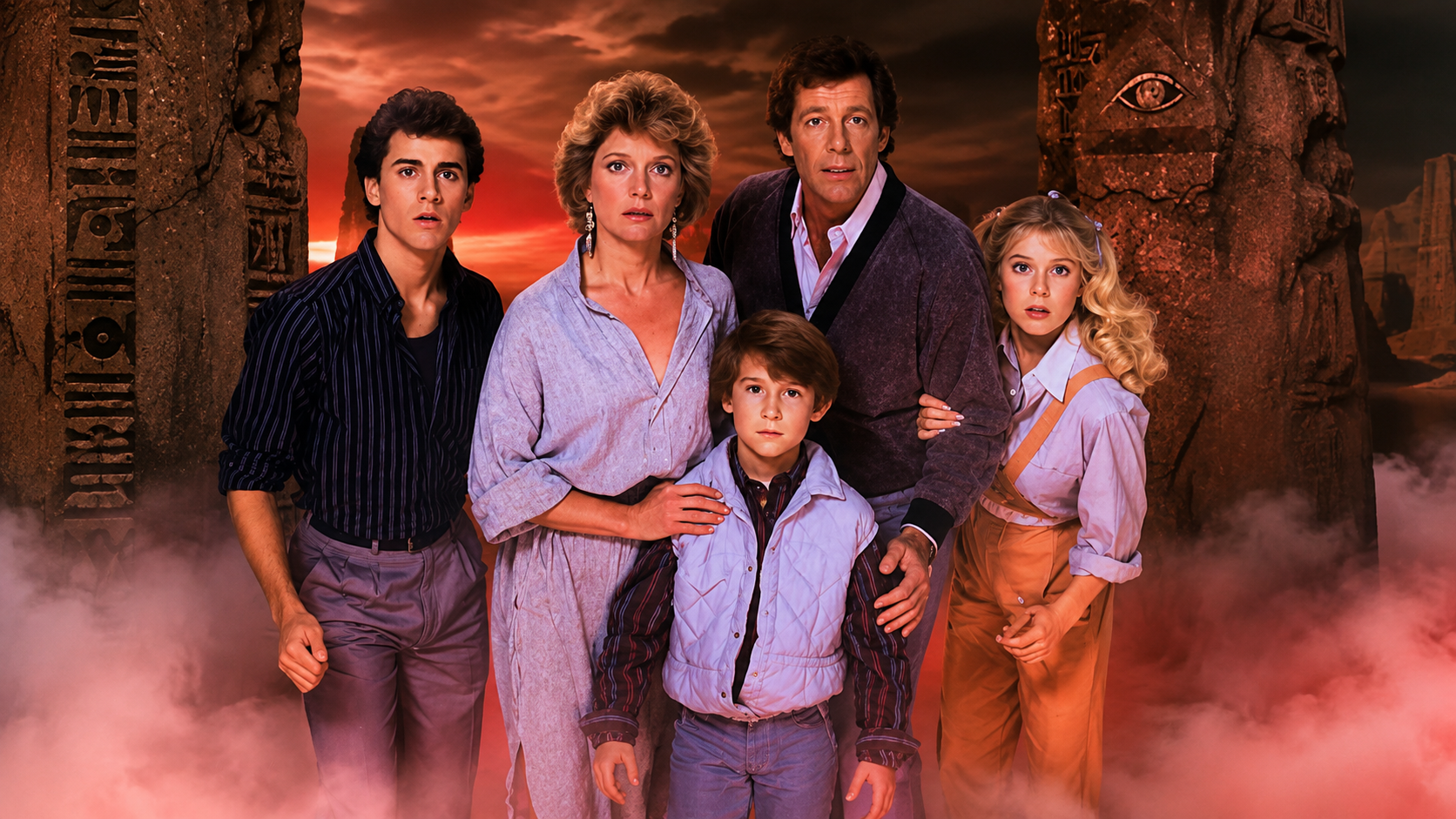
In January 1985, CBS introduced viewers to one of the more unusual science-fiction programs of the decade. An ordinary American family visiting Egypt enters the Great Pyramid and, following a strange cosmic event, finds itself transported to another world. Instead of returning to the familiar landscape outside the pyramid, the family emerges in a mysterious civilization filled with futuristic technology, isolated provinces, androids, authoritarian governments and soldiers determined to capture them.
The series was called Otherworld, and its run was remarkably brief. Only eight episodes were broadcast before CBS pulled the plug, leaving its central story unresolved and the Sterling family still searching for a way home. Yet for viewers who happened to discover the show during those few weeks in 1985, Otherworld became one of those television memories that never entirely disappeared.
Four decades later, it is also fascinating to revisit because its basic concept feels surprisingly modern. Beneath the family-adventure exterior was a serialized mystery involving parallel worlds, different societies, government control and an ongoing journey toward an uncertain destination. With a larger budget and a streaming platform behind it, Otherworld is the kind of premise that could easily find an audience today.
A Family Vacation Goes Very Wrong
The story begins with Hal and June Sterling traveling through Egypt with their children, Trace, Gina and Smith. During their visit to the Great Pyramid, an unusual planetary alignment coincides with a mysterious event inside the ancient structure. When the Sterlings eventually emerge, they discover that they are no longer in Egypt—or apparently anywhere on Earth.
They have somehow arrived on a strange world called Thel. Exactly how they got there, what Thel really is and whether it exists in another dimension are part of the mystery surrounding the series. What quickly becomes clear is that getting home will not be simple.
Rather than relying on astronauts, scientists or heavily armed futuristic heroes, Otherworld placed an ordinary suburban family at the center of its science-fiction story. The Sterlings have no special knowledge of the world they have entered and no sophisticated equipment to protect themselves. They must learn the rules as they travel, relying largely on one another while trying to stay ahead of the authorities.
That family dynamic gave the series a recognizable emotional center even when the surroundings became increasingly strange.
Welcome to the Provinces of Thel
One of Otherworld’s most interesting ideas was the structure of Thel itself. The world was divided into separate provinces, with travel between them tightly controlled. Each province could have its own customs, level of technology and social structure, and inhabitants might know surprisingly little about what existed beyond their borders.
The borders were enforced by intimidating soldiers known as Zone Troopers. Because the Sterling family arrived without authorization and didn’t belong anywhere in Thel’s carefully controlled society, they quickly attracted the attention of the authorities.
This arrangement gave the writers an unusually flexible premise. As the family traveled from one province to another, the series could essentially reinvent itself each week. One territory might resemble a futuristic technological society, while another could evoke an earlier period of American history. Other provinces could be used to explore authoritarianism, social conformity, gender roles, technology or popular culture.
It was almost as though The Twilight Zone, Lost in Space and a family road-trip series had been combined into one concept.
The Sterling Family
Sam Groom starred as Hal Sterling, the father trying to keep his family together while navigating a world he doesn’t understand. Gretchen Corbett played his wife, June, while Tony O’Dell portrayed their teenage son Trace and Jonna Lee played their daughter Gina. Chris Hebert appeared as their younger son Smith, with Brandon Crane playing the character in the original pilot.
The decision to make the protagonists a family was important because it allowed Otherworld to remain accessible even when the science-fiction concepts became unusual. Viewers weren’t required to understand complicated technology or mythology. They experienced Thel through the same confused perspective as the Sterlings.
Their objective was also wonderfully simple: keep moving, stay together and somehow find a route back to Earth.
Standing in their way was one of the show’s most memorable characters—and an actor modern viewers will immediately recognize.
Jonathan Banks Before Breaking Bad
Jonathan Banks played Kommander Nuveen Kroll, the Zone Trooper officer determined to capture the Sterling family. Long before Banks became famous to a new generation as Mike Ehrmantraut in Breaking Bad and Better Call Saul, he was already demonstrating the intimidating screen presence that would become one of his trademarks.
Kroll served as the recurring threat connecting the family’s weekly adventures. Even when the Sterlings escaped into another province, there was always the possibility that Kroll and the Zone Troopers would eventually catch up with them.
Banks’ presence gives Otherworld an interesting connection to modern television history. Anyone discovering the show today is likely to experience that wonderful moment of recognition when Kroll appears on screen and they realize exactly who they’re watching.
Eight Episodes and Eight Different Adventures
The provincial structure allowed Otherworld to experiment with different kinds of stories during its short run. The eight broadcast installments were Rules of Attraction, The Zone Troopers Build Men, Paradise Lost, Rock and Roll Suicide, Village of the Motorpigs, I Am Woman, Hear Me Roar, Mansion of the Beast and Princess Metra.
One of the best-remembered episodes is “Rock and Roll Suicide,” in which Trace and Gina encounter a society reminiscent of conservative 1950s America and introduce its teenagers to rock ‘n’ roll. The premise allowed the show to play with generational rebellion, censorship and the disruptive power of popular culture while still functioning as an entertaining adventure.
Other episodes moved into stories involving androids, strange communities, social control and relationships. The result could be uneven, but that unpredictability was also part of the show’s appeal. Viewers never knew exactly what kind of society the Sterlings would discover after crossing the next border.
The Series Roderick Taylor Wanted to Make
Behind the scenes, however, there was considerable disagreement over what Otherworld should actually be.
Creator Roderick Taylor appears to have envisioned something darker and more challenging than the straightforward family adventure CBS wanted. Contemporary reporting before the premiere described a significant creative difference between Taylor and the network. CBS saw the concept primarily as an accessible family-oriented action-adventure series, while Taylor wanted to use science fiction to place an ordinary family in unsettling situations and explore more serious ideas.
According to a 1985 Los Angeles Times report, CBS rejected 12 of 13 initial episode ideas Taylor submitted, with several apparently considered too dark or inappropriate for the tone the network wanted.
That disagreement helps explain one of the curious qualities of Otherworld. At times it feels like a light family adventure; at others it hints at a much darker science-fiction series hiding underneath. The concept had room for both, but the show never lasted long enough to discover which direction would ultimately define it.
The Episode CBS Wouldn’t Make
One of Taylor’s proposed stories demonstrates how much darker the series might have become.
A script called “Seeing Double” involved duplicates of the Sterling family. Rather than simply creating the usual science-fiction scenario of heroes fighting evil versions of themselves, the duplicates would reportedly attempt to psychologically destroy their originals by exploiting their deepest fears.
The episode was never produced.
It’s an intriguing glimpse at the Otherworld that might have developed had the series continued and Taylor been given more freedom. The show’s basic format could support stories involving psychological horror, political allegory, satire and more serious speculative fiction just as easily as conventional family adventure.
Unfortunately, there wasn’t enough time to explore those possibilities.
Why Was Otherworld Canceled?
There probably wasn’t one single reason for the show’s disappearance. Otherworld premiered on Saturday nights at 8 p.m., a difficult environment for an unusual new science-fiction series trying to establish an audience. The program also suffered from uncertainty over its identity. CBS wanted a broadly accessible family adventure, while its creator clearly saw opportunities to push the material in more challenging directions.
Critical reaction was mixed, and the show never developed the ratings necessary to convince CBS to give it additional time. In the network television environment of 1985, expensive or unusual science-fiction programs weren’t necessarily given multiple seasons to slowly build an audience.
The eighth episode, “Princess Metra,” aired on March 16, 1985. There was no grand conclusion and no triumphant return through the pyramid. The Sterlings remained trapped in Thel, still searching for the path that might eventually take them home.
Their journey simply stopped.
What About the Supposed Lost Episodes?
Over the years, Otherworld’s brief history has occasionally created confusion about how many episodes actually existed. The original premiere came from a two-hour pilot that was subsequently divided, and additional scripts and story ideas were developed during production. This has contributed to stories about unaired or “lost” completed episodes.
However, the television run consists of eight produced broadcast installments. Other concepts may have reached the script or development stage, but the mysterious additional filmed episodes sometimes discussed by fans do not appear to exist.
In some ways, the small episode count adds to the show’s mystique. Otherworld isn’t a forgotten series requiring months of viewing to rediscover. Its entire televised existence can be explored in only a handful of hours.
Was Otherworld Ahead of Its Time?
Watching the premise through modern eyes makes this perhaps the most interesting question.
A family becomes trapped in a parallel world. Every region they enter reveals another society with different rules. An authoritarian system controls movement between territories. A recurring antagonist follows the heroes across those boundaries. Larger mysteries about the nature of the world remain unresolved while the characters pursue a long-term objective that might eventually take them home.
That structure sounds remarkably compatible with contemporary serialized television.
Today, Otherworld could easily be imagined as a ten-episode streaming drama with elaborate production design, deeper mythology and a season-long narrative. Each province could still provide an individual story while gradually revealing more about Thel and the forces controlling it.
In 1985, however, American network television was built around very different expectations. Shows were expected to attract large audiences quickly, individual episodes often needed to remain accessible to viewers who had missed the previous week, and ambitious science fiction could be expensive to produce.
Otherworld arrived with a concept that may simply have needed more time than CBS was prepared to give it.
The Show That Refused to Completely Disappear
Although its original network run lasted less than two months, Otherworld didn’t vanish entirely. Later cable reruns, including appearances on the Sci Fi Channel, introduced the series to viewers who had missed its original CBS broadcast.
For others, however, the show existed for years as little more than a half-remembered television memory: a family traveling through a strange world, futuristic soldiers, mysterious provinces, a pyramid and the constant search for a way home. Some viewers remembered individual scenes without even remembering the title of the series they came from.
That may be the perfect definition of forgotten television.
Otherworld wasn’t around long enough to become a major franchise or a permanent part of popular culture. It didn’t produce hundreds of episodes, spin-offs or reunion specials. For a few weeks in 1985, it simply appeared on CBS, introduced viewers to an intriguing new universe and then disappeared before its story could be completed.
Yet forty years later, people still remember it.
And perhaps that’s the strongest argument that there was something worthwhile hidden inside those eight episodes. Otherworld remains one of the great “what if?” stories of 1980s science-fiction television: a strange, ambitious little series that opened a doorway to another world but wasn’t given enough time to show us where that doorway might eventually lead.
Do you remember watching Otherworld in 1985? Or is this forgotten sci-fi series completely new to you? Let us know in the comments.