The Forgotten Star Trek: When the Enterprise Returned on Saturday Mornings
In 1973, four years after Star Trek disappeared from prime-time television, the Enterprise made an unexpected return—as a Saturday morning cartoon. With most of the original cast back behind the microphones, Star Trek: The Animated Series gave fans 22 new adventures and became the often-forgotten bridge between the original series and the movies that followed.
For many television viewers, the story of the original Star Trek seems fairly straightforward. NBC canceled the series in 1969, reruns turned it into a cult phenomenon during the 1970s, and eventually Captain Kirk and his crew returned in Star Trek: The Motion Picture in 1979. But there is an important chapter hiding between those two eras, one that can easily be overlooked today.
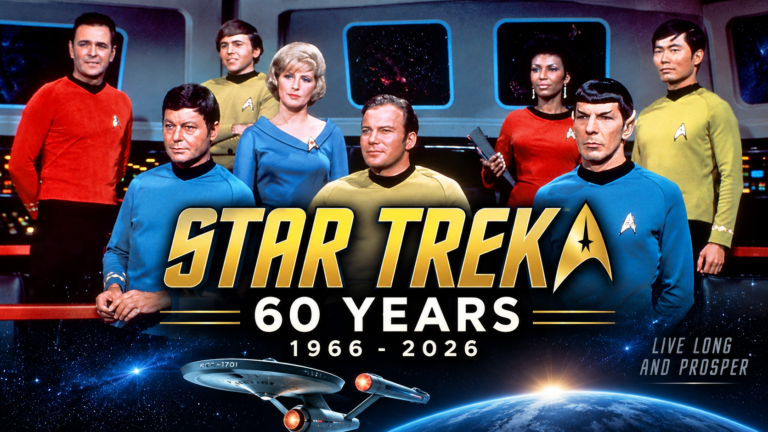
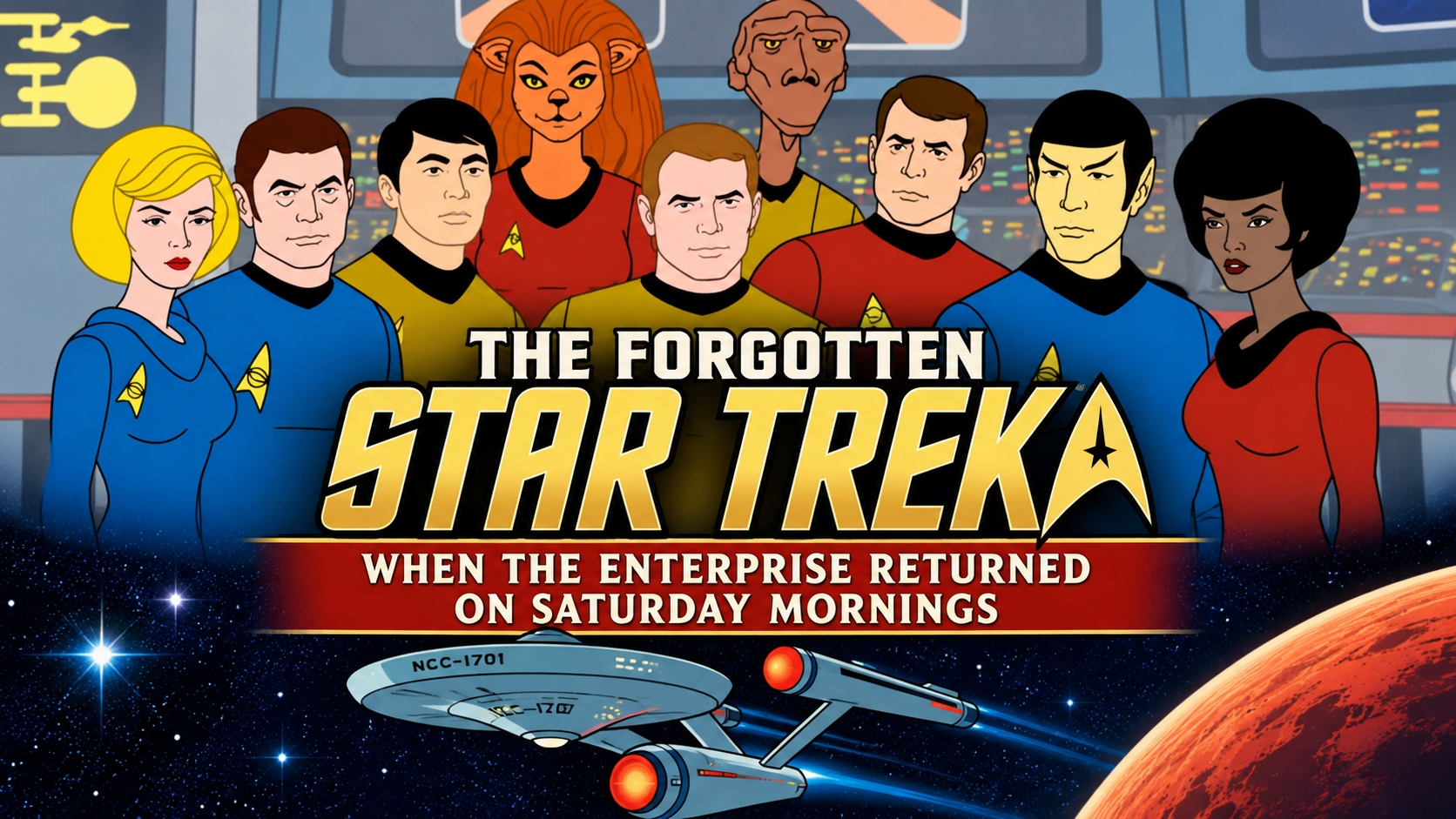
Four years after the original Enterprise disappeared from prime-time television, Kirk, Spock, McCoy, Scotty, Uhura and Sulu were back. William Shatner was once again Captain Kirk. Leonard Nimoy was Spock. DeForest Kelley was Dr. McCoy. Most of the familiar voices were there, the Enterprise was once again exploring strange new worlds, and new Star Trek adventures were being produced for television.
There was just one rather significant difference.
This time, the Enterprise was a cartoon.
Star Trek Comes Back to Television
Star Trek: The Animated Series premiered on NBC on September 8, 1973, exactly seven years after the original series had made its television debut. It arrived during an era when Saturday morning was practically its own television universe. For millions of American children, Saturday meant getting up early, pouring a bowl of cereal and settling in for several uninterrupted hours of cartoons before the adults reclaimed the television.
Into that world came something rather different. Although Star Trek was now animated and scheduled as children’s programming, the basic idea hadn’t changed very much. The Enterprise was still traveling through space, Kirk was still making difficult command decisions, Spock was still applying logic to everything around him, and McCoy was still finding reasons to argue with Spock.
The animation was produced by Filmation, the studio that would become one of the most familiar names in Saturday morning television. Its limited-animation style is unmistakable today, particularly to anyone who grew up watching cartoons of the period. Characters frequently moved somewhat stiffly, backgrounds were reused and certain sequences had the economical look necessary for producing television animation on tight schedules and budgets.
Yet animation also gave Star Trek something the original series had rarely enjoyed: the ability to imagine without worrying quite so much about whether an idea could physically be built on a television soundstage.
Suddenly, the Budget Didn’t Control the Galaxy
The original Star Trek had always dreamed bigger than its budget. Gene Roddenberry and his writers could imagine enormous alien civilizations and spectacular planets, but eventually somebody had to figure out how to create them with 1960s television money. That often meant clever lighting, painted backdrops, reused sets, costumes and whatever convincing alien landscape could be found within driving distance of the studio.
Animation changed the equation. Drawing a planet with a bizarre landscape wasn’t necessarily much more difficult than drawing an ordinary one. Aliens no longer needed to be actors wearing makeup, which meant they didn’t always have to possess conveniently human bodies. The Enterprise could encounter enormous creatures, unusual environments and genuinely alien-looking civilizations without a production manager wondering how much the set was going to cost.
The animated format even allowed the Enterprise crew itself to become more alien. Lieutenant Arex, the ship’s navigator, was an Edosian with three arms and three legs, while Lieutenant M’Ress was a feline Caitian communications officer. Characters like these would have been considerably more complicated to realize convincingly on the original live-action series, but in animation they could simply take their places on the bridge.
For a program built around exploring the limitless possibilities of space, becoming a cartoon had unexpectedly removed some very earthly limitations.
Most of the Enterprise Crew Really Came Back
One reason The Animated Series feels so much like genuine Star Trek rather than merely a children’s adaptation is the voices. William Shatner returned as Kirk, Leonard Nimoy as Spock, DeForest Kelley as McCoy, James Doohan as Scotty, Nichelle Nichols as Uhura and George Takei as Sulu. Majel Barrett also returned and voiced Nurse Chapel as well as M’Ress.
Hearing those actors again made an enormous difference. Close your eyes during certain scenes and it can feel surprisingly close to an episode of the original show. Shatner still sounds like Kirk, Kelley still delivers McCoy’s complaints with exactly the right irritation, and Nimoy’s unmistakable voice immediately makes animated Spock feel like the same character viewers had known since 1966.
James Doohan became particularly valuable to the production because Scotty was only one of the many characters he voiced. Doohan supplied voices for numerous guest characters and aliens throughout the series, helping populate the animated galaxy without requiring an enormous cast of performers.
One familiar member of the bridge crew, however, was missing.
Where Was Chekov?
Walter Koenig did not return as Pavel Chekov. Budget considerations meant the production couldn’t bring back every regular performer, and Chekov was the character who was left out. For fans of the original crew, his absence remains one of the most noticeable differences between the live-action and animated Enterprises.
But Koenig wasn’t completely absent from animated Star Trek. He wrote the episode “The Infinite Vulcan,” becoming the first member of the original Star Trek cast to receive a writing credit for the franchise.
It’s one of those wonderfully strange pieces of Star Trek trivia: Chekov himself wasn’t aboard the animated Enterprise, but the actor who played him still found a way onto the show.
This Wasn’t Just Star Trek for Little Kids
Calling The Animated Series a Saturday morning cartoon can create the wrong impression today. It certainly had younger viewers in mind, and episodes had to fit the shorter running time of children’s television, but many of the people creating the show had strong connections to the original Star Trek.
Several writers from the live-action series returned, and the stories often explored concepts that wouldn’t have seemed out of place during the original run. There were intelligent science-fiction ideas, ethical dilemmas, dangerous alien encounters and stories that expanded pieces of Star Trek mythology.
One of the most celebrated examples is “Yesteryear,” written by D.C. Fontana. The episode sends Spock into the past and explores his childhood on Vulcan, including his relationship with his parents and the difficulties he experienced growing up between two cultures. It gave viewers a deeper look at a character who had already become one of the franchise’s most beloved figures.
There were also direct connections to earlier adventures. “More Tribbles, More Troubles,” written by David Gerrold, served as a follow-up to the original series favorite “The Trouble with Tribbles,” bringing back both the furry little creatures and Cyrano Jones. Other episodes revisited familiar species, characters and ideas, making the animated show feel like a continuation rather than a complete reinvention.
Saturday Morning Star Trek
For viewers who actually experienced the show in 1973, however, there was another element that’s difficult to recreate today: where Star Trek appeared.
Saturday morning television was a ritual.
Children didn’t open an app and choose an episode from a library containing decades of television. They knew when their favorite programs were on, and if they wanted to watch them, they needed to be sitting in front of the television at the right time. The morning might begin with a bowl of cereal, cartoons would fill the next few hours, and somewhere among that weekly parade of animated adventures was the U.S.S. Enterprise.
That placed Star Trek in front of a particularly important audience. The original series was already finding younger fans through syndicated reruns, and now there were brand-new adventures designed for a television schedule dominated by children and teenagers. Some viewers who would later become lifelong Star Trek fans first encountered Kirk and Spock not through NBC’s prime-time series of the 1960s, but through Saturday mornings in the 1970s.
For them, the animated Enterprise wasn’t a strange footnote.
It was Star Trek.
Only 22 Episodes
The comeback didn’t last particularly long. Star Trek: The Animated Series produced just 22 episodes across two seasons, with the final original episode airing in 1974. Compared with the enormous franchise that followed, it seems remarkably small.
Yet the series achieved something the original live-action Star Trek never did: it won an Emmy. In 1975, the animated series received the Daytime Emmy Award for Outstanding Entertainment Children’s Series, an unusual distinction for a franchise whose original network run had struggled so hard simply to remain on television.
After those 22 episodes, however, the Enterprise once again went quiet.
But by then, Star Trek itself was becoming increasingly difficult to dismiss.
The Bridge Between Two Star Trek Eras
This is what makes The Animated Series so interesting when viewed from fifty years later. It sits almost perfectly between the two great early chapters of Star Trek history.
On one side is the original television series: canceled in 1969 and kept alive through syndication and an increasingly passionate fan community. On the other is the rebirth of Star Trek as a major movie franchise beginning with Star Trek: The Motion Picture in 1979.
In between them is a little Saturday morning cartoon.
Yet it wasn’t merely merchandise inspired by the original program or a simplified retelling using different performers. Most of the original cast returned, established Star Trek writers contributed stories, familiar characters and ideas continued to develop, and audiences were given 22 completely new journeys aboard the Enterprise.
The original five-year mission hadn’t reached five years on NBC.
Animation quietly helped it get a little closer.
The Star Trek That Was Easy to Forget
Once Star Trek became enormous again, The Animated Series was inevitably overshadowed. The movies reunited the original cast in live action, Star Trek: The Next Generation introduced an entirely new Enterprise in 1987, and eventually Deep Space Nine, Voyager, Enterprise and later productions expanded the universe far beyond anything viewers could have imagined in 1973.
The animated show became the odd little series sitting between the familiar eras. Even its place within official Star Trek continuity was debated for years, contributing to the sense that it existed somewhere off to the side of the larger franchise.
Today, however, it’s much easier to appreciate what those 22 episodes represented. Star Trek had been canceled. There was no guarantee of a movie franchise, no Captain Picard waiting in the future and certainly no sprawling television universe. The phenomenon that Star Trek would eventually become was still taking shape.
And on Saturday mornings in 1973, while children sat in front of television sets with their cereal bowls nearby, the Enterprise was already flying again.
It may be the forgotten Star Trek, but it helped prove something that the next half-century would make abundantly clear:
You could cancel Star Trek. Keeping it gone was another matter entirely.