The Songs That Sound Better After Midnight: 1980s Late-Night Radio
There was something different about FM radio after midnight in the 1980s. The streets were quiet, the dashboard lights glowed, and certain songs seemed to take on a life they never had during the day. From The Cars and Sade to Phil Collins and Roxy Music, these were the songs made for the quieter hours, when the rest of the world was asleep and the radio felt like it was playing just for you.
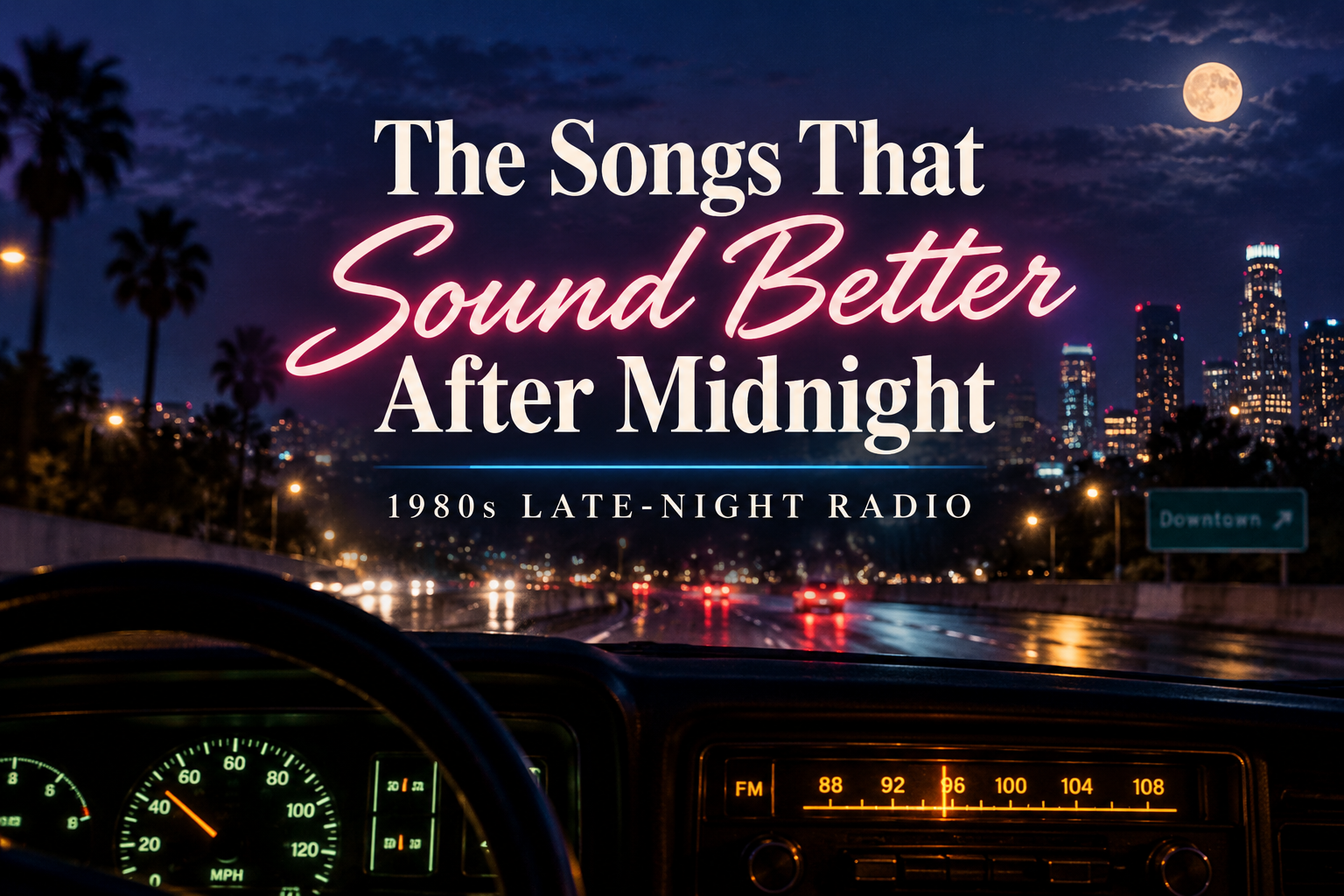
There was something different about the radio after midnight in the 1980s.
During the day, radio was everywhere. It played in the car, at work, in stores, beside the swimming pool and through the open windows of houses on summer afternoons. But late at night, when most of the neighborhood had gone dark and the traffic outside had thinned to almost nothing, the radio became more personal. The voices of the DJs grew quieter, the commercials seemed farther apart, and certain songs suddenly sounded as though they had been waiting all day for exactly this hour.
Maybe you were driving home with the dashboard glowing green or orange in front of you. Maybe you were lying in bed with a clock radio on the nightstand, keeping the volume just low enough that nobody down the hall could hear it. Or maybe you were simply awake when everyone else was asleep, turning the dial and discovering that FM radio after midnight seemed to belong to a different world.
And some 1980s songs belonged to that world more than others.
“Drive” — The Cars (1984)
The Cars could make bright, sharp-edged pop-rock with the best of them, but “Drive” seemed to come from somewhere completely different. Benjamin Orr’s restrained vocal, the spacious synthesizers and that slow, deliberate rhythm gave the song a loneliness that became even stronger when heard late at night.
It was one of those records that could make an empty highway feel strangely cinematic. The streetlights passed overhead, the road disappeared into darkness beyond the headlights, and for a little more than three minutes there seemed to be nobody else in the world. “Drive” was a major radio hit in 1984, but midnight was when it really seemed to find its natural home.
“In the Air Tonight” — Phil Collins (1981)
Few songs could change the atmosphere of a room as quickly as “In the Air Tonight.” From its opening moments, there was something unsettling about it: the sparse drum machine, distant keyboards and Phil Collins singing as though he were telling you something he had been carrying around for years.
Then came that drum break.
By now it is one of the most famous moments in 1980s music, but imagine hearing it through a good stereo in 1981, late at night, before decades of movies, television shows and commercials had made it so familiar. The silence and tension preceding those drums made them sound enormous. This wasn’t background music. When “In the Air Tonight” came on, you listened.
“True” — Spandau Ballet (1983)
Some records seem almost designed for low lights, and “True” is one of them. Its smooth production, gentle rhythm and Tony Hadley’s unmistakable vocal gave it an elegance that separated it from much of the louder pop surrounding it in 1983.
Late-night radio gave songs like “True” room to breathe. There was no music video competing for your attention, no phone in your hand and no endless catalog waiting for you to choose something else. If the DJ played “True,” you stayed with it. And somewhere between the soft keyboards and that saxophone solo, four o’clock in the afternoon could never compete with one o’clock in the morning.
“Missing You” — John Waite (1984)
“I ain’t missing you at all” might be one of the least convincing declarations in 1980s pop music, and that is precisely what makes John Waite’s biggest solo hit work so well.
Everything about the record suggests the opposite. There is distance, regret and the unmistakable feeling of trying to convince yourself that something doesn’t hurt anymore. During the daytime, it was an excellent pop record. After midnight, particularly if there happened to be someone you were trying very hard not to think about, it became something else entirely.
Radio was good at finding you at moments like that.
“Smooth Operator” — Sade (1984)
When Sade arrived on American radio in the mid-1980s, the sound was unmistakable. “Smooth Operator” didn’t need enormous drums or screaming guitars to command attention. It moved quietly, confidently and effortlessly, with Sade Adu’s cool vocal floating above an arrangement that seemed made for a city after dark.
This was sophisticated nighttime music. You could imagine it coming from the radio of a car crossing a nearly empty city at 1:30 in the morning, passing illuminated hotel entrances, traffic signals changing for nobody and office towers with only a few windows still lit. Even today, those opening notes seem capable of turning an ordinary room into someplace considerably more glamorous.
“Holding Back the Years” — Simply Red (1985)
There is a particular kind of song that catches you off guard when you’re alone, and “Holding Back the Years” is one of them. Mick Hucknall was remarkably young when he recorded it, yet the performance carried the weariness and reflection of someone looking back across decades.
That made it ideal late-night radio. After midnight, when there were fewer distractions, lyrics had a way of getting through. Memories you hadn’t thought about for years could suddenly return because of one melody, one line or one song you hadn’t heard since another period of your life.
Perhaps that was one of radio’s greatest tricks. You weren’t looking for the memory. The radio found it for you.
“Avalon” — Roxy Music (1982)
If there were ever an album designed to be heard after dark, Avalon would have a strong claim.
Its title track is lush, mysterious and almost dreamlike. Bryan Ferry’s vocal seems to drift through the arrangement rather than sit on top of it, surrounded by shimmering keyboards, restrained percussion and atmospheric guitar. It sounded luxurious without being loud and romantic without becoming sentimental.
On late-night FM, “Avalon” could seem to arrive from some distant station you had accidentally discovered while turning the dial. You might not even have known what song was playing at first. That was part of the magic. Before phones could identify a song in seconds, sometimes you simply listened and hoped the DJ would tell you the title when it ended.
“Bette Davis Eyes” — Kim Carnes (1981)
“Bette Davis Eyes” was everywhere in 1981, but beneath its enormous pop success was a wonderfully nocturnal record. The synthesizer, the unusual percussion and Kim Carnes’ raspy vocal gave it a smoky quality that sounded completely different once the sun went down.
There was mystery in the song, and 1980s radio was particularly good at mystery. Album covers weren’t always in front of you. There was no video accompanying every listen. Sometimes all you had was a voice coming through two speakers in a dark room, leaving your imagination to create everything else.
“I Can’t Tell You Why” — Eagles (1980)
Technically arriving right at the beginning of the decade, “I Can’t Tell You Why” carried some of the smooth California sound of the late 1970s into the new era. Timothy B. Schmit’s delicate vocal, Don Felder’s restrained guitar and the song’s unhurried groove made it almost impossible to rush.
It was the kind of record an FM DJ could slip into a late-night set without needing to say very much afterward. The song itself created the mood. For listeners who remember radio before tightly programmed playlists became increasingly dominant, these quieter transitions were part of the pleasure: one song would simply lead you somewhere you hadn’t expected to go.
“Wicked Game” — Chris Isaak (1989)
“Wicked Game” belongs at the very edge of our 1980s journey. Recorded for Chris Isaak’s 1989 album Heart Shaped World, it would not become a major hit until the following year, after its use in David Lynch’s Wild at Heart helped bring attention to it.
But sonically, it belongs here.
The haunting guitar, enormous sense of space and Isaak’s aching vocal make “Wicked Game” almost the definition of a song that sounds better when everyone else has gone to sleep. It feels less like a conventional pop recording than something drifting in from far away. Put it on at noon and it’s beautiful. Hear it alone on a dark road after midnight and it becomes unforgettable.
When the DJ Was Still Awake With You
The songs were only part of what made late-night radio special. There was also the person on the other side of the microphone.
Late-night DJs often sounded different from their daytime counterparts. They didn’t need to fight morning traffic or shout over the excitement of the afternoon drive. Their voices could be quieter and more conversational, sometimes giving the impression that they knew only a handful of people were still listening—and you were one of them.
There was companionship in that.
Before streaming services could create a personalized playlist for every mood imaginable, you surrendered a certain amount of control when you turned on the radio. You didn’t know what was coming next. A song you loved might appear without warning. Something you’d never heard before might stop you in your tracks. And occasionally the DJ would play exactly the record you needed at exactly the right moment.
One More Song Before Sleep
Today we can summon virtually any song ever recorded within seconds. We can skip tracks, repeat them, build playlists containing hundreds of favorites and carry entire music libraries in our pockets. It is an extraordinary convenience, and few of us would willingly give it up.
But convenience isn’t quite the same thing as discovery.
There was something wonderful about being awake at 1:17 in the morning in 1985 and having absolutely no idea what song the radio would play next. The room was dark, the red numbers of the clock glowed beside the bed, and somewhere across town a DJ placed another record into the night.
Then those first few notes came through the speakers.
And suddenly you weren’t ready to go to sleep just yet.