Strings in the Control Room: How “Love’s Theme” Turned Barry White’s Vision into a No. 1 Instrumental
What most listeners miss is how carefully “Love’s Theme” is built: beneath the romance, it is an expertly engineered pop record with a groove strong enough to cross every format on the dial. That is exactly why it still feels so natural on classic hits radio.
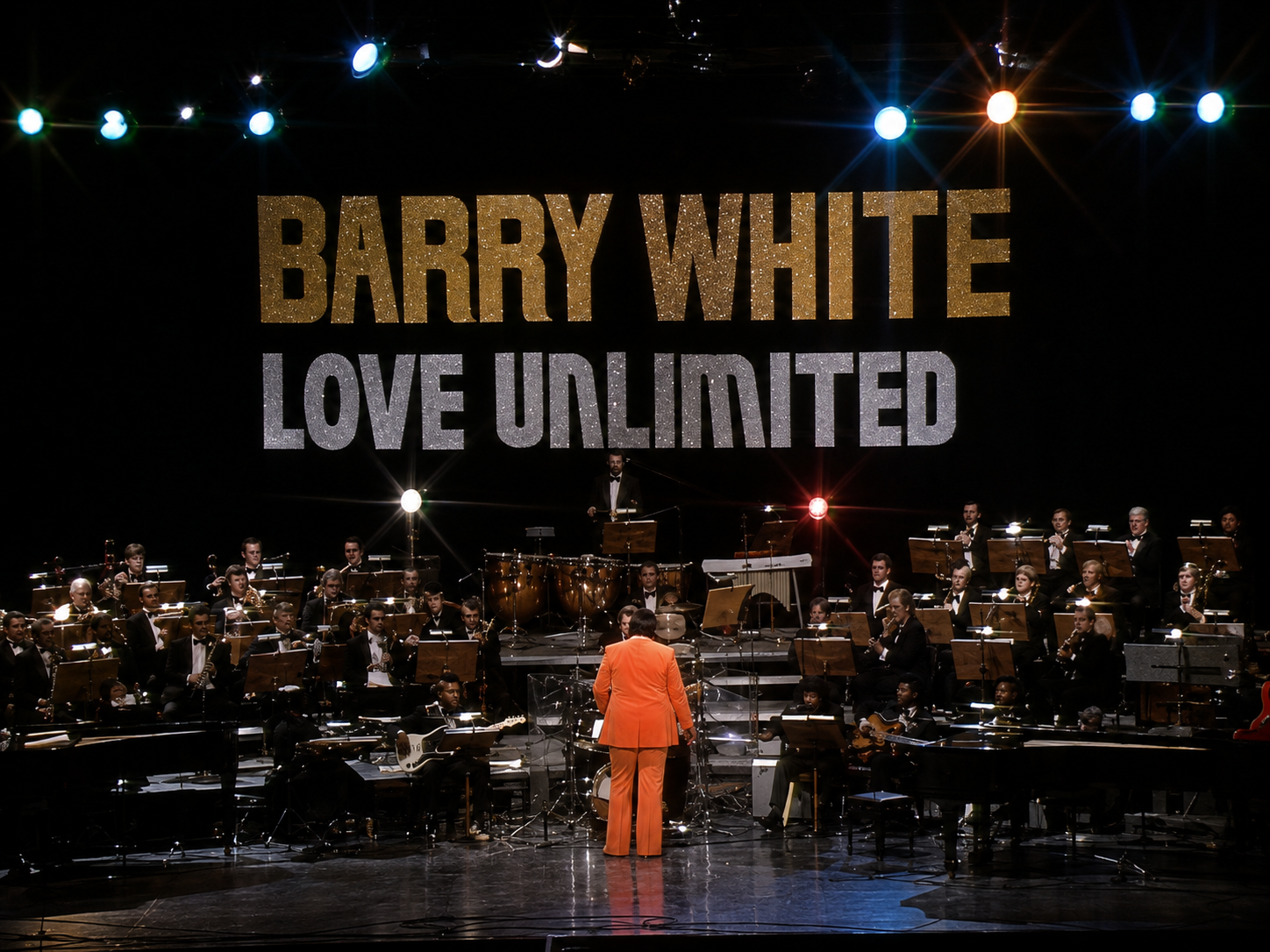
Before a single lyric could tell you what the song meant, “Love’s Theme” had already said everything. Those sweeping strings, that graceful glide of the melody, the soft but insistent pulse underneath it all — the record feels like a room slowly filling with light. Released in late 1973 and rising to prominence in 1974, Love Unlimited Orchestra’s signature hit became one of the defining instrumentals of its era, a record that managed to be lush, elegant, and deeply accessible all at once.
It was also a remarkable achievement for Barry White, who was building an empire that stretched far beyond his famous speaking-singing baritone. With “Love’s Theme,” he proved he could create a hit without words, using arrangement, atmosphere, and sheer emotional momentum to do the talking.
A melody before the message
How the song was written
The origins of “Love’s Theme” are closely tied to Barry White’s work with Love Unlimited, the female vocal trio made up of Glodean James, Linda James, and Diane Taylor. White had already been crafting a distinctive musical world around them: romantic, orchestral, and rhythmically grounded in soul. He was not simply producing songs; he was developing a whole atmosphere.
“Love’s Theme” began as an instrumental concept that carried the emotional DNA of that world. Barry White co-wrote the piece with Gene Page, the gifted arranger and conductor whose fingerprints are all over the record’s rich architecture. If White supplied the grand romantic vision, Page helped shape it into a fully realized orchestral statement, balancing silky string lines with a groove that never loses its footing.
There is a wonderful confidence in the composition. The melody is memorable almost immediately, but it does not rush. It unfolds. That patience is part of the song’s magic. Rather than pushing toward a dramatic climax, it invites the listener to settle into its motion. In that sense, “Love’s Theme” was perfectly aligned with Barry White’s broader style: sensual, spacious, and deeply controlled.
Built from a bigger idea
By the early 1970s, soul music was expanding in fascinating directions. Philadelphia soul was bringing in elegant arrangements, disco was beginning to take shape in clubs and on dance floors, and pop audiences were increasingly open to crossover sounds. Barry White understood that an instrumental could thrive in that environment if it had enough personality. “Love’s Theme” was not background music pretending to be a hit. It was a hit record built from orchestral color, groove, and emotional clarity.
The song was released under the name Love Unlimited Orchestra, a studio ensemble created to bring White’s large-scale musical ideas to life. That name mattered. It suggested abundance, glamour, and a kind of cinematic sweep — exactly what listeners heard when the record came on the radio.
Inside the studio
Barry White, Gene Page, and the players
The key creative figures behind “Love’s Theme” were Barry White as producer, co-writer, and guiding force, and Gene Page as co-writer, arranger, and conductor. Page was one of the era’s great musical architects, able to translate broad emotional ideas into detailed arrangements that felt both polished and alive.
The recording also depended on a strong pool of Los Angeles session musicians. While individual lineups could vary across sessions in that period, the sound itself tells the story of seasoned professionals at work: tight rhythm section playing, disciplined ensemble strings, and a horn presence used with taste rather than excess. Nothing is cluttered. Every part has a purpose.
That was one of Barry White’s great gifts as a producer. His records often sounded luxurious, but they were never shapeless. He knew how to make a track feel full without making it heavy. On “Love’s Theme,” the rhythm section gives the record its heartbeat, while the strings provide the emotional lift. The result is both danceable and dreamy — a combination that would become enormously influential.
The arrangement that made it unforgettable
One of the most striking things about “Love’s Theme” is how naturally it moves between pop accessibility and orchestral sophistication. The opening instantly sets the mood, but the arrangement keeps adding subtle pleasures: a rhythmic nudge here, a swelling phrase there, a sense of forward motion that never breaks the spell.
Gene Page’s arranging is central to that effect. The strings do not merely decorate the groove; they carry the song’s identity. Meanwhile, Barry White’s production gives the entire performance a warm, inviting sheen. The recording feels intimate despite its scale, as if a full orchestra has somehow stepped into your living room without losing any of its grandeur.
“Love’s Theme” is one of those rare instrumentals that people can hum after one listen — not because it is simple, but because it is beautifully shaped.
When the charts lit up
A rare instrumental smash
Commercially, “Love’s Theme” was a sensation. It reached No. 1 on the Billboard Hot 100 in early 1974, a remarkable achievement for any instrumental, let alone one so rooted in soul and orchestral styling. It also topped the Billboard Easy Listening chart and performed strongly on the R&B chart, proving just how broad its appeal was.
That crossover success is worth pausing on. Instrumentals had certainly been hits before, but by the mid-1970s the pop charts were increasingly dominated by vocal stars and singer-songwriters. For an orchestral soul instrumental to cut through in such a big way showed how irresistible the record was. Radio embraced it. Record buyers embraced it. Dance audiences embraced it. It seemed to belong everywhere at once.
Reception beyond the numbers
Part of the record’s commercial power came from its versatility. “Love’s Theme” could sit comfortably on soul stations, pop stations, easy listening formats, and at parties where people wanted something elegant but still rhythmic. It was sophisticated without being distant. Romantic without becoming overly sentimental. Stylish without sounding exclusive.
That balance helped make the song more than just a chart event. It became a piece of shared musical language. Even listeners who did not know the title often recognized the opening bars immediately.
The wider musical moment
Where soul, pop, and disco were meeting
To understand the importance of “Love’s Theme,” it helps to hear it in the context of its time. The early 1970s were full of musical cross-pollination. Soul was becoming more orchestrated. Pop was becoming more rhythm-conscious. Club culture was encouraging longer grooves and smoother transitions. “Love’s Theme” sits right at that intersection.
In many ways, it points toward disco before disco fully took over the mainstream. The steady pulse, the luxurious strings, and the sense of physical movement are all there. Yet it also retains the warmth of classic soul and the melodic clarity of pop. It does not feel trapped in one category, which is one reason it has lasted so well.
Barry White was especially important in this transition. He helped make lush orchestration feel central to Black popular music in a new way, not as a novelty but as a core expressive tool. “Love’s Theme” was a major statement in that evolution.
A signature of the Barry White universe
Although Barry White would become even more famous for his own vocal hits, “Love’s Theme” reminds us that his talent was much bigger than his voice. He was a builder of moods, a master of arrangement by instinct and collaboration, and a producer with a sharp understanding of what audiences responded to emotionally.
The record also helped define the identity of Love Unlimited Orchestra itself. This was not just a backing unit attached to a star producer. It became a recognizable brand, associated with romance, polish, and a kind of glamorous sweep that felt unmistakably 1970s.
The legacy of a record that still glides
Why it remains a classic hits favourite
What keeps “Love’s Theme” alive on classic hits radio is not just nostalgia, though nostalgia certainly plays a part. It is the song’s construction. The melody lands instantly. The groove is gentle but firm. The arrangement feels rich without becoming crowded. And because there are no lyrics fixing it to one specific story, listeners can bring their own memories to it.
That openness has given the record a long cultural life. It has appeared in films, television, compilations, and countless discussions of 1970s romance and style. It often functions as shorthand for sophistication, but that should not obscure the musical craft involved. This is not a joke record, a novelty, or a decorative old favourite. It is a beautifully made pop-soul instrumental with real structural intelligence.
Behind-the-scenes details worth savouring
- It was a breakthrough without a lead vocal: Barry White built a hit on arrangement, feel, and melody alone, which is far harder than it sounds.
- Gene Page’s role was crucial: his arranging and conducting helped turn White’s vision into something both lush and disciplined.
- It helped broaden Barry White’s brand: audiences came to see him not only as a singer and songwriter, but as a producer capable of creating an entire musical universe.
- Its influence reached into disco and beyond: the combination of strings and groove became a defining template for much of the decade.
A lasting glow
There is something wonderfully confident about “Love’s Theme.” It does not need lyrics to persuade you, and it does not need flashy tricks to hold your attention. It simply arrives, opens up, and carries you along. In an era crowded with unforgettable voices, Barry White and Love Unlimited Orchestra created a classic that spoke just as powerfully without one.
More than fifty years on, the record still feels like a small act of elegance on the airwaves — a reminder that pop music can be grand, tender, and instantly memorable all at once. When those strings rise and the rhythm settles in, you are not just hearing a hit from 1974. You are hearing a masterclass in mood, movement, and musical confidence.