Before He Was King of the Monsters: The Original Godzilla of 1954
Before Godzilla became a pop-culture icon and battled an army of giant monsters, he emerged from the sea in 1954 as something far darker. The original Japanese *Godzilla* was a haunting black-and-white story shaped by the fears of the atomic age—and the beginning of a movie legend that would endure for generations.
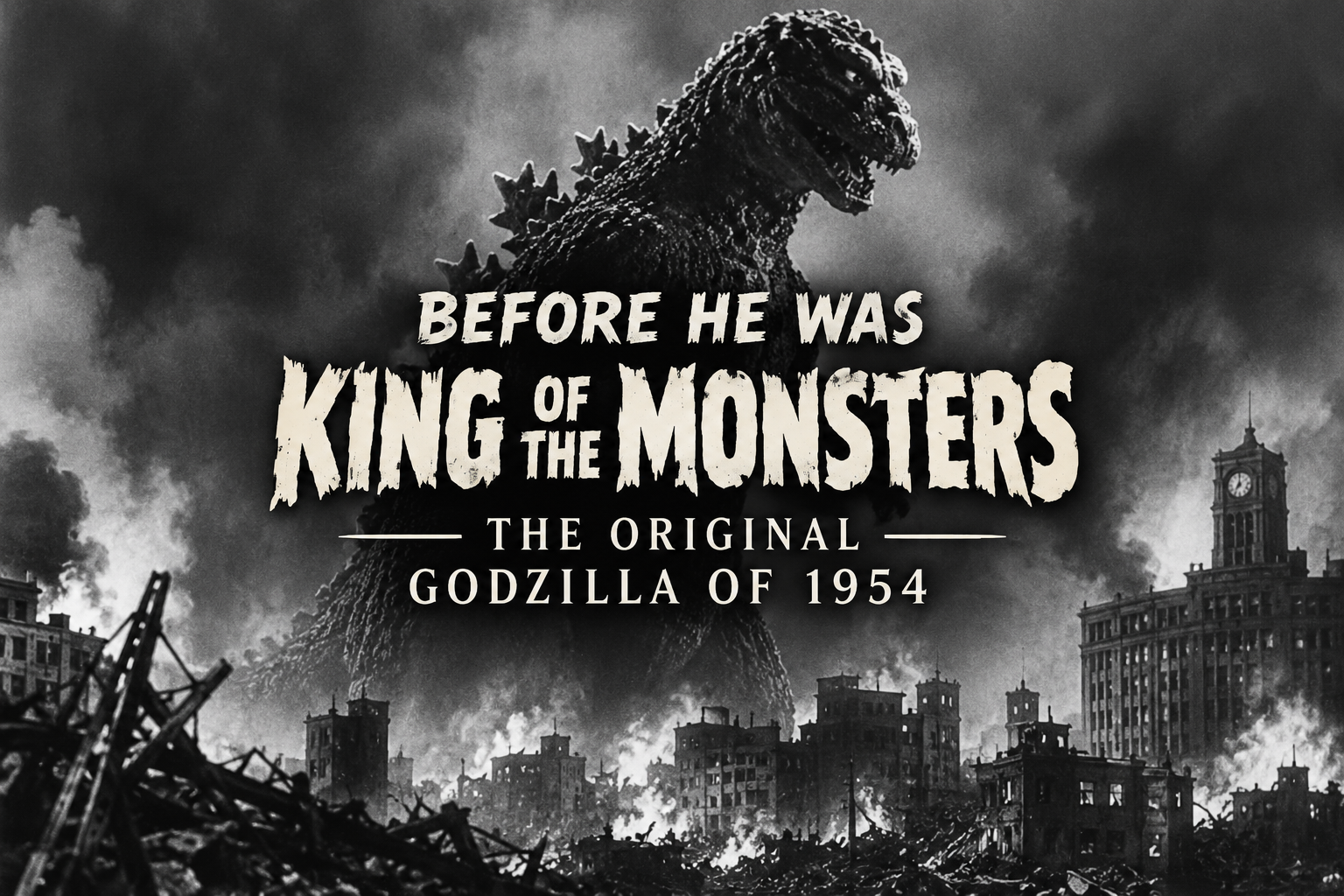
Long before Godzilla fought giant moths, three-headed dragons, mechanical versions of himself and nearly every other monster Japanese filmmakers could imagine, he emerged from the sea as something much more frightening.
In 1954, audiences in Japan saw Gojira for the first time. There were no bright colors, no playful monster battles and very little of the larger-than-life adventure that would eventually become associated with the Godzilla name. The original film was shot in stark black and white, and when Godzilla appeared over the hills of Odo Island or walked through a burning Tokyo, he wasn’t presented as a superhero or even simply as a giant prehistoric animal.
He was a nightmare from the atomic age.
A Monster Born From a Very Real Fear
It is difficult to understand the original Godzilla without remembering when it was made. Less than a decade had passed since the atomic bombings of Hiroshima and Nagasaki, and memories of the destruction were still painfully recent. Then, in March 1954, another nuclear incident brought those fears back into everyday Japanese life.
The Japanese fishing vessel Daigo Fukuryū Maru, known in English as Lucky Dragon No. 5, was exposed to radioactive fallout from an American hydrogen-bomb test at Bikini Atoll. The fishermen returned to Japan suffering from radiation sickness, and the incident caused widespread fear about radioactive contamination.
Only months later, that anxiety found its way onto movie screens.
Producer Tomoyuki Tanaka developed the idea for a giant monster connected to nuclear testing, while director Ishirō Honda approached the story with unusual seriousness. Godzilla was imagined as an ancient creature awakened and transformed by nuclear explosions. The monster wasn’t merely attacking civilization. In a sense, civilization had created the conditions that brought him back.
That distinction gives the original movie a weight that many of its sequels deliberately left behind.
This Wasn’t the Godzilla Many of Us Met on Television
For viewers who discovered Godzilla years later on Saturday afternoon television, the original film can be surprising.
Many of the Godzilla movies that circulated widely during the 1960s and 1970s were colorful spectacles filled with fantastic creatures and increasingly elaborate battles. Godzilla himself gradually changed as well, eventually becoming something closer to a defender of Earth.
There is almost none of that personality in the 1954 Godzilla.
When he reaches Tokyo, the destruction is treated like a genuine catastrophe. Buildings collapse. Fires spread across the city. Families attempt to escape. Hospitals fill with injured people. Radio reporters continue broadcasting as the monster approaches them. The camera frequently remains with ordinary people rather than treating the destruction merely as spectacle.
For Japanese audiences watching in 1954, images of a city reduced to flames carried memories that were not remotely distant.
How They Made a Giant Monster in 1954
Today we are accustomed to seeing enormous creatures created through computer-generated imagery, but Godzilla’s first appearance came from an entirely different world of filmmaking.
Special-effects director Eiji Tsuburaya and his team constructed detailed miniature sections of Tokyo and combined them with monster suits, puppetry and other practical effects. Performers Haruo Nakajima and Katsumi Tezuka wore the Godzilla suit for many sequences, while puppets were used for certain close-ups and effects that couldn’t easily be achieved with the full costume.
Nakajima would eventually become particularly associated with the character, playing Godzilla in numerous films and helping establish the physical movements audiences came to recognize.
Watching the original effects today is part of the pleasure. You can sometimes recognize that you’re looking at miniatures, yet there is a physical quality to the destruction that remains remarkably effective. Buildings don’t simply disappear into pixels. They buckle, burn and collapse. Electrical towers spark. Smoke hangs over miniature streets. Godzilla physically moves through a city that filmmakers actually constructed for him to destroy.
It became the foundation of the Japanese special-effects tradition that would eventually be known around the world.
And Then There Was That Sound
Even people who have never watched a complete Godzilla movie probably recognize the roar.
Composer Akira Ifukube created not only the film’s unforgettable musical score but also helped establish the soundscape surrounding the monster. His heavy, marching music gives Godzilla’s approach an almost inevitable feeling, as though something enormous and unstoppable is coming toward the city.
The footsteps are just as important.
Before audiences even properly see Godzilla, they hear him. The pounding footsteps and strange roar make the creature feel enormous before the movie has to show his full size. In a darkened theater in 1954, that combination of sound, music and black-and-white imagery must have been extraordinary.
It is one of those cases where technical limitations may actually have helped create something more memorable.
The Human Story Is Just as Important
Another thing easily forgotten about the original Godzilla is how much of the movie belongs to its human characters.
At the center of the story is Dr. Daisuke Serizawa, a scientist who has developed a terrifying device called the Oxygen Destroyer. It may be powerful enough to kill Godzilla, but Serizawa understands immediately what could happen if governments learned how to reproduce it.
His dilemma mirrors the larger theme of the movie.
Human beings have created weapons powerful enough to change the world, and once that knowledge exists, can it ever truly be controlled?
The final confrontation with Godzilla therefore isn’t simply about finding a bigger weapon to defeat a bigger monster. It asks whether humanity can stop repeating the same cycle that created the disaster in the first place.
That is a surprisingly serious question for a movie that would eventually launch one of cinema’s biggest monster franchises.
The Godzilla America First Saw Was Different
There is another interesting chapter to the story.
When the movie reached American audiences in 1956, it appeared as Godzilla, King of the Monsters! Rather than simply dubbing the Japanese film, the American version was substantially reworked and incorporated newly filmed scenes featuring Raymond Burr as American reporter Steve Martin.
For decades, this altered version was the Godzilla movie many Western viewers knew.
That makes watching the original Japanese Gojira today especially fascinating. Without the additional American footage and restructuring, the movie feels less like the creature feature that later audiences might expect and more like a Japanese postwar drama that happens to contain a giant radioactive monster.
Before Godzilla Became an Icon
Of course, Godzilla didn’t remain this frightening forever.
The success of the first movie led to sequels, and before long Japan had an entire universe of giant monsters. Godzilla fought Anguirus, King Ghidorah, Mothra, Mechagodzilla and many others. The movies became bigger, stranger, more colorful and, at times, wonderfully ridiculous.
Children bought toys. Godzilla appeared on television. Generations discovered the movies through weekend broadcasts, VHS tapes, video stores and late-night monster marathons.
Somewhere along the way, the creature that had once represented nuclear terror became beloved.
And perhaps that is why returning to the first film is so interesting.
Go Back to 1954
If your memory of Godzilla is a man in a rubber suit wrestling another monster while buildings collapse around them, go back and watch the movie that started everything.
Turn off the lights. Leave the Japanese soundtrack on and use subtitles. Let the black-and-white photography, Akira Ifukube’s music and the slow appearance of the monster do their work.
Don’t watch it expecting Godzilla vs. Mechagodzilla or one of the enormous modern Hollywood productions.
Watch it as an audience might have watched it in 1954.
A fishing boat disappears at sea. Something enormous is moving beneath the water. Strange footprints appear. Radiation is detected. People begin looking nervously toward the ocean.
And eventually, over the top of a hill, a head appears.
For the first time in movie history, the world is looking at Godzilla.
Nobody watching that screen in 1954 could possibly have known that they were witnessing the birth of a monster we’d still be talking about more than seventy years later.