Neil Diamond lit up every room he sang in
Neil Diamond brought drama, warmth, and unforgettable melodies to popular music, creating songs that still fill dance floors, car radios, and concert halls with pure joy. This upbeat look behind the scenes traces his journey from Brooklyn songwriter to one of classic hits radio's most enduring voices.
There are some voices that do more than carry a tune. They fill a room, lift a memory, and somehow make a song feel personal even when millions of people know every word. Neil Diamond has always had that kind of voice: rich, dramatic, warm, and unmistakably his own. For classic hits listeners, he is more than a chart star. He is the writer of singalong anthems, the performer with glittering stage presence, and the storyteller who could move from intimate confession to full-throated celebration in a heartbeat.
Behind the famous choruses and sold-out concerts is a remarkable story of persistence, craft, and a songwriter who learned early that a great melody could travel anywhere. Neil Diamond’s career has stretched across decades, generations, and changing musical fashions, yet his songs still feel alive the moment they come on the radio.
From Brooklyn beginnings to Tin Pan Alley dreams
Neil Diamond was born on January 24, 1941, in Brooklyn, New York, and grew up in a household where music was part of everyday life. His family later spent time in Wyoming before returning to Brooklyn, and those early moves gave him a sense of the wider world beyond the city streets. Still, New York was the place where his musical ambitions took shape.
As a teenager, Diamond was drawn to songwriting as much as singing. He has often spoken about the spark that came from hearing great popular songs and realising that someone had to sit down and create them. Folk music, rhythm and blues, and the emerging pop sounds of the late 1950s all fed his imagination. He briefly attended New York University on a fencing scholarship, an unusual detail in the story of a future music icon, but the pull of songwriting proved stronger than academic life.
That decision led him into the legendary Brill Building scene in Manhattan, where young writers worked at a furious pace, shaping songs for publishers and performers. It was a perfect training ground. Diamond learned discipline, structure, and the art of writing hooks that stayed with listeners long after the record stopped spinning. In those early years, he was not yet the fully formed star the world would come to know. He was a determined young writer, hustling for opportunities, learning how to marry emotion with commercial appeal.
One of his first notable successes came as a songwriter for others, including songs recorded by artists such as Jay and the Americans. That behind-the-scenes apprenticeship mattered. It taught him how songs could take on different lives depending on who sang them, and it sharpened his own sense of identity as a performer.
The breakthrough years that changed everything
Neil Diamond’s breakthrough as a recording artist began in the mid-1960s, and once it arrived, it did not do so quietly. His early hits for Bang Records announced a new and distinctive talent. “Solitary Man”, released in 1966, carried a moody, introspective quality that stood apart from much of the pop around it. It was not just catchy; it felt personal, slightly bruised, and deeply human. That emotional directness would become one of his trademarks.
Then came “Cherry, Cherry”, a record bursting with energy and swagger. Where “Solitary Man” revealed vulnerability, “Cherry, Cherry” showed Diamond’s ability to write a driving pop-rock hit with instant appeal. The contrast between those songs hinted at the range he would continue to explore throughout his career.
The late 1960s and early 1970s saw Diamond move into a new league. Signing with Uni Records gave him greater artistic freedom, and the hits kept coming. “Sweet Caroline” in 1969 became one of the defining songs of his career, and indeed one of the great communal singalongs in popular music. Its famous chorus has become almost a public ritual, sung in sports stadiums, concert halls, weddings, parties, and anywhere people want to feel united for a few glorious minutes.
Diamond later said the song was inspired in part by a photograph of Caroline Kennedy as a child, though he also recognised how the song had grown far beyond its original spark. That is one of the fascinating things about his work: he often wrote from a personal impulse, but the songs opened themselves up so completely that audiences made them their own.
By the early 1970s, he was not just a hitmaker but a major concert attraction. Songs such as “Cracklin’ Rosie”, “Song Sung Blue”, and “I Am… I Said” cemented his place among the era’s biggest stars. He could deliver upbeat radio favourites and deeply reflective ballads with equal conviction. Few artists managed that balance so consistently.
The songs that made listeners sing, sway, and remember
Any Neil Diamond spotlight has to pause for the songs, because this catalogue is packed with records that seem woven into everyday life. Some became chart triumphs. Others turned into emotional landmarks for listeners.
- “Sweet Caroline” – The ultimate crowd-pleaser, famous for its joyful build and irresistible chorus.
- “Cracklin’ Rosie” – A spirited, catchy number that became his first American number one hit.
- “Song Sung Blue” – Gentle, melodic, and quietly comforting, it showed his gift for simplicity.
- “I Am… I Said” – One of his most personal songs, wrestling with identity, loneliness, and belonging.
- “Cherry, Cherry” – Early Diamond at full energy, with a punchy rhythm and youthful confidence.
- “Solitary Man” – A defining statement of introspective pop songwriting.
- “America” – Grand, sweeping, and full of movement, it became an anthem of hope and arrival.
- “Love on the Rocks” – A dramatic heartbreak ballad delivered with enormous emotional force.
- “Hello Again” – Tender and cinematic, showing his softer side in the 1980s.
- “Forever in Blue Jeans” – Relaxed, catchy, and full of easy charm.
Then there is “Red Red Wine”, a song Diamond wrote and recorded in 1967. His original version had a smooth, reflective feel, but the song found renewed life through later cover versions, most famously by UB40. It is a reminder of how strong his songwriting was: his compositions could be reinterpreted across styles and generations while still retaining their emotional core.
Another major chapter came with Jonathan Livingston Seagull, the 1973 soundtrack album that earned him a Grammy and showed his more ambitious, spiritual side. It was not simply another collection of pop singles. It suggested an artist reaching for something more expansive and philosophical.
Behind the scenes, a craftsman at work
Part of Neil Diamond’s enduring appeal lies in the fact that he was never just a singer handed great material. He was the architect of so much of his own success. He wrote with a strong sense of drama, but he also understood economy. A Neil Diamond song often gets to the heart of its feeling quickly, then builds with repetition, rhythm, and phrasing until it becomes something almost theatrical.
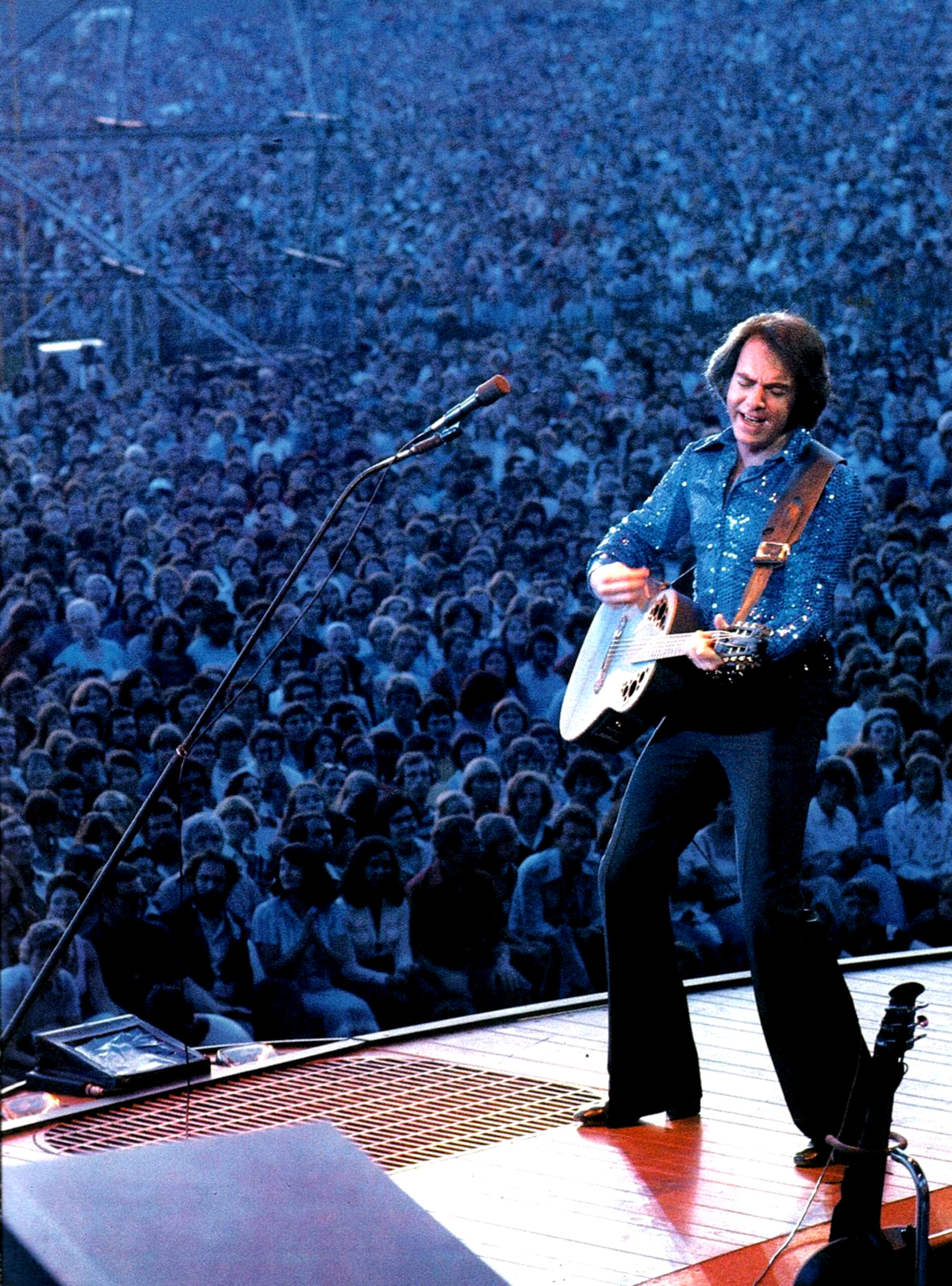
That theatrical quality was central to his stage persona. In concert, Diamond could be dazzling: sequined shirts, commanding presence, broad gestures, and a voice that seemed to reach the back row without strain. Yet for all the spectacle, there was always a songwriter’s intimacy at the centre. He knew how to make a giant venue feel personal.
One often-quoted line from Diamond captures his connection to songwriting itself:
“Songs are my conversation with people.”
That idea explains a great deal. Even his biggest anthems feel like they are trying to connect rather than simply impress. He wrote songs people could step into, songs that invited participation. That is one reason they continue to thrive on radio. They do not just play in the background. They ask listeners to join in.
There are also some fascinating lesser-known threads in his story. Before becoming a star, Diamond wrote “I’m a Believer”, which became a massive hit for The Monkees in 1966. It is one of the great pop songs of its era, and it showed that even before his own solo fame fully exploded, he was already shaping the sound of the charts from behind the curtain.
Another intriguing chapter came with his 1980 film and soundtrack The Jazz Singer. The film itself received mixed reactions, but the music was a major success, producing songs including “Love on the Rocks”, “Hello Again”, and “America”. In classic Neil Diamond fashion, even a complicated project yielded songs that outlasted the headlines around it.
A style all his own
Trying to place Neil Diamond neatly in one genre has always been difficult, and that is part of what makes him so compelling. His music draws from pop, rock, folk, adult contemporary, gospel touches, and the grand emotional sweep of classic American songwriting. At times he could sound intimate and confessional; at others, he could sound almost hymn-like, reaching for something huge and communal.
His voice was central to that blend. It had grit without roughness, richness without heaviness, and a natural dramatic lift that made even simple lines feel important. He also had a gift for rhythm. Listen closely to songs like “Cherry, Cherry” or “Cracklin’ Rosie” and you hear how strongly he understood momentum. Listen to “I Am… I Said” or “Hello Again” and you hear his patience with a line, his willingness to let emotion settle in.
His influence can be heard in generations of singer-songwriters who learned that commercial success and personal expression did not have to be opposites. He helped prove that a songwriter could be both accessible and deeply individual. Artists across pop and rock have admired his melodic instincts, his emotional honesty, and his command of a live audience.
Why Neil Diamond still matters on classic hits radio
For classic hits radio listeners today, Neil Diamond remains essential because his songs still do what great radio songs are meant to do: they connect instantly. Within a few seconds, a listener knows where they are. A piano figure, a drumbeat, that voice rising into a chorus, and suddenly the car, the kitchen, the office, or the garden feels brighter.
His records also carry memory beautifully. They can call up first dances, family road trips, summer evenings, old friendships, and the thrill of hearing a favourite song in just the right moment. But nostalgia alone is not enough to explain his staying power. These songs endure because they are expertly built, emotionally generous, and endlessly replayable.
There is something wonderfully democratic about Neil Diamond’s music. It belongs equally to dedicated fans who know every album track and to casual listeners who simply cannot resist joining in when “Sweet Caroline” comes on. That wide embrace is rare. It is the mark of an artist who understood not only how to write songs, but how to make people feel included in them.
Even in later years, as Diamond’s live appearances became less frequent following his 2018 announcement that he had been diagnosed with Parkinson’s disease, the affection surrounding him only seemed to deepen. Audiences were reminded that his work had already become part of the cultural fabric. The songs were still there, still rising from radios and playlists, still bringing people together.
Neil Diamond matters because he gave popular music both scale and heart. He could be glittering and grand, but he never lost the human touch. For anyone who loves classic hits, his catalogue is a reminder that the best songs are not just heard. They are carried with us, sung back to the speakers, and shared across generations.
And that may be the most Neil Diamond thing of all: behind the showmanship, behind the chart numbers, behind the famous choruses, there was always a songwriter reaching out, one song at a time, lighting up the room.