Why Buck Rogers Still Sparks
Here's what made Buck Rogers in the 25th Century such a hard show to resist: charm, chrome, clever casting, and a future that looked like it had stepped straight out of a disco dream. This upbeat look back revisits the series with plenty of nostalgia and a few behind-the-scenes pleasures along the way.
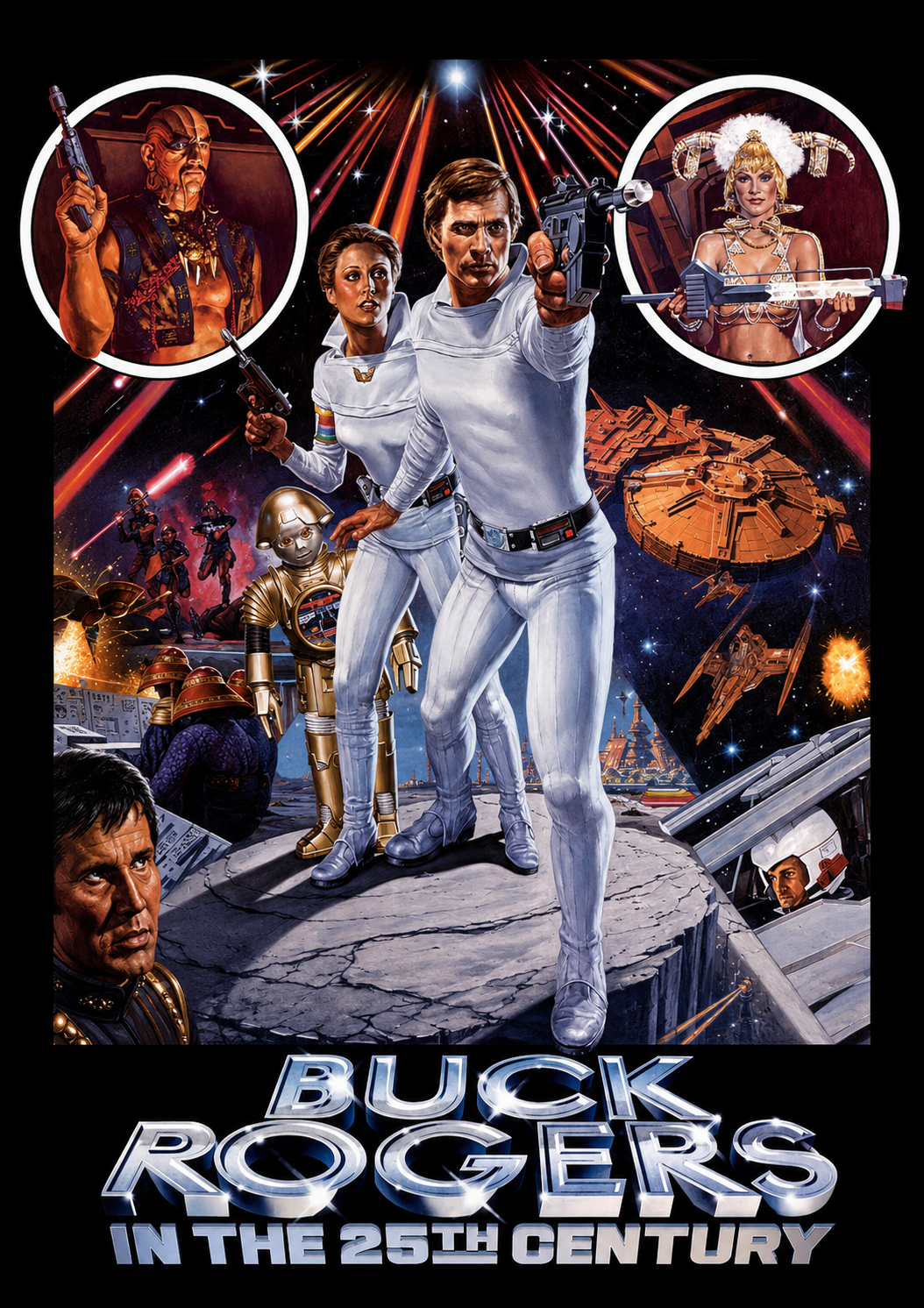
There are television shows that feel tied to their moment, and then there are shows that seem to beam in from somewhere just beyond it. Buck Rogers in the 25th Century, which launched at the end of the 1970s, belongs firmly in that second category. It is flashy, playful, a little outrageous, and completely aware that science fiction can be both thrilling and fun. For many viewers, it was not just a series. It was an event: the kind of programme that made the living room feel a little more futuristic the moment the theme music began.
Looking back now, Buck Rogers is easy to enjoy on several levels at once. It works as a colourful adventure, as a time capsule from the late 1970s, and as a fascinating example of how television tried to ride the wave created by the space craze of the era. Most of all, it remains a warm, entertaining reminder that escapism does not need to be solemn to leave a lasting impression.
A space-age hero for prime time
The series was based on the classic comic-strip character Buck Rogers, but this version gave the old hero a modern television makeover. Gil Gerard played Captain William “Buck” Rogers, a 20th-century astronaut who awakens centuries in the future after being frozen in space. It is a terrific premise because it gives the audience a guide through this strange world: Buck is seeing it all for the first time, just as we are.
That future, of course, is pure late-1970s imagination. The costumes shimmer. The sets gleam. The dialogue moves easily from danger to flirtation to comedy. And at the centre of it all is Gerard, who understood the assignment perfectly. He did not play Buck as a distant superhero. He played him as a charming, quick-thinking man thrown into extraordinary circumstances, with just enough swagger to keep things lively.
Then there was Erin Gray as Colonel Wilma Deering, giving the show real steel and balance. Wilma was not simply there to admire the hero. She was intelligent, capable, and commanding, and Gray brought a grounded presence that helped the series avoid drifting too far into camp. Add in the wonderfully dry vocal performance of Mel Blanc as Twiki, the wisecracking robot companion, and the show had a cast dynamic that felt instantly memorable.
The magic of its late-70s style
Part of the pleasure of revisiting Buck Rogers in the 25th Century is that it wears its era so proudly. This is future fantasy filtered through disco lights, glossy production design, and the kind of television confidence that believed viewers would happily follow a story if it had enough energy and charm. That confidence was not misplaced.
The series arrived in a period when science fiction was booming on screens both large and small. Audiences had embraced spectacular space adventures, and television wanted in. Buck Rogers answered that demand with a style all its own. It did not try to be grim or philosophical at every turn. Instead, it leaned into adventure serial fun, with laser battles, alien plots, sleek starships, and a hero who could throw out a one-liner without breaking stride.
What keeps it appealing is that the show understood entertainment value. It knew that viewers wanted action, but also glamour. They wanted futuristic hardware, but also personality. They wanted danger, but not at the expense of a good time. In that sense, Buck Rogers played like a perfect Friday-night record spin: lively, polished, and designed to keep the mood high.
That unforgettable visual identity
Even people who have not seen the series in years often remember the look immediately. The uniforms, the metallic textures, the glowing control panels, the theatrical villains, the dramatic model work: all of it combines into a version of the future that is less about realism and more about excitement. It is a future built for television, where every frame tries to give the audience something fun to look at.
There is also something deeply affectionate in the way the show presents tomorrow. This is not a future of total despair. It is adventurous, sometimes absurd, often glamorous, and full of possibility. That optimism gives the series a buoyant quality that still feels refreshing.
Behind the scenes, ambition was everywhere
One of the most interesting things about Buck Rogers in the 25th Century is how much effort went into making it feel big. The series began with a theatrical feature released before the weekly programme, and that gave it a scale unusual for television at the time. Producers clearly wanted viewers to feel they were getting something cinematic in their own homes.
The visual effects team had a considerable task. This was an era before digital shortcuts, so spacecraft, explosions, and futuristic environments often depended on miniatures, optical effects, compositing, and a great deal of patient craftsmanship. Watching the show now, you can sense that hands-on ingenuity in nearly every action sequence. There is a tactile charm to practical effects that modern productions sometimes struggle to match.
The show also benefited from the broader television tradition of the time: guest stars, self-contained adventures, and bold concepts introduced with confidence. One week could bring political intrigue, the next a strange alien threat, the next a comic detour. That variety gave the series a radio-like quality. Tune in, and you knew you would get the familiar voices and atmosphere you loved, but with a fresh hook each time.
The chemistry that sold it
Science fiction can have all the dazzling hardware in the world, but if the cast does not click, the illusion fades quickly. Buck Rogers succeeded because its central performances gave the spectacle a human pulse. Gil Gerard brought easy charisma, Erin Gray brought authority and intelligence, and the supporting players added colour in all the right places.
The relationship between Buck and Wilma was especially important. It gave the show a spark that was playful without becoming weightless. Their exchanges often carried the rhythm of a good pop duet: one voice confident, the other measured, both making the tune stronger.
Why it still works for nostalgic viewers
Some series survive because they are flawless. Others survive because they are distinctive, generous, and impossible to confuse with anything else. Buck Rogers in the 25th Century belongs in that second group. It is a show with personality to spare.
For nostalgic viewers, that matters enormously. Rewatching it is not just about plot. It is about texture. It is about hearing that theme, seeing those opening images, and remembering a time when futuristic television could be bright, cheeky, and unapologetically entertaining. It is about the pleasure of a series that invites you in with a grin.
There is also a deeper reason the show lingers. Buck himself is an appealing fantasy figure: an ordinary man, in some ways, dropped into an extraordinary age and somehow keeping his balance through wit and nerve. That is a timeless setup. It gives the series an emotional accessibility beneath all the chrome and laser fire.
Buck Rogers remains one of those rare television adventures that can make you smile before the first scene has properly settled in.
A quick look back in motion
If you want to recapture some of that gleaming, high-energy appeal, this clip is a fine place to start:
The second season shift
No review of Buck Rogers in the 25th Century is complete without mentioning that the series changed direction in its second season. The format moved toward a more roaming, exploratory style, with Buck and company aboard the starship Searcher. The idea was understandable: broaden the canvas, deepen the science-fiction world, and perhaps steer the show toward something more expansive.
For some viewers, that shift was intriguing. For others, it lost a little of the original sparkle. The first season had a pop sheen and a playful rhythm that felt uniquely its own. The second season aimed for a different tone, and while it had its merits, many fans still gravitate to the earlier episodes where the blend of action, humour, and style felt most effortless.
That contrast, though, is part of the show’s story. It reveals how television was always balancing audience expectations, creative ambition, and the pressure to evolve. Even the changes make the series more interesting to revisit now.
Final thoughts
Buck Rogers in the 25th Century is not merely a relic from the late 1970s. It is a bright, energetic piece of television history that still knows how to entertain. It captures a moment when science fiction on television was eager to dazzle, unafraid of glamour, and happy to mix adventure with a wink.
That is why the show still sparks. It reminds us that the future, at least on television, once arrived in silver fabrics, bold music, and a hero with a confident smile. For fans of classic genre television, and for anyone who enjoys revisiting the more exuberant side of late-70s pop culture, Buck Rogers remains well worth the trip.
- Best reason to revisit: the irresistible blend of camp, charisma, and action
- Standout performance: Erin Gray’s poised and memorable Wilma Deering
- Most lasting quality: a sense of fun that never apologises for itself