Space: 1999 — television’s bold leap into the unknown
Why does Space: 1999 still matter to classic hits fans? Because like a great record, it has style, confidence, and a sense of adventure that never really goes out of tune.
What happens when a television series aims for the stars with the confidence of a stadium anthem? Space: 1999 is the answer: a dazzling, ambitious science-fiction adventure that still feels special because it never thought small. For many viewers, it was not just a programme about the Moon drifting through deep space. It was a weekly invitation to imagine bigger worlds, stranger dangers, and a future built with style, seriousness, and just a little bit of beautiful 1970s swagger.
Created by Gerry and Sylvia Anderson, the series first arrived in 1975 and quickly stood apart from other science-fiction television of its day. Set on Moonbase Alpha after a catastrophic explosion blasts the Moon out of Earth’s orbit, the show follows Commander John Koenig, Doctor Helena Russell, Professor Victor Bergman, and the rest of Alpha’s crew as they encounter mysterious planets, alien intelligence, and cosmic phenomena on their journey through the unknown. It is a wonderfully simple premise, and that simplicity gave the series room to be imaginative week after week.
A science-fiction series with cinematic ambition
One of the first things that strikes you about Space: 1999 is just how big it looks. This was television made with the eye of a filmmaker. The sets were sleek and expansive, the miniatures were detailed and convincing, and the Eagle transporters remain some of the most elegant spacecraft ever designed for the screen. Even now, those ships have a clean, practical beauty about them, like something dreamt up by engineers who also happened to have excellent taste.
That visual polish mattered. In the mid-1970s, audiences were used to science fiction on television looking inventive but often a little cramped. Space: 1999 pushed far beyond that. It had atmosphere, scale, and a cool modern design language that made Moonbase Alpha feel believable. You could almost hear the hum of the corridors and imagine the tension in the command centre as another impossible object appeared on the scanners.
There is also a seriousness in the presentation that gives the show its distinctive flavour. This is not a wink-at-the-camera kind of adventure. The characters react to danger with urgency, uncertainty, and often genuine fear. That weight gives the series drama, even when the plots become gloriously strange.
The Eagle transporter steals every scene
If one machine deserves its own fan club, it is the Eagle. Functional, modular, and unmistakably stylish, it became the signature image of the series. Plenty of science-fiction vehicles look exciting, but the Eagle looked useful. It felt like a craft people might actually rely on, which made every launch and landing more thrilling. Ask longtime fans what they remember first, and many will picture that graceful white transporter lifting off against the blackness of space.
The cast gives the cold vastness a human heartbeat
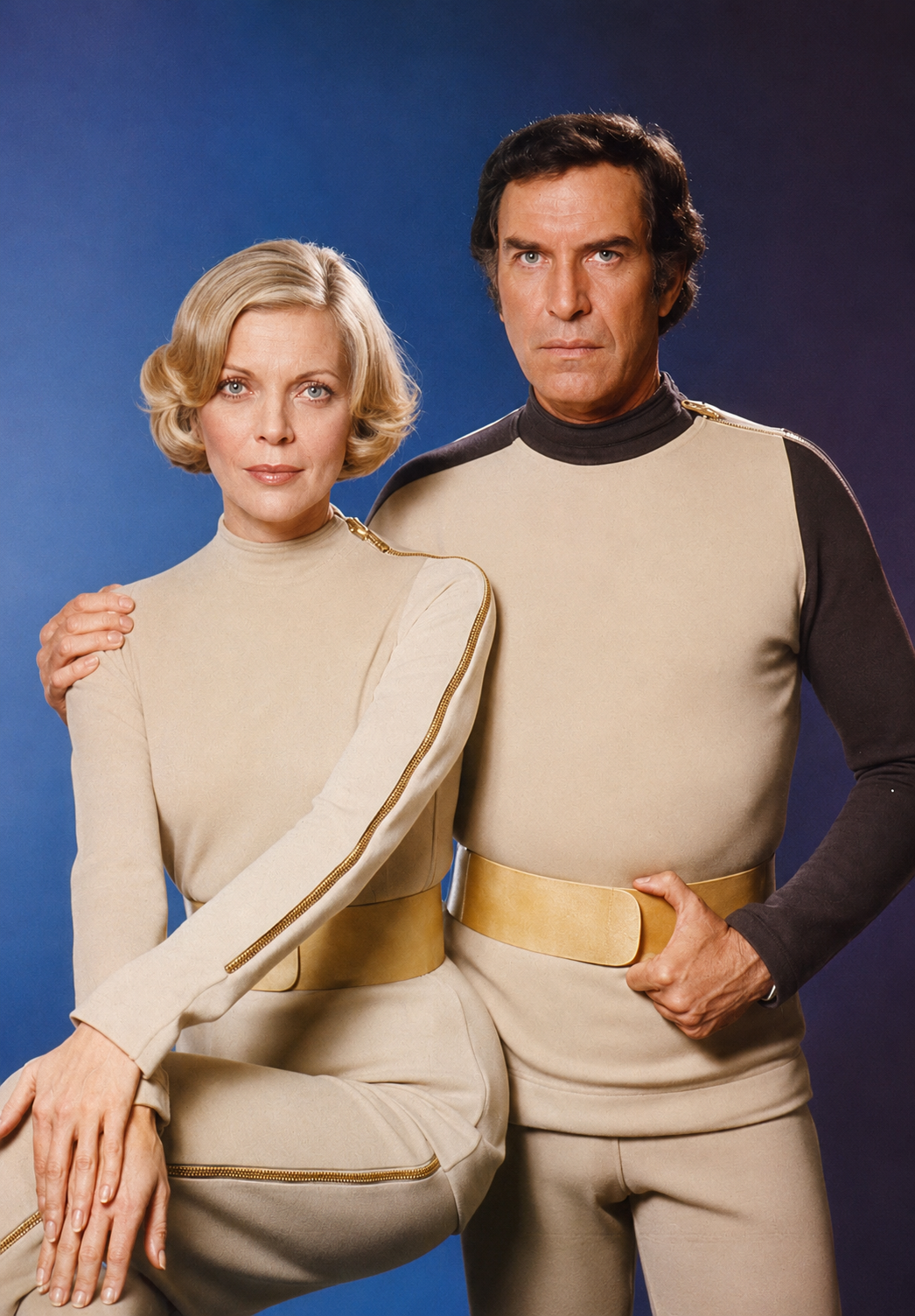
Martin Landau brings a commanding presence to John Koenig. He plays the role with intensity and intelligence, giving the series a strong centre. Barbara Bain, as Doctor Helena Russell, adds compassion and resolve, balancing the hard-edged survival story with warmth and moral clarity. And then there is Barry Morse as Professor Victor Bergman, one of the show’s great pleasures. He brings curiosity, humanity, and a gentle wisdom that makes even the strangest episode feel grounded.
Together, the cast helped the series avoid becoming just a parade of impressive effects. At its best, Space: 1999 is about isolation, leadership, fear, and hope. The Moonbase Alpha crew are not explorers by choice. They are survivors, cut off from home, trying to make sense of an endless series of encounters that could either save them or destroy them.
That emotional setup gives the programme a haunting quality. Beneath the futuristic hardware and dramatic music, there is a very human question at the heart of it all: how do people keep going when the familiar world is gone?
Behind the scenes, this was television built with care
Part of the enduring affection for Space: 1999 comes from the craftsmanship behind it. Gerry and Sylvia Anderson had already transformed television science fiction with earlier productions, but this series showed what happened when their experience met a larger canvas. The production team poured enormous effort into model work, set design, costumes, and visual effects, creating a world that felt coherent and distinctive.
The special effects were supervised with remarkable precision, and it shows. The miniature photography has a tactile richness that many viewers still love today. In an age before digital effects could do almost anything, these sequences had to be planned, lit, and filmed with patience and ingenuity. There is a handmade magic to that process. You can sense the artistry in every Eagle launch, every spinning moonscape, every silent drift through the stars.
A transatlantic production with real star power
The series also had an international flavour that helped it travel well. With American leads, British production expertise, and a concept broad enough to capture imaginations around the world, Space: 1999 became the kind of show that viewers in many countries could claim as their own. It felt polished and exportable, but never generic.
Guest stars added another layer of excitement. Familiar faces would appear in stories that ranged from eerie psychological drama to full-scale cosmic peril. That variety gave the show a fresh energy. One week it could feel philosophical and unsettling, the next like a tense survival thriller.
Why it still clicks with classic hits audiences
There is a good reason Space: 1999 belongs comfortably in the world of a classic hits radio station blog. It shares something important with the great songs of the 1960s, 70s, and 80s: confidence. It is a show that commits fully to its mood, its style, and its sense of wonder. Like a memorable record, it has an identity you recognise immediately.
Classic hits audiences often respond to more than nostalgia alone. They respond to craft, personality, and atmosphere. Space: 1999 has all three. Its opening titles alone have the punch of a great intro track, promising drama on a grand scale. Its design is as distinctive as an album cover you can spot across the room. And its emotional tone, serious but adventurous, taps into that same appetite for art that aimed high and meant it.
There is also the pleasure of rediscovery. Watching the series now, you are not only revisiting a television favourite. You are reconnecting with an era when science fiction on screen was becoming more sophisticated, more cinematic, and more daring. That makes it a wonderful companion piece to the music of the period: both reflect a time when popular culture was reaching outward, experimenting with texture, ambition, and identity.
The uneven edges are part of the charm
No honest review should pretend the series is flawless. Some episodes are stronger than others, and the shift in tone between the first and second seasons has long been a talking point among fans. Season one often leans into mystery and mood, while season two becomes more colourful and action-driven. Viewers tend to have their preference, and that debate is part of the fun.
There are moments when the science is more poetic than plausible, and moments when the dialogue carries the grand solemnity of a show determined to sound important. But that is also part of what makes Space: 1999 memorable. It swings big. It does not settle for being merely adequate background television. Even its stranger choices feel like the work of people trying to create something distinctive.
- Best reason to watch: the extraordinary design and effects work
- Most lasting image: an Eagle transporter gliding across the lunar surface
- Biggest strength: a serious, immersive atmosphere
- Enduring appeal: it treats science fiction as drama, not decoration
A series that still knows how to lift off
Seen today, Space: 1999 remains a fascinating and often thrilling piece of television. It is stylish, earnest, occasionally eerie, and full of visual imagination. More importantly, it still carries that electric feeling of possibility that made so much 1970s popular culture so exciting. This was not small-screen science fiction thinking modestly. This was television looking up at the night sky and deciding to go for it.
Space: 1999 may be set in the future, but its appeal is timeless: bold design, committed performances, and the irresistible pull of the unknown.
For longtime fans, it is a warm return to Moonbase Alpha. For newcomers, it is a chance to discover a series that dared to be elegant, serious, and spectacular all at once. And for anyone who loves the classics, whether on the radio or on the screen, it is easy to admire a production that still glows with this much character.
In short: Space: 1999 is not just a nostalgic curiosity. It is a beautifully made adventure with genuine atmosphere and a lasting sense of wonder. Decades later, that launch sequence still works. The doors slide open, the engines fire, and suddenly you are ready to travel into the unknown all over again.