The Weirdest Saturday Morning Shows of the 1970s
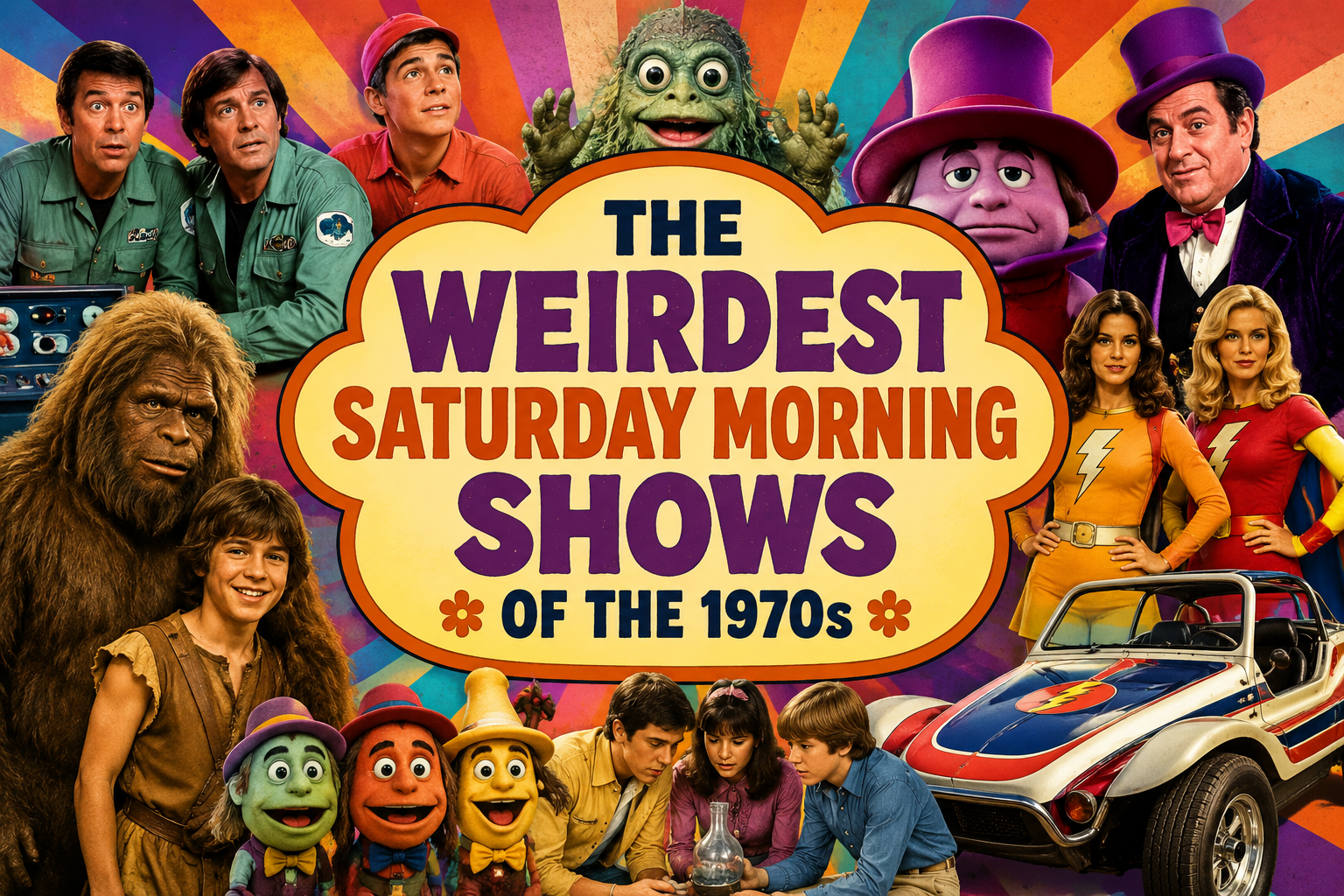
Saturday mornings in the 1970s could get wonderfully weird. From talking hats and friendly sea monsters to superhero dune buggies, accidental astronauts and even a crime-fighting Bigfoot, we look back at some of the strangest and most unforgettable shows that made ’70s kids’ TV unlike anything before or since.
Saturday morning television in the 1970s operated under a different set of rules.
A boy could fall into a gigantic magician’s hat and discover a civilization populated by talking hats. Two maintenance workers could accidentally launch themselves into space. A friendly sea monster could hide in a clubhouse while trying to avoid his frightening family. A beat-up dune buggy could magically transform into a superhero. And somewhere in the middle of all this, a rock band dressed in some of the loudest clothing ever permitted on network television might suddenly appear.
Nobody seemed particularly concerned about explaining any of it.
That was part of the magic.
The 1970s were an extraordinarily experimental period for children’s television, particularly on Saturday mornings. Animation still dominated the schedules, but networks were willing to try live-action fantasy, science fiction, superheroes, puppets, musical comedy and concepts so strange that describing them today can sound like you’re remembering a dream.
And nobody embraced that wonderful weirdness quite like Sid and Marty Krofft.
Lidsville — Welcome to the Land of Talking Hats
Perhaps no television premise captures the peculiar imagination of the decade better than Lidsville.
Debuting on ABC in 1971, the series starred Butch Patrick — already familiar to television audiences as Eddie Munster — as Mark, a teenager who visits a magic show and somehow falls into an enormous magician’s hat.
At the bottom isn’t a rabbit.
It’s an entire world.
Lidsville is populated by living, talking hats, many of them designed around their personalities and occupations. There are good hats and bad hats, strange creatures and, presiding over much of the madness, the flamboyant magician Horatio J. HooDoo, played with tremendous enthusiasm by Charles Nelson Reilly.
The sets were colorful, the characters were bizarre and the entire production had the unmistakable Krofft combination of children’s fantasy, vaudeville, puppetry and psychedelic design.
Trying to explain Lidsville to someone who has never seen it is difficult.
“It’s about a kid trapped in a civilization of giant talking hats.”
That sounds less like a television pitch and more like something somebody dreamed after falling asleep with the TV on.
Yet in 1971, it was Saturday morning television.
Sigmund and the Sea Monsters — The Monster Who Didn’t Want to Be Scary
Then there was poor Sigmund.
Sigmund and the Sea Monsters, which premiered in 1973, began with an idea that was actually rather sweet underneath all the rubber costumes and seaweed.
Sigmund is a young sea monster who has a problem: he doesn’t want to frighten people.
That makes him something of an embarrassment to his monster family.
After leaving home, Sigmund becomes friends with two human brothers, Johnny and Scott, who hide him in their clubhouse. Much of the comedy comes from trying to keep Sigmund’s existence secret while his considerably less friendly relatives attempt to bring him back.
Visually, however, the show was pure 1970s Krofft.
Sigmund looked like a walking pile of greenish seaweed with enormous eyes, while his family resembled creatures that might have washed ashore from another dimension. The costumes were intentionally exaggerated, the situations were silly and everything had that wonderfully handmade quality common to children’s television of the era.
Kids didn’t need computer-generated creatures to believe in a sea monster.
A performer inside an enormous rubber costume worked just fine.
Far Out Space Nuts — The Wrong Button Can Ruin Your Entire Day
The premise of Far Out Space Nuts is magnificent in its simplicity.
Two maintenance workers are preparing a spacecraft for launch. One of them accidentally presses the wrong button.
They launch themselves into space.
That’s essentially how the adventure begins.
Premiering in 1975 and starring Bob Denver and Chuck McCann, Far Out Space Nuts sent its hapless heroes from planet to planet, encountering aliens and getting themselves into increasingly ridiculous situations while trying to find their way home.
Denver was, of course, already one of television’s great lovable bunglers thanks to Gilligan’s Island, so placing him aboard a spacecraft was almost inevitable.
The result was something resembling Gilligan’s Island accidentally colliding with Lost in Space, except with the unmistakable visual eccentricity of a Krofft production.
Aliens, strange planets, cheap-but-charming sets and two men who had absolutely no business exploring the universe made Far Out Space Nuts one of the more wonderfully ridiculous Saturday morning adventures of 1975.
And somehow, “maintenance workers accidentally blast into outer space” was not even the strangest Krofft idea that year.
The Lost Saucer — Jim Nabors and Ruth Buzzi Take Kids Into the Future
Also arriving in 1975 was The Lost Saucer, and this one requires a little explanation.
Jim Nabors and Ruth Buzzi played androids named Fi and Fum who arrive on Earth aboard a flying saucer. Two children and their babysitter climb aboard, and before long the spacecraft accidentally travels through time.
The group then spends the series visiting bizarre future civilizations while attempting to return home.
If that sounds strange, it gets stranger.
The future worlds could be populated by clones, unusual creatures or societies built around some absurd rule. One episode featured a future where exercise was illegal. Another involved a world where plants could talk. There were even creatures known as “chickaphants.”
Yes.
Chickaphants.
The show mixed science fiction with comedy and often slipped social lessons into its strange futuristic societies. But for children watching at home, the attraction was simpler: every week the saucer could land somewhere completely different.
The possibilities were endless, especially when nobody seemed particularly interested in keeping Saturday morning science fiction grounded in reality.
Dr. Shrinker — Three Tiny People Versus One Very Mad Scientist
By 1976, things weren’t becoming any more normal.
Dr. Shrinker appeared as one of the segments within ABC’s The Krofft Supershow. Its premise involved three young people stranded on an island controlled by the appropriately named Dr. Shrinker.
The doctor had invented a machine capable of shrinking people.
Naturally, he used it on them.
The newly miniature heroes — known as the Shrinkies — then spent their adventures trying to avoid being captured by Dr. Shrinker and his assistant while searching for a way to return to normal size.
It was essentially a mad-scientist movie transformed into Saturday morning entertainment.
Giant everyday objects suddenly became part of the scenery, ordinary dangers became enormous threats, and Dr. Shrinker spent an impressive amount of time trying to capture three tiny people.
Even stranger was the presentation surrounding it. Dr. Shrinker wasn’t necessarily something you tuned into by itself. It existed inside The Krofft Supershow, alongside several other miniature programs.
Which brings us to perhaps the most gloriously 1970s part of the whole thing.
Kaptain Kool and the Kongs — Because Of Course There Was a Band
The Krofft Supershow debuted on ABC in 1976 and wrapped several different adventures into one enormous Saturday morning package.
But somebody had to introduce them.
Apparently a normal host was out of the question.
Instead, viewers got Kaptain Kool and the Kongs, a fictional rock band whose members had names including Kaptain Kool, Superchick, Turkey, Nashville and Flatbush.
Their outfits alone could probably power a small city.
The group performed songs and comedy segments while introducing shows such as Dr. Shrinker, Electra Woman and Dyna Girl, Wonderbug and The Lost Saucer. Later combinations would include Magic Mongo and Bigfoot and Wildboy.
Imagine being a kid in 1976.
You’ve finished your cereal. You’re sitting six feet from a wood-paneled television set. A brightly dressed fake rock band appears, performs a song, and then introduces a story about a mad scientist shrinking people on an island.
Nobody asks questions.
It’s Saturday.
Wonderbug — The Superhero Dune Buggy
Long before Knight Rider gave television a technologically advanced talking Pontiac, Saturday morning television gave children Wonderbug.
The Wonderbug segments of The Krofft Supershow followed three teenagers who discover an old, dilapidated dune buggy.
In its ordinary form, the vehicle is known as Schlepcar.
But using a magical horn, the beat-up buggy can transform into Wonderbug — a fantastic vehicle capable of helping the teenagers fight crime and get themselves out of trouble.
Think about the progression for a moment.
Three teenagers find a junky car.
The junky car is magical.
The magical car becomes a superhero.
Perfectly reasonable.
Wonderbug could perform spectacular feats, and the concept fit beautifully into the mid-1970s fascination with dune buggies, vans, customized cars and anything else with wheels.
It was ridiculous.
It was colorful.
And if you were nine years old, you probably desperately wanted one.
Electra Woman and Dyna Girl — Superheroes With Maximum ’70s Style
Not everything on The Krofft Supershow was completely absurd.
Some of it was simply spectacularly ’70s.
Electra Woman and Dyna Girl featured Deidre Hall and Judy Strangis as a superhero duo battling colorful villains with the help of electronic gadgets and their ElectraCar.
The influence of the 1960s Batman television series was obvious, but the costumes, technology and visual style belonged firmly to the following decade.
There was an ElectraBase. There were electronic gadgets. There were outrageous villains. There were brightly colored superhero costumes.
It was campy before most of the children watching it knew what campy meant.
Among all the strange programs surrounding it, Electra Woman and Dyna Girl has become one of the better-remembered pieces of The Krofft Supershow. It captured something that modern superhero productions rarely attempt: superheroes could be exciting while also being completely ridiculous.
Magic Mongo — There’s a Genie at the Beach
By 1977, perhaps television executives were beginning to run out of ordinary premises.
Enter Magic Mongo.
The series, another Krofft production, revolved around teenagers who discover a bottle containing a genie named Mongo. Naturally, Mongo’s magical attempts to help his new friends had a habit of creating additional problems.
A genie sitcom wasn’t necessarily a new idea — I Dream of Jeannie had already demonstrated the possibilities — but placing the concept into the colorful world of Saturday morning television gave it a distinctly different personality.
At this point, children watching Krofft productions had encountered talking hats, sea monsters, accidental astronauts, androids, tiny castaways, superhero cars and futuristic civilizations.
A genie almost seemed normal.
Bigfoot and Wildboy — Bigfoot Becomes a Superhero
And then someone apparently asked the obvious question:
What if Bigfoot were the good guy?
Bigfoot and Wildboy debuted in 1977 as part of the Krofft Saturday morning universe. Instead of treating Bigfoot as a mysterious monster lurking in the wilderness, the show transformed him into a heroic character.
Bigfoot had rescued a young boy lost in the Pacific Northwest wilderness and raised him as his companion, Wildboy. Together they encountered villains, strange creatures and assorted science-fiction threats.
This wasn’t a documentary-style search for Sasquatch.
This was Bigfoot having adventures.
It arrived during a decade when interest in Bigfoot, UFOs, the Bermuda Triangle and unexplained phenomena was everywhere in popular culture. Saturday morning television simply took the next logical step and gave Bigfoot his own young sidekick.
Looking back, it’s difficult not to admire the confidence involved.
“Bigfoot and a kid fight bad guys.”
Sold.
Why Were the Shows So Strange?
There is an important reason so many of these programs share a similar feeling: a remarkable number came from Sid and Marty Krofft.
The brothers helped create a distinctive form of live-action children’s television built around elaborate costumes, puppetry, colorful fantasy environments, music and concepts that didn’t need to obey the rules of ordinary life. Their shows became Saturday morning fixtures during a period when children’s television had previously been much more heavily dominated by animation.
And while it’s easy to laugh at the costumes and effects today, there was something genuinely imaginative about what they were doing.
These weren’t enormous productions with blockbuster budgets.
They relied on sets, costumes, miniature effects, puppets and performers to create entire worlds. Kids supplied the rest with their imaginations.
The limitations may actually be one reason the programs remain so memorable.
Nothing looked quite like them.
Saturday Morning Was Allowed to Be Weird
That’s perhaps what we miss most when looking back at these shows.
Children’s television didn’t always have to belong to a carefully managed franchise. It didn’t need a cinematic universe, expensive computer animation or a line of sequels already planned before the first episode aired.
Sometimes somebody could apparently walk into a network meeting and say:
“What if there’s a whole city populated by talking hats?”
And somehow a television series came out the other side.
The results weren’t always masterpieces. Some were silly even by 1970s standards. The special effects could be primitive, the costumes could be ridiculous and the stories sometimes seemed to have been assembled from whatever ideas happened to be lying around the writers’ room that afternoon.
But they had personality.
And for the kids sitting on the carpet with a bowl of cereal on Saturday morning, that was enough.
You didn’t question why Bigfoot had a teenage sidekick.
You didn’t wonder about the engineering behind a flying superhero dune buggy.
You didn’t ask why an entire civilization consisted of hats.
You just watched.
Because it was the 1970s.
Because it was Saturday morning.
And Saturday morning television was allowed to be wonderfully, gloriously weird.