“Walking Distance”: The Twilight Zone Episode That Understood Our Longing for the Past
What if you could walk back into the town of your childhood and find everything exactly as you remembered it? In The Twilight Zone’s unforgettable “Walking Distance,” Rod Serling explored our longing for simpler days and the bittersweet truth that while we can revisit the past in our memories, we can never truly live there again.
There are episodes of The Twilight Zone remembered for frightening monsters, impossible twists and endings that leave you staring at the television after the credits begin to roll. Then there is “Walking Distance,” an episode that does something much quieter and, in many ways, much more powerful. It takes one of the most familiar human wishes—the desire to go back to a happier and simpler time—and turns it into one of the most moving stories the series ever produced.
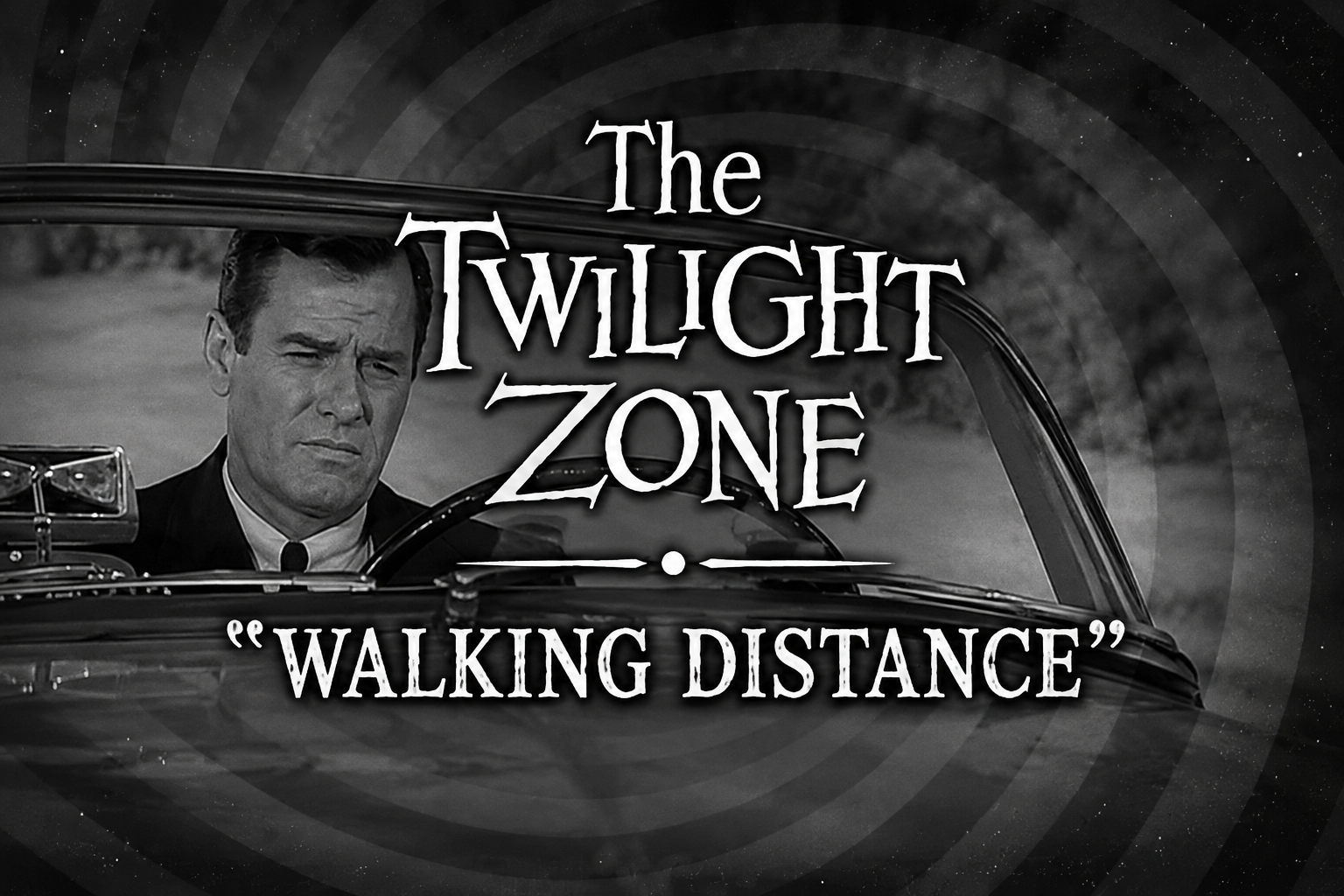
First broadcast on October 30, 1959, during the first season of The Twilight Zone, “Walking Distance” was written by series creator Rod Serling and stars Gig Young as Martin Sloan. There are no spaceships, alien invasions or futuristic machines here. Instead, Serling gives us a small American town, an old-fashioned drugstore, children playing in the park, a carousel turning in the afternoon and a tired middle-aged man who suddenly discovers that yesterday may be much closer than he ever imagined.
More than six decades later, the episode has lost none of its emotional power. If anything, “Walking Distance” seems to become more meaningful as we grow older, because eventually most of us begin to understand exactly what Martin Sloan is searching for.
A Man Who Needs to Get Away
Martin Sloan is a 36-year-old advertising executive who has become exhausted by the pressures and responsibilities of his life. While driving through the countryside, he stops at a service station near Homewood, the small town where he grew up. Realizing that his childhood hometown is only a short distance away, Martin decides to leave his car behind and walk there.
When he reaches Homewood, everything seems strangely familiar. The streets look exactly as he remembers them, the drugstore is still serving the same kind of sodas he enjoyed as a boy, children are playing outside and the carousel is turning in the park. Gradually, Martin realizes that he hasn’t simply returned to the town where he grew up. Somehow, he has walked directly into the Homewood of his childhood.
Even more astonishingly, somewhere in that town is another Martin Sloan—a young boy enjoying an ordinary summer day without any idea that the nervous stranger wandering through Homewood is actually himself, decades in the future.
For Martin, it initially seems as though he has been given an extraordinary gift. Everything he has spent years remembering is suddenly real again, close enough to touch. Yet The Twilight Zone slowly reveals that getting the past back may not be quite the gift Martin believes it to be.
The Past Always Looks Better From a Distance
One of the reasons “Walking Distance” has aged so beautifully is that Martin’s longing is instantly recognizable. Most of us eventually develop our own version of Homewood, a place or period that exists somewhere between genuine memory and the idealized version of it that we have carried with us through the years.
Maybe it’s the neighborhood where we grew up, the house where our grandparents lived, the shopping mall before it was remodeled or demolished, the corner store that disappeared decades ago or the amusement park we visited every summer. Sometimes all it takes is an old photograph, a familiar song on the radio or even a particular smell to bring an entire world rushing back.
In those memories, everything can seem just a little better than it probably was. Summers lasted forever, Christmas felt more exciting, Saturday mornings belonged entirely to us and friends seemed to live only a bicycle ride away. Our parents were younger, our grandparents were still there and there always seemed to be plenty of time before we had to worry about tomorrow.
Martin doesn’t simply remember that world. He has somehow been allowed to step back inside it, and at first that seems like the ultimate fantasy. Serling, however, understands that there is also something dangerous hidden inside the desire to return.
Meeting the Boy He Used to Be
Martin eventually finds his younger self and desperately tries to make the boy understand how fortunate he is. He wants to tell him to appreciate the carousel, the summer afternoons and all those seemingly insignificant moments because one day they will become precious memories.
The boy, naturally, cannot understand what this strange adult wants from him. Why would he? A child living through an ordinary summer afternoon has no reason to believe that decades later he might remember that afternoon as one of the happiest periods of his life.
That is one of the most quietly heartbreaking ideas in the episode: we rarely recognize nostalgia while we’re creating it.
The family dinner doesn’t seem important when we’re sitting at the table. Riding in the back seat of the family car is simply a ride home. A Saturday afternoon with friends doesn’t feel historic, and the television program everyone gathers to watch is simply what happens to be on that night. Only years later, when the people have changed and the places have disappeared, do those ordinary moments acquire their extraordinary weight.
Martin understands something his younger self cannot possibly understand: childhood ends. But knowing how valuable those days will eventually become doesn’t mean he can reclaim them.
The Conversation With His Father
The emotional heart of “Walking Distance” arrives when Martin’s father finally understands who this mysterious visitor really is. Instead of turning the impossible situation into something frightening, Serling gives us a remarkably tender conversation between a father and his grown son.
Martin’s father realizes why his son has returned. Martin is tired of the adult world and has been searching for someplace where life doesn’t demand quite so much from him. Homewood represents safety, simplicity and a period when other people worried about tomorrow while Martin was free to enjoy today.
His father gently helps him understand that he cannot stay. Martin has already had his childhood and his summer, while the young Martin now living in Homewood deserves the opportunity to experience those days for himself.
It is a beautifully simple message, but one that becomes increasingly meaningful with age. The past can comfort us, remind us where we came from and even help us understand who we have become, but trying to live there means turning away from the life that is still waiting for us.
Rod Serling’s Own Homewood
Part of the reason “Walking Distance” feels so personal is that Homewood was strongly influenced by Rod Serling’s memories of growing up in Binghamton, New York. Throughout his writing, Serling repeatedly returned to ideas involving childhood, small-town America, memory and the passage of time, but in “Walking Distance” those themes seem particularly intimate.
Homewood isn’t important because anything historically significant happened there. Its importance comes from ordinary things: the soda fountain, the bandstand, the carousel, neighborhood streets and the distant sound of children playing outside. These aren’t monuments to history; they’re the little details from which childhood memories are built.
That is also why the episode connects so naturally with anyone who has ever returned to a childhood neighborhood after many years away. The buildings may still be there, but something is different. The streets seem smaller, stores have changed names, trees have grown and strangers now live inside houses we once knew intimately. We recognize the place, yet the world we remember is no longer really there.
Every Generation Has Its Own Homewood
There is another fascinating layer to watching “Walking Distance” today that audiences in 1959 couldn’t possibly have experienced. Martin Sloan is nostalgic for the world of his childhood, but more than sixty years later, we can now feel nostalgic for Martin Sloan’s own present-day world.
The automobiles, service stations, storefronts, clothing and television production itself all belong to another era. Even the supposedly modern 1959 world Martin wants to escape has become part of the past that viewers now look back upon with affection.
Every generation eventually develops its own Homewood. For one person it might be 1935, while for someone else it might be 1965, 1978 or 1985. It might be a summer evening when the windows were open and a radio played somewhere in the house, walking through the mall on a Friday night, renting a movie from the neighborhood video store or sitting in the back seat of the family car while your parents talked in the front.
Those moments rarely seemed particularly important while they were happening. That’s part of what makes remembering them so powerful.
We Can Visit, But We Can’t Stay
By the end of “Walking Distance,” Martin returns to his own time with a better understanding of what he was really searching for. The happiness he remembered wasn’t hidden somewhere in Homewood waiting for him to reclaim it. Those days were special precisely because they belonged to a particular moment in his life, and trying to repeat them could never truly recreate what he had lost.
That is where “Walking Distance” becomes more than a story about nostalgia. It becomes a gentle warning about it.
There is nothing wrong with looking backward. Old records, television shows, photographs, movies, cars and familiar places can reconnect us with pieces of ourselves that haven’t completely disappeared. Sometimes hearing a song we haven’t heard in forty years can bring back a room, a person or an afternoon with astonishing clarity.
The danger comes when yesterday begins to look so beautiful that today no longer seems capable of giving us memories worth keeping.
Perhaps that is why “Walking Distance” remains one of the most beautiful episodes of The Twilight Zone. Rod Serling understood that when we say we wish we could go back, we aren’t really asking for an old house, an old neighborhood or an old summer afternoon. We are searching for the people who were there, the feeling of having time ahead of us and, perhaps most of all, the person we used to be.
We know we can’t actually return to those days. But every once in a while, a song, a photograph, an old television show or a familiar place takes us close enough that we can almost see them again.
For a little while, we’re within walking distance of home.