Before Reality TV: The Wild World of 1970s Game Shows
Before reality TV, there were game shows—colorful, unpredictable and sometimes wonderfully chaotic. From *Match Game* and *The Price Is Right* to *Let’s Make a Deal* and *The Gong Show*, the 1970s turned ordinary contestants, larger-than-life hosts and celebrity panelists into unforgettable daytime television.
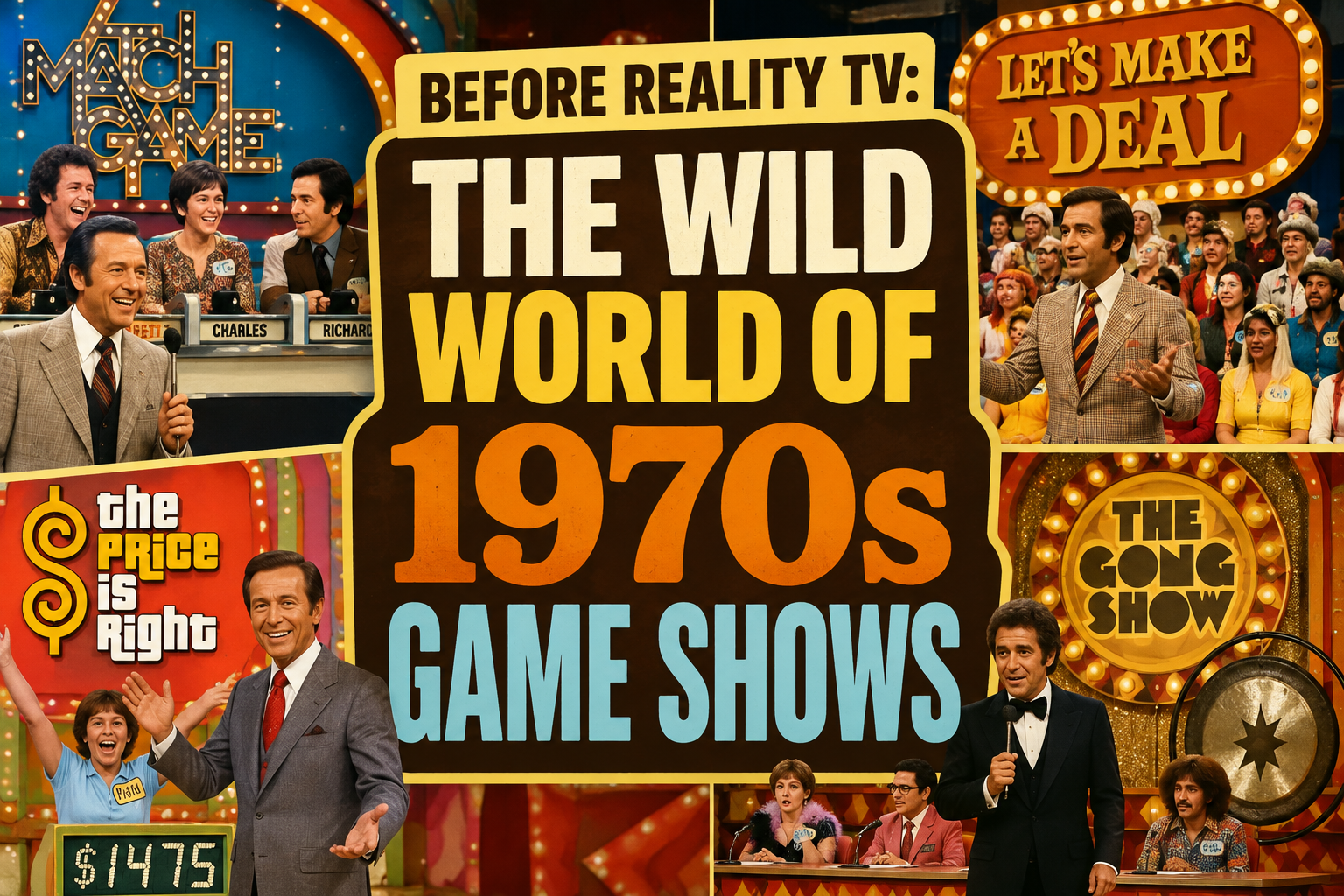
Long before reality television turned ordinary people into celebrities, television had another place where just about anything could happen. It had flashing lights, enormous curtains, questionable prizes, celebrity panelists, screaming contestants and hosts who somehow managed to keep the whole thing moving no matter how strange it became.
The 1970s were a golden age of the television game show.
Turn on the television during the daytime and you could find contestants guessing prices, completing sentences, making deals or trying to figure out which celebrity was telling the truth. Game shows also spilled into evenings and syndicated television, becoming such a familiar part of the schedule that their theme songs, sets and hosts remain instantly recognizable decades later.
And compared with today’s highly polished television, they could feel wonderfully unpredictable.
Match Game Made Television Feel Like a Party
Few shows captured the looseness of 1970s television better than Match Game.
The revived version arrived on CBS in 1973 with Gene Rayburn holding his famously long microphone and attempting to maintain some semblance of order while a panel of celebrities filled in the blanks to deliberately suggestive questions.
The game itself was almost secondary.
Viewers tuned in for Charles Nelson Reilly, Brett Somers, Richard Dawson and the rotating collection of celebrities who seemed to be having as much fun as the audience. The panelists teased one another, laughed at their own answers and occasionally appeared to forget that they were supposed to be playing a game.
That was precisely the appeal. Match Game didn’t feel carefully rehearsed. It felt like someone had accidentally put cameras in front of a particularly funny cocktail party.
Come on Down!
Then there was The Price Is Right.
Although the original version dated back to the 1950s, the version most viewers recognize today began in 1972 with Bob Barker. Its opening moments produced one of television’s great game-show rituals: hearing your name followed by the command to “Come on down!”
Contestants didn’t calmly walk to Contestants’ Row. They ran, screamed, jumped and hugged complete strangers.
And then came the prizes.
Living-room furniture. Appliances. Trips. Boats. New cars.
Even when you weren’t particularly interested in buying a refrigerator, there was something strangely compelling about watching four people attempt to determine exactly how much one cost.
Games such as Plinko would come later, but many of the show’s familiar pricing games and the excitement surrounding the Showcase helped make The Price Is Right a daytime institution during the 1970s.
Let’s Make a Deal Was Controlled Chaos
If The Price Is Right was exciting, Let’s Make a Deal could look completely insane to anyone walking into the room without knowing what was happening.
There was Monty Hall surrounded by grown adults dressed as chickens, babies, cowboys, vegetables and practically anything else that might attract his attention.
Contestants were offered choices. Take the money or trade it. Keep the prize or choose what was behind the curtain. Take the sure thing or gamble on something better.
Sometimes there was a car waiting.
Sometimes there was a goat.
That uncertainty made the show irresistible. The audience wasn’t simply watching contestants answer questions. Everyone watching at home was making the decision with them.
“Take the curtain!”
“No! Keep the money!”
For a few minutes, the living room became part of the studio audience.
The Newlywed Game Asked Questions Nobody Else Would
Game shows also discovered that relationships could provide plenty of entertainment.
The Newlywed Game, which began in the 1960s and continued into the ’70s, put recently married couples in situations that could become hilariously uncomfortable. Bob Eubanks asked questions about their habits, arguments, personalities and romantic lives, and then waited to see whether their answers matched.
Sometimes they did.
Frequently they didn’t.
The fun was watching the reactions. A wrong answer might produce embarrassment, disbelief or the unmistakable expression of someone realizing there was going to be an interesting conversation on the drive home.
Long before television built entire reality series around relationships, The Newlywed Game had already discovered that ordinary couples could be enormously entertaining.
Hollywood Squares Put Celebrities in Boxes
Hollywood Squares had one of the simplest and most memorable sets in television history: nine celebrities sitting inside an enormous tic-tac-toe board.
Peter Marshall asked the questions, contestants decided whether they agreed or disagreed with the celebrities’ answers, and Paul Lynde regularly stole the show from the center square.
Once again, the celebrities were a major reason people watched.
The jokes, personalities and banter mattered almost as much as who actually won. It was a formula that appeared repeatedly throughout the decade: build a simple game, surround it with entertaining people and allow enough room for something unexpected to happen.
Password Proved You Didn’t Need a Giant Set
Not every game show required flashing lights and people dressed as vegetables.
Password demonstrated how entertaining television could be with an extraordinarily simple idea. One person knew a word. Another had to guess it from one-word clues.
That was basically it.
Yet the format created remarkable tension. Viewers inevitably played along, shouting answers at the television while wondering how the contestant could possibly fail to guess something that seemed completely obvious from the couch.
Allen Ludden became inseparable from the show, and celebrity appearances—including frequent appearances by Betty White, whom he married in 1963—gave Password the comfortable feeling of spending time with familiar television personalities.
And Then Came The Gong Show
By the middle of the decade, game shows had become so familiar that television was ready to make fun of them.
Enter The Gong Show.
Beginning in 1976 and hosted by Chuck Barris, it was supposedly a talent competition. Contestants performed for celebrity judges, who could strike a giant gong when an act became unbearable.
But describing The Gong Show as a talent competition is a little like describing a circus as a business meeting.
There were singers, dancers, comedians and performers who were almost impossible to categorize. Some appeared genuinely talented. Others seemed to have wandered onto the set from another dimension.
That was the point.
You never knew what you were going to see next.
In some ways, The Gong Show anticipated the reality and talent television that would arrive decades later. It understood that viewers weren’t always looking for perfection. Sometimes they simply wanted to watch something unpredictable.
The Hosts Became Part of the Family
One reason these programs remain so strongly associated with their era is that the hosts were in people’s homes constantly.
Bob Barker. Gene Rayburn. Monty Hall. Peter Marshall. Bob Eubanks. Allen Ludden. Chuck Barris.
They weren’t actors playing characters. They appeared as themselves, day after day, speaking directly to contestants and viewers. After years of watching them, audiences felt as though they knew them.
Every host also had a different style. Barker was smooth and reassuring. Rayburn could barely contain the chaos around him. Hall seemed capable of negotiating a deal with anyone. Barris often looked as though he couldn’t quite believe what was happening on his own program.
The right host could turn a simple television game into something people watched for years.
We Played Along From the Couch
Perhaps the greatest secret of the 1970s game show was that the contestant wasn’t the only person playing.
We were playing too.
We guessed the price before the contestant did. We tried to solve the Password clue. We shouted “agree!” at Hollywood Squares. We knew which curtain the contestant should choose on Let’s Make a Deal, although naturally we had absolutely no idea what was behind it.
That participation made game shows perfect television.
You didn’t need to know what happened last week. There was no complicated storyline to follow. You could turn on the television halfway through an episode and immediately understand what was happening.
And tomorrow there would be another one.
When Daytime Television Had Its Own Personality
There was also something special about encountering these shows during the day.
Maybe you were home sick from school. Maybe it was summer vacation. Maybe you were visiting your grandparents and the television had been playing since breakfast.
The familiar voices of game-show hosts floated through living rooms and kitchens while sunlight came through the curtains. Commercials interrupted the games. Appliances and vacation packages were described with enormous enthusiasm. Audience members applauded as another contestant came running down the aisle.
For children, daytime television almost felt like a world that normally belonged to adults. Being home from school meant temporarily gaining access to it.
Years later, hearing one of those old theme songs can bring the entire atmosphere back.
Before Reality TV, We Already Loved Watching Regular People
Reality television didn’t invent our fascination with watching ordinary people on television.
Game shows had understood it decades earlier.
The contestants weren’t polished celebrities. They were teachers, secretaries, mechanics, homemakers, newlyweds and people from towns all across America who suddenly found themselves standing beneath studio lights trying to win a refrigerator, a vacation or a brand-new car.
They got nervous. They made terrible decisions. They screamed when they won. They sometimes said things they probably wished they could take back.
And audiences loved them for it.
The sets may look wonderfully dated now, the prizes sometimes seem amusingly modest, and the fashions leave absolutely no doubt about which decade we’re watching. But put on an old episode of Match Game, The Price Is Right or The Gong Show and something interesting happens.
You start playing along again.
For a little while, it’s daytime television in the 1970s, the big curtain is about to open, and somewhere behind it there might just be a brand-new car.