When Every Town Had a Five-and-Dime
Remember when every downtown had a five-and-dime? From Woolworth and Kresge to lunch counters, toy aisles and treasures you could actually afford with your allowance, these stores sold a little bit of everything—and became a big part of our memories.
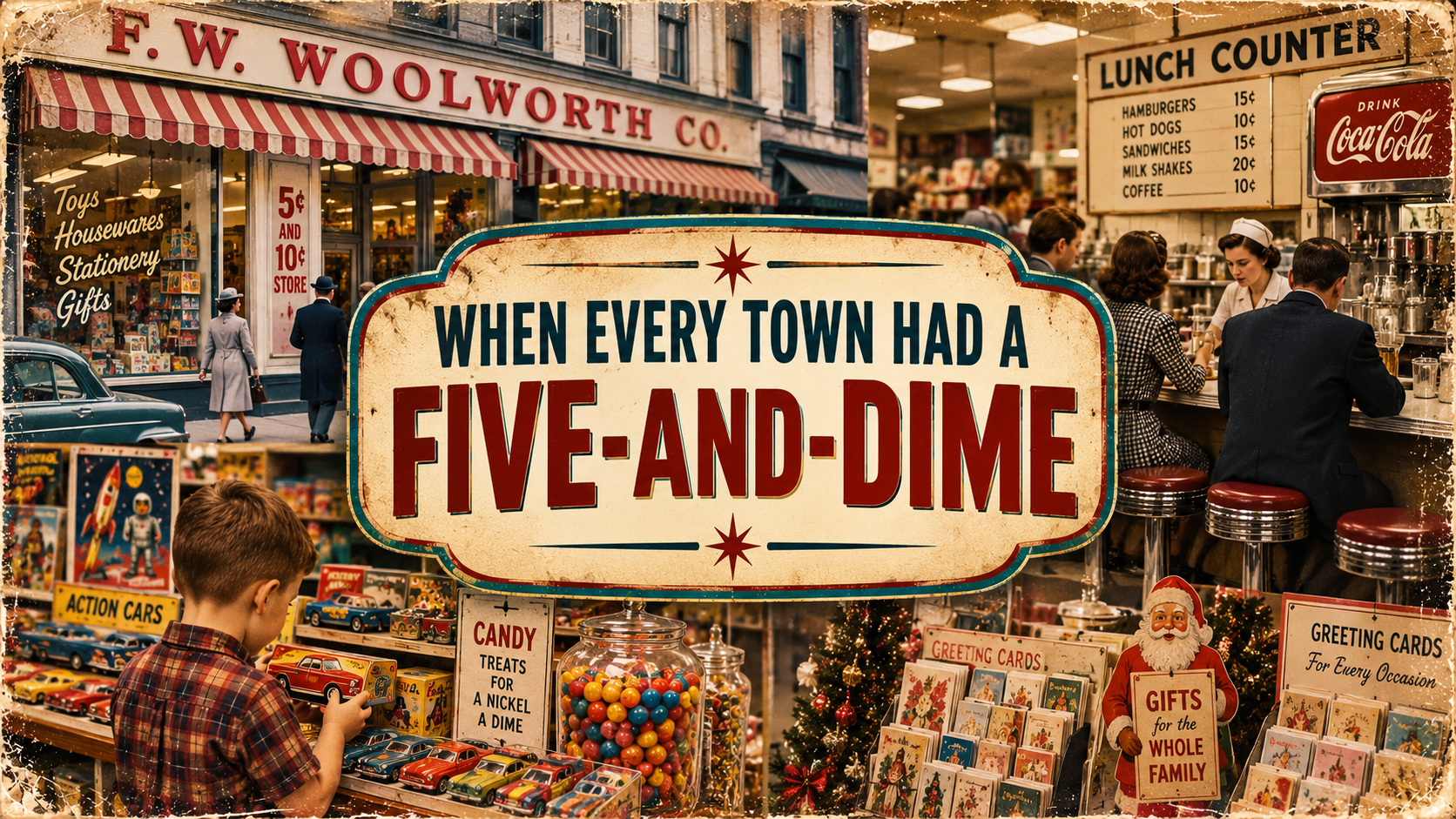
There was a time when almost every downtown seemed to have one: a long storefront with big display windows, aisles crowded with merchandise and prices low enough that even a kid with a little allowance money could walk through the door and come out carrying something. You might have gone in for a spool of thread, a birthday card or a new kitchen utensil and somehow ended up looking at toys, records, candy and a dozen other things you hadn’t planned to buy.
It was the five-and-dime, and for much of the 20th century it was one of the most familiar stores on Main Street.
Names like Woolworth, Kresge, W.T. Grant, McCrory and Ben Franklin once appeared in towns and cities across America. There were regional chains and independent variety stores too, each with its own personality, but they shared a basic idea: sell a little bit of almost everything at prices ordinary people could afford.
Long before the big-box store, the dollar store or one-click shopping, the five-and-dime was where America went for all the little things.
The Store That Seemed to Sell Everything
Calling a five-and-dime a “variety store” was probably the most accurate description because variety was exactly what made these places remarkable. The original nickel-and-dime price concept eventually became outdated as prices rose, but the name survived because everyone understood what it meant.
Walk through the doors and you might find sewing notions, kitchen utensils, stationery, greeting cards, toiletries, artificial flowers, picture frames, cleaning supplies, socks, underwear, costume jewelry, school supplies, toys, candy, records and seasonal decorations. Some stores carried pets or tropical fish. Others had fabric counters, cosmetics, housewares and hardware. Merchandise seemed to occupy every available inch.
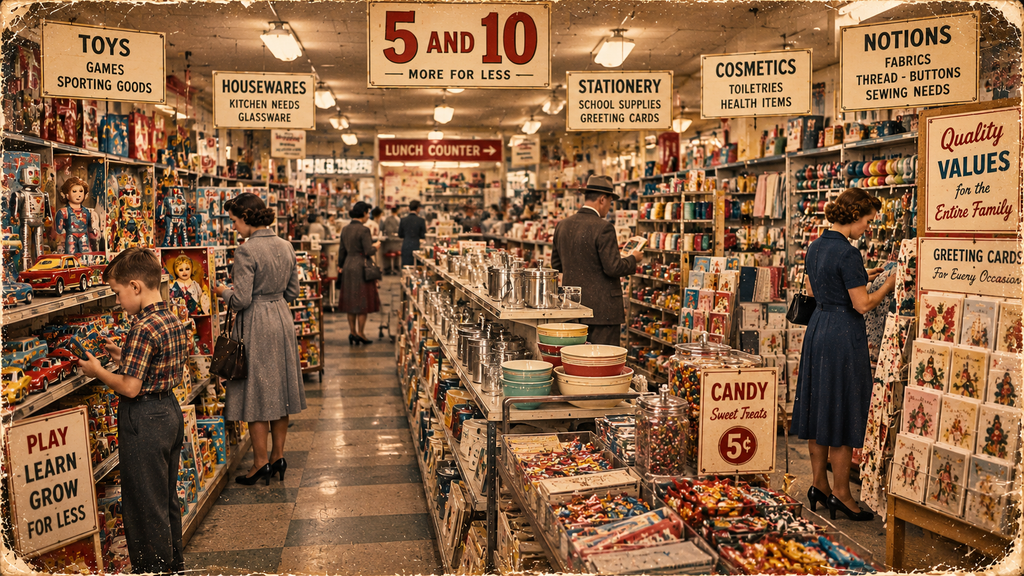
Unlike modern stores organized around one particular category, the five-and-dime was built around the idea that there was always something else you might need. You could enter looking for shoelaces and leave with a birthday card, a bag of candy, a new spatula and a plastic toy for one of the kids.
For families watching their budgets, that combination of low prices and enormous variety made these stores indispensable.
For children, it made them magical.
A Kid With a Little Money Could Actually Buy Something
One of the great pleasures of the five-and-dime was that children weren’t merely spectators. If you had some allowance money, birthday money or a few coins left over from an errand, there were things in the store you could actually afford.
That changed the entire experience.
The toy department might have inexpensive cars, plastic soldiers, balls, jacks, yo-yos, cap guns, dolls, coloring books, puzzles and small novelty toys. Near the register or candy counter were even more possibilities. You didn’t need your parents to make a major purchase. Sometimes a quarter or fifty cents was enough to give you a serious decision to make.
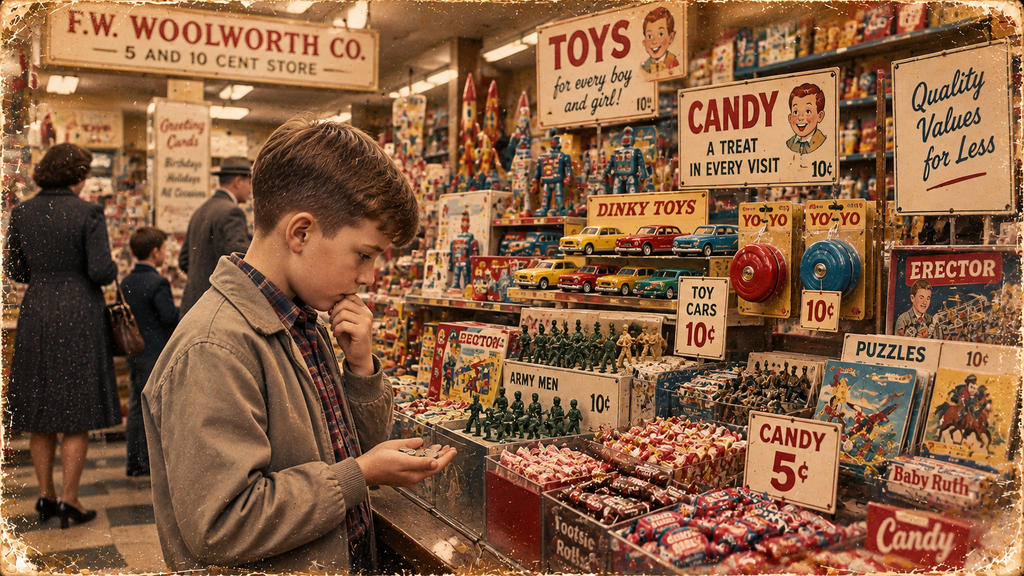
Children learned an early lesson in economics standing in those aisles. If you bought this, you couldn’t buy that. If you saved another week’s allowance, maybe you could afford something better. Or you could abandon the whole plan and spend the money on candy.
Plenty of financial plans probably ended that way.
The important thing was that it was your money, and choosing how to spend it made a trip to the five-and-dime feel very different from following Mom through the supermarket.
Woolworth Was the Name Everybody Knew
Of all the five-and-dime chains, F.W. Woolworth became the name most closely associated with the idea. Frank Woolworth began experimenting with fixed-price stores in the late 1870s, and the concept eventually grew into an enormous retail empire. Woolworth stores became fixtures of downtown shopping districts, recognizable to generations of Americans.
But Woolworth wasn’t alone. S.S. Kresge, the company that would eventually give rise to Kmart, built its own large network of variety stores. W.T. Grant became another familiar Main Street name, as did McCrory, while Ben Franklin stores brought the variety-store concept to communities across the country, often through locally operated locations.
Depending on where you grew up, one of those names may immediately bring back a particular downtown, shopping center or Main Street. In other places, the store everyone remembers wasn’t part of a famous chain at all. It may simply have been the local variety store that had been there for decades.
The names were different, but the experience was remarkably familiar.
The Lunch Counter Was Half the Attraction
For many people, the strongest five-and-dime memories aren’t of anything they bought from a shelf. They’re of sitting on a stool at the lunch counter.
A busy Woolworth lunch counter could be a destination in its own right. Shoppers sat side by side on stools while employees worked behind the counter serving sandwiches, hamburgers, hot dogs, soups, coffee, pie, ice cream, milkshakes and fountain drinks. Depending on the location and era, you might stop for a quick lunch while shopping downtown or simply meet someone there for coffee.
There was something wonderfully uncomplicated about it. You didn’t need reservations, and nobody expected you to spend the afternoon. You took a seat, ordered something familiar and watched the activity of the store continue around you.
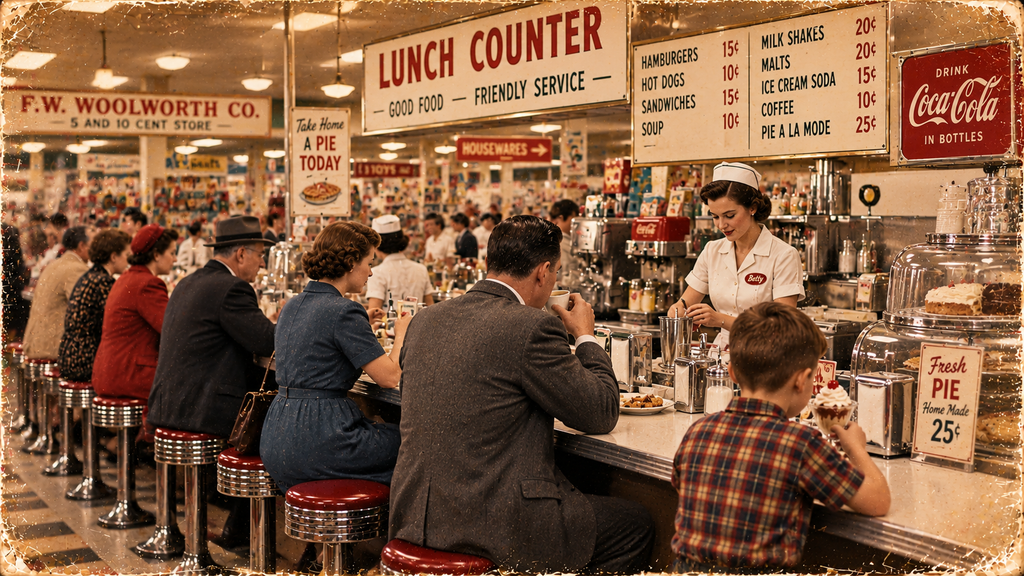
For children, the soda fountain could make an ordinary shopping trip feel like a special occasion. A milkshake, sundae or fountain Coke after following Mom through downtown was a pretty good reward for behaving yourself.
Those counters also occupy a much more serious place in American history. In 1960, four Black college students sat down at the segregated Woolworth lunch counter in Greensboro, North Carolina, and refused to leave after being denied service. The Greensboro sit-in helped inspire similar protests across the country and became one of the defining events of the civil-rights movement. Today, part of that original counter is preserved as an artifact of a moment when an everyday retail space became the setting for extraordinary social change.
Where Mom Bought a Little Bit of Everything
For adults, the five-and-dime wasn’t primarily about nostalgia. It was useful.
If a button came off a shirt, there were needles and thread. If somebody had a birthday coming up, there were cards and wrapping paper. If the kitchen needed a measuring cup, dish towel or inexpensive utensil, there was a housewares aisle. School project tomorrow? Poster board, pencils, glue and construction paper were probably somewhere in the store.
The sewing and notions department was especially important in an era when more clothing was repaired at home. Buttons, zippers, elastic, ribbon, patterns, thread and countless other small items could all be found without making a special trip to a larger department store.
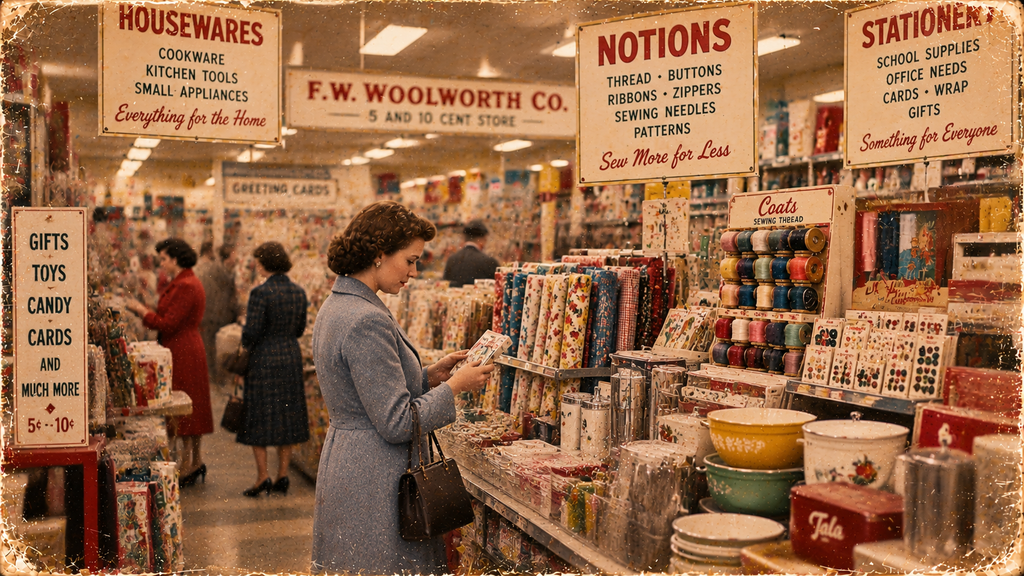
There were toiletries and cosmetics, hair accessories and costume jewelry. There were socks and stockings, inexpensive clothing basics and things for the house that nobody thought much about until they suddenly needed them.
That was the beauty of the five-and-dime. It specialized in things that didn’t seem important until you needed one.
The Toy Aisle Didn’t Need to Be Huge
The toy selection at a five-and-dime couldn’t compete with the enormous toy stores that came later, but to a child it didn’t need to.
There was always something to investigate.
Small metal or plastic cars might hang from displays. Bags of toy soldiers waited beside rubber balls and inexpensive games. There were dolls, plastic animals, puzzles, crayons, coloring books and toys whose appeal was sometimes impossible for adults to understand.
The packaging was colorful, the prices were tempting and the selection changed often enough that it was worth checking every time you visited.
Many of these weren’t toys expected to survive for generations. They were inexpensive little diversions bought with allowance money or handed to a child after a shopping trip. Some broke before the weekend was over.
Others somehow became treasured possessions.
And decades later, it’s often those little toys rather than the expensive Christmas presents that people suddenly remember.
Records, Magazines and Whatever Was New That Week
Five-and-dimes also gave shoppers something they couldn’t get from today’s online search box: the pleasure of stumbling across something unexpected.
A record rack might contain inexpensive singles and albums. Magazine racks offered comics, movie magazines, women’s magazines, hobby publications and whatever else was popular at the time. Paperback books could sit beside puzzle books and children’s activity books.
You didn’t arrive because an algorithm had recommended something. You simply saw it.
That kind of accidental discovery was a big part of shopping. Maybe a record cover caught your eye. Maybe a magazine headline made you pick it up. Maybe there was some odd little gadget hanging near the register that you had never seen before but suddenly couldn’t imagine living without.
The five-and-dime was full of things you didn’t know you were looking for.
Christmas at the Five-and-Dime
If the five-and-dime was fun during the rest of the year, Christmas transformed it.
The seasonal aisles filled with ornaments, tinsel, artificial wreaths, wrapping paper, greeting cards, ribbons, bows, inexpensive decorations and small gifts. Store windows became holiday displays, and downtown streets filled with shoppers carrying bags from one store to another.
For children with only a little money to spend, the five-and-dime offered something especially important: the chance to buy presents themselves.
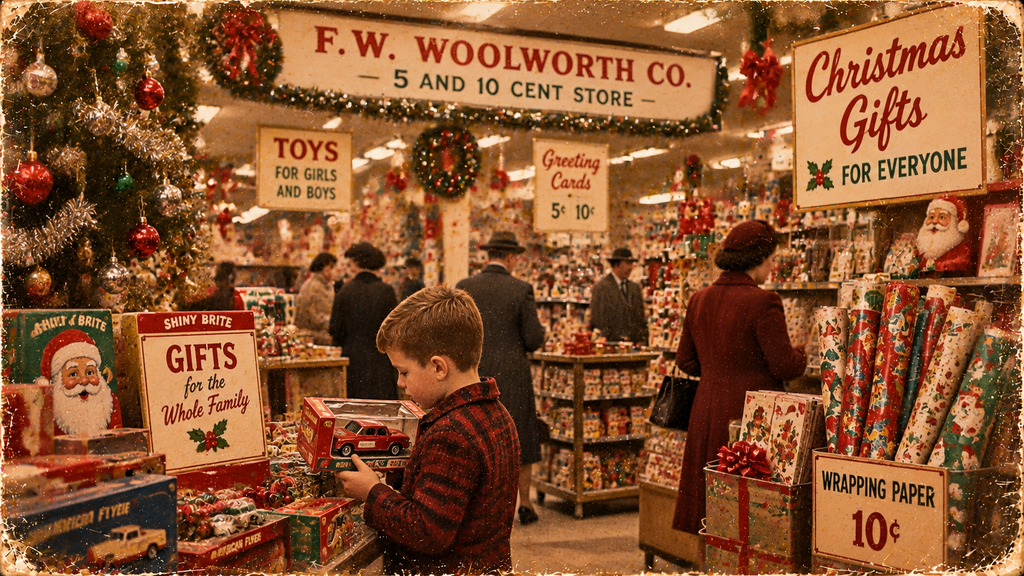
A child might have a few dollars saved and a list containing Mom, Dad, brothers, sisters and maybe grandparents. The gifts weren’t expensive, but that wasn’t the point. Choosing them without revealing what you were buying was part of growing up.
Dad might receive a handkerchief or some little tool. Mom could get costume jewelry, perfume, a kitchen item or something decorative for the house. A younger sibling might get a toy.
Then came wrapping everything at home and trying desperately to keep the presents secret until Christmas morning.
For many people, those inexpensive gifts are now among their warmest holiday memories.
The Store Windows Were Part of Main Street
Before shopping became centered around massive parking lots and enclosed malls, downtown storefronts mattered.
Five-and-dime windows were advertisements, entertainment and decoration all at once. Seasonal displays changed throughout the year. Back-to-school supplies appeared near the end of summer. Halloween brought masks and decorations. Christmas filled the windows with toys, ornaments and artificial snow.
People walking downtown actually stopped to look.
The five-and-dime also benefited from being surrounded by everything else Main Street offered. The drugstore might be nearby, along with a shoe store, bakery, movie theater, bank, department store, barber shop and local restaurant. A shopping trip wasn’t necessarily a visit to one enormous retailer. It was a walk from business to business.
The five-and-dime fit perfectly into that world because sooner or later, somebody needed something it sold.
When Main Street Began to Change
The five-and-dime didn’t vanish because people suddenly stopped needing inexpensive household goods. Retail itself changed around it.
Suburban shopping centers and malls drew customers away from traditional downtown districts. Discount retailers became larger and more efficient. Supermarkets expanded their non-food selections. Drugstores began carrying more general merchandise. Chains such as Kmart and later Walmart offered the same promise of low prices and broad selection on a much larger scale.
Ironically, some of the companies behind the five-and-dime helped create the world that replaced it. Kresge opened the first Kmart stores in the 1960s and increasingly shifted its attention toward the discount-store format. Other longtime chains struggled to adapt. W.T. Grant collapsed in the 1970s, while the traditional Woolworth stores survived much longer before the company finally closed its remaining U.S. variety stores in 1997.
Ben Franklin stores continued in some communities, and the spirit of the five-and-dime never completely disappeared. Dollar stores, discount chains and modern variety retailers inherited pieces of the formula.
But the old Main Street version was fading away.
It Wasn’t Really About Five Cents or Ten Cents
By the later decades of the five-and-dime, very little actually cost a nickel or a dime anymore. The name had become a memory of the original idea rather than a description of the price tags.
But perhaps that’s appropriate, because when people remember these stores today, they’re usually not remembering the exact prices anyway.
They remember the place.
They remember walking downtown with their mother and wandering toward the toy aisle while she looked for sewing supplies. They remember spinning around on a lunch-counter stool while waiting for a milkshake. They remember spending allowance money on something completely unnecessary and carrying it home as though it were a treasure.
They remember Christmas decorations appearing in the windows, candy near the register, wooden floors in an old downtown location and shelves crowded with more things than seemed possible.
Most of all, they remember a kind of store that didn’t demand much from you. You didn’t need a shopping list or a large budget. You could walk through the doors simply to look around.
Maybe you needed a birthday card.
Maybe Mom needed thread.
Maybe you had fifty cents burning a hole in your pocket.
Whatever brought you inside, there was a pretty good chance you wouldn’t leave empty-handed.
That was the five-and-dime.