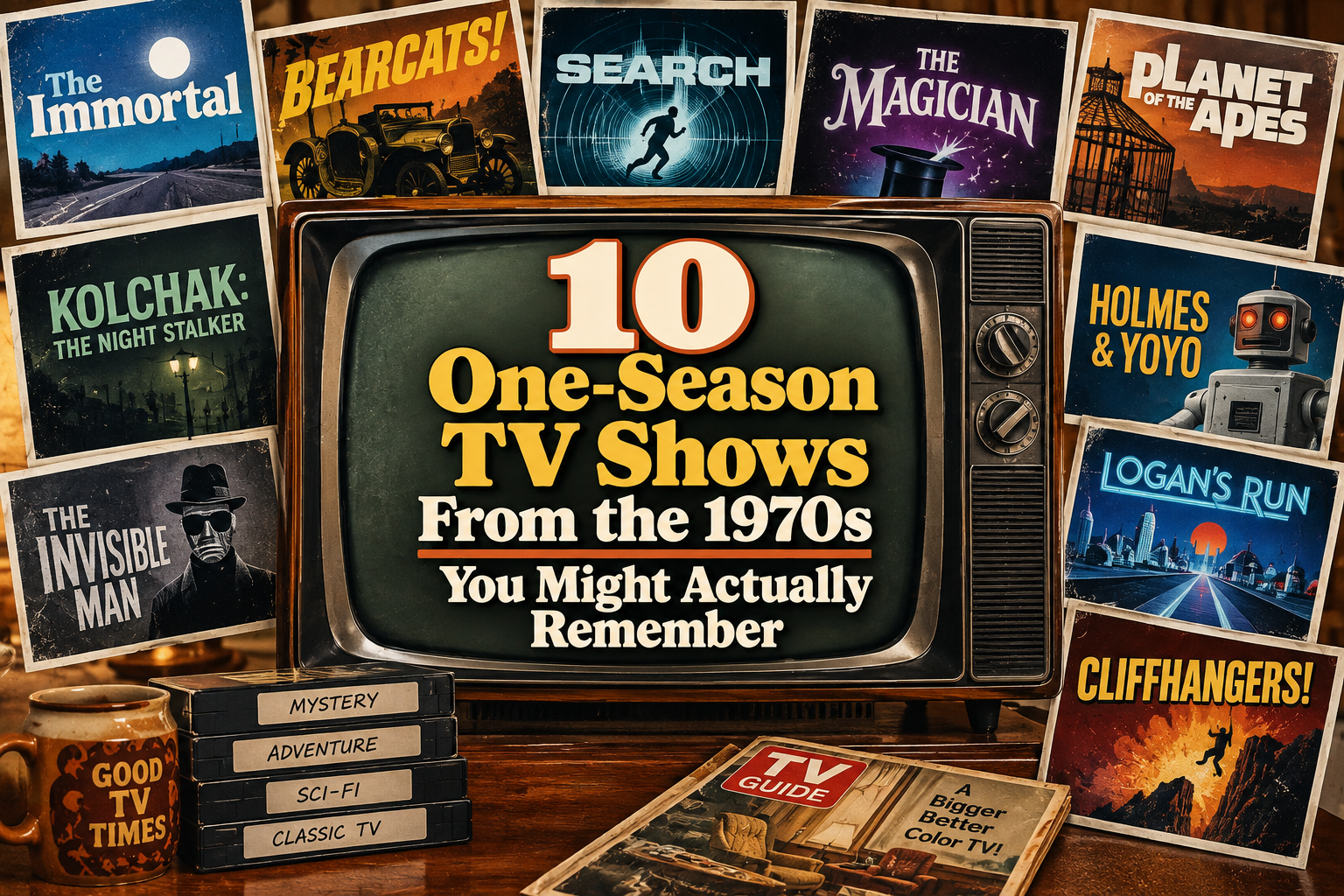
10 One-Season TV Shows From the 1970s You Might Actually Remember
They came, they disappeared, but somehow we never completely forgot them. From Search and The Magician to Kolchak: The Night Stalker and Logan’s Run, these 10 short-lived TV shows prove that sometimes one season was all it took to leave a lasting memory.
Television memory can be a funny thing.
Some shows stayed on the air for ten years and have almost completely disappeared from our memories. Others lasted barely a season, yet somehow left behind an image, a theme song, a character or even a single scene that we’ve carried around for nearly half a century.
The 1970s were filled with shows like that.
Back then, if you liked a new series, there was no guarantee it would be around very long. There was no streaming service where a small but devoted audience could discover it later. A network put a show on the schedule, watched the ratings, moved it around if things weren’t working and sometimes pulled the plug before viewers had much chance to get attached.
And yet, we did get attached.
Here are ten television shows from the 1970s that only lasted one season, but may still cause you to say, “Wait a minute… I remember that!”
1. The Immortal (1970–1971)
Imagine discovering that your blood could make other people practically immortal.
That was the intriguing premise behind The Immortal, starring Christopher George as test driver Ben Richards. Richards discovers that his blood contains special properties that make him resistant to disease and aging. Unfortunately, once a wealthy dying man learns about it, Richards becomes extremely valuable—and not in a good way.
Much of the series became a chase, with Richards on the run from people who wanted to control him and use his blood.
The concept feels surprisingly modern today, mixing science fiction, conspiracy and the classic fugitive-on-the-run formula. ABC aired only one season, but for viewers who encountered it, The Immortal was difficult to forget.
2. Bearcats! (1971)
Two adventurers. An early automobile. The American West.
Bearcats! starred Rod Taylor and Dennis Cole as Hank Brackett and Johnny Reach, troubleshooters who traveled around taking dangerous assignments during the early years of the 20th century.
Instead of riding horses like traditional Western heroes, they traveled in a 1914 Stutz Bearcat.
That automobile alone was enough to make the show memorable.
The series arrived at an awkward moment for television Westerns. The genre that had dominated television for years was beginning to fade, while audiences were moving toward more contemporary police and detective shows.
Bearcats! didn’t survive the transition, but that beautiful car and unusual turn-of-the-century setting gave it an identity all its own.
3. Search (1972–1973)
This is one that might unlock a very specific television memory.
Search followed agents working for World Securities Corporation who carried tiny electronic devices that allowed a control center to monitor what they were seeing and hearing.
Remember, this was 1972.
The agents had miniature cameras, communications technology and support from computers and technicians watching remotely. Hugh O’Brian, Tony Franciosa and Doug McClure rotated as the show’s principal agents.
At the time it seemed futuristic.
Today, when nearly everyone carries a camera, tracking device and communication system in a pocket, Search can seem strangely ahead of its time.
NBC gave it only one season, but science-fiction and spy-TV fans have never completely forgotten it.
4. The Magician (1973–1974)
Bill Bixby solving crimes with magic tricks?
That’s essentially what viewers got with The Magician.
Bixby played Anthony Blake, a wealthy professional magician who used illusion, escape artistry and his knowledge of deception to help people in trouble.
There was no supernatural explanation. Blake wasn’t actually performing magic. The fun was watching him use the techniques of a professional illusionist in situations normally handled by a private detective.
It was exactly the sort of high-concept television idea that the 1970s seemed willing to try.
The series disappeared after a single season, but Bill Bixby certainly didn’t disappear from television. A few years later, he would become much better known as David Banner in The Incredible Hulk.
For some viewers, though, he’ll also always be the magician who solved crimes.
5. Planet of the Apes (1974)
By 1974, Planet of the Apes had already become a major movie franchise, so bringing the concept to weekly television seemed perfectly logical.
The CBS series starred Roddy McDowall as Galen, alongside Ron Harper and James Naughton as astronauts Alan Virdon and Peter Burke. The two men find themselves on a future Earth dominated by apes and spend much of the series traveling from place to place while trying to survive and understand what happened.
For children who already loved the movies, having Planet of the Apes on television every week was a big deal.
Unfortunately, there weren’t many weeks.
The series produced only 14 episodes before being canceled. But between the makeup, the ape villages, the costumes and Galen himself, it left behind some powerful childhood memories.
And Planet of the Apes wasn’t finished with television yet. An animated series would follow the next year.
6. Kolchak: The Night Stalker (1974–1975)
If there is one show on this list whose reputation became larger after it disappeared, it may be Kolchak: The Night Stalker.
Darren McGavin played Carl Kolchak, a Chicago newspaper reporter who had an unfortunate habit of discovering stories involving vampires, monsters, ghosts and other things his editors—and usually the authorities—refused to believe existed.
Kolchak wasn’t a glamorous hero. He wore a rumpled suit and straw hat, carried a camera and tape recorder and often seemed one step away from either proving the supernatural existed or getting himself killed.
The series lasted only 20 episodes.
Yet its influence stretched far beyond that single season. Years later, The X-Files creator Chris Carter would acknowledge Kolchak as an important influence.
For a canceled 1970s television show, that’s quite a legacy.
7. The Invisible Man (1975–1976)
The 1970s loved taking science-fiction concepts and dropping them into weekly adventure television.
The Invisible Man starred David McCallum as scientist Daniel Westin, who discovers a method of making objects invisible. Naturally, things don’t go exactly according to plan, and Westin eventually becomes permanently invisible himself.
The show’s solution was memorable: Westin wore a lifelike mask and gloves when he needed to appear visible, removing them when it was time to disappear.
The effects may look modest compared with what television can accomplish today, but in the mid-1970s the transformation could be fascinating—especially to younger viewers.
NBC canceled the series after one season, but the network wasn’t ready to abandon the invisible-man idea completely. Gemini Man, starring Ben Murphy, followed in 1976 with a somewhat different take on the concept.
8. Holmes & Yoyo (1976–1977)
The title alone may bring this one back.
Holmes & Yoyo was a comedy about police detective Alexander Holmes, played by Richard B. Shull, who is assigned a new partner named Gregory “Yoyo” Yoyonovich.
The catch?
Yoyo is a robot.
John Schuck played the robotic detective, whose mechanical abilities were useful but whose malfunctions inevitably created problems. It was part police show, part science fiction and part sitcom—a combination that could only have emerged from a particularly adventurous television meeting.
It didn’t last.
But Holmes & Yoyo is exactly the kind of show people remember decades later because the premise was so unusual. You might forget dozens of conventional police dramas.
The cop with the robot partner?
That sticks around.
9. Logan’s Run (1977–1978)
After the success of the 1976 movie, Logan’s Run seemed like another science-fiction property perfectly suited for television.
Gregory Harrison played Logan, with Heather Menzies as Jessica and Donald Moffat as the android Rem.
Like the movie, the series took place in a future society where life inside a domed city appears comfortable and perfect—until you reach the age when that comfortable life is supposed to end.
Logan and Jessica escape and begin searching for Sanctuary.
The weekly television format allowed them to encounter different communities and remnants of the outside world, giving the show more of an adventure-series structure.
CBS aired only 14 episodes.
For young science-fiction fans in the late 1970s, however, futuristic vehicles, strange societies, advanced technology and an android companion could make quite an impression.
10. Cliffhangers! (1979)
And then there was Cliffhangers!, one of those television experiments that sounds almost unbelievable today.
NBC attempted to recreate the feeling of old movie serials by presenting three different continuing adventures within the same program. There was Stop Susan Williams, an adventure mystery; The Secret Empire, a science-fiction Western; and The Curse of Dracula, featuring—yes—Dracula.
Each story ended with the kind of danger designed to make viewers return the following week.
It was an ambitious idea and deliberately old-fashioned at a time when television was heading toward the 1980s.
Audiences didn’t stick around in large enough numbers, and Cliffhangers! was canceled after one season.
Its short life almost makes it more fascinating today. It feels like a strange artifact from an era when networks were still willing to put something genuinely unusual on prime-time television just to see whether audiences might like it.
Gone, But Somehow Not Forgotten
None of these programs became a MASH*, All in the Family or Happy Days. There weren’t hundreds of episodes waiting to be repeated for decades.
Some barely had enough episodes to fill a few months.
But television didn’t work the way it does today.
If you were a kid who loved Planet of the Apes, those 14 episodes mattered. If you thought the technology on Search was incredible, you remembered it. If Kolchak scared you one Friday night, you might still remember exactly what the living room looked like while you watched it.
Sometimes all it took was one season.
One strange premise.
One unforgettable opening sequence.
Or one television show that everyone else seems to have forgotten.
That’s part of the fun of looking through an old television schedule. Every once in a while, you’ll see a title you haven’t thought about in 40 or 50 years—and suddenly the memory comes rushing back.
How many of these do you remember? And what’s the one short-lived 1970s TV show you thought only you remembered?