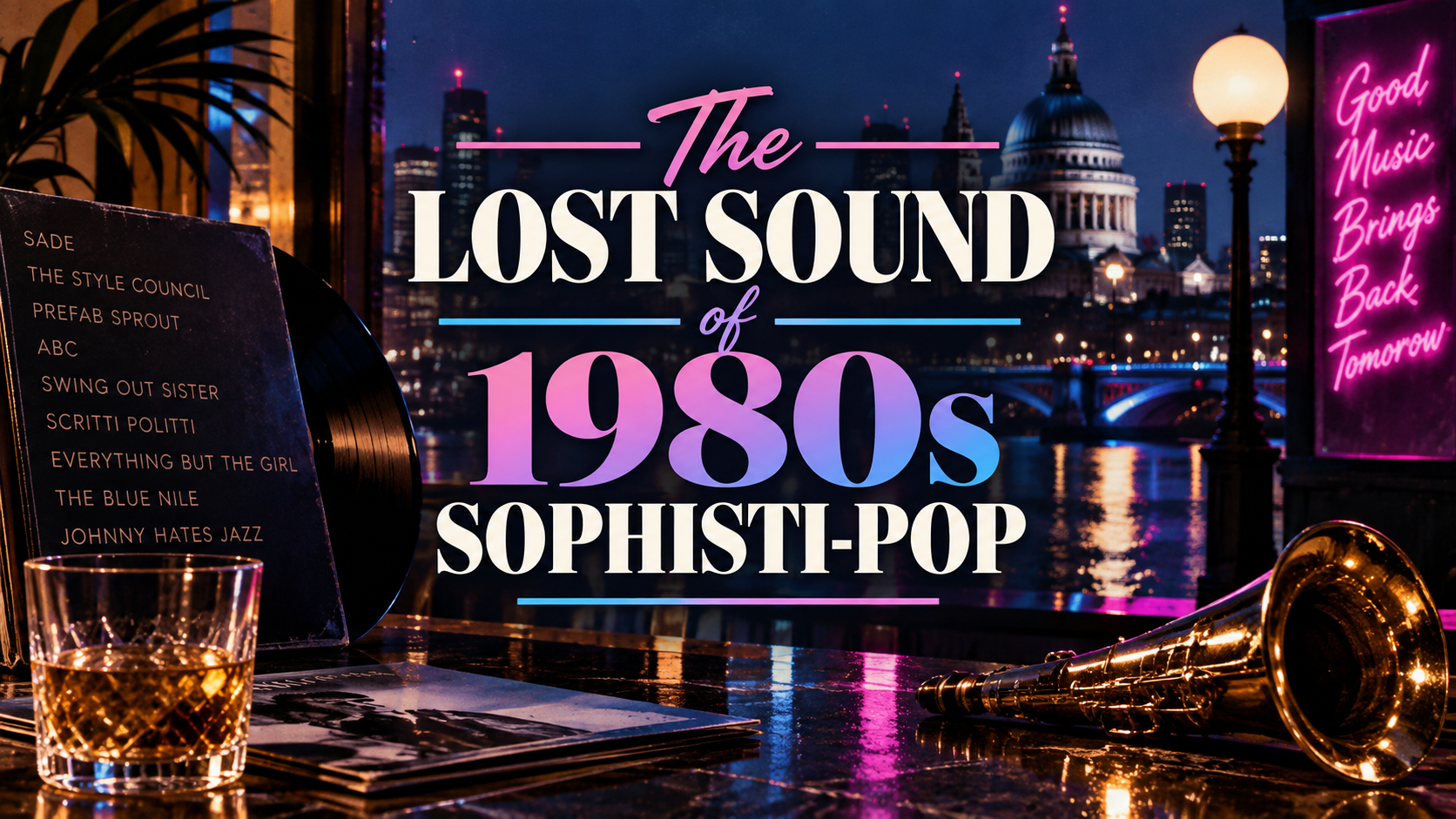
The Lost Sound of 1980s Sophisti-Pop
Beyond the neon, big drums and synth-pop of the 1980s was another sound—smooth, stylish and sophisticated. From Sade and The Style Council to Prefab Sprout and Swing Out Sister, Sophisti-pop blended jazz, soul and polished pop into music that still sounds effortlessly cool today.
Not everything about the 1980s was neon, synthesizers and enormous drums.
Somewhere beyond the stadium rock, MTV pop and New Wave was another sound—cooler, smoother and considerably more sophisticated. It borrowed from jazz and soul, mixed acoustic instruments with the latest studio technology, and often seemed more interested in creating an atmosphere than demanding your attention.
Today, we call much of it Sophisti-pop.
But if you were listening to the radio in the 1980s, chances are you never called it that. You simply knew that when Sade, The Style Council, Prefab Sprout or Swing Out Sister came through the speakers, the mood changed.
The lights seemed a little lower. The city outside seemed a little more interesting.
And pop music suddenly sounded very grown-up.
A Different Kind of 1980s Pop
The popular image of 1980s music tends to emphasize excess. Bigger hair, bigger drums, louder guitars, brighter synthesizers and music videos filled with enough smoke machines to change the weather.
Sophisti-pop went in another direction.
The arrangements could still be beautifully produced and unmistakably modern, but there was often restraint behind them. Jazz chords appeared where you might expect straightforward pop. Horns, piano, fretless bass, clean guitar and carefully placed percussion shared space with synthesizers and drum machines. Soul and R&B influences were everywhere.
There was also a certain elegance to the presentation. These weren’t necessarily artists dressing like rock stars. Album covers, videos and promotional photographs could look as though they belonged in fashion magazines.
It was 1980s pop music wearing a good jacket.
Sade Made Cool Sound Effortless
If one artist captures the feeling better than almost anyone else, it is Sade.
When Diamond Life appeared in 1984, it sounded remarkably different from much of what surrounded it. “Smooth Operator” had saxophone, jazz-inflected guitar, understated percussion and Sade Adu’s calm, unmistakable voice. “Your Love Is King” was warmer and more romantic, while “Hang On to Your Love” brought a subtle groove underneath the sophistication.
Nothing seemed rushed.
That was part of the appeal.
Sade’s records didn’t need to compete with the louder corners of the decade because they created their own environment. Put one on late at night and suddenly the room felt different. Even today, “Smooth Operator” can conjure images of city lights, hotel bars and wet streets reflecting neon without needing a single enormous 1980s drum fill.
And perhaps most importantly, the records haven’t aged like novelties from their era. They still sound elegant.
The Style Council Left Rock Behind
Paul Weller could easily have continued making guitar-driven music after The Jam ended. Instead, The Style Council allowed him to explore soul, jazz, funk and sophisticated pop.
Songs such as “You’re the Best Thing” and “My Ever Changing Moods” sounded far removed from the urgency of punk. Piano, brass, soulful vocals and polished arrangements became central to the music.
For listeners who had followed Weller through The Jam, the transition could be surprising. But it represented something larger happening in British music during the period. A generation raised on punk and New Wave was beginning to look backward toward soul, jazz and classic songwriting while simultaneously embracing modern production.
The result wasn’t retro.
It sounded completely contemporary.
ABC Brought Glamour Back to Pop
ABC approached sophistication from a different direction.
The Lexicon of Love arrived in 1982 with strings, dramatic arrangements, sharp suits and enough romantic heartbreak to fill an old Hollywood movie. Trevor Horn’s production gave songs such as “The Look of Love” and “Poison Arrow” an enormous sense of polish without sacrificing their pop hooks.
There was theatricality here, certainly, but also craftsmanship.
ABC demonstrated that sophisticated pop didn’t necessarily have to be quiet. It could be glamorous, dramatic and danceable. It could borrow from orchestral pop and soul while still sounding perfectly suited to the new world of MTV.
And it could make heartbreak sound remarkably stylish.
Prefab Sprout Made Pop for People Who Were Listening Closely
Then there was Prefab Sprout.
Paddy McAloon’s songwriting could be melodic, clever, romantic and occasionally strange, often within the same song. The band’s records rewarded close listening in a way that much mainstream pop didn’t necessarily demand.
Their 1985 album Steve McQueen—released as Two Wheels Good in the United States—contained songs such as “When Love Breaks Down,” blending sophisticated songwriting with the beautifully detailed production of Thomas Dolby.
Prefab Sprout never became a massive American pop phenomenon, but that almost adds to their appeal today. Discovering them can feel like finding a forgotten section of the 1980s that somehow escaped the endless rotation of decade-themed playlists.
This was music designed to last longer than the fashion surrounding it.
Swing Out Sister Arrived at Exactly the Right Moment
By 1986 and 1987, the Sophisti-pop sound had become increasingly polished.
Swing Out Sister’s “Breakout” captured that moment beautifully. Bright horns, keyboards, an irresistible rhythm and Corinne Drewery’s smooth vocal created something that sounded optimistic, stylish and unmistakably metropolitan.
It was modern without being cold.
Their music also demonstrated how far this sound had traveled from conventional rock. The guitar no longer had to be the center of everything. Brass arrangements, keyboards, programmed rhythms and jazz-influenced harmonies could carry a pop record.
“Breakout” became a major international hit, but it also represented one of the moments when this sophisticated strain of British pop crossed fully into the mainstream.
There Were More of Them Than We Remember
Once you start listening for this sound, you begin finding it everywhere.
Scritti Politti brought an almost obsessive studio perfection to sophisticated electronic pop. Everything but the Girl mixed jazz, folk and pop influences with Tracey Thorn’s distinctive voice. The Blue Nile created spacious, atmospheric records that seemed practically designed for listening after midnight.
Johnny Hates Jazz took the polished approach into mainstream pop with “Shattered Dreams,” while Level 42 blended jazz-funk musicianship with increasingly accessible songwriting.
Not every one of these artists fits neatly into the same genre, and that’s part of the problem with applying labels decades later. Sophisti-pop wasn’t a rigid musical movement with membership cards and clearly defined rules.
It was more like a shared sensibility.
The songs were polished. The musicianship mattered. Soul and jazz were never very far away. Production was modern but rarely allowed to overwhelm the songwriting.
And everything sounded just a little more sophisticated than ordinary pop.
Music for the City After Dark
Perhaps Sophisti-pop is best understood not by describing the instruments but by describing the place where it seems to belong.
It’s nighttime.
The pavement is wet from an earlier rain. Cars pass under streetlights while reflections stretch across the road. Restaurants are closing, office buildings still have a few illuminated windows, and somewhere behind the glass of a small bar a record is playing quietly.
That record could be Sade.
It could be The Blue Nile.
Maybe it’s Prefab Sprout, Everything but the Girl or Swing Out Sister.
There is something inherently urban about much of this music. Yacht Rock makes us imagine California sunshine, boats and afternoons near the water. Sophisti-pop feels different.
Sophisti-pop belongs after dark.
Why Did the Sound Fade?
By the end of the decade, pop music was changing again.
Dance music was becoming increasingly dominant. House and electronic music were moving from clubs toward the mainstream. Hip-hop was growing rapidly. Alternative rock was waiting around the corner, and the glossy production techniques that had once sounded remarkably sophisticated were becoming commonplace.
Some Sophisti-pop artists continued successfully. Others evolved, disappeared from mainstream radio or retained devoted audiences without producing the enormous hits they once had.
The term itself never became particularly important to ordinary listeners at the time.
That may be one reason the music sometimes feels forgotten today.
Ask someone to describe 1980s music and they’ll probably mention Michael Jackson, Madonna, Prince, Bon Jovi, Duran Duran or synth-pop long before they mention Prefab Sprout.
But put on “Smooth Operator,” “The Look of Love,” “You’re the Best Thing” or “Breakout,” and recognition comes immediately.
The sound never really left our memory.
We simply forgot what shelf to put it on.
You Can Still Hear That Sound on Classic Gold Radio
That’s one of the pleasures of going back through the music of the 1980s. Beyond the songs everybody remembers are entire sounds and styles waiting to be rediscovered.
At Classic Gold Radio, that’s exactly the kind of music we enjoy bringing back.
Alongside the big hits of the 1970s and 1980s, there is room for the smoother and more sophisticated side of the decade—the records with warm keyboards, jazz-influenced arrangements, soulful vocals and the kind of production that somehow sounds even better when the lights are low.
Because the 1980s weren’t only about neon, big hair and enormous drums.
Sometimes they wore a good jacket, ordered something at the bar and stayed out until after midnight.