
Late Night’s Great Rivalry
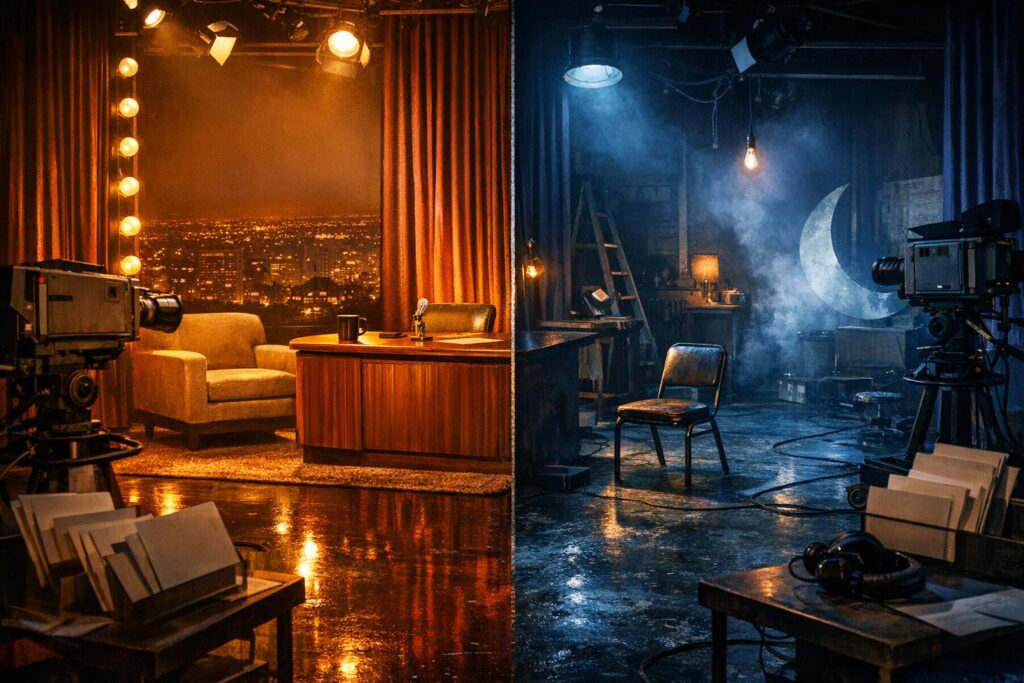
For years, American late-night television had a duel at its heart: Jay Leno and David Letterman, two very different hosts chasing the same audience after dark. One was all bright energy and broad appeal, the other sly, offbeat, and wonderfully unpredictable. Together, they turned a time slot into a cultural event, and their rivalry became one of television’s most fascinating backstage stories.
Two comics, two styles, one big stage
If you tuned in during the 1980s and 1990s, you could feel the contrast immediately. Jay Leno came across like the hardworking stand-up who could walk into any room and win it over. His comedy was fast, accessible, and built for a wide audience. He had the rhythm of a road comic who had spent years sharpening his material in clubs, always ready with another punchline.
David Letterman, by contrast, felt like the cool mischief-maker in the corner of the room. His humour could be dry, ironic, even gloriously awkward. He played with the format of late-night television rather than simply filling it. A standard celebrity interview might suddenly become a deadpan comedy sketch. A throwaway moment could become more memorable than the planned segment. That unpredictability gave Letterman a special kind of magic.
For viewers, this was not just a battle between two hosts. It was a choice between two comic worlds. Did you want comfort and familiarity, or something a little stranger and more self-aware? Radio listeners know the feeling well. It is like choosing between a polished chart favourite and a cult classic that somehow says more with a sideways glance.
The throne everyone wanted
At the centre of the story was The Tonight Show, one of the most prized jobs in American television. For decades, it had been the crown jewel of late night. Johnny Carson was the king of that world, smooth and effortless, a host who made the whole thing look easy. So when it became clear that Carson would eventually step away, the question started humming through the entertainment business like a hot record everyone wanted to hear first: who would replace him?
Both Leno and Letterman had strong claims. Leno had been a frequent guest host for Carson and had built a reputation as a reliable, audience-friendly performer. Letterman, meanwhile, had become a critical darling with Late Night with David Letterman, a show that pushed the boundaries of what late-night television could be.
On paper, each man looked like a worthy successor. In practice, the decision became a storm of politics, loyalty, ambition, and network nerves. Behind the studio lights, executives weighed ratings potential, audience expectations, and personal relationships. It was not just about who was funniest. It was about who could carry a legacy while keeping advertisers, affiliates, and millions of viewers happy.
Behind the curtain
A television drama with no script
What made the Leno-Letterman story so gripping was how human it all felt. This was not a simple hero-versus-villain tale. It was messier than that, and much more interesting.
Leno was often portrayed as the tireless competitor, a comedian who never stopped working and never lost sight of the prize. He had a reputation for being relentless, the sort of performer who would do extra sets, make extra calls, and stay one step ahead. In show business, that kind of drive can be admired and feared in equal measure.
Letterman, meanwhile, carried the air of the brilliant outsider who seemed destined for the top job, at least in the eyes of many critics and devoted fans. When he did not get The Tonight Show, the disappointment landed with real force. It felt, to many, like the end of one chapter of television and the beginning of another that nobody had quite expected.
The behind-the-scenes tension became part of the legend. Meetings, negotiations, shifting promises, bruised feelings, and strategic moves all added to the drama. For audiences, it was a reminder that entertainment history is often shaped not just by talent, but by timing and boardroom decisions.
Late-night television looked relaxed on screen, but behind the scenes it could be every bit as competitive as prime-time drama.
When the rivalry became public
Once Leno took over The Tonight Show in 1992 and Letterman moved to CBS for The Late Show with David Letterman in 1993, the rivalry was no longer whispered about behind closed doors. It was right there on television every night, playing out in ratings, monologues, guest bookings, and media coverage.
This was a golden era for the late-night format because the competition was so clear. Leno leaned into mainstream appeal. His monologues were built to land quickly and cleanly, and his show often felt like a dependable nightly gathering. Letterman offered a sharper edge, with Top Ten lists, oddball humour, and a style that seemed to wink at the audience while taking apart television conventions.
And then there were the guests. In the battle for attention, celebrity bookings mattered enormously. Big stars, major interviews, and memorable moments became part of the nightly contest. Each show wanted the conversation the next morning. Each host wanted the clip people would talk about at work, over breakfast, or during the drive home.
For a generation of viewers, this was appointment television. Before streaming, before endless clips on demand, late night still had the thrill of happening now. If something surprising happened, you wanted to see it live or hear about it first thing the next day.
Why audiences connected so deeply
More than ratings, it was about identity
Part of the reason this rivalry lasted so powerfully in public memory is that people did not just watch Leno or Letterman. They identified with them.
Leno represented one kind of entertainment tradition: polished, approachable, and built to welcome everyone in. He was the host your parents liked, the one who could keep the show moving and avoid too much discomfort. There is a craft to that, and it should not be underestimated.
Letterman represented something else: irony, invention, and a slightly rebellious streak. He appealed to viewers who liked their comedy with a little bend in it, something clever hiding under the surface. He could make awkwardness funny, and he made the machinery of television part of the joke.
That divide gave the rivalry its emotional charge. Fans were not simply picking a presenter. They were picking a tone, a sensibility, even a worldview. In that sense, the contest said as much about the audience as it did about the hosts themselves.
The legacy they left behind
Today, the late-night landscape looks very different, but the Leno-Letterman era still casts a long shadow. Their rivalry helped define what the format could be at its commercial peak. It showed that style matters as much as structure, and that two hosts can sit behind similar desks and create completely different experiences.
It also left behind a blueprint for how television rivalries capture the public imagination. The story had everything: ambition, disappointment, reinvention, and endurance. It had the familiar rhythm of a great music feud or a chart battle, where talent meets timing and the audience gets drawn into every twist.
Both men, in their own ways, became institutions. Leno proved himself durable and enormously successful with mainstream viewers. Letterman became a symbol of smart, distinctive late-night comedy, an influence on generations of hosts who followed. You can still see traces of both men in modern television: the broad monologue craftsman and the host who delights in turning the format inside out.
A rivalry worth remembering
Looking back now, what stands out is not just who won which ratings week or who landed which guest. It is the atmosphere of the whole era. The glow of studio lights. The opening monologue after a long day. The sense that somewhere, across town, another host was stepping onto another stage, trying to own the same hour in a completely different way.
Jay Leno and David Letterman gave late-night television one of its richest chapters because they were never interchangeable. Their differences made the contest compelling, and their talent made it last. One played it with a grin and a rapid-fire joke. The other raised an eyebrow and made the silence part of the laugh.
That is why the story still resonates. It is nostalgic, yes, but it is also a reminder of a time when television felt like a shared nightly ritual, and when two gifted performers could turn a scheduling battle into pop culture legend.
- Jay Leno: broad, energetic, stand-up driven style
- David Letterman: ironic, inventive, and unpredictable approach
- The key battleground: the post-Carson future of The Tonight Show
- Why it mattered: viewers saw their own tastes reflected in each host
- Enduring impact: both helped shape the modern late-night template