The 10 Scariest Aliens of 1960s Television
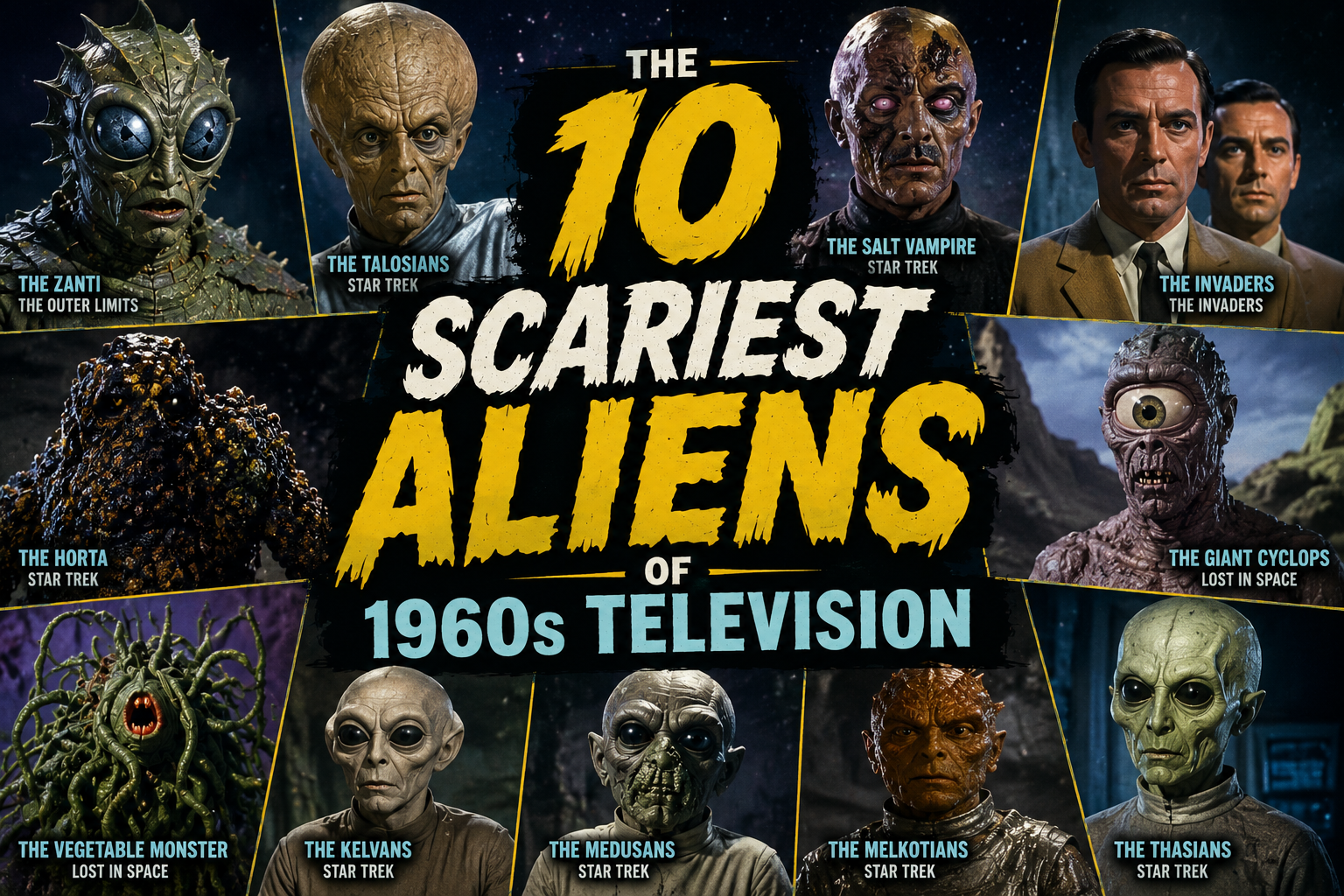
Before CGI, television's scariest aliens ran on rubber suits and pure imagination — and they still worked. Here are the 10 creatures that taught a generation to fear the dark.
There was a particular kind of dread that only a black-and-white television set could deliver. No CGI, no jump-scare sound design engineered in a studio, just a rubber suit, a fog machine, a theremin wailing somewhere in the background, and a family gathered around a single glowing screen in the living room. And somehow, it worked. The aliens of 1960s television didn’t need to look real to feel real — they needed only to look wrong, and the decade’s writers, makeup artists, and directors turned out to be masters of wrongness.
This was the golden age of anthology science fiction, when “The Twilight Zone” and “The Outer Limits” taught America that the scariest stories weren’t about monsters from outer space so much as about what those monsters revealed about us. It was also the decade that gave the world “Star Trek,” “Doctor Who,” and “Lost in Space,” shows that turned alien encounters into a weekly ritual. Whatever the show, the formula for a truly frightening 1960s alien tended to combine three things: an unsettling design built from whatever the budget allowed, a premise that lodged itself in your subconscious long after the credits rolled, and, often, a twist that made the horror feel less like fantasy and more like a warning.
Here, in countdown order, are ten aliens that gave a generation of television viewers a reason to sleep with the hallway light on.
10. The Zanti Misfits — The Outer Limits (1963)
“The Zanti Misfits” arrived in the first season of “The Outer Limits” and proved that nothing needed to be humanoid to be horrifying. The Zanti were an alien race who asked humanity to use a patch of Arizona desert as a penal colony for their criminals — a deal Earth’s leaders accepted, sight unseen. What emerged from the landed spacecraft were skittering, ant-headed creatures with human hands, each one a small nightmare of a body plan that shouldn’t have existed. Filmed in tight, disorienting close-ups, the Zanti didn’t need special effects wizardry to unsettle viewers; the sheer wrongness of their anatomy did the work. It remains one of the most talked-about hours of the original “Outer Limits” run, and deservedly so.
9. The Thetan — The Outer Limits, “The Architects of Fear” (1963)
Few episodes of 1960s television are as quietly devastating as “The Architects of Fear,” in which scientist Allan Leighton volunteers to be surgically transformed into a convincing alien — the “Thetan” — as part of a desperate scheme to unite a Cold War-frightened humanity against a common enemy. The transformation, achieved through painful surgery and prosthetics, turns Leighton into a genuinely disturbing sight: an insectoid, semi-crustacean being with a face barely recognizable as human. The true horror, though, wasn’t the creature design — it was the ending, one of the bleakest in the series’ history, where the “alien” is executed by frightened humans before the truth can be revealed. It’s a story about how the fear of the alien can be more dangerous than any alien could ever be.
8. The Talosians — Star Trek, “The Cage” (1965)
Before Captain Kirk ever set foot on the Enterprise, Captain Christopher Pike was trapped by the Talosians, a race of telepathic beings with grotesquely enlarged craniums who had lost their bodies to psychic illusion after a planetary catastrophe. What made the Talosians frightening wasn’t brute force — they never so much as raised a hand against their captives — but the total helplessness of being manipulated inside your own mind, unable to trust anything you saw, heard, or felt. “The Cage,” filmed in late 1964, was deemed too cerebral and “too talky” to air as originally produced and sat unbroadcast for decades — but its footage was recycled into the 1966 two-part episode “The Menagerie,” introducing millions of television viewers to a species that proved psychological horror could be just as effective as a monster with teeth.
7. The Salt Vampire — Star Trek, “The Man Trap” (1966)
When “Star Trek” made its television debut on September 8, 1966, the very first episode American audiences saw was “The Man Trap” — and the creature at its center, the shape-shifting M-113 salt vampire, set the tone for just how strange this new show intended to be. The last of its species, the creature could assume the appearance of anyone, including a beloved figure from a crew member’s past, before draining its victims of the salt their bodies needed to survive. Its true form — grayish, tentacle-faced, with suckers along its arms — was reserved for the kill. Pairing a monster with the tragedy of loneliness (it truly was the last of its kind, desperately trying to survive), the episode set a template “Star Trek” would return to again and again: even its horrors had a point of view.
6. The Gorn — Star Trek, “Arena” (1967)
Few alien costumes are more instantly recognizable — or more fondly mocked — than the Gorn, the reptilian captain who faced off against Kirk on a rocky, sound-stage desert in “Arena,” which first aired January 19, 1967. Judged purely by 21st-century special-effects standards, the lumbering, rubber-suited Gorn is an easy target for jokes. But airing in 1967, to a country still getting used to color television, the Gorn’s hissing menace and sheer alienness — a full seven feet of scaled, clawed reptile intelligence — was legitimately unsettling. It helped that the story refused to let the Gorn simply be a monster: by the episode’s end, it’s revealed the creature was defending its territory, not attacking out of malice, deepening the fright with a note of tragic misunderstanding.
5. The Cybermen — Doctor Who, “The Tenth Planet” (1966)
When the Cybermen debuted in the 1966 serial “The Tenth Planet,” they introduced British television to a fear that has only grown more resonant with time: the fear of losing your humanity to your own machines. Once-organic beings from the planet Mondas who replaced their failing bodies with cybernetic parts, the Cybermen spoke in a flat, sing-song monotone that made their emotionless cruelty even more chilling than the Daleks’ famous screech. “The Tenth Planet” also holds a singular place in television history as the story in which William Hartnell, the very first actor to play the Doctor, transformed into Patrick Troughton — the moment that originated what fans now call “regeneration,” meaning the Cybermen’s debut coincided with the birth of one of the medium’s most enduring science-fiction concepts.
4. The Horta — Star Trek, “The Devil in the Dark” (1967)
Some 1960s aliens scared audiences through sheer strangeness of form, and none embodied that better than the Horta, the silicon-based, magma-dwelling creature at the heart of “The Devil in the Dark.” For most of the episode, the Horta is presented purely as a threat: a shapeless, acid-secreting rock monster killing miners one by one in the tunnels of Janus VI. Janos Prohaska’s now-iconic costume — essentially a carpet draped over a crawling actor — became instantly memorable precisely because it looked like nothing else on television. And true to “Star Trek” form, the episode subverted its own horror in the final act, revealing the Horta as a mother protecting her eggs rather than a mindless killer, turning a monster story into one of the series’ most humane hours.
3. The Kanamits — The Twilight Zone, “To Serve Man” (1962)
Nine feet tall, bald, robed, and unnervingly serene, the Kanamits — played memorably by a towering Richard Kiel — arrived on Earth promising to end war, hunger, and poverty, and largely delivered on that promise. Rod Serling’s “To Serve Man,” broadcast in the show’s third season in 1962, built its horror not through violence but through creeping, dawning dread, as a linguist works to translate the Kanamits’ guidebook only to discover, in the episode’s now-legendary final twist, that “To Serve Man” is a cookbook. It’s a testament to the era’s storytelling craft that an episode almost entirely free of monster makeup or special effects remains one of the most quoted, parodied, and genuinely unsettling half-hours in television history — right down to Kiel’s chillingly calm smile as the truth is revealed.
2. The Daleks — Doctor Who (1963)
Created by writer Terry Nation and first appearing in the serial simply titled “The Daleks” in December 1963, these pepper-pot-shaped, radiation-scarred remnants of the Kaled race became the single most iconic alien menace in British television history — and arguably in all of 1960s television. Encased in armored, gun-metal shells and driven by a single-minded genocidal hatred of anything unlike themselves, the Daleks terrified an entire generation of British children who famously hid behind the sofa whenever that grating, mechanized “EX-TER-MIN-ATE!” rang out. Unlike so many rubber-suited monsters of the era, the Daleks’ horror lay in what they represented rather than how they looked: a warning, delivered barely two decades after World War II, about where unchecked hatred and fascism could lead.
1. The Invaders — The Invaders (1967–1968)
Topping the list isn’t a single creature but an entire concept that proved more disturbing than any rubber suit could manage. Premiering in 1967 and starring Roy Thinnes as architect David Vincent, “The Invaders” presented aliens who looked, dressed, and spoke exactly like ordinary Americans — indistinguishable except for a rigid little finger that wouldn’t bend and a habit of glowing bright red and vanishing when they died. There was no spaceship to point to, no monster to flee from. The horror of “The Invaders” was paranoia itself: the creeping suspicion that the man at the diner counter, the neighbor next door, or even a trusted colleague might not be human at all, and that no one would believe you if you tried to warn them. Airing during a decade already thick with Cold War anxiety, “The Invaders” distilled 1960s dread into its purest form — and proved that the scariest alien of all might be the one you can’t tell apart from anyone else.
Why These Aliens Still Matter
What’s striking, looking back across all ten entries, is how rarely the scares actually came from the special effects budget. The Kanamits terrify with a plot twist. The Talosians terrify with an idea. The Invaders terrify by removing the alien costume altogether. Even the more elaborately costumed creatures — the Gorn, the Horta, the Zanti Misfits — tended to be given a motive, a tragedy, or a point of view that turned a simple monster into something closer to a mirror.
That’s the real legacy of 1960s television science fiction. Working with limited budgets, black-and-white cameras, and the technical constraints of live-to-tape production, a generation of writers and producers discovered that the most effective monster is rarely the one with the sharpest teeth. It’s the one that makes you look twice at your own reflection — or at the person sitting next to you on the couch.
Sources
- To Serve Man (The Twilight Zone) – Wikipedia
- Arena (Star Trek: The Original Series) – Wikipedia
- The Man Trap – Wikipedia
- The Daleks – Wikipedia
- Terry Nation – Wikipedia
- The Tenth Planet – Wikipedia
- Cyberman – Wikipedia
- The Zanti Misfits – Wikipedia
- The Cage (Star Trek: The Original Series) – Wikipedia
- The Invaders – Wikipedia
- The Architects of Fear – Wikipedia
- The Devil in the Dark – Wikipedia