The Forgotten Sound of Adult Contemporary Radio in the 1980s
From Christopher Cross and Air Supply to Lionel Richie, Chicago, Phil Collins and Whitney Houston, Adult Contemporary radio created a softer soundtrack to the 1980s. Revisit the smooth songs, warm FM voices and late-night radio atmosphere that became part of everyday life—and discover why this forgotten sound can still take us straight back to 1986.
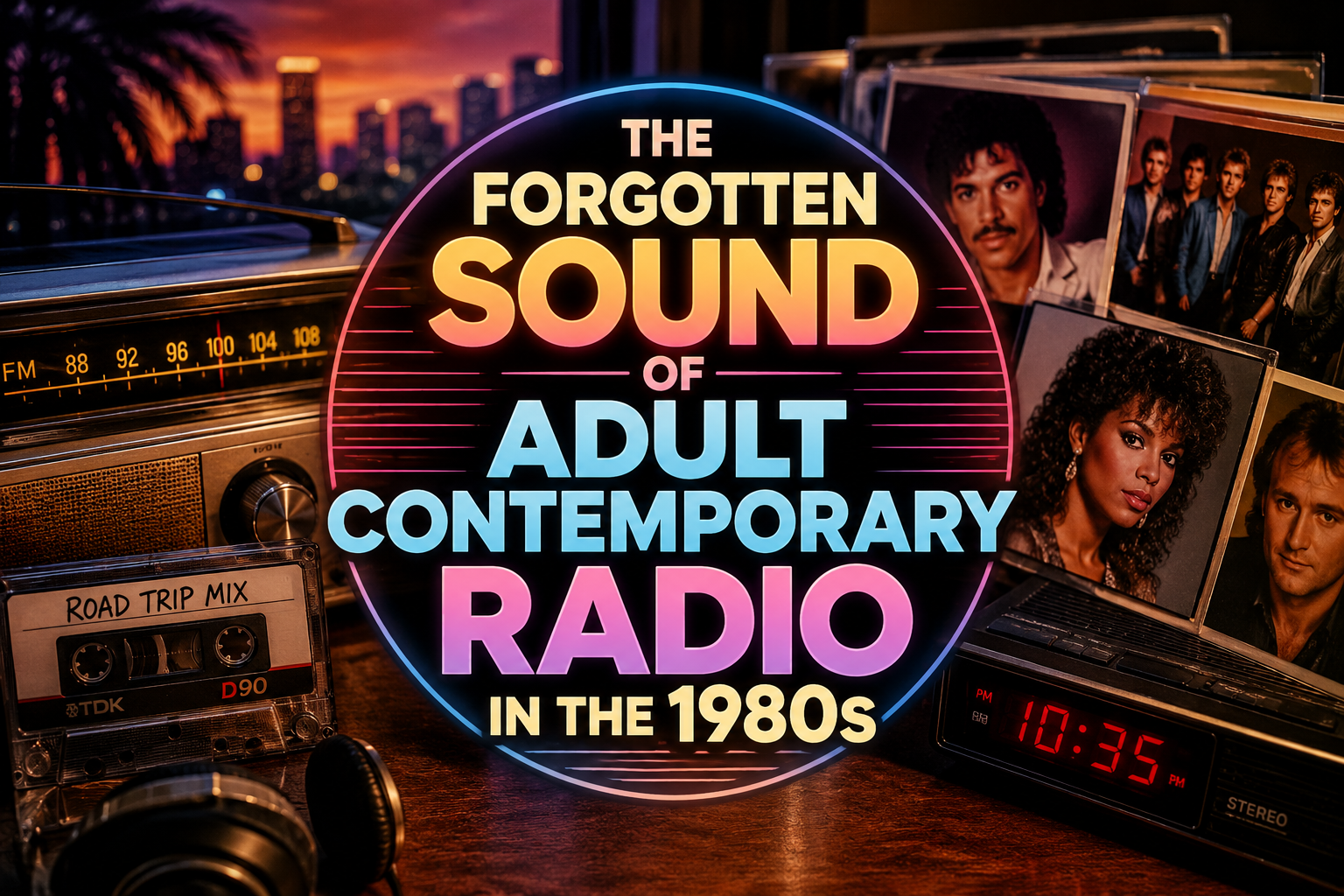
When people remember the sound of the 1980s, they usually remember the decade at its loudest. Synth-pop, new wave, hair metal, MTV, enormous drums and neon-colored music videos tend to dominate our memories. But there was another soundtrack playing throughout the decade, one that was considerably softer and perhaps even more common in everyday life.
It was coming from the radio in the kitchen while breakfast was being made. It played quietly from speakers in offices, waiting rooms and department stores. You heard it while riding in your parents’ car at night, during long summer drives and on Sunday afternoons when nobody seemed to be in much of a hurry.
This was the world of Adult Contemporary radio, and for millions of listeners, it was one of the defining sounds of the 1980s.
The Other Side of the ’80s
Adult Contemporary wasn’t really a musical genre in the traditional sense. It was a radio format, and its strength came from bringing together songs and artists that sounded comfortable alongside one another.
A typical station could move from Christopher Cross to Air Supply, then play Lionel Richie, Chicago, Phil Collins, Billy Joel, Whitney Houston, Steve Winwood or Hall & Oates without the transitions feeling particularly strange.
There were love songs, polished pop records, softer rock songs and the occasional older favorite from the 1970s. The common denominator was that the music was melodic, accessible and generally easy to live with.
And that last part mattered.
Adult Contemporary wasn’t necessarily music that demanded your attention. It was music that could become part of your surroundings. You could have a conversation while it played. You could drive for hours with it. You could work with it in the background.
Yet every so often, a song would come through the speakers that made you turn the volume up.
When Christopher Cross Sounded Like the Future
Few artists capture the transition into 1980s Adult Contemporary better than Christopher Cross.
Songs such as “Sailing,” “Arthur’s Theme (Best That You Can Do)” and “Think of Laura” had an extraordinarily polished quality. The arrangements were smooth, the vocals relaxed and the production seemed almost designed for FM stereo.
Today, “Sailing” is frequently associated with what we now call yacht rock. At the beginning of the 1980s, however, listeners weren’t thinking about modern genre labels. It was simply a beautiful record coming through the radio.
Christopher Cross wasn’t alone. Artists such as Ambrosia, Little River Band, Boz Scaggs and Air Supply helped carry the sophisticated soft-rock sound of the late 1970s into the new decade.
For a few years, that sound seemed to be everywhere.
Air Supply and the Era of the Giant Love Song
If Adult Contemporary radio had one specialty during the early 1980s, it was the dramatic love song.
And few acts embraced it quite like Air Supply.
“Lost in Love,” “All Out of Love,” “The One That You Love” and “Even the Nights Are Better” were enormous, emotional records built around memorable melodies and soaring choruses.
There was nothing understated about the feelings in these songs.
The same radio dial might bring you REO Speedwagon’s “Keep on Loving You,” Journey’s “Open Arms,” or Foreigner’s “Waiting for a Girl Like You.” These were rock bands, but their ballads could comfortably live alongside the softer artists dominating Adult Contemporary playlists.
That crossover became one of the format’s greatest strengths. AC radio didn’t care very much whether an artist normally belonged to rock, pop, R&B or something else.
If the song felt right, it belonged.
Lionel Richie Was Practically Made for the Format
Then there was Lionel Richie.
Few voices fit 1980s Adult Contemporary radio as naturally.
After leaving the Commodores, Richie began an extraordinary solo run with songs including “Truly,” “Hello,” “Stuck on You,” “Say You, Say Me” and “Ballerina Girl.”
His records had warmth without sounding old-fashioned and sophisticated production without becoming cold. They worked equally well on pop radio and Adult Contemporary stations, helping define the middle of the decade.
Put on “Hello” today and it’s difficult not to imagine it coming from an FM radio somewhere around 1984.
That is the peculiar power of this music. Sometimes a song doesn’t merely remind you of a decade.
It reminds you of a room.
Chicago Reinvents Itself
The 1980s also brought one of the most remarkable transformations in pop music.
Chicago, the horn-driven rock band responsible for songs such as “25 or 6 to 4” in the previous decade, gradually evolved into one of the defining Adult Contemporary acts of the ’80s.
The turning point was “Hard to Say I’m Sorry” in 1982. Later came songs including “Hard Habit to Break,” “You’re the Inspiration,” “Will You Still Love Me?” and “Look Away.”
The sound was glossy, emotional and unmistakably ’80s.
Chicago’s transformation reflected what was happening across radio. The softer rock sound of the 1970s hadn’t disappeared. It had simply been remodeled with synthesizers, digital production and the enormous drums of the new decade.
The Phil Collins Effect
By the middle of the decade, Adult Contemporary radio was changing.
The warm acoustic textures of the late ’70s and early ’80s increasingly gave way to synthesizers, drum machines and much bigger production.
Few artists navigated that change better than Phil Collins.
Songs such as “Against All Odds (Take a Look at Me Now),” “One More Night,” “Separate Lives” with Marilyn Martin and later “Two Hearts” became fixtures of mainstream radio.
Collins could produce a song that sounded thoroughly modern while still appealing to listeners who might not have been interested in new wave or the more aggressive side of rock.
Steve Winwood accomplished something similar with records like “Higher Love” and “Back in the High Life Again.”
The technology had changed.
The feeling hadn’t.
Then Came Whitney
Adult Contemporary radio in the second half of the 1980s would be difficult to imagine without Whitney Houston.
Her arrival brought a younger, brighter energy to the format while retaining everything AC programmers loved: extraordinary vocals, memorable melodies and immaculate production.
Songs such as “Saving All My Love for You,” “Greatest Love of All,” “Didn’t We Almost Have It All” and “Where Do Broken Hearts Go” became natural Adult Contemporary staples.
Whitney demonstrated how broad the format had become. Adult Contemporary wasn’t simply soft rock anymore. Pop, R&B and sophisticated dance-pop could all find their way onto the station as long as the right song connected with the audience.
Don’t Forget the Saxophone
And then there was that saxophone.
You could almost make an entire article about the saxophone’s role in 1980s radio.
Glenn Frey’s “The One You Love,” George Michael’s “Careless Whisper,” and Foreigner’s “Urgent” are only a few examples of how effectively the instrument could create that unmistakable late-night ’80s atmosphere.
The saxophone had existed in popular music forever, of course, but during the 1980s it often became shorthand for sophistication, romance and nighttime.
Add an electric piano, a smooth bass line and just the right amount of reverb and suddenly it was 11:30 at night in 1986.
The DJs Were Part of the Sound
Something else has largely disappeared along with this style of radio: the presentation.
Adult Contemporary DJs rarely needed to shout.
The announcer might come in gently as the previous song faded, tell you the artist, mention the weather, perhaps remind you about a contest and then introduce another song.
There was often a calmness to it.
The processing of FM radio added another layer. Voices sounded warm and close. Songs flowed into station IDs and jingles. Commercial breaks somehow became part of the rhythm of listening.
And because you couldn’t instantly skip a song, the station itself became the experience.
You didn’t choose every record.
You chose the station.
Then you let the station take you somewhere.
The Delilah-Type Feeling Before Delilah
Even before nationally syndicated nighttime dedication programs became strongly associated with Adult Contemporary radio in later years, the format already seemed made for nighttime listening.
The tempo slowed. The personalities became quieter. Love songs suddenly sounded better.
Driving home after dark while Peter Cetera, Richard Marx, Anita Baker, George Michael or Gloria Estefan played on the radio created an atmosphere that is surprisingly difficult to reproduce today.
It wasn’t simply the music.
It was the combination of the music, the darkness outside the windshield, the illuminated dashboard and the knowledge that thousands of other people somewhere around town were probably hearing exactly the same song at exactly the same moment.
Radio made listening feel communal.
The Songs That Were Everywhere Without Feeling Like Hits
Perhaps the strangest thing about revisiting Adult Contemporary radio is realizing how many enormous songs have quietly slipped out of everyday rotation.
You might suddenly hear “Missing You” by John Waite, “Sara” by Starship, “Nothing’s Gonna Change My Love for You” by Glenn Medeiros, “Caught Up in the Rapture” by Anita Baker, or “Hold Me Now” by Thompson Twins, and an entire piece of the decade comes rushing back.
These weren’t obscure recordings.
Many were major hits.
But nostalgia tends to compress decades into a relatively small collection of songs. The same handful of massive ’80s tracks appear in movies, commercials and retro playlists again and again, while hundreds of records that actually filled the radio dial receive much less attention.
That’s why listening to an old Adult Contemporary playlist can sometimes feel more nostalgic than listening to an ’80s greatest-hits collection.
You aren’t just hearing the songs everyone remembers.
You’re hearing the songs you forgot you remembered.
Where Did That Sound Go?
Adult Contemporary radio never disappeared. The format still exists, and many stations remain enormously successful.
But its identity changed.
As musical tastes evolved through the 1990s and 2000s, AC stations evolved with them. The soft-rock-heavy mixture that characterized much of the 1980s gradually became something different.
The listening environment changed too.
Streaming services allow us to construct incredibly precise playlists. We can hear exactly the songs we want, whenever we want them. There is tremendous convenience in that.
But something was lost when we stopped surrendering control to the radio.
There was pleasure in not knowing what was coming next.
Maybe it would be a song you loved.
Maybe it would be one you’d forgotten.
Maybe the opening notes would suddenly make everyone in the car say, “Oh, I love this song.”
Somewhere on the FM Dial, It’s Still 1986
Perhaps that is what makes the forgotten sound of 1980s Adult Contemporary radio so comforting today.
It wasn’t trying particularly hard to be cool.
It wasn’t rebellious. It wasn’t dangerous. It didn’t need outrageous clothes or spectacular music videos.
It simply sounded good coming from the radio.
Christopher Cross. Air Supply. Lionel Richie. Chicago. Phil Collins. Whitney Houston. Steve Winwood. Anita Baker. Peter Cetera. Richard Marx.
Songs for driving home.
Songs for Sunday mornings.
Songs playing quietly from the kitchen.
Songs heard through the tiny speaker of a clock radio while you were getting ready for school or work.
And somewhere deep in our memories, they’re all still playing together on the same station — somewhere on the FM dial, on a warm evening in 1986.