Fake Live, Real Magic — How Bennie And The Jets Became a Glam Era Classic
With its fake live atmosphere, futuristic glamour and unforgettable piano hook, “Bennie And The Jets” turned studio trickery into pure pop theatre. Here is the story of how Elton John and his team made one of the most distinctive hits of the 1970s.
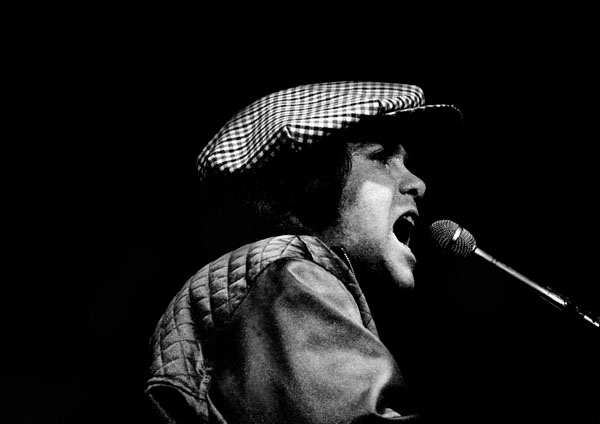
Few records capture the playful illusion of 1970s pop quite like “Bennie And The Jets”. Released on Elton John’s 1973 album Goodbye Yellow Brick Road, it arrived dressed as a futuristic live performance, full of cheers, swagger and glittery attitude. It sounded like a transmission from some chrome-plated pop tomorrow, but at its heart it was the work of a tight-knit group of musicians and songwriters operating at the peak of their powers.
More than half a century later, the song still feels fresh: part satire, part celebration, and entirely unforgettable. Its stuttering piano hook, its mock-concert atmosphere and Elton’s deliciously theatrical vocal made it one of the defining singles of the era.
A song born from wit, style and sharp observation
Elton John and Bernie Taupin’s creative spark
Like so many Elton John classics, the song began with lyricist Bernie Taupin. Taupin wrote words that affectionately poked at the exploding world of glam rock, celebrity culture and manufactured pop sensations. “Bennie And The Jets” presents a fictional band, all flash and futuristic cool, seen through the eyes of breathless fans. The lyric is knowingly exaggerated, almost like a glossy magazine feature turned into music.
Taupin had a gift for creating cinematic scenes, and here he built a world of electric boots, mohair suits and a band that seemed larger than life. There was humour in it, but not cruelty. The song gently sends up the hype machine while also enjoying every sparkling minute of it.
A melody Elton almost underestimated
When Elton John came to set the lyric to music, he created one of his most distinctive piano-driven arrangements. Yet, famously, he was not initially convinced it would be a hit. Compared with some of the more immediate songs on Goodbye Yellow Brick Road, “Bennie And The Jets” felt odd, angular and a little unconventional. Its clipped rhythm and stop-start phrasing gave it a different pulse from the flowing ballads and straight-ahead rockers that also filled the album.
That unusual shape turned out to be its secret weapon. The song feels both loose and precise: a glam-rock strut with a funky edge, built around a piano part that lands like camera flashes. It sounds effortless now, but it was a bold choice for a single.
Inside the studio: creating a live spectacle out of thin air
The team behind the record
The recording was produced by Gus Dudgeon, the brilliant studio architect behind many of Elton John’s greatest records. Dudgeon understood how to give Elton’s songs scale without losing their personality. He worked closely with arranger and conductor Del Newman on other material from the era, but “Bennie And The Jets” relied more on groove, texture and atmosphere than orchestral sweep.
The core musicians were Elton John’s celebrated band:
- Elton John – vocals and piano
- Davey Johnstone – guitar
- Dee Murray – bass
- Nigel Olsson – drums
Together, they had developed an almost telepathic chemistry by the early 1970s. That chemistry mattered enormously. Even a song built around artifice needed a real band underneath it, and this group could make almost anything feel exciting.
The famous fake audience
One of the great stories behind “Bennie And The Jets” is that its “live” feel was largely an illusion. The track was recorded in the studio at Château d’Hérouville in France during the marathon sessions for Goodbye Yellow Brick Road. Afterwards, producer Gus Dudgeon and the team added crowd noise and applause to make it sound like Elton was performing it onstage.
Those audience sounds were reportedly taken from recordings of real concerts, including performances at places such as the Royal Festival Hall. Mixed carefully into the track, they transformed the song into a piece of audio theatre. The cheers swell at just the right moments, the room seems to breathe around the piano, and suddenly the listener is no longer in a studio but in the middle of a glamorous event.
It was a clever move, and a slightly mischievous one too. In an era when authenticity was often prized in rock music, “Bennie And The Jets” openly played with illusion. It winked at the audience while giving them a bigger show.
A performance with space and swagger
Listen closely and the arrangement is beautifully disciplined. Elton’s electric piano-style attack gives the song its clipped, percussive identity. Nigel Olsson’s drumming leaves room for the groove to breathe, while Dee Murray’s bass keeps everything grounded. Davey Johnstone adds touches of guitar that colour the edges rather than crowd the centre.
The pauses are just as important as the notes. Those little breaks, with the audience roaring back in, make the whole thing feel theatrical. It is a masterclass in tension, release and timing.
From album track to chart giant
The single that surprised almost everyone
When Goodbye Yellow Brick Road was released in 1973, it was overflowing with potential hits. “Candle in the Wind”, “Saturday Night’s Alright for Fighting” and the title track were all obvious talking points. “Bennie And The Jets”, by contrast, was less predictable.
Its rise was helped enormously by radio, especially in North America, where it connected strongly with listeners. In the United States, the song became a major success, reaching number 1 on the Billboard Hot 100 in 1974. That achievement confirmed what audiences had already sensed: strange or not, it was irresistible.
Elsewhere, it also performed strongly and became one of Elton John’s signature songs. Commercially, it helped underline just how extraordinary his run was in the first half of the 1970s. He was not simply having hits; he was creating records with personality, risk and range.
Why audiences responded
Part of the song’s appeal was that it worked on several levels at once. It was catchy enough for pop radio, stylish enough for glam fans and rhythmically strong enough to attract a broader audience. Its groove gave it crossover appeal, and over time it became especially admired for the way it sat comfortably between rock, pop and soul-inflected pop craftsmanship.
There is also the hook itself: that title phrase, delivered with a stammering, teasing rhythm, is impossible to forget. Some songs enter the room politely. “Bennie And The Jets” kicks the doors open in platform boots.
Glam rock, pop theatre and the mood of 1973
A perfect fit for a flamboyant moment
To understand the song’s place in history, it helps to picture the musical landscape of the early 1970s. Glam rock was in full bloom. Artists were playing with identity, fashion, science-fiction imagery and larger-than-life stage personas. Pop was becoming more visual, more theatrical and more self-aware.
“Bennie And The Jets” fits beautifully into that world, but it also comments on it. It is not just a glam song; it is a song about the machinery of pop excitement. It captures the thrill of hype, the electricity of youth culture and the sense that stars could seem almost superhuman under the lights.
At the same time, Elton John himself was one of the defining figures of that era. His glasses, costumes, stagecraft and fearless embrace of showmanship made him an ideal messenger for a song like this. He was inside the spectacle and smart enough to grin at it too.
The broader Elton John moment
By 1973, Elton John was in astonishing form. The partnership with Bernie Taupin was producing songs at a remarkable rate, and albums such as Don’t Shoot Me I’m Only the Piano Player and Goodbye Yellow Brick Road showed how wide their range could be. Tender ballads, hard-driving rock songs, country touches, gospel colours, pop miniatures: it was all there.
“Bennie And The Jets” is important because it shows another side of that brilliance. It is not simply well written; it is conceptually clever. It proved Elton and Bernie could build a whole little universe inside a hit single.
Legacy, influence and lasting affection
A standard in Elton’s catalogue
Over the decades, “Bennie And The Jets” has remained one of Elton John’s most beloved recordings. It became a concert favourite, a radio staple and a song instantly associated with his 1970s peak. New listeners keep discovering it, often with the same reaction people had at the time: what exactly is this, and why can’t I stop playing it?
Its durability comes from that blend of craft and character. It is musically tight, lyrically witty and sonically distinctive. There really is nothing quite like it.
Echoes in popular culture
The song has enjoyed a long life in films, television, advertising and tributes to the glam era. It is one of those records that instantly evokes sequins, spotlights and a sense of playful excess. It also helped reinforce Elton John’s image as a performer who could turn pop into event-sized entertainment.
Artists across genres have admired it, sampled its spirit or nodded to its theatrical confidence. Its influence can be felt in later pop records that blur the line between sincerity and performance, between concert energy and studio invention.
The anecdote that says it all
Perhaps the most charming behind-the-scenes detail is that a song Elton himself doubted as a single became one of his defining hits. That happens sometimes in pop history: the song that seems a little too odd, a little too stylised, turns out to be the one that lasts because it dares to be different.
“Bennie And The Jets” endures because it understands a timeless truth about pop music: sometimes the magic lies not in pretending the show is real, but in making the illusion so joyful that nobody wants it to end.
Still strutting after all these years
More than 50 years on, “Bennie And The Jets” still sparkles with mischief and confidence. It is a studio creation masquerading as a live event, a satire that became a genuine anthem, and a glam-era gem that never lost its shine. With Elton John, Bernie Taupin, Gus Dudgeon and a superb band all pulling in the same direction, the result was not just a hit record but a miniature pop universe.
Turn it up today and it still feels like the house lights have dropped, the crowd has erupted and something fabulous is about to happen.