Eruption
The night they recorded “Eruption,” rock guitar seemed to split into a before and after. Van Halen brought fireworks, humour and pure California energy to the airwaves — and decades later, those records still sound like they are grinning.
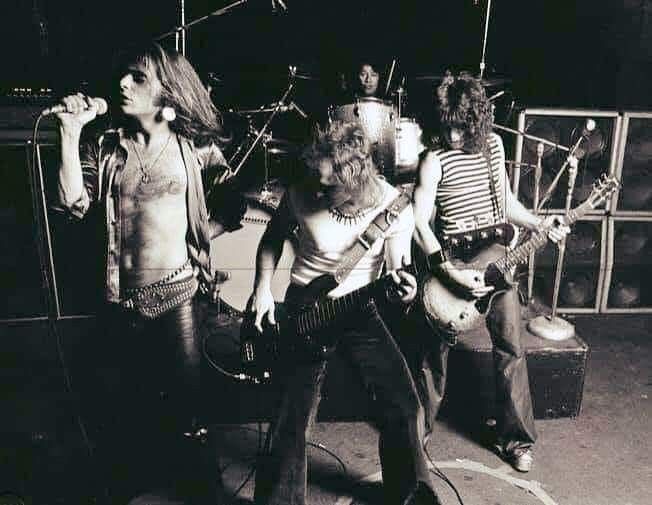
Few bands changed the feeling of rock music as quickly and as dramatically as Van Halen. When they arrived in the late 1970s, they did not simply score hits — they seemed to throw open the windows. Their records had flash, humour, swagger and a sense of pure motion, powered by Eddie Van Halen’s astonishing guitar work, Alex Van Halen’s thunderous drumming, Michael Anthony’s high harmonies and bass, and the irrepressible frontman David Lee Roth. Later, Sammy Hagar would help steer the band into a hugely successful second era, proving Van Halen were more than a one-configuration phenomenon.
For classic hits radio listeners, Van Halen still feels like a jolt of adrenaline between familiar favourites. Their songs are celebratory, loud in all the right ways, and packed with hooks that have outlived changing fashions. Behind the party energy, though, is a story of immigrant roots, relentless practice, clubland grit, studio invention and a catalogue full of songs that still light up the airwaves.
Brothers, a piano, and a remarkable beginning
The heart of Van Halen begins with two brothers born in the Netherlands: Alex and Edward Van Halen. Their father, Jan Van Halen, was a musician — a saxophonist and clarinettist — and music was part of daily life from the start. In 1962, the family moved to Pasadena, California, seeking opportunity and a fresh start. Like many immigrant families, they carried ambition, discipline and a willingness to work hard.
As children, Alex and Eddie were trained on piano, and that early musical grounding mattered. Even listeners who know Van Halen mainly for volcanic guitar solos can hear a strong sense of rhythm, structure and melody in their songs. Eddie, in particular, had an ear that reached beyond brute force. He was not just playing fast — he was thinking like an arranger.
One of the great rock stories is that the brothers eventually switched instruments. Eddie had begun on drums, while Alex played guitar, but before long they traded places. It turned out to be one of the luckiest swaps in music history. Eddie developed a style on guitar that sounded almost impossible, while Alex became the band’s powerhouse drummer, full of swing and attack.
In California, the brothers absorbed British invasion groups, hard rock, blues and pop. They played in various early bands, steadily building a local reputation. The missing pieces arrived with bassist Michael Anthony and singer David Lee Roth, whose confidence and showmanship made him impossible to ignore. Roth had a flair for performance that matched the brothers’ intensity, and together they became a formidable live act on the Los Angeles club circuit.
The clubs, the backyard parties, the breakthrough
Before the platinum albums and arena lights, Van Halen built their name the old-fashioned way: by playing anywhere they could, often at parties and clubs around Southern California. They became known for sets that felt explosive and unpredictable. People did not just hear about Van Halen — they were told they had to see them.
A key figure in the story is Gene Simmons of Kiss. Impressed by the band, he helped finance a demo in the mid-1970s. That did not immediately turn into a record deal, but it gave the group momentum and credibility. The bigger break came when Warner Bros. executive Mo Ostin and producer Ted Templeman saw the band live. Templeman especially understood what made them special: this was a band with virtuosity, yes, but also songs, personality and a sense of fun.
Their 1978 debut album Van Halen hit like a thunderclap. It remains one of the most electrifying debut records in rock history. The album introduced listeners to a band that could tear through hard rock with precision while still sounding loose, playful and alive. It also gave the world “Runnin’ with the Devil,” “Ain’t Talkin’ ’Bout Love,” “Jamie’s Cryin’,” and, of course, “Eruption.”
“Eruption” was barely over a minute long, yet it changed guitar culture almost overnight. Eddie’s two-handed tapping technique became the stuff of legend. Guitar shops, bedrooms and rehearsal spaces were suddenly full of players trying to decode what they had just heard. But what made “Eruption” so powerful was not only speed or technique — it was drama. It sounded like a stunt, a symphony and a street race all at once.
“I never took a lesson,” Eddie Van Halen once said, in essence telling the world that curiosity, obsession and experimentation were his teachers.
That spirit of experimentation would define the band. Eddie was famous for tinkering with equipment, combining parts, modifying guitars and chasing sounds in ways that felt half engineer, half magician. His homemade “Frankenstrat” guitar became almost as iconic as the riffs themselves.
The songs that made them radio giants
Van Halen’s catalogue is deep, but some songs have become permanent residents on classic hits radio because they capture the band’s appeal so perfectly.
- “Runnin’ with the Devil” — slow, menacing and unforgettable, this was a statement of intent. The opening car-horn effect and Eddie’s controlled guitar fire made it instantly distinctive.
- “Ain’t Talkin’ ’Bout Love” — built on one of rock’s great riffs, this track remains a favourite for its snarling groove and singalong attitude.
- “Dance the Night Away” — proof that Van Halen could do melodic, radio-friendly rock without losing their spark. It is bright, breezy and endlessly replayable.
- “Panama” — all engine roar and grin, this may be the ultimate Van Halen anthem. It sounds like chrome, sunshine and a fast highway.
- “Jump” — the band’s biggest hit, driven by Eddie’s keyboard riff, showed that Van Halen could evolve without sounding cautious. It topped charts and became one of the defining songs of the 1980s.
- “Hot for Teacher” — frantic, funny and musically ferocious, it paired jaw-dropping musicianship with a wink and a laugh.
- “Why Can’t This Be Love” — with Sammy Hagar on vocals, this polished, emotional hit launched a new chapter and proved the band still had massive mainstream appeal.
- “Right Now” — dramatic and urgent, this later-era classic carried a broader emotional weight while still sounding unmistakably Van Halen.
What unites these songs is craft. Even at their wildest, Van Halen understood hooks. Their records were not just showcases for technical brilliance; they were built to connect instantly. That is one reason they still work so well on radio. A few seconds is all it takes to know exactly who you are hearing.
More than flash: the Van Halen sound
It is easy to talk about Eddie Van Halen’s guitar pyrotechnics, because they were extraordinary, but the band’s real genius was balance. They fused hard rock power with pop instinct, groove with precision, and virtuosity with accessibility. Alex’s drumming gave the songs a muscular swing rather than a stiff march. Michael Anthony’s backing vocals added lift and brightness. Roth brought theatrical charisma, while Hagar later brought a more muscular, soulful vocal style.
Eddie’s guitar tone deserves special mention. It was warm, aggressive and elastic, with a bounce that made even complicated passages feel joyful. He did not merely play notes; he made the instrument speak in squeals, dives, harmonics and sudden bursts of melody. Yet he was also a gifted rhythm guitarist, and that often gets overlooked. The riffs in Van Halen songs are not just frameworks for solos — they are central characters.
The band also had a sense of humour, something not every hard rock act managed well. Van Halen could be outrageous without becoming cold or mechanical. There was always a human grin in the music. That mix of excellence and mischief helped them stand apart.
Line-up changes, reinvention, and staying power
By the mid-1980s, after a remarkable run of albums including Van Halen II, Women and Children First, Fair Warning, Diver Down and 1984, tensions within the band had grown. David Lee Roth departed in 1985, a moment many assumed would end the group’s golden run. Instead, Van Halen reinvented themselves with Sammy Hagar.
The first album of that era, 5150, was a huge success. Hagar’s arrival shifted the chemistry and broadened the emotional range of the band. Songs like “Dreams,” “Love Walks In” and “When It’s Love” showed a more expansive, polished side without losing the core energy. It was not the same Van Halen as before — and that was exactly the point. They adapted and thrived.
That ability to survive change is part of their legacy. Many bands are tied completely to one moment, one singer, one sound. Van Halen, despite internal struggles and famously complicated relationships, remained a major force across different eras. Even listeners who strongly prefer one version of the band usually admit that both periods produced enduring music.
Studio stories, famous moments, and lesser-known details
One of the most famous stories in rock involves “Beat It” by Michael Jackson. Eddie Van Halen played the guitar solo as a guest, and he reportedly did it quickly, almost as a favour, reshaping the song with his unmistakable style. It was a striking crossover moment: one of rock’s greatest guitarists dropping into one of pop’s biggest records.
Then there is the brown sound — the elusive term often used to describe Eddie’s ideal guitar tone. Fans and gear experts have spent decades trying to capture it exactly. It became part of rock mythology, a reminder that Van Halen inspired not just casual listeners but entire communities of musicians, producers and instrument makers.
Another lesser-known detail is how much discipline sat behind the apparent chaos. The band projected a party atmosphere, but the musicianship came from serious work. Eddie especially was known for practising obsessively. The ease listeners hear on record was hard-earned.
And while Van Halen were often painted as pure excess, there was real musical curiosity in the band. Eddie loved classical influences, melody and harmonic movement. His keyboard writing on songs like “Jump” and “Right Now” showed a musician always looking for another doorway.
David Lee Roth once brought a ringmaster’s energy to the band, while Sammy Hagar later added a more grounded power — two very different frontmen, each helping write a major chapter in the same story.
Why Van Halen still matters on classic hits radio
For classic hits radio, Van Halen is the kind of band that changes the temperature of a room. Their songs arrive with colour and momentum. Whether it is the opening stomp of “Panama,” the keyboard burst of “Jump,” or the dark swagger of “Runnin’ with the Devil,” the effect is immediate. These are records that wake people up, spark memories and invite a little air-guitar whether anyone is watching or not.
They also matter because they represent something essential about great radio music: individuality. Van Halen never sounded generic. In an age when listeners have endless choice, that kind of musical identity is priceless. A Van Halen song is recognisable within seconds, and that instant connection is exactly what keeps classic hits formats vibrant.
There is nostalgia here, certainly, but not the dusty kind. Van Halen still feels alive because the records are alive — full of risk, joy and personality. They remind listeners of a time when rock could be technically dazzling, commercially huge and genuinely fun all at once.
Eddie Van Halen’s death in 2020 brought a wave of tributes from across the music world, and rightly so. He was one of those rare players who permanently changed his instrument’s vocabulary. But Van Halen’s story is bigger than one man, even a genius. It is the story of a band that turned hard work, chemistry and daring into a body of music that still crackles through speakers decades later.
That is why Van Halen remains essential listening. Not just because they were influential. Not just because they sold millions. But because when their best songs come on, they still feel like an event. On classic hits radio, that is gold.