
What Ruled Sunday Night in America in 1985?

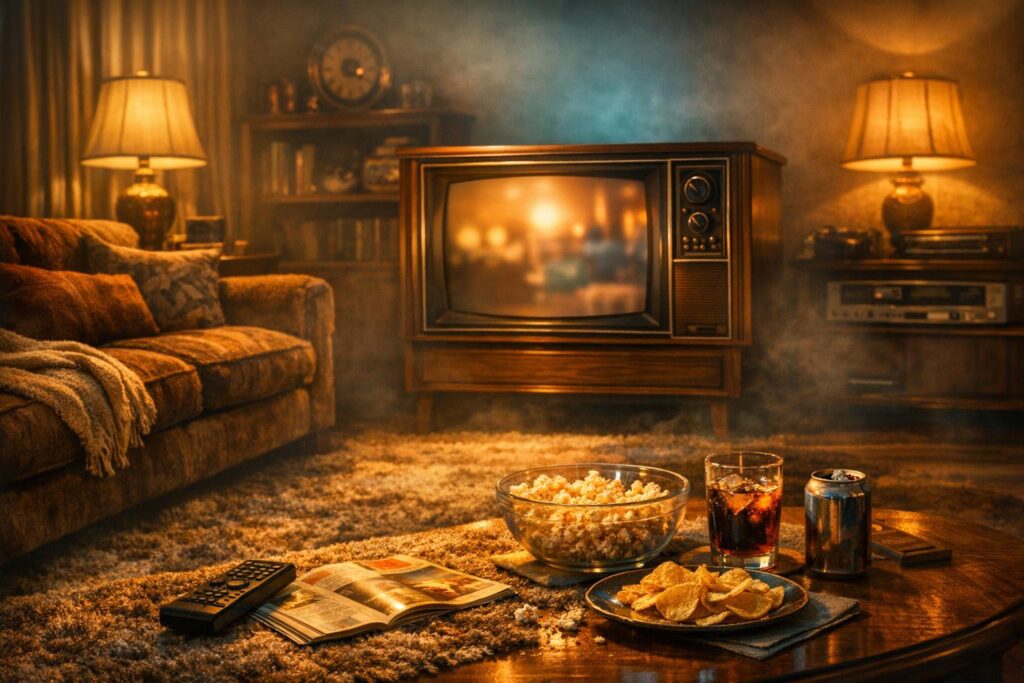
Turn the dial, settle into the sofa, and picture the glow of a television set filling the living room. In 1985, Sunday prime time in the United States was a weekly ritual, a polished parade of big dramas, family favourites, glittering variety specials, and the kind of event television that had people talking at school and at work the next morning.
If you love classic hits radio, you already know the feeling: certain years have a pulse all their own. Sunday nights in 1985 had that same pulse. This was an era when networks still battled for the biggest audience, when a hit series could become part of the national conversation, and when the line-up mattered almost as much as the programmes themselves. The order of the evening was carefully built, like a well-sequenced album.
The Big Three Set the Stage
In 1985, American prime time was still dominated by the three major broadcast networks: ABC, CBS, and NBC. Cable was growing, but for much of the country, these networks were the main event. Sunday night was especially important because it drew families, couples, and weekend viewers all at once. Networks wanted broad appeal, and they programmed accordingly.
That meant a mix of dependable crowd-pleasers and prestige shows with a little glamour around them. It also meant that each network tried to create a distinct mood for the evening. One might lean into family viewing, another into glossy drama, another into appointment television with a major hit in the anchor slot.
By 1985, the idea of flow was everything. Executives wanted viewers to stay put from one show to the next. If a network could win the 8 o’clock hour, it had a real shot at carrying that audience through the rest of the night.
ABC’s Sunday Strength
ABC entered the mid-1980s with serious momentum. The network had become known for slick entertainment and broad, popular appeal, and Sunday nights reflected that confidence. In many markets, ABC used the evening to showcase a blend of family-friendly programming and dramatic event television.
The Wonderful World of Disney
For many viewers, Sunday started with The Wonderful World of Disney. It was familiar, comforting, and perfectly placed. Long before streaming libraries and endless on-demand menus, this was a reliable family gathering point. Parents trusted it, children loved it, and the Disney name carried a kind of Sunday-night magic.
There was something beautifully simple about it: one programme, one time slot, one shared experience. That matters more in hindsight than it may have seemed at the time. In a fragmented media world, it is easy to forget how powerful a common viewing habit could be.
Hardcastle and McCormick and the Action Hour
ABC also had room for action and charm. Hardcastle and McCormick brought a breezy mix of crime-fighting, personality, and high-concept fun. It was the kind of series that fit the decade perfectly: stylish, energetic, and built to keep viewers engaged without asking too much of them at the end of the weekend.
This was one of the secrets of 1980s scheduling. Sunday night had to feel exciting, but not exhausting. Networks wanted a line-up that could entertain the whole household and ease people into Monday without losing that prime-time sparkle.
The Colbys and Dynasty-Era Glamour
By 1985, prime-time soap operas were still a major force, and ABC knew the value of glamour. The Colbys, launched as a companion to Dynasty, carried the era’s taste for wealth, power, shoulder pads, and dramatic confrontations. These were not quiet programmes. They were designed to shimmer.
Behind the scenes, this kind of television was expensive and competitive. Sets had to look grand, costumes had to impress, and every episode had to promise another twist. It was television with a glossy finish, and Sunday night was one of the best shop windows for it.
CBS Played the Long Game
CBS had a different personality. It often leaned into stability, familiar stars, and shows that could attract a wide age range. On Sundays, that approach paid off. The network understood that viewers wanted quality, but they also wanted comfort.
60 Minutes, the Unshakeable Lead-In
One of the great powerhouses of the era was 60 Minutes. It was not just a news magazine; it was an institution. Its ticking stopwatch and serious reporting gave CBS a strong, credible start to the evening.
That lead-in was gold. A programme like 60 Minutes brought a large audience to the network, and CBS could then steer those viewers toward lighter entertainment or drama. In scheduling terms, it was like opening a concert with a guaranteed crowd favourite.
Murder, She Wrote Becomes a Sunday Giant
If one programme captures the spirit of Sunday prime time in 1985, it may well be Murder, She Wrote. Angela Lansbury’s Jessica Fletcher was smart, warm, observant, and endlessly watchable. The show became a major hit because it offered mystery without bleakness, intelligence without heaviness, and a lead character audiences genuinely enjoyed spending time with.
There is a radio parallel here. Some songs become hits not because they shout the loudest, but because they are simply irresistible every time they come on. Murder, She Wrote had that quality. Week after week, it invited viewers in and made them feel at home.
Behind the scenes, the success of the series also proved something important: star power still mattered enormously. Lansbury was already beloved, and CBS built around that trust. It was a masterclass in giving audiences exactly what they did not yet know they needed.
Crazy Like a Fox and the Art of Balance
CBS also used Sunday to balance prestige and accessibility. Crazy Like a Fox, starring Jack Warden and John Rubinstein, offered a lighter detective flavour. It was another reminder that 1985 television loved private investigators, clever banter, and plots that moved briskly enough to keep the popcorn flowing.
What stands out now is how carefully these schedules were built. Networks were not just choosing shows; they were shaping the emotional rhythm of the evening.
NBC Chased Event Television
NBC in 1985 was in transition, but it was also ambitious. The network was still building toward the powerhouse years that would soon define it, and Sunday night was part of that effort. NBC wanted programmes that felt special, contemporary, and conversation-worthy.
Movie Nights and Big-Promotion Programming
One key ingredient was the Sunday Night Movie. In the 1980s, a network movie presentation could still feel like an event. Before home video became fully dominant and years before streaming, a major film on network television came with anticipation, promotion, and a sense of occasion.
That is easy to underestimate now. Viewers planned around these broadcasts. Networks promoted them heavily, and the presentation itself carried weight. A Sunday night movie was not background noise; it was often the centrepiece.
The Highwayman, Knight Rider Spirit, and 80s Adventure
Action-adventure remained a Sunday staple across the decade, and NBC understood the appeal of futuristic vehicles, charismatic leads, and high-concept premises. Even when specific shows came and went, the network kept chasing that kinetic 1980s energy.
It was all part of a larger television language of the time: bold themes, strong visual hooks, and opening credits that practically announced themselves like hit singles. You could hear the first few notes and know exactly what world you were entering.
Why Sunday Night Felt So Big
Part of the magic was scarcity. If you missed a programme, you missed it. There was no easy replay, no pause button, and no endless menu waiting for you later. That made Sunday prime time feel important in a way that is hard to recreate.
It was also one of the last truly shared spaces in popular culture. Millions of people watched the same episodes at the same time. Cliffhangers landed harder. Plot twists travelled faster. A breakout character could become a national favourite almost overnight.
And then there was the craft behind it all. Network schedulers, producers, writers, stars, and promo teams were all working toward the same goal: hold the audience, build the night, win the week. It was strategy and show business rolled together.
Sunday prime time in 1985 was not just television scheduling. It was a weekly performance, carefully arranged and brightly lit.
The Living Room as Front Row Seat
Looking back now, what makes those 1985 Sunday line-ups so memorable is not only which shows aired, but how they were experienced. Families negotiated over the remote, or got up to turn the dial by hand. Theme songs became household signals. Commercial breaks meant a quick trip to the kitchen. Everyone knew when the evening was winding down.
That is where the nostalgia really lives. Not just in the titles, but in the atmosphere. The soft hum of the set. The network announcer’s voice. The sense that one more programme could stretch the weekend just a little longer.
For classic hits fans, it is a familiar kind of memory. Just as a great song can transport you back to a first car or a summer night, a Sunday television line-up can bring back the texture of ordinary life in the mid-1980s. And in 1985, America had plenty worth tuning in for.
Want to revisit the era?
You can find vintage promos, theme songs, and clips by starting with this search on YouTube.
- ABC leaned into family viewing, action, and glossy drama
- CBS used trusted brands like 60 Minutes and Murder, She Wrote
- NBC chased event programming with movies and high-concept adventure
- The real star of the night was the shared viewing experience