Wizards and Warriors: The Forgotten 1983 Fantasy Series That Lasted Just Eight Episodes
In 1983, CBS took a bold leap into fantasy with Wizards and Warriors, a colorful mix of sword fights, sorcery, monsters and comedy. Despite its ambitious production, the adventure lasted just eight episodes before disappearing into TV history.
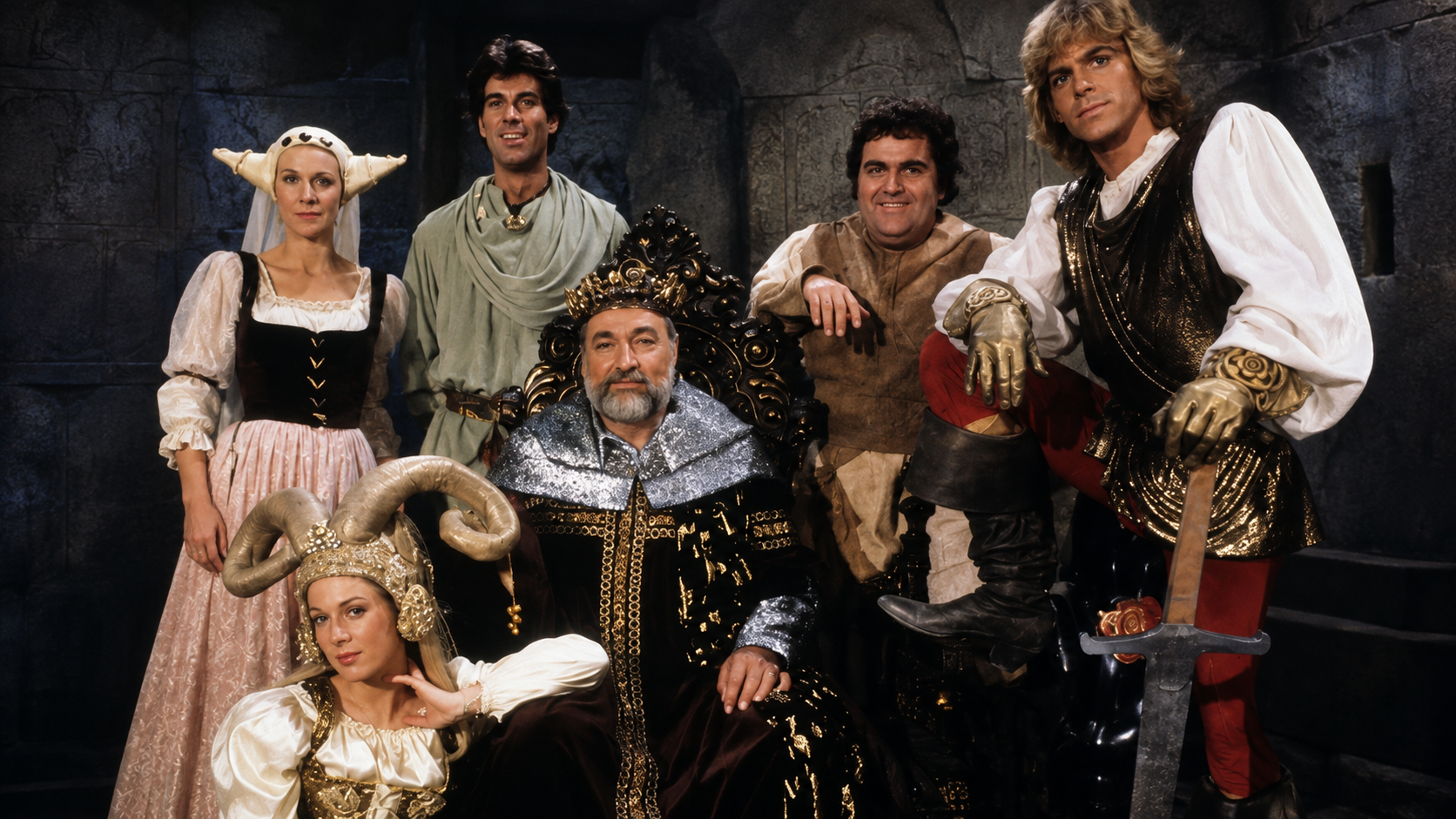
Long before Hercules: The Legendary Journeys and Xena: Warrior Princess brought sword fights, sorcery and tongue-in-cheek fantasy adventures to weekly television, CBS attempted something remarkably similar.
It was 1983, a time when fantasy was enjoying a resurgence at the movies and Dungeons & Dragons was capturing the imaginations of young players across America. CBS decided to enter that world with an expensive hour-long series filled with castles, wizards, monsters, magic weapons, evil princes and heroic warriors.
There was one important difference: it wasn’t supposed to be taken entirely seriously.
The show was called Wizards and Warriors, and despite an elaborate production, a talented cast and an unusual mixture of fantasy and comedy, it survived for only eight episodes. Today it has become one of those wonderfully obscure pieces of 1980s television that even dedicated fans of the decade may have completely forgotten.
Welcome to a Time That Never Was
Wizards and Warriors premiered on CBS on February 26, 1983. Created by veteran television writer and producer Don Reo, the series took place in the mythical land of Aperans, where neighboring kingdoms fought one another using swords, warriors, witches and powerful wizards.
Reo deliberately avoided tying the show to any recognizable historical period. While the setting looked medieval, the world operated according to its own rules. Magic and strange technology could coexist, allowing the writers to introduce almost anything the story required.
At the center of the series was the conflict between the heroic Prince Erik Greystone and the villainous Prince Dirk Blackpool. Erik fought on behalf of the kingdom of Camarand and was engaged to Princess Ariel Baaldorf, while Blackpool represented the neighboring kingdom of Karteia and seemed permanently occupied with schemes involving conquest, kidnapping and destruction.
The basic setup sounded like traditional sword-and-sorcery fantasy, but Wizards and Warriors approached it with a sense of humor. Its heroes could be brave without being overly noble, its villains were knowingly theatrical, and its princess wasn’t exactly the quiet damsel audiences might have expected.
Contemporary descriptions of the series emphasized that combination. Creator Don Reo reportedly pitched the concept as something like “Butch Cassidy and Sundance in Camelot,” which captures the tone remarkably well.
Jeff Conaway Trades His Taxi for a Sword
The show’s leading man was immediately recognizable to 1980s television audiences.
Jeff Conaway played Prince Erik Greystone, a heroic warrior who frequently found himself battling monsters, villains and magical threats. Conaway was already famous as Kenickie in Grease and Bobby Wheeler on the hit sitcom Taxi, making the fantasy adventure a significant change of direction for him.
Conaway reportedly saw Wizards and Warriors as an opportunity to move beyond the kind of characters he had previously been playing and establish himself as an action-adventure leading man.
Erik was accompanied by Marko, his loyal and imposing companion, played by Walter Olkewicz. Their partnership gave the series some of the buddy-adventure quality Reo wanted and provided a counterbalance to the show’s increasingly eccentric collection of royalty and sorcerers.
On the opposite side was Duncan Regehr as Prince Dirk Blackpool, the flamboyantly evil rival to Greystone. Blackpool dressed in black, plotted constantly and embraced villainy with enough enthusiasm to make him one of the show’s most memorable characters.
Clive Revill played Blackpool’s sorcerer Vector, while Ian Wolfe appeared as the good wizard Traquill. Randi Brooks played the witch Bethel, adding yet another magical personality to a world already overflowing with them.
And Then There Was Princess Ariel
One of the show’s secret weapons was Julia Duffy as Princess Ariel Baaldorf.
Duffy would become much better known later in 1983 when she joined Newhart as Stephanie Vanderkellen, but viewers of Wizards and Warriors had already seen her demonstrate the spoiled, self-absorbed comic personality she could play so well.
Ariel wasn’t written as a conventional fantasy princess. She was beautiful and royal, but also spectacularly spoiled, demanding and accustomed to having everyone around her take care of life’s inconveniences.
A contemporary Cinefantastique review joked that Ariel was the kind of princess who might not even understand gravity because a servant would catch anything she dropped before it reached the floor. That comic exaggeration was typical of the show’s approach to fantasy.
Instead of simply parodying the genre, however, Wizards and Warriors tried to have things both ways. The monsters, sets, costumes and action were treated seriously enough to create a believable fantasy world, while the characters were allowed to recognize how ridiculous their circumstances could sometimes become.
That balance was unusual for American network television in 1983.
Dungeons & Dragons Helped Inspire the Idea
The timing of Wizards and Warriors wasn’t accidental.
Fantasy was everywhere. Movies such as Conan the Barbarian, Excalibur and Clash of the Titans had helped revive sword-and-sorcery adventures on the big screen, while Dungeons & Dragons was becoming a cultural phenomenon.
Don Reo’s own children were interested in Dungeons & Dragons, and their enthusiasm helped plant the seed for the series. Reo later recalled that he wanted to create an hour-long swashbuckling action-adventure and gradually moved from thinking about pirates toward knights and fantasy. He was also interested in William Goldman’s The Princess Bride, years before the famous film adaptation appeared in 1987.
What Reo didn’t want was another relentlessly grim fantasy story. He felt that many contemporary fantasy movies took themselves extremely seriously, and he wanted characters who could actually have a sense of humor.
That distinction became central to Wizards and Warriors. It offered sword fights and evil sorcerers, but it also wanted viewers to laugh.
It Was Originally Called Greystone’s Odyssey
The series nearly arrived with a completely different title.
During development it was known as Greystone’s Odyssey, referring to Jeff Conaway’s Prince Erik Greystone. The title was eventually changed because Warner Bros. was preparing Greystoke: The Legend of Tarzan, Lord of the Apes and wanted to avoid confusion between the two names.
Wizards and Warriors certainly told audiences more clearly what they were getting, although it also made the program sound somewhat like a role-playing game.
Behind that straightforward title was a surprisingly elaborate mythology. Background material developed for the show placed its civilization millions of years into the future, after earlier technological societies had risen and fallen. What appeared to the characters as magic could therefore sometimes blur the distinction between supernatural power and remnants of ancient technology.
Unfortunately, eight episodes weren’t nearly enough time to explore everything the creators had imagined.
CBS Spent a Lot of Money on It
For a forgotten series, Wizards and Warriors was hardly a cheap experiment.
A contemporary Cinefantastique report described it as the most expensive television series CBS had attempted at that point, with approximately $8 million spent on the eight episodes.
That money was visible on screen. The production required elaborate fantasy costumes, castle interiors, outdoor locations, monsters, stunt work, weapons and special effects. Creating a different fantasy adventure every week was considerably more complicated than producing a conventional sitcom or police drama on standing sets.
The costumes were particularly impressive. Designer Theadora Van Runkle, whose film work included Bonnie and Clyde and The Thomas Crown Affair, won a Primetime Emmy for her work on the series.
Even some of the directing talent was notable. Bill Bixby—the star of The Incredible Hulk and an accomplished television director—directed three of the eight episodes.
CBS clearly wasn’t treating the project as disposable television.
The problem was that all that ambition came with a price.
Eight Adventures and Then It Was Gone
The first episode, “The Unicorn of Death,” aired on February 26, 1983. It was followed by “The Kidnap,” “The Rescue,” “Night of Terror,” “Skies of Death,” “The Caverns of Chaos,” “The Dungeon of Death” and finally “Vulkar’s Revenge” on May 14.
Even the episode titles sound like something pulled from an old fantasy role-playing campaign.
The stories included kidnappings, demons, magical weapons, cursed castles, dangerous caverns and quests for mysterious objects. In “The Caverns of Chaos,” Erik searches for the fruit of the Astrid tree to save his father’s life. “The Dungeon of Death” sends him through a dangerous underground passage with a band of thieves and cutthroats, while “Vulkar’s Revenge” forces Greystone and Blackpool into an uneasy truce when they encounter a monstrous zombie-demon.
There was certainly no shortage of imagination.
There simply weren’t enough viewers.
Why Was Wizards and Warriors Canceled?
The biggest problem was the same one that has killed many ambitious television shows: the audience wasn’t large enough to justify the cost.
CBS gave the series a substantial promotional campaign, but because of its expensive production, Wizards and Warriors needed to demonstrate quickly that it could attract a significant audience. According to contemporary reporting, the network was looking for strong ratings by roughly the fourth or fifth episode before committing to additional production.
They never arrived.
Creator Don Reo acknowledged at the time that four weeks wasn’t much time for an unusual show to establish itself, but network television could be unforgiving. A fantasy series costing roughly a million dollars per episode in 1983 needed more than a small group of enthusiastic fans.
The scheduling didn’t help. Wizards and Warriors aired Saturday nights at 8 p.m., initially replacing the canceled adventure series Bring ‘Em Back Alive. Saturday evening could be a difficult place to launch an unconventional fantasy program, particularly one trying to appeal simultaneously to children, adults, fantasy enthusiasts and comedy viewers.
CBS broadcast all eight produced episodes, but there would be no second season.
Perhaps Television Wasn’t Ready for It
Looking back more than forty years later, Wizards and Warriors seems oddly familiar.
A fantasy world filled with eccentric characters. Large-scale adventure mixed with deliberate comedy. Heroes who don’t behave like solemn mythological figures. Villains who enjoy being villains. Magic, monsters and ongoing character relationships presented with a wink to the audience.
A decade later, Hercules: The Legendary Journeys and Xena: Warrior Princess would find large audiences using some of those same ingredients. Modern fantasy television has gone even further, demonstrating that audiences will happily embrace elaborate fictional worlds when given enough time to understand them.
That doesn’t necessarily mean Wizards and Warriors would have become a huge hit if CBS had simply waited. The series was quirky, expensive and sometimes tonally unusual. But its willingness to mix fantasy spectacle with comedy now seems much less strange than it probably did to network executives and audiences in 1983.
In that sense, it may have arrived a little too early.
A Tiny Piece of 1980s Television History
Unlike many short-lived television shows, Wizards and Warriors wasn’t completely lost. The eight episodes eventually received an official DVD release through the Warner Archive Collection, giving curious viewers an opportunity to rediscover the series decades after its cancellation.
It has also retained a small but remarkably dedicated following. A fan archive devoted to the program has preserved interviews, production information, episode details, photographs and contemporary articles—an impressive legacy for a series that existed on CBS for less than three months.
Perhaps that devotion makes sense. Television history isn’t made only by the shows that survived for ten seasons. Sometimes the most interesting programs are the experiments that appeared briefly, tried something unusual and disappeared before audiences fully understood what they were watching.
Wizards and Warriors was one of those experiments.
For eight episodes in 1983, CBS gave viewers a world of heroic princes, spoiled princesses, evil sorcerers, magical weapons, strange creatures and outrageous adventures. Then the gates to Aperans closed almost as quickly as they had opened.
For the relatively small group of viewers who happened to be watching, however, the memory never completely disappeared.
Do you remember Wizards and Warriors from its original 1983 run, or is this the first time you’ve heard of this forgotten fantasy series? Let us know in the comments.