The Stores We Couldn’t Walk Past at the Mall in the 1980s
Take a nostalgic walk through the 1980s mall and revisit the stores we could never resist, from Sam Goody and Kay-Bee Toys to RadioShack, Waldenbooks, Spencer Gifts and Chess King. Remember when a Saturday at the mall meant music, arcades, food courts, friends and nowhere else you needed to be.
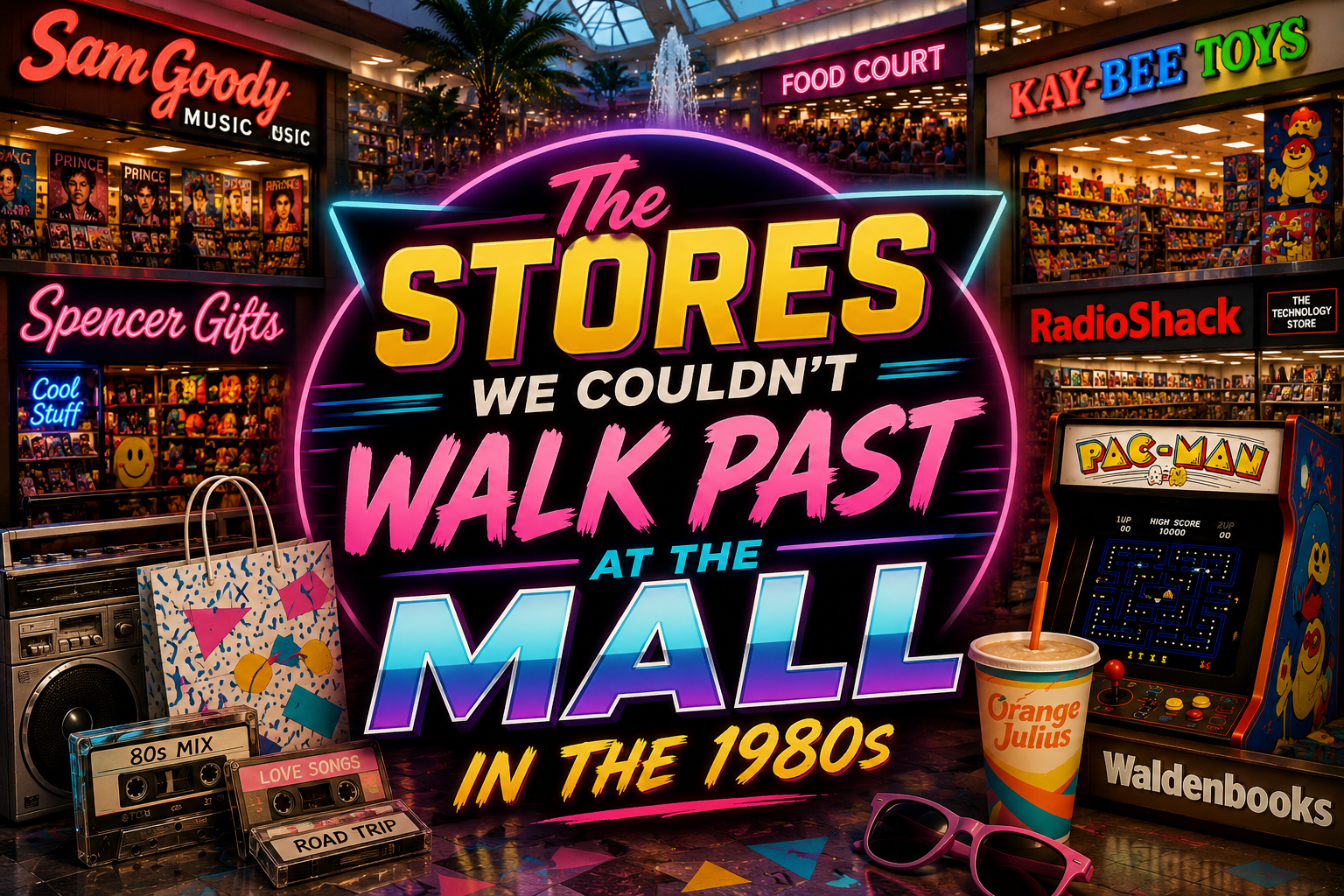
There was a time when going to the mall wasn’t something you did because you needed a new pair of shoes or had to pick up an order. Going to the mall was the activity.
On a Friday night or Saturday afternoon in the 1980s, the mall could feel like the center of the universe. Teenagers wandered around in groups, parents carried shopping bags from the department stores, kids begged for one more quarter for the arcade, and somewhere in the distance you could hear the unmistakable electronic sounds of Pac-Man or Galaga competing with whatever hit song was playing over the mall’s speakers.
You could smell pizza from the food court, popcorn from somewhere nearby and that strange mixture of perfume, new clothes and chlorinated fountain water that somehow smelled exactly like… the mall.
And then there were the stores.
Every mall was different, but certain names seemed to appear again and again across America. Some were places we actually intended to visit. Others had such powerful gravitational pull that walking past them without going inside seemed almost impossible.
Here are some of the stores that made an afternoon at the mall in the 1980s something we still remember.
Spencer Gifts: You Had to See What Was Inside
You didn’t necessarily need anything from Spencer Gifts.
That was never really the point.
The point was seeing what bizarre new things they had.
Walking into Spencer’s during the 1980s felt different from walking into almost any other mall store. There were black lights, novelty signs, posters, lava lamps, gag gifts and things that seemed just inappropriate enough to make younger shoppers nervous about their parents walking in behind them.
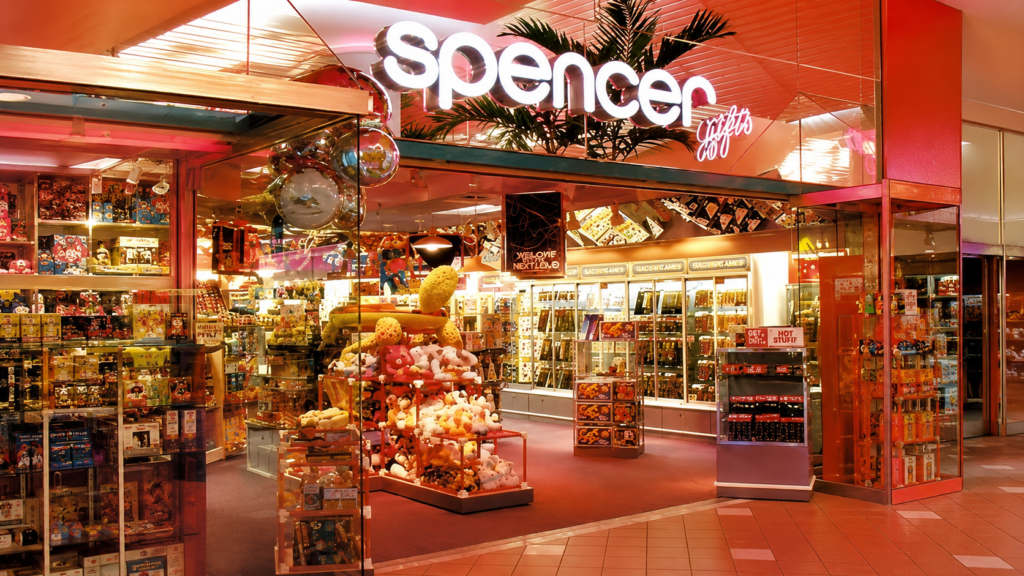
For teenagers, that slight sense of forbidden territory was part of the attraction.
You might leave without spending a dollar, but if you passed Spencer Gifts while walking through the mall, chances were somebody in your group was going to say, “Let’s go in.”
And everybody went in.
Sam Goody: When Buying Music Was an Experience
Before an entire musical universe could fit inside your phone, finding new music required a little more effort.
And that made it much more fun.
Sam Goody was one of the great destinations for music fans. The walls and displays were filled with album covers, cassette tapes and eventually compact discs. New releases were prominently displayed, while the rest of the store invited you to browse alphabetically through artists you already knew and ones you’d never heard before.
There was something wonderfully physical about discovering music this way.
You picked up an album because the cover looked interesting. You turned it over and studied the song titles. You checked the price. Maybe you’d heard one song on the radio and wondered whether the rest of the record was worth your money.
Buying an album wasn’t a casual click.
It was a decision.
And once you finally brought that cassette or record home, you usually listened to the entire thing.
Camelot Music: Another Stop for the Serious Music Fan
Depending on where you lived, Camelot Music might have been your mall’s essential record store.
Like Sam Goody, Camelot became part of the ritual of discovering music. Rows of cassettes and records gave shoppers a chance to see what was new, what was selling and what album covers everyone seemed to be carrying around.
Record stores also served another purpose that streaming can’t quite duplicate: they showed you what other people were listening to.
The teenager standing a few feet away might be looking through heavy metal tapes. Someone else was searching for the newest Prince album. Another shopper was checking the latest pop releases.
Music wasn’t hidden inside individual headphones and personalized algorithms.
It was sitting there on the shelves for everyone to see.
RadioShack: The Store That Made Everything Seem Possible
For anyone fascinated by electronics, RadioShack could turn a five-minute mall stop into half an hour.
The store wasn’t particularly large, but somehow it seemed packed with possibilities.
There were radios, cassette recorders, headphones, speakers, cables, batteries, calculators, electronic components, scanners, walkie-talkies and strange little adapters whose purpose you might not completely understand but still wanted to examine.
By the 1980s, computers had become another reason to stop.
RadioShack’s TRS-80 line helped introduce many people to personal computing, and seeing a computer sitting inside an ordinary mall store still felt exciting at a time when having one at home was far from universal.
RadioShack was the kind of place where your father might go in looking for a cable while you wandered over to see what electronic gadget you suddenly decided you absolutely needed.
Kay-Bee Toys: Nearly Impossible for a Kid to Ignore
If you were a child walking through the mall and saw Kay-Bee Toys, whatever your parents had planned for the next fifteen minutes was probably about to be delayed.
The store seemed to spill toys right out toward the mall walkway.
Action figures. Dolls. Board games. Matchbox cars. Electronic toys. Stuffed animals. Video games. Toys tied to the cartoons and movies you were watching at home.
During the 1980s, that meant shelves connected to some of the decade’s biggest childhood obsessions: He-Man, G.I. Joe, Transformers, My Little Pony, Care Bears, Cabbage Patch Kids and countless others.
Even when you knew perfectly well you weren’t getting anything, you still wanted to look.
And when Christmas was approaching?
Kay-Bee became dangerous territory for parents.
Waldenbooks: When the Bookstore Was Part of the Mall Experience
There was something wonderfully quiet about stepping into Waldenbooks after walking through a busy mall.
Suddenly the noise outside seemed to fade.
The stores weren’t enormous by today’s bookstore standards, but the shelves seemed to contain everything: bestsellers, mysteries, science fiction, romance novels, biographies, children’s books, magazines and those paperback racks that could keep you browsing far longer than expected.
For younger shoppers, there were movie and television tie-ins, joke books, fantasy novels and books connected to whatever cultural phenomenon was happening at the time.
Waldenbooks also reminds us how different malls once were.
They weren’t simply collections of clothing stores.
You could buy a book, discover an album, look at a computer, find a birthday present and eat dinner without ever leaving the building.
B. Dalton: The Other Mall Bookstore
If your mall didn’t have Waldenbooks, there was a good chance it had B. Dalton Bookseller.
For years, the two chains were familiar competitors in American malls, and both became part of the everyday experience of browsing for books before online retailers transformed the business.
You didn’t arrive with an algorithm recommending what to read next.
You wandered.
Maybe a cover caught your attention. Maybe something was displayed near the entrance. Maybe you found another book by an author you’d enjoyed before.
That kind of accidental discovery was one of the pleasures of the mall.
You frequently found things you hadn’t gone there looking for.
Chess King: Pure 1980s Mall Fashion
Few store names immediately summon the image of the 1980s mall quite like Chess King.
The men’s clothing chain became especially associated with young men’s fashion, offering the kind of clothes that made perfect sense beneath the neon lights of an ’80s shopping center.
This was an era of bold shirts, sweaters, jackets, pleated pants and fashion choices that could sometimes be… adventurous.
Looking back at photographs from the decade, it’s easy to laugh at certain styles. But at the time, stores like Chess King were selling the look of the moment.
And if you were a teenage guy hoping to look a little cooler on Friday night, the mall was where you went to find out what “cool” currently looked like.
The Limited: The Look of the Decade
For many young women, The Limited became another defining mall destination.
The store’s fashions evolved with the decade, but it became closely connected with the polished, colorful style that characterized so much of 1980s clothing.
The mall was incredibly important to fashion then because trends were visible everywhere around you.
You saw what was displayed in the windows.
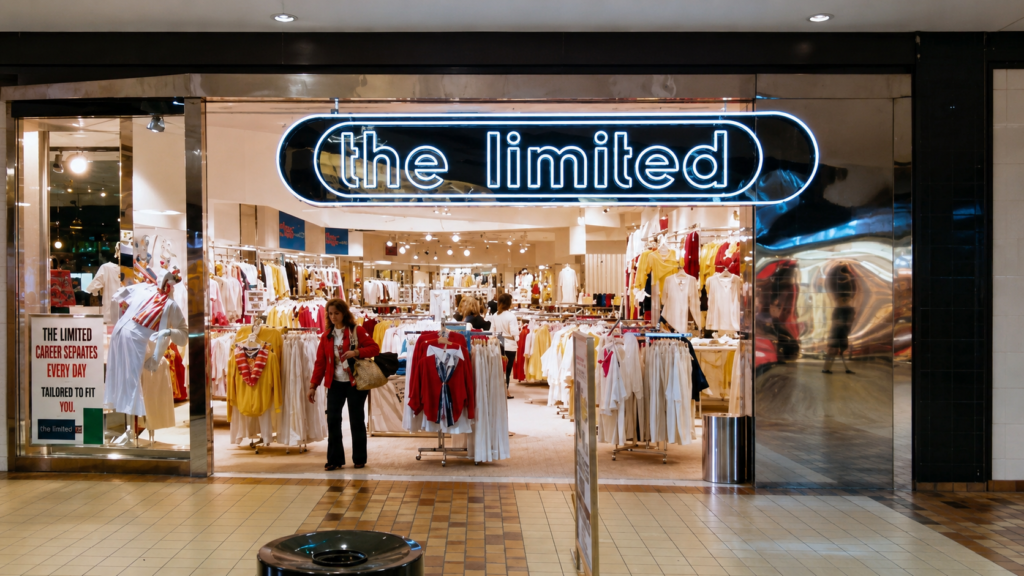
You saw what the mannequins were wearing.
And perhaps most importantly, you saw what everyone else walking through the mall was wearing.
Long before social media feeds told us what was fashionable, the mall performed much of the same job.
Hickory Farms: Mostly for the Samples
Not every irresistible mall stop involved clothes, music or toys.
Sometimes it involved cheese.
For many shoppers, Hickory Farms was one of those places you noticed before you even reached it. Sausages, cheeses, crackers, gift boxes and samples made it especially difficult to ignore around the holidays.
It was the sort of store children probably wouldn’t have chosen as a destination on their own.
But once somebody started handing out samples?
Suddenly everyone was interested.
The Hickory Farms mall store became especially connected with Christmas shopping, when malls were crowded, decorations hung everywhere and shoppers seemed to be carrying twice as many bags as usual.
Orange Julius: Technically Not a Store… But We Were Stopping Anyway
Eventually, all that shopping required something to drink.
And for generations of mall shoppers, that meant Orange Julius.
That frothy orange drink became so closely associated with malls that simply seeing the old logo can bring back memories of food courts and crowded shopping-center walkways.
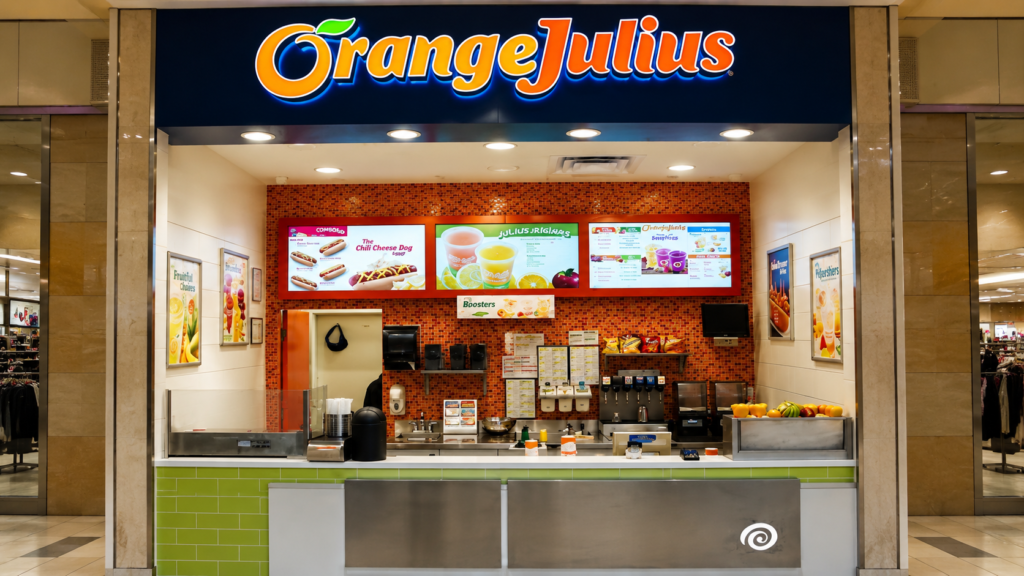
Maybe you had spent the afternoon looking through records.
Maybe the kids had dragged you through the toy store.
Maybe you had already walked from one end of the mall to the other twice.
An Orange Julius somehow made sense.
The food and drinks were as important to the mall experience as many of the stores themselves.
And Then There Was the Arcade
It might have been Aladdin’s Castle, Time-Out, Space Port, or an independent arcade unique to your local mall.
Whatever the name, you could usually hear it before you saw it.
The electronic chorus of dozens of arcade cabinets spilled into the mall: explosions, digital music, bells and synthesized voices mixed with the sound of quarters dropping into machines.
Inside were Pac-Man, Ms. Pac-Man, Donkey Kong, Galaga, Centipede, Defender, Dragon’s Lair and dozens of other games competing for your attention and your quarters.
For kids and teenagers, the arcade wasn’t just another business.
It was often the destination.
Parents could go shopping.
You knew where you wanted to be.
The Department Store at the End of the Mall
And anchoring everything were the department stores.
Depending on your city and your particular mall, the names varied enormously: Sears, JCPenney, Macy’s, Montgomery Ward, Bamberger’s, Jordan Marsh, Filene’s and many regional chains that have since disappeared.
These stores were enormous compared with the smaller shops lining the mall corridors.
You could buy clothes downstairs, furniture somewhere else, appliances in another department and perhaps stop at a restaurant or lunch counter before leaving.
The department store wasn’t simply another tenant.
It was one of the reasons the mall existed.
Families might enter through Sears or JCPenney, walk through the entire mall, spend several hours shopping and eventually return through the same store to reach their car.
The Stores Were Only Half the Story
Looking back, it’s tempting to think that nostalgia for 1980s malls is simply nostalgia for businesses that disappeared.
But that’s only part of it.
What we really miss may be the experience surrounding them.
We miss walking through the mall without knowing exactly what we were going to buy. We miss discovering a new cassette because its cover caught our eye. We miss checking the toy store even though we had no money. We miss wandering into Spencer’s just to laugh at something ridiculous.
We miss meeting friends without constantly checking phones.
We miss sitting beside the fountain deciding what to do next.
We miss the arcade sounds in the distance.
We miss carrying actual shopping bags.
And maybe we even miss hearing our parents say:
“We’re leaving in five minutes.”
Knowing perfectly well that somehow we’d still be there twenty minutes later.
Meet Me at the Mall
The American shopping mall hasn’t completely disappeared, but the world that created the great mall culture of the 1980s certainly has changed.
Many of the stores that once filled those corridors are gone. Others survive online or in very different forms. Some malls have been renovated beyond recognition, while others sit nearly empty where crowds once gathered every weekend.
But mention Sam Goody, Kay-Bee Toys, Waldenbooks, Chess King or an afternoon spent feeding quarters into arcade machines, and something remarkable happens.
For a moment, you can almost see it again.
The fountains are running.
The food court is crowded.
A pop song is echoing faintly through the building.
Your friends are waiting outside the record store.
And you’ve got nowhere else you need to be.
It’s Saturday afternoon.
It’s 1986.
Meet you at the mall.