UHF 17 at Sundown
Dust hangs in the air, hoofbeats echo, and under layers of painstaking make-up Roddy McDowall gives the small screen one of science fiction television’s warmest performances. The 1974 Planet of the Apes series was brief, but it left behind a strange, spirited world that still rewards a return visit.
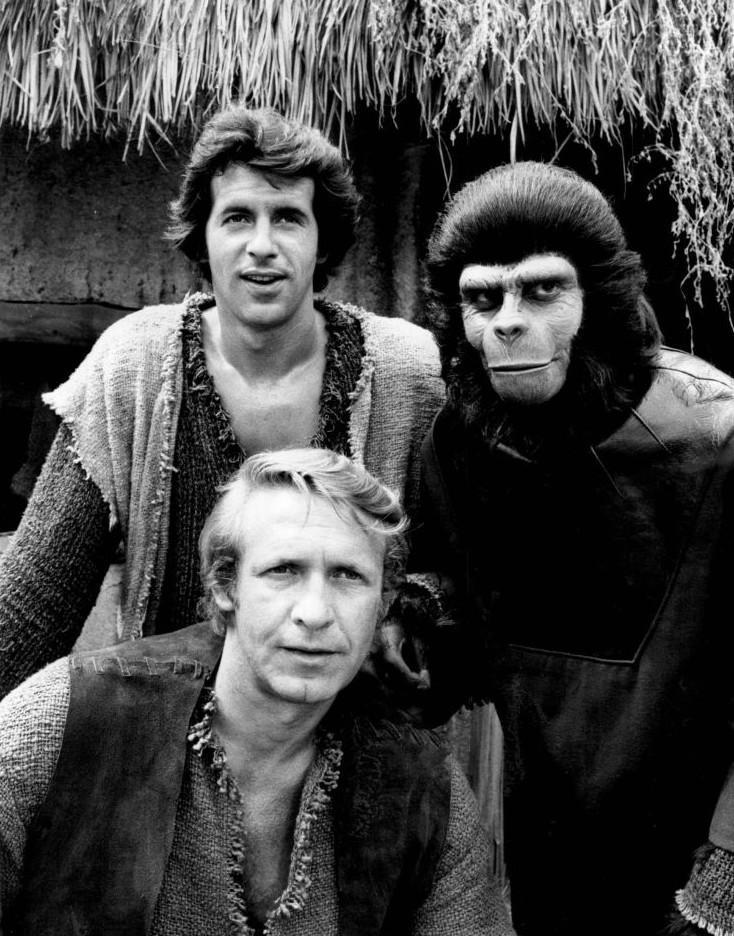
There was something wonderfully uncanny about settling in for Planet of the Apes on television. The familiar world was there, but tilted just enough to feel strange: dusty landscapes, stern ape society, human fugitives on the run, and that constant sense that civilisation had been turned inside out. For viewers who had thrilled to the original films, the 1974 TV series offered a weekly return trip to one of science fiction’s most memorable worlds.
It only ran for 14 episodes, which gives it the glow of a short-lived cult favourite. Yet that brief run has helped preserve its appeal. This was not a sprawling franchise machine in the modern sense. It was a network television adventure series trying to translate a bold, philosophical film concept into an accessible weekly format. In doing so, it created something distinctive: part chase serial, part social allegory, part frontier drama, all wrapped in the unforgettable imagery of apes on horseback ruling over humans.
A small-screen return to a big idea
By the time the television series arrived, Planet of the Apes was already a proven phenomenon. The 1968 film had made a deep impression with its startling ending, imaginative world-building, and sharp commentary on power, prejudice, and human folly. Sequels followed quickly, and audiences clearly had an appetite for more.
The TV version took a practical route into that universe. Rather than trying to continue every thread from the films, it introduced new human leads: astronauts Alan Virdon and Pete Burke, played by Ron Harper and James Naughton. After crash-landing on a future Earth ruled by apes, they find themselves fugitives in a rigid society where humans are mostly mute, oppressed, and denied status.
Helping them is Galen, the chimpanzee played by Roddy McDowall, whose presence gave the series both continuity and heart. McDowall was already deeply associated with the franchise, and his return brought instant credibility. Galen is clever, sympathetic, and quietly funny, often serving as the bridge between the audience and this upside-down civilisation.
The series also had a strong recurring adversary in Urko, played with commanding force by Mark Lenard. Urko is not merely a villain in the moustache-twirling sense. He is a hardline enforcer of ape authority, suspicious of change and relentless in pursuit. That gave the show a reliable dramatic engine: each week, Virdon, Burke, and Galen moved through new communities and new dilemmas while Urko remained close behind.
Adventure first, ideas close behind
One of the pleasures of revisiting the series is seeing how neatly it balanced action and thought. This was network television, so it needed momentum: escapes, pursuits, close calls, disguises, and tense encounters. But underneath the adventure format, the franchise’s larger concerns remained intact.
Questions of class, law, dogma, and fear of the other run through the series. Ape society is stratified and guarded. Humans are treated as lesser beings. Scientific inquiry is constrained when it challenges accepted belief. Those themes were already central to the films, and the television series found ways to keep them alive in weekly stories.
At times, the show feels almost like a western in futuristic costume. There are isolated settlements, suspicious authorities, rough terrain, and travellers moving from one dangerous stop to another. That structure suited television beautifully. It gave each episode a fresh setting while preserving the larger arc of survival and pursuit.
And for all its serious ideas, the series never forgot to be entertaining. That matters. A good classic television adventure knows how to pull you in with urgency first, then leave you thinking afterwards. Planet of the Apes managed exactly that.
Behind the scenes: masks, heat, and television deadlines
If the films had already proved that the ape make-up could astonish audiences, the TV series had to perform a similar miracle on a tighter schedule and budget. That alone makes it an impressive production story.
The make-up challenge
The ape make-up remained one of the show’s greatest achievements. Even now, there is something tactile and convincing about it. The faces have weight and texture. Different ape classes are visually distinct. Chimpanzees, gorillas, and orangutans each carry their own social identity through costume and design.
But that realism came at a price. Applying the make-up was a long and demanding process, requiring patience from performers and precision from the crew. Under hot lights and outdoor conditions, it could be exhausting. Television production moves quickly, and every extra minute in the chair mattered. The fact that the cast still delivered expressive performances through layers of prosthetics is a real testament to their skill.
Roddy McDowall’s steady hand
Roddy McDowall was invaluable here. He understood the franchise’s tone better than almost anyone, and he knew how to act through make-up without losing nuance. Galen could be wry, anxious, compassionate, or indignant, often within the same scene. McDowall made that look effortless, though it certainly was not.
He also helped give the series emotional warmth. In a world built on suspicion and hierarchy, Galen’s friendship with the human leads gives the show its pulse. Without that relationship, the series might have become too cold or purely procedural. McDowall kept it human, even while playing a chimpanzee.
Location work and atmosphere
The landscapes did a great deal of heavy lifting too. Dry hills, scrubland, caves, villages, and rugged backroads gave the show a believable frontier atmosphere. The outdoors helped sell the scale of the ape-ruled world, even when television budgets could not match the spectacle of the cinema screen.
There is a certain 1970s television texture to it all that adds to the charm today. You can feel the dust, the sunlight, the practical craftsmanship. Nothing is overly polished. Instead, it has that hands-on, made-with-ingenuity quality that so many classic series share.
The cast that kept it moving
Ron Harper and James Naughton made an effective central pair. Harper’s Alan Virdon is resourceful and thoughtful, often carrying the burden of planning the next move. Naughton’s Pete Burke brings a grounded, approachable energy that helps the danger feel immediate rather than abstract. Together, they avoid becoming generic fugitives. Their friendship gives the series momentum and personality.
Then there is Mark Lenard’s Urko, one of the show’s great assets. Lenard had a gift for authority tinged with menace. Urko is driven by loyalty to the established order, but also by fear: fear of upheaval, fear of human intelligence, fear that the world might not be as stable as ape doctrine insists. That makes him more interesting than a simple pursuer.
The wider supporting cast, episode by episode, also helped flesh out the world. Judges, soldiers, villagers, scholars, and rebels all added shades to ape society. Even within the limits of weekly television, the series suggested a civilisation with rules, contradictions, and fault lines.
Why it still has that pull
Some television series become beloved because they ran forever. Others are treasured because they vanished too soon. Planet of the Apes belongs firmly in the second category. Its single season leaves you wanting more, which is often a powerful ingredient in nostalgia.
It also benefits from being part of a larger cultural memory. The imagery of the franchise is so strong that the series arrives with built-in atmosphere. Yet it earns its place by doing something different from the films. It turns a grand science fiction premise into a weekly road story, where each stop reveals another corner of a broken world.
For viewers who discovered it in repeat broadcasts, local television schedules, or weekend science fiction slots, the series carries another layer of affection. It feels like the kind of show you stumbled across and then made a point of catching again. That is a special kind of television bond: not just prestige viewing, but personal viewing.
A bright, strange relic worth revisiting
Seen today, Planet of the Apes is a fascinating time capsule of 1970s television craft and franchise storytelling. It is ambitious without being grandiose, thoughtful without forgetting to entertain, and earnest in a way that feels refreshing now.
Most of all, it is fun to spend time in this world again. The hoofbeats, the warning horns, the severe uniforms, the desert roads, the uneasy alliances: it all comes back with a vividness that lingers. You can sense the cast and crew working hard to bring a difficult concept to weekly television, and that effort gives the show much of its enduring charm.
Not every episode lands with equal force, and the format naturally softens some of the films’ darker edges. But that is part of the story too. This was a bold attempt to keep a remarkable idea alive for home audiences, and it succeeded more often than it failed.
Planet of the Apes on television may have been brief, but it never felt small in imagination. It remains one of those treasured cult series that invites you back not just for nostalgia, but for the pleasure of seeing a great idea reinvented with grit, intelligence, and heart.
For classic television fans, science fiction lovers, and anyone who enjoys the handmade magic of 1970s adventure drama, it is well worth another look. Sometimes the most memorable signals are the ones that flickered across the dial for only a short while.