What Was on TV on a Saturday Night in 1965?
Saturday night television in 1965 had a wonderful rhythm: family adventure, big-name variety, western drama, and a touch of late-night intrigue. As the medium kept evolving through the mid-1960s, these lineups captured both the comfort of old favourites and the first flashes of something more modern.
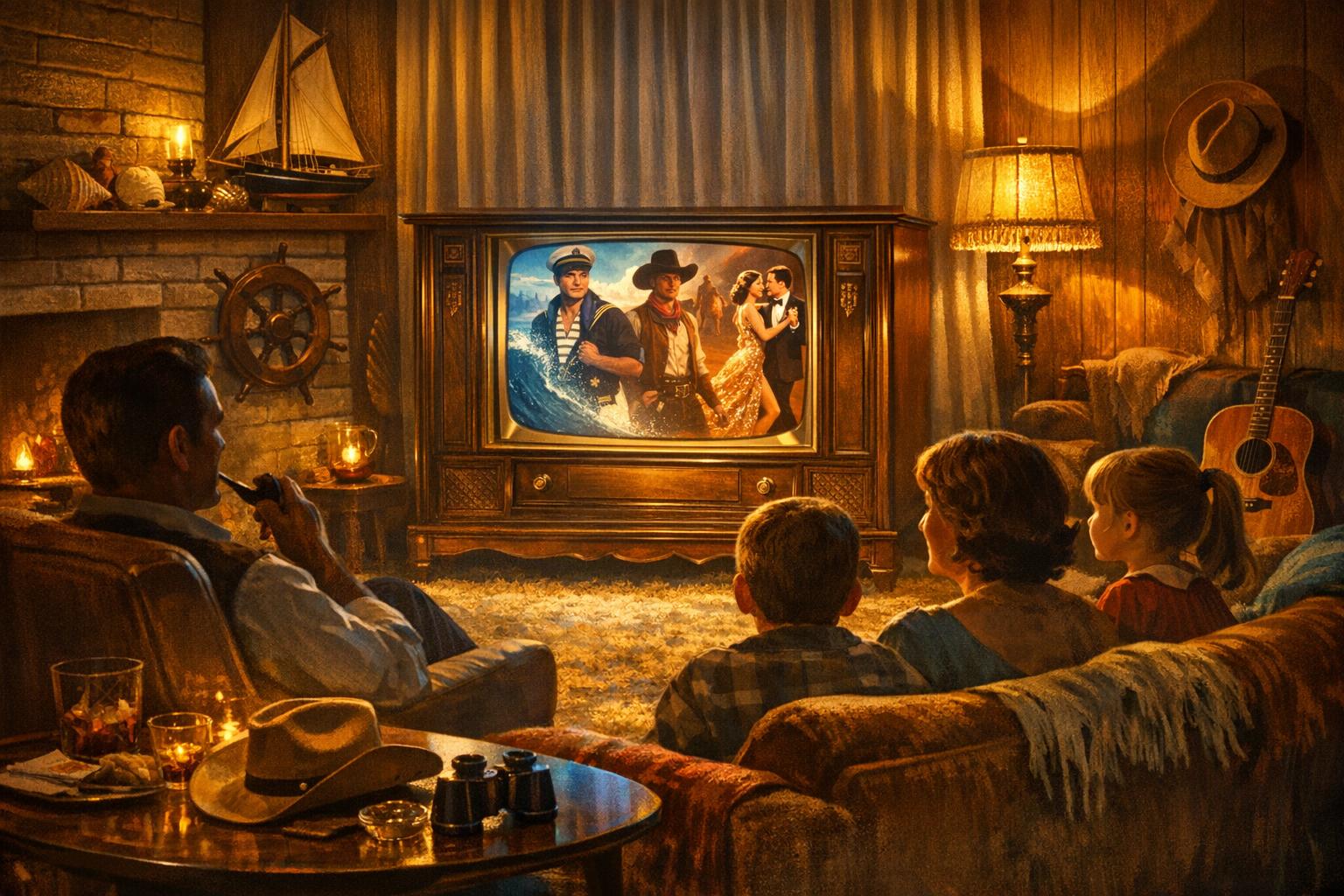
Picture the scene: dinner plates cleared away, the family gathered in the living room, and that television set glowing like the centrepiece of the house. In 1965, Saturday night viewing in the United States had a rhythm all its own. It was part comfort, part spectacle, and part weekly ritual. You did not scroll endlessly looking for something to watch. You picked a channel, settled in, and let the evening unfold.
What makes a mid-1960s Saturday lineup so fascinating is how clearly it reflected the tastes of the time. Family adventure, broad comedy, western drama, music, dancing, and star-packed variety hours all had their place. It was television built for households rather than niches, and the big three networks—NBC, CBS, and ABC—each offered their own flavour of weekend entertainment.
Saturday night in 1965 at a glance
Around this period, a typical Saturday night lineup in America often mixed easy-going family fare with heavyweight ratings favourites. Some programmes were true national events, while others served as dependable alternatives for viewers who wanted something gentler, glossier, or just a little different.
Here is the kind of lineup many viewers would remember from around 1965, with a breakdown of the evening as it might have felt in real time.
Early Evening (7:30–8:30 PM)
7:30 PM – Flipper (NBC)
This was the sort of show that made perfect sense as the night’s opening act. Flipper brought sunshine, sea spray, and family-friendly adventure into the living room. With its stories of a remarkably clever dolphin and the people around him, it had warmth, action, and just enough wonder to hook younger viewers while keeping parents happy too.
It was light, cheerful television—an easy way to begin the evening before the bigger stars and prestige dramas arrived. In many homes, this was ideal “everyone can watch” programming.
8:00 PM – The Jackie Gleason Show (CBS)
If one programme had the size, swagger, and show-business sparkle to dominate a Saturday night, it was The Jackie Gleason Show. Jackie Gleason was already a giant of American entertainment, and his variety format delivered exactly what many viewers wanted at the weekend: comedy sketches, music, dancing, celebrity guests, and a sense that anything might happen.
Gleason had a larger-than-life presence, and that made the show feel like an event. It was the kind of programme families planned around. If the television was on CBS at 8:00, chances were good it stayed there for a while.
There was also something wonderfully old-school about its scale. Big band sounds, polished performers, and broad comedy all came together in a style that now feels like a time capsule of mainstream entertainment at its peak.
ABC alternative – The Adventures of Ozzie and Harriet
For viewers who preferred something softer and more homespun, ABC offered a very different mood with The Adventures of Ozzie and Harriet. By 1965, the series already carried a sense of familiarity and comfort. It was gentle, domestic, and reassuringly straightforward.
Not every Saturday night viewer wanted showbiz razzle-dazzle. Some wanted a wholesome half-hour that felt like a visit with old friends. This was that option.
Prime Time Power Hour (8:30–10:00 PM)
8:30 PM – The Lawrence Welk Show (ABC)
Then came one of the most distinctive sounds on American television: The Lawrence Welk Show. Welk’s famous “champagne music” was polished, melodic, and deeply popular with middle America. The programme offered music, dancing, smiling performers, and an atmosphere of pure weekend ease.
There is something charming about how confidently it occupied its own lane. Even as television tastes were beginning to shift in the mid-1960s, Welk remained a major draw by giving his audience exactly what they loved. If your ideal Saturday night involved waltzes, vocal numbers, and a beautifully staged variety setting, this was your destination.
It also reminds us that 1965 television was not one single cultural mood. While younger audiences were starting to look for fresher, faster, more ironic entertainment, millions still tuned in for elegance, melody, and tradition.
8:30 PM – Get Smart (CBS alternative, debuted in 1965)
If you wanted proof that television was changing, Get Smart was right there. Debuting in 1965, this spy spoof brought a younger, sharper comic energy to the schedule. Created in the era of James Bond mania, it poked fun at espionage thrills with deadpan humour, gadgets, absurd plots, and the unforgettable Maxwell Smart at the centre of it all.
Compared with more traditional variety programming, Get Smart felt modern. It had a wink in its eye. For younger viewers especially, it represented the growing appetite for comedy that moved faster and played with pop culture rather than simply presenting a stage-style format.
9:00 PM – Gunsmoke (CBS)
At 9:00, Saturday night often belonged to Gunsmoke. This was one of the biggest shows on television, full stop. More than just a western, it was a serious, well-made drama with strong characters, moral tension, and the dusty atmosphere of Dodge City brought vividly to life each week.
James Arness as Marshal Matt Dillon gave the series a steady, commanding centre, and audiences responded in huge numbers. By the mid-1960s, westerns were still enormously important to American TV, and Gunsmoke stood near the top of the heap.
Its popularity says a lot about the era. Saturday night viewers wanted entertainment, certainly, but they also made room for dramatic storytelling with weight and consequence. Gunsmoke was not background noise. It was appointment television.
Late Evening (10:00–11:00 PM)
10:00 PM – The Wild Wild West (CBS)
By 10:00 PM, the mood could turn stylish and a little stranger. The Wild Wild West was one of the cleverest examples of genre-mixing on 1960s television: part western, part spy adventure, part fantasy, and entirely distinctive. With secret agents, elaborate villains, gadgets, and action wrapped in a frontier setting, it felt unlike almost anything else on the schedule.
Looking back, it seems ahead of its time. It had flair, imagination, and a slightly offbeat quality that made it memorable. If Gunsmoke represented the classic western done straight, The Wild Wild West showed how television was beginning to bend old formats into something new.
Other late-night possibilities
Depending on region, affiliate choices, and scheduling shifts, viewers might also have encountered other familiar titles in the later part of the evening.
- Perry Mason – Even in reruns, it remained a strong attraction. Courtroom drama, sharp questioning, and that reliable final-act reveal made it endlessly watchable.
- The Hollywood Palace (ABC) – A glossy variety showcase with rotating hosts and major stars. If you liked surprise guests and a touch of glamour, this was a very appealing option.
How the networks stacked up
CBS
CBS looked especially powerful on a Saturday night around this time. With The Jackie Gleason Show, Gunsmoke, and The Wild Wild West, it offered a lineup that was broad but commanding: comedy and variety up front, heavyweight drama in the middle, and stylish adventure to close the night.
ABC
ABC leaned into warmth and entertainment with The Adventures of Ozzie and Harriet, The Lawrence Welk Show, and The Hollywood Palace. It was a channel for viewers who wanted charm, music, familiarity, and star turns.
NBC
NBC’s Flipper gave the evening an inviting start, especially for families. While the exact lineup could vary, NBC often competed by offering accessible, audience-friendly programming rather than trying to mimic the exact tone of its rivals.
Why this lineup still feels special
There is a reason these schedules still spark nostalgia. They capture a moment when television was both simpler and surprisingly varied. A single evening could take you from a dolphin adventure to a comedy giant, from ballroom sparkle to a western showdown, and then on to espionage on horseback.
For anyone who loves classic entertainment, a 1965 Saturday night lineup is more than a list of programmes. It is a snapshot of how people relaxed, connected, and shared stories before the age of endless choice. The set hummed, the networks battled for attention, and millions of viewers experienced the same moments at the same time.
That is the magic of old television: not just what was on, but how the whole country seemed to settle in together and watch.
And really, that is why these lineups still glow in the memory. They were dependable, entertaining, and full of personality—just like the era itself.