Loud, Proud, Unstoppable
Some bands sound like they were born to blast out of a car radio, and Grand Funk Railroad are high on that list. Their rise through the late 1960s and 1970s turned raw Midwestern muscle into a string of enduring classic hits that still feel thrilling today.
Turn up a Grand Funk Railroad record and you can almost feel the room change. The guitars come charging in, the drums hit with real force, and suddenly it is easy to understand why this Michigan trio became one of the biggest live attractions of the early 1970s. They were not polished in the way some critics wanted, and that was part of the appeal. Grand Funk Railroad sounded like a band built for open highways, packed arenas, and car radios turned all the way up.
For classic hits listeners, their music still has that immediate spark. Whether it is the swagger of We’re an American Band, the irresistible groove of The Loco-Motion, or the tender warmth of Some Kind of Wonderful, Grand Funk Railroad delivered songs that feel big, direct, and made to be shared. Behind that power was a story of hard work, working-class roots, and a rise so fast it remains one of rock’s most striking success stories.
Michigan roots and the road into music
Grand Funk Railroad came together in Flint, Michigan, a city with deep industrial roots and a no-nonsense character that suited the band perfectly. The classic lineup featured singer and guitarist Mark Farner, bassist and vocalist Mel Schacher, and drummer Don Brewer. Before they became arena-filling stars, they were young musicians absorbing the sounds of rock, soul, blues, and rhythm and blues that poured out of radios across America.
Mark Farner grew up in a musical household and developed an early love for singing and playing guitar. He had the kind of voice that could sound gritty one moment and surprisingly vulnerable the next, and he brought a natural charisma to the stage. Don Brewer, meanwhile, built his musical foundation behind the drums, developing the heavy, driving style that would become one of the band’s signatures. Mel Schacher had already made a name for himself in local circles as a powerful bassist, and his thick, muscular playing helped give Grand Funk Railroad its enormous sound.
Before Grand Funk Railroad, Farner and Brewer had played together in a group called Terry Knight and the Pack. Terry Knight, who later became Grand Funk’s manager and producer, recognised the chemistry and commercial potential in these musicians. Schacher joined after playing with ? and the Mysterians for a time, and the pieces clicked into place. The name Grand Funk Railroad was a playful nod to the Grand Trunk Western Railroad line that ran through Michigan, and it suited them: sturdy, loud, and always moving forward.
There was no manufactured image here. These were Midwestern musicians who looked and sounded like they had earned every note. That authenticity mattered. In an era when rock was becoming more ambitious and theatrical, Grand Funk Railroad offered something earthy and immediate. They felt like a band listeners could believe in.
The breakthrough that critics missed
Grand Funk Railroad’s ascent was remarkably quick. Their big early break came in 1969 when they appeared at the Atlanta International Pop Festival. They were not yet household names, but their performance drew attention, and their momentum built fast. Their debut album, On Time, arrived that same year, followed closely by Grand Funk, often called the Red Album because of its cover.
What happened next is one of the most fascinating parts of the Grand Funk story: while many critics dismissed them, audiences absolutely loved them. The band sold records in huge numbers and became a concert sensation. This gap between critical opinion and public enthusiasm became almost part of their identity. Grand Funk Railroad were a people’s band. Fans did not need permission from reviewers to enjoy the experience of those pounding rhythms and giant hooks.
By the early 1970s, the trio were among the biggest acts in America. Their live popularity was so intense that their 1971 Shea Stadium concert in New York sold out in just 72 hours, reportedly faster than The Beatles had done years earlier. That became a headline-grabbing moment and a clear sign that Grand Funk Railroad had moved into the top rank of rock attractions.
Their early albums, including Closer to Home, captured the band’s raw energy and expanding confidence. The title track I’m Your Captain (Closer to Home) became one of their defining songs, a dramatic, emotional piece that showed there was more to Grand Funk than brute force. It built slowly, opened out into a haunting, almost dreamlike finale, and became a favourite on FM radio. For many fans, it remains their masterpiece.
The songs that made them radio giants
Grand Funk Railroad produced a run of songs that still jump out of the speakers today, each showing a slightly different side of the band.
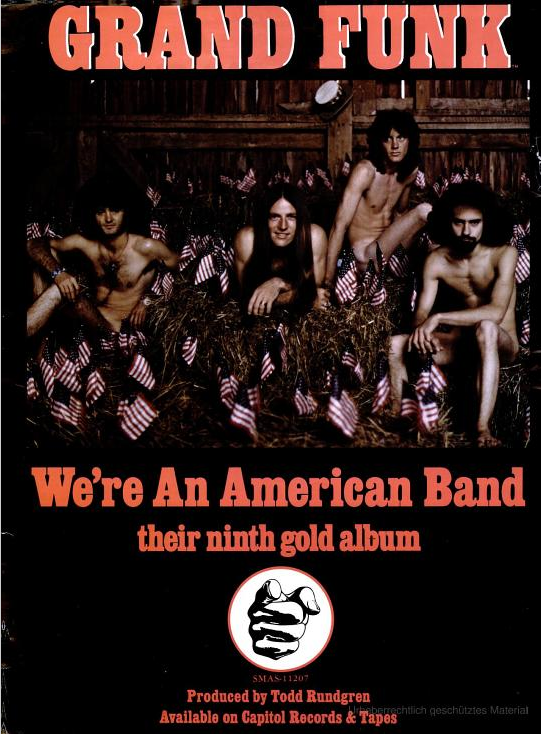
- We’re an American Band — Released in 1973, this was a major turning point. Produced by Todd Rundgren, it sharpened the band’s sound without losing their punch. Sung by Don Brewer, the song is funny, brash, and gloriously self-aware, a rock and roll postcard from life on the road. Its opening drum pattern is instantly recognisable, and its chorus remains one of classic rock radio’s great singalong moments.
- Some Kind of Wonderful — Their 1974 version of this soul-flavoured song brought warmth, swagger, and a wonderfully loose groove. It is one of those records that feels like a party the moment it starts.
- The Loco-Motion — Grand Funk took Little Eva’s pop classic and transformed it into a stomping, high-energy rock hit. It was a bold move, and it paid off: the song became a number one hit and showed the band could reinvent familiar material in their own image.
- I’m Your Captain (Closer to Home) — Epic, emotional, and deeply atmospheric, this remains one of their most beloved recordings.
- Bad Time — Written by Mark Farner, this 1975 hit revealed a more melodic and reflective side of the group. Its bittersweet tone gave listeners another reason to appreciate the band’s range.
- Footstompin’ Music — The title says it all. This is Grand Funk in full celebration mode: rhythmic, joyful, and impossible to sit still through.
Those songs helped define the band not just as album artists or concert heroes, but as a reliable source of radio excitement. They knew how to make records that sounded huge yet accessible, and that balance is one reason their catalogue has lasted so well.
A bigger sound, a broader reach
At their core, Grand Funk Railroad were a hard rock band, but that label only tells part of the story. Their music pulled from blues, soul, garage rock, rhythm and blues, and straight-ahead pop. The engine room was always that rhythm section: Don Brewer’s forceful drumming and Mel Schacher’s booming bass created a foundation that could feel almost physical. Over the top came Mark Farner’s guitar and vocals, full of grit, energy, and sincere emotion.
One of the band’s strengths was their ability to shift gears. They could be thunderous and stripped-down on one track, melodic and polished on the next. As the 1970s progressed, they embraced a cleaner production style, especially with Todd Rundgren’s involvement, and that helped them score some of their biggest singles. Yet even when the arrangements became more radio-friendly, Grand Funk never lost their sense of momentum.
That versatility also helps explain their influence. You can hear traces of Grand Funk Railroad in later American rock bands that prized power, groove, and direct communication over fashionable cool. They helped establish the arena-rock template before that term was fully established: big riffs, bigger choruses, and songs designed to connect instantly with thousands of people at once.
Grand Funk were never about standing at a distance from the audience. Their music wanted to meet listeners right where they lived: in the car, at a summer concert, at a backyard gathering, or through a radio speaker late at night.
Stories, surprises, and lesser-known details
One of the most charming things about Grand Funk Railroad is how often their story defies expectations. For a start, they were frequently underestimated by the music press, yet they kept selling records and packing venues. That tension between elite opinion and popular love gives their career an underdog spirit, even at the height of their fame.
Their Shea Stadium triumph remains one of the great anecdotes of the era. To be compared with The Beatles in terms of ticket demand was no small thing. It captured the frenzy surrounding the band at their peak and reminded everyone just how massive they had become.
Another memorable chapter came with producer Todd Rundgren. Bringing him in for We’re an American Band was a smart and significant move. Rundgren helped tighten the band’s arrangements and highlight their hook-writing, giving them a sound that was both harder and more commercially focused. It was not a reinvention so much as a spotlight being switched on at exactly the right angle.
Then there is the fact that one of their biggest hits, The Loco-Motion, was a remake many listeners did not see coming. It takes confidence to revisit such a well-known song, and Grand Funk approached it with the kind of muscular enthusiasm that made it entirely their own.
There were also tensions and changes, as there often are in successful bands. Creative differences, business pressures, and shifting musical trends affected the group over time. But even through breakups and reunions, the songs endured. That is often the real test of a band’s legacy: whether the music still feels alive once the headlines fade.
Why Grand Funk Railroad still matter
For classic hits radio listeners today, Grand Funk Railroad represent something timeless in popular music: the joy of a band that means every word and plays every note with conviction. Their records do not feel distant or overly complicated. They feel welcoming. The hooks are strong, the performances are committed, and the energy is genuine.
They also capture a particular spirit of early 1970s American rock at its most open-hearted. This was music made for movement and release. You can hear it in the celebratory stomp of Footstompin’ Music, the road-worn grin of We’re an American Band, and the emotional reach of I’m Your Captain. These songs still work because they tap into feelings that do not age: excitement, longing, pride, freedom, and the simple thrill of turning up a favourite record.
For radio, that matters enormously. A great classic hit is not just a successful old song. It is a record that can still brighten a drive, trigger a memory, or make a listener sing along before the second chorus arrives. Grand Funk Railroad have several of those. Their music carries nostalgia, certainly, but it also carries momentum. It still moves.
And perhaps that is the best way to understand their place in rock history. Grand Funk Railroad were not built around mystery or detachment. They were built around connection. They gave fans volume, hooks, heart, and a sense that rock and roll could be both massive and personal at the same time. Decades later, that combination still sounds irresistible.
So when Grand Funk Railroad comes on the radio, it is more than a throwback. It is a reminder of a band that trusted the power of a great riff, a strong chorus, and a full-throttle performance. Loud, proud, and unstoppable then, they remain just as satisfying now.