A Woman’s Face (1941): Joan Crawford’s Dark and Haunting Transformation
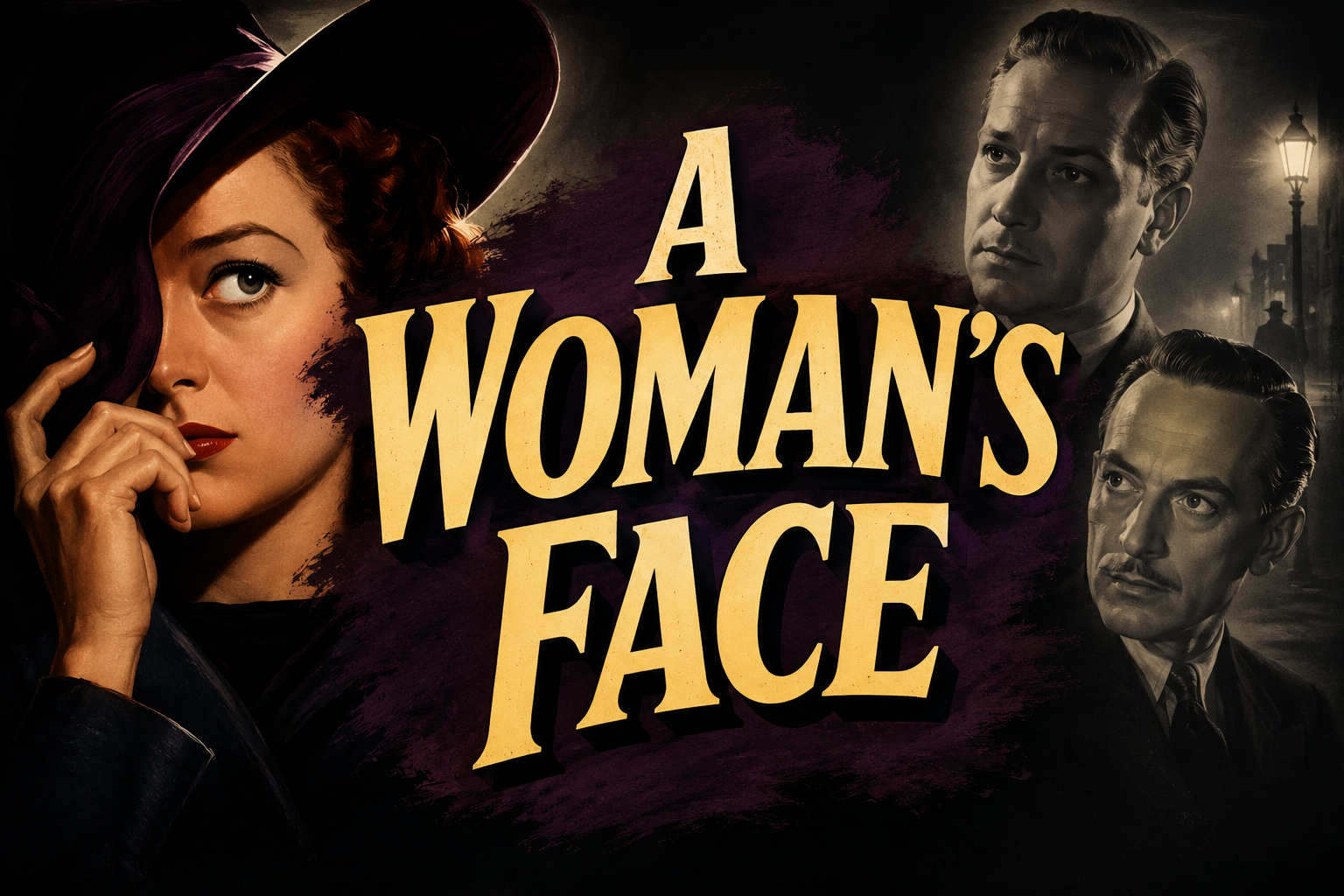
Joan Crawford delivers one of the most unusual performances of her career in *A Woman’s Face* (1941), playing a scarred and bitter woman whose life changes after a pioneering plastic surgeon gives her a new appearance. Directed by George Cukor and co-starring Melvyn Douglas and Conrad Veidt, this dark psychological drama explores beauty, rejection, redemption and the difficult question of whether changing the face can truly change the person beneath it.
There are certain movies from Hollywood’s Golden Age that seem to belong to a later era. They are darker than we expect, psychologically complicated, filled with shadows and morally uncertain characters who don’t fit neatly into the categories of hero and villain.
A Woman’s Face, released by MGM in 1941, is one of those films.
Directed by George Cukor and starring Joan Crawford, Melvyn Douglas and Conrad Veidt, the movie gave Crawford one of the most unusual roles of her career. Gone, at least initially, were the glamorous gowns, carefully photographed close-ups and polished image associated with one of MGM’s biggest stars. Instead, Crawford appears as Anna Holm, a bitter and hardened woman whose badly scarred face has helped shape the way she sees both herself and the world.
But A Woman’s Face is about much more than physical appearance.
It is a story about what happens when a person who has spent years believing herself to be rejected suddenly receives the possibility of beginning again — and discovers that changing a face may be much easier than changing a life.
The Woman Behind the Scar
The movie opens in Sweden with Anna Holm on trial for murder. Rather than immediately explaining what has happened, the story gradually unfolds through testimony and flashbacks, allowing us to piece together Anna’s past and the events that brought her into the courtroom.
Anna has carried severe facial scars since childhood, the result of a fire accidentally started by her drunken father. Years of being stared at, feared and judged have left their mark far beyond her face. She has become cold, distrustful and deeply resentful.
She also operates on the wrong side of the law.
Anna is involved in a blackmail operation, using other people’s secrets as a way to make money. There is very little softness left in her personality. She has learned to expect cruelty from the world, so she has decided to give some of it back.
Then she meets Dr. Gustav Segert, played by Melvyn Douglas.
Segert is a skilled plastic surgeon who believes he can repair Anna’s scarred face. His interest is initially medical, but the operation creates something neither of them can fully anticipate.
Anna is given a face that allows her, perhaps for the first time in her adult life, to move through the world without people recoiling from her.
And suddenly she has to decide what kind of woman she wants to be.
Joan Crawford Without the Movie-Star Armor
One of the most fascinating things about A Woman’s Face is seeing Joan Crawford deliberately surrender the glamorous screen image MGM had spent years creating around her.
Crawford reportedly wanted the role despite the concerns of MGM chief Louis B. Mayer, who was reluctant to have one of his major female stars appear so dramatically disfigured. Working closely with George Cukor, Crawford approached Anna not as a glamorous woman temporarily hidden beneath makeup, but as someone whose entire personality had been shaped by years of humiliation and isolation.
Cukor was careful to prevent Crawford’s familiar movie-star mannerisms from slipping into the performance. For one important scene in which Anna describes the childhood accident that scarred her, he wanted her delivery to be emotionally flat rather than theatrical. He reportedly had Crawford repeatedly recite multiplication tables in preparation so that she would deliver the story almost mechanically.
The result is remarkably effective.
Anna doesn’t need to cry or beg the audience for sympathy. Her emotional damage is already visible in the way she speaks, moves and reacts to other people.
The scar makeup itself was created by Jack Dawn, head of MGM’s makeup department, and the movie initially avoids giving us a clear look at Anna’s entire face. Cukor and cinematographer Robert Planck frequently hide the scarred side in darkness or carefully controlled angles before finally allowing the audience to see it.
It gives the opening portions of the film an atmosphere that feels surprisingly close to film noir.
A New Face — But Is It a New Woman?
The surgery creates the central question of the movie.
If the world had treated Anna differently from the beginning, would she have become the woman we meet at the start of the story?
After the operation, she discovers an entirely different experience. People no longer react to her scar. She can enter a room without immediately feeling judged. For the first time, the possibility of affection, acceptance and even an ordinary life seems real.
But her past hasn’t disappeared.
Waiting for her is Torsten Barring, played by Conrad Veidt, a charming aristocrat with whom Anna has become infatuated. Torsten treated Anna differently even before her surgery, seemingly looking beyond her appearance when others could not.
Unfortunately, his acceptance comes with a terrible price.
Torsten is manipulative, calculating and far more dangerous than Anna initially understands. He sees her devotion as something he can exploit, gradually drawing her toward a scheme involving his family and a young child standing between him and a fortune.
Anna therefore finds herself caught between two possible futures.
One leads deeper into the darkness that has defined her life.
The other offers the possibility that she might still become someone different.
Conrad Veidt Makes Charm Feel Dangerous
For viewers who know Conrad Veidt primarily from Casablanca, released the following year, his performance here is another reminder of just how effective he could be at creating sophisticated menace.
Torsten doesn’t need to behave like a conventional movie villain. Much of his power comes from charm.
He knows Anna loves him. More importantly, he understands why.
For a woman who has spent much of her life believing that nobody could possibly desire her, his attention is intoxicating. Torsten uses that emotional vulnerability brilliantly, making Anna believe that the terrible things he asks of her are somehow connected to the future they might share.
Veidt gives the character an elegant coldness that fits perfectly with the film’s European setting and increasingly sinister atmosphere.
More Than a Story About Beauty
It would have been easy for A Woman’s Face to become a simple Hollywood transformation story: scarred woman receives surgery, becomes beautiful and discovers happiness.
Fortunately, the movie is much more interesting than that.
Anna’s new appearance doesn’t automatically erase years of anger, loneliness and criminal behavior. The surgery changes the way other people see her, but she must still decide how she sees herself.
That distinction gives the film much of its emotional weight.
The movie also raises an uncomfortable question about how much of Anna’s bitterness was created by society itself. People treated her as something frightening because of her appearance. Eventually, she began behaving like the person they seemed to expect her to be.
Once that reaction disappears, another Anna slowly begins to emerge.
Not because beauty magically makes her good, but because she finally discovers that another life might actually be possible.
A European Story Made by MGM
Although A Woman’s Face was an MGM production, its story had already appeared on screen before Hollywood tackled it.
The film was based on a play by Francis de Croisset, and a Swedish adaptation titled En kvinnas ansikte had been released in 1938. That version starred a young Ingrid Bergman and was directed by Gustaf Molander.
When MGM produced its American adaptation, it retained the Swedish setting rather than relocating the story to the United States. That decision contributes enormously to the movie’s distinctive atmosphere.
Even contemporary observers noted its unusually European appearance, while exterior snow scenes were filmed in Sun Valley, Idaho. Production ran from January 23 through March 29, 1941, with MGM releasing the finished film that May.
The setting, shadow-filled photography, isolated houses, snowy landscapes and morally complicated story make A Woman’s Face feel very different from the polished drawing-room dramas often associated with MGM.
An Early Hint of the Crawford Still to Come
Watching A Woman’s Face today is especially interesting when we know what was waiting for Joan Crawford later in the decade.
Four years later, she would give the performance that won her the Academy Award for Mildred Pierce. Films such as Possessed, Daisy Kenyon, Humoresque and Flamingo Road would further establish the harder, more psychologically complex Crawford persona that many classic-film fans remember today.
A Woman’s Face feels like an important step toward that period.
Here Crawford isn’t relying primarily on glamour or star presence. She is playing anger, shame, emotional isolation, obsession and eventually the frightening realization that she may have gone too far.
It demonstrates that beneath the carefully constructed MGM image was an actress capable of considerably darker material.
Why A Woman’s Face Is Worth Rediscovering
More than eight decades after its release, A Woman’s Face remains one of the more intriguing films in Joan Crawford’s long career.
Part melodrama, part crime story and part psychological thriller, it sits somewhere between the elegant MGM productions of the 1930s and the shadowy film noirs that would become such an important part of American cinema during the 1940s.
But what makes the movie memorable isn’t simply the scar makeup or Crawford’s physical transformation.
It is Anna Holm herself.
She begins the story convinced that the world has already decided who she is. When her face changes, she receives something much more frightening than beauty:
a second chance.
And A Woman’s Face asks whether someone who has spent years living in darkness can recognize that second chance before it disappears.
For fans of Joan Crawford, George Cukor, classic Hollywood melodrama or the darker side of 1940s cinema, this is one of those Golden Age films that deserves to be remembered — and rediscovered.