Murder, Moonlight, Radio Gold
Here's what made "The Night the Lights Went Out in Georgia" such irresistible radio: a killer twist, a cool-headed vocal, and a production that turned a murder ballad into pure pop drama. More than a hit, it was a three-minute thriller that listeners still stop to hear through to the end.
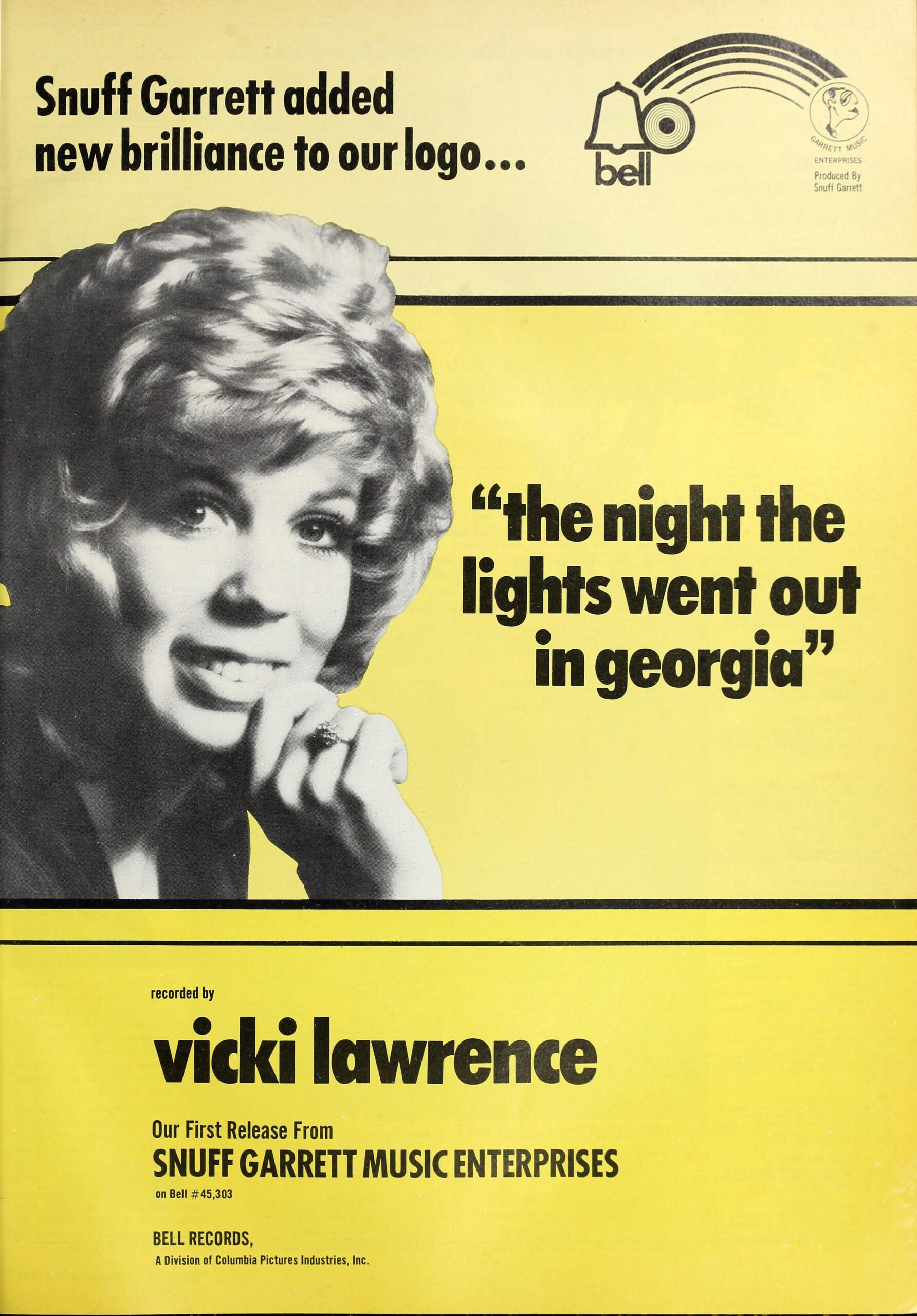
Few records grab you by the collar quite like “The Night the Lights Went Out in Georgia”. It arrives with a hush, unfolds like a back-porch thriller, and then lands its twist with the confidence of a great late-night radio story. Released in 1973 and sung by Vicki Lawrence, the song turned a dark Southern tale into one of the most unforgettable pop hits of the decade.
What made it work was not just the shock ending. It was the perfect blend of storytelling, character, atmosphere, and timing. In an era when radio was full of singer-songwriters, glam, soul, country-pop, and richly produced story songs, this record found a lane all its own. It sounded cinematic before that word became a standard compliment.
A murder ballad built for the pop charts
Bobby Russell writes a Southern gothic drama
The song was written by Bobby Russell, a gifted songwriter with a sharp ear for narrative and melody. Russell had already made his mark as the writer of “Little Green Apples” and “Saturday Morning Confusion,” and he knew how to make everyday language feel musical. With “The Night the Lights Went Out in Georgia,” he leaned into something moodier: a compact murder ballad with betrayal, revenge, injustice, and a final revelation worthy of a crime novel.
The lyric paints a vivid Southern scene: a brother returns home, hears that his wife has been unfaithful, confronts the man involved, and is swept into a murder accusation. Then comes the twist. The real killer is his sister, who has been quietly watching events unfold. That last confession gives the record its sting. It is not just a sad story or a revenge song. It is a perfectly timed plot reveal.
Russell reportedly intended the song for a male singer at first, and one famous name often enters the story: Cher. As the tale goes, Sonny Bono did not think a song with the word “Georgia” in the title was right for Cher, since she was strongly associated with “Gypsys, Tramps & Thieves” and broad pop-drama rather than a Southern character piece. Whether viewed as a missed opportunity or a lucky break, that decision opened the door for someone else.
How Vicki Lawrence ended up with the song
A television favourite steps into the recording booth
By the early 1970s, Vicki Lawrence was already well known to television audiences from The Carol Burnett Show. She had comic timing, charm, and a familiar face, but a major hit record was not necessarily the obvious next chapter. That is part of what makes this story so enjoyable. Sometimes pop history turns on one inspired piece of casting.
Lawrence was married to Bobby Russell at the time, which made the song’s path to her especially direct. But that should not overshadow the performance itself. Novelty alone does not create a number one record. Lawrence sang it with just the right balance of restraint and drama. She did not oversell the lyric. Instead, she let the story do the work, delivering each line with a cool, knowing calm that made the ending hit even harder.
The production that sold the suspense
The record was produced by Snuff Garrett, one of the most successful pop producers of the era. Garrett had a real gift for making records sound immediate on radio. He understood hooks, pacing, and arrangement, and he knew that this song needed tension more than vocal fireworks.
The production is deceptively clever. The rhythm moves steadily, almost like footsteps. The arrangement uses country-pop touches, but never lets the song drift into pure country. Instead, it sits in that rich early-1970s crossover space where pop, country, and narrative songwriting met. The backing supports the lyric like a film score, creating suspense without crowding the singer.
Session musicians helped give the record its polish, as was common in Los Angeles recording at the time. While not every listener knew their names, these players were often the hidden engine of hit records in the period, able to move from pop to country to soft rock with ease. That versatility mattered here. The song needed precision, not excess.
Climbing the charts
A number one hit in America
When the single arrived in 1973, audiences responded fast. “The Night the Lights Went Out in Georgia” reached number one on the Billboard Hot 100, making it Vicki Lawrence’s signature recording and one of the year’s most memorable hits. It also performed strongly on other charts, including adult contemporary listings, showing how widely it connected across radio formats.
That success was impressive because the song was not built around a huge singalong chorus in the usual sense. Its power came from suspense and payoff. Listeners wanted to hear how it ended, and once they knew the twist, they wanted to hear it again. That is a rare trick in pop music: a record that works both as a first-time shock and a repeat-listen favourite.
Commercial reception beyond the chart peak
The single sold strongly and became the kind of hit that gave Lawrence a permanent place in oldies radio. Even people who could not immediately name the singer often recognized the opening lines. That is a sign of a record that has moved beyond chart statistics and into shared memory.
Critics and listeners alike were drawn to its storytelling structure. In a market crowded with love songs, breakup ballads, and dance records, this one felt like a miniature movie. It stood out instantly on the radio, which is often half the battle when a song is competing for attention.
Behind the scenes and around the edges
A famous misunderstanding about the lyric
One of the most talked-about details surrounding the song is its geography. Sharp-eared listeners have long pointed out that the line about the brother making tracks for “Andy’s house” and the mention of a nearby town can feel a little loose in terms of real Georgia locations. In other words, the song is more interested in atmosphere than map accuracy.
That has never hurt its appeal. If anything, it adds to the folklore. Pop songs often create emotional landscapes rather than literal ones, and this record lives in a dramatic, moonlit version of the American South shaped as much by storytelling tradition as by geography.
Not just a gimmick song
Because the lyric has such a strong twist, some people remember it as a novelty hit. But that label does not quite fit. Novelty records usually lean on a joke, a voice effect, or a passing fad. “The Night the Lights Went Out in Georgia” is something sturdier. It is a classic story song, closer in spirit to murder ballads, country confessionals, and dramatic folk narratives than to one-season pop curiosities.
That is why it has lasted. The twist is memorable, but the craft is what keeps the record alive.
Why it fit the early 1970s so well
An era that welcomed story songs
The early 1970s were remarkably open to songs with plots. This was the age of records that took their time, set scenes, and trusted listeners to follow along. Radio could move from deeply personal singer-songwriter material to elaborate pop productions, from country crossover to soul confessionals, often within the same hour.
In that setting, “The Night the Lights Went Out in Georgia” made perfect sense. It shared DNA with country storytelling, but it was polished enough for mainstream pop radio. It had a theatrical edge that suited the decade’s appetite for character-driven songs. And it arrived at a moment when female performers were increasingly allowed to inhabit roles beyond straightforward romance. Lawrence was not singing as a passive observer. By the end, she was the one holding the secret.
Southern imagery in the pop imagination
The song also tapped into a broader fascination with Southern imagery in 1970s popular culture. Country influences were flowing more freely into pop, and audiences were comfortable with songs that used regional detail to create atmosphere. The result here was not documentary realism but a stylized Southern gothic mood: small towns, family honour, whispers, blood on the ground, and a truth hidden until the final verse.
Legacy that still flickers
Enduring life on radio and in popular culture
More than fifty years later, the song still feels like an event when it comes on. That is one reason classic hits radio has kept it close. It changes the temperature of a playlist for three minutes. You can almost see listeners turning up the volume, waiting for the twist they already know is coming.
The song has also enjoyed a long afterlife through cover versions, references, and continued discussion. Reba McEntire later recorded a successful version that introduced the story to a new generation, proving just how durable the writing was. Not every hit can survive a remake. This one could, because the core narrative is so strong.
Vicki Lawrence’s musical calling card
For Vicki Lawrence, the record remains her defining music hit, a remarkable achievement for a performer better known at first for television. That crossover success gives the song an extra bit of sparkle in pop history. It reminds us that the right material, delivered with conviction, can cut through expectations.
And that is really the magic of “The Night the Lights Went Out in Georgia”. It is catchy without being lightweight, dramatic without becoming camp, and familiar without losing its edge. Every great old radio favourite has a reason it stays with us. This one still glows because it tells a terrific story, and tells it with style.
- Writer: Bobby Russell
- Artist: Vicki Lawrence
- Producer: Snuff Garrett
- Release year: 1973
- US Billboard Hot 100 peak: No. 1
Some songs ask you to sing along. This one asks you to lean in closer.