Still impossible to turn off
Here's what made “In the Summertime” such a runaway hit: a lightning-fast song idea, a wonderfully loose recording, and a groove that still feels like sunshine pouring out of the radio.
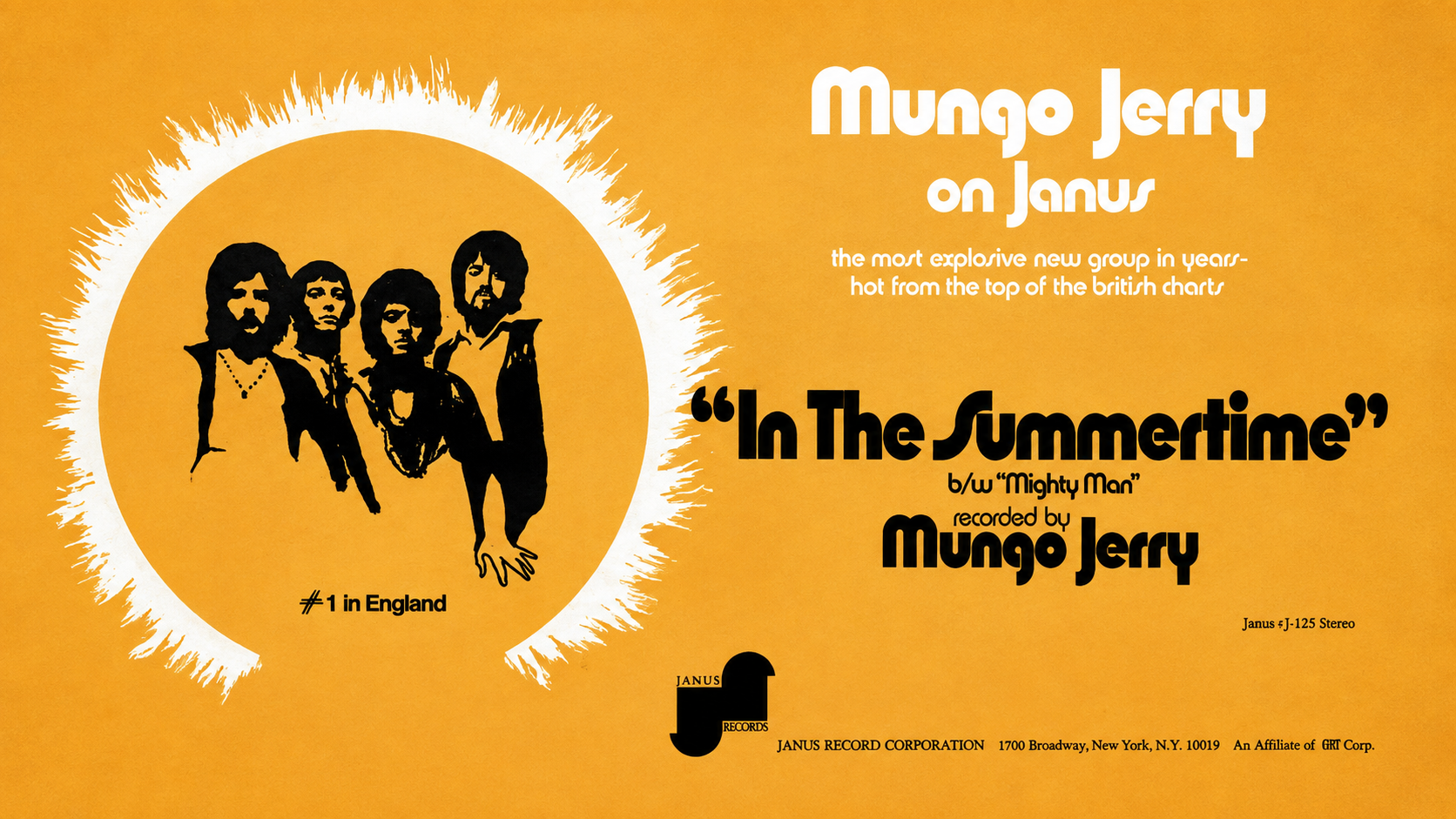
Few records capture the feeling of a hot day quite like “In the Summertime”. The moment that loose, skipping rhythm begins, it feels as if someone has opened the car windows, turned up the radio, and let the sunshine pour in. Released in 1970 by Mungo Jerry, the song became one of the defining global hits of its era: casual, cheerful, and just rough-edged enough to sound like it was made by real people having real fun.
Yet behind that easygoing charm is a story full of speed, instinct, and a little bit of music-business surprise. “In the Summertime” was not built like a grand studio epic. It arrived with a jug-band bounce, a singalong chorus, and an almost accidental sense of timing. That may be exactly why it lasted.
A song written in a flash
Ray Dorset’s quick burst of inspiration
The driving force behind Mungo Jerry was Ray Dorset, the singer, guitarist, and songwriter who wrote “In the Summertime.” One of the most repeated and enduring stories around the song is that Dorset wrote it very quickly—often said to have been composed in around ten minutes. Whether one imagines a lightning strike of inspiration or a songwriter drawing on years of absorbed influences, the result certainly sounds spontaneous.
Dorset reportedly wrote it on an old guitar while he was still working before fame arrived. That matters, because the song does not feel manufactured. It feels like something pulled straight out of everyday life: a simple invitation to enjoy the weather, flirt a little, and forget your worries for a while. Its lyrics are direct, playful, and memorable, built for instant connection.
That simplicity was one of its great strengths. In 1970, pop music was full of experimentation, heavy statements, and increasingly ambitious studio productions. “In the Summertime” went the other way. It offered a grin, a groove, and a chorus anyone could remember after one listen.
Why the idea struck a nerve
The song arrived at a moment when popular music was wonderfully crowded. Rock was growing heavier, singer-songwriters were becoming more introspective, and pop was stretching in every direction. Against that backdrop, Mungo Jerry delivered something earthy and unpretentious. It had roots in skiffle, jug-band music, folk-blues, and good-time pop, but it never sounded like a museum piece. It sounded alive.
There was also a freedom in its mood that audiences immediately recognized. “In the Summertime” was not trying to lecture anyone or chase fashion. It simply celebrated pleasure, movement, and youth. That made it ideal radio material and ideal summer material too.
Inside the recording
A homemade feel with expert instincts
Part of the song’s magic lies in how relaxed it sounds. The record has a loose-limbed, almost busking quality, as though the band might be playing on a street corner or in a crowded pub with everyone clapping along. That atmosphere was no accident. Mungo Jerry leaned into a stripped-back, rhythmic style that made the performance feel immediate.
The original hit recording featured key contributions from Ray Dorset and early Mungo Jerry members including Colin Earl, Mike Cole, and Paul King. Their combination helped shape the record’s unusual texture. Instead of depending on a dense wall of instruments, the track used rhythm and personality as its engine.
One of the most distinctive sounds on the record is the use of a jug, which gave the song its quirky, bouncing character. Add acoustic guitar, a chugging beat, handclaps, and that easy vocal delivery, and the whole thing feels wonderfully informal. But informal is not the same as careless. Making a record sound this effortless takes judgment.
Barry Murray and the production touch
The song was produced by Barry Murray, who understood that its charm lay in not overworking it. A more polished production might have sanded away the very qualities that made “In the Summertime” stand out. Murray helped preserve the song’s raw buoyancy, allowing the rhythm to breathe and the performance to keep its grin.
That production choice was crucial. In 1970, studios were capable of increasingly sophisticated layering, but “In the Summertime” won by sounding open and human. Listeners could practically hear the room around the musicians. The record felt close, not distant.
The unusual release format
Another fascinating detail is that the song was first issued in the United Kingdom in a distinctive maxi-single format, with extra tracks added. That was unusual enough to help it stand out in record shops, and it reinforced the sense that Mungo Jerry were not following the usual script. Even before many people heard the song, the release already looked a little different from the competition.
The hit that swept across the world
Chart domination in 1970
Once “In the Summertime” reached the public, it moved fast. The single became a massive international success, topping charts in multiple countries and turning Mungo Jerry into a household name almost overnight. In the United Kingdom, it was a major number one hit and one of the biggest-selling singles of the year. Its success spread across Europe, Australia, Canada, and many other territories.
In the United States, where British acts were competing in a crowded and changing market, the song also performed strongly, reaching the upper reaches of the charts and becoming a major radio favorite. That transatlantic success says a great deal about the record. It was rooted in a very specific, slightly scruffy style, yet it connected almost everywhere.
Commercially, the song became one of the best-selling singles of its time, with sales often estimated in the many millions worldwide. For a record with such a carefree spirit, those numbers are astonishing. It was not merely a seasonal novelty. It was a phenomenon.
Why radio loved it
Programmers could hear immediately what made it work. The intro was inviting, the rhythm was infectious, and the chorus landed without effort. It sounded great blasting from a car speaker, a kitchen radio, or a beachside transistor set. Most importantly, it created an instant mood. Some songs ask for your attention; “In the Summertime” simply wins it.
- Memorable opening groove that listeners recognized in seconds
- Singalong chorus built for repeat plays
- Light, uncluttered arrangement that cut through on radio
- Universal theme of sunshine, fun, and freedom
The people behind the name Mungo Jerry
A band with an offbeat identity
Mungo Jerry was never a standard pop package. Even the group’s name had character, reportedly drawn from T. S. Eliot’s poem Mungojerrie and Rumpelteazer from Old Possum’s Book of Practical Cats. That literary connection sits amusingly beside the band’s rough-and-ready image. It is a reminder that pop history is full of unexpected combinations.
Ray Dorset remained the central figure, and his writing gave the group its signature. But the hit’s success was also tied to the chemistry of the musicians around him, whose rhythmic looseness and willingness to embrace unusual textures gave the song its identity. This was not anonymous backing. The performance itself is part of the songwriting’s appeal.
Not just a novelty act
Because “In the Summertime” was so huge and so cheerful, some listeners have occasionally treated it as a novelty record. That is a little unfair. Yes, it is playful. Yes, it is uncomplicated on the surface. But plenty of records have tried to sound this natural and failed. Mungo Jerry found a groove that felt both old-fashioned and current, which is much harder than it sounds.
Its place in the wider sound of 1970
Between counterculture and commercial pop
The early 1970s were a fascinating crossroads. The idealism of the late 1960s was still in the air, but pop was becoming more fragmented. Hard rock was rising, progressive rock was expanding, soul was evolving, and singer-songwriters were turning inward. In that environment, “In the Summertime” stood out by looking backward in order to feel fresh.
Its skiffle-and-jug-band echoes connected it to earlier traditions of homemade music-making, where rhythm could be built from whatever was at hand and personality mattered more than polish. At the same time, its hook was pure pop. That blend made the record feel familiar and surprising all at once.
There is also a deeper reason the song fit its moment. After years of social upheaval and artistic seriousness, audiences still wanted joy. “In the Summertime” supplied it without embarrassment. It did not pretend to be profound. It understood that a great pop record can be valuable simply because it makes people feel good.
Legacy, debate, and lasting affection
A perennial summer anthem
More than five decades later, “In the Summertime” remains one of those records that returns as soon as the weather turns warm. It has appeared in films, television, advertising, compilations, and endless oldies playlists. Every generation seems to rediscover it. That is not just nostalgia at work; it is durability.
Its opening moments are enough to transport listeners. Some songs date themselves to a particular year. This one certainly carries 1970 in its bones, but it also escapes the year. Sunshine, motion, flirtation, laughter, and a little carefree mischief never really go out of style.
The lyrics through a modern lens
Like a number of pop songs from its era, “In the Summertime” has also prompted occasional discussion about some of its lyrics and attitudes. That is part of the story too. Songs do not travel through time unchanged; listeners bring new ears to them. Even so, the record’s central appeal has remained its exuberance, its rhythmic charm, and its sense of release.
The anecdote that says everything
Perhaps the most revealing fact about “In the Summertime” is still the oldest one: the idea that it was written in a matter of minutes. Whether taken literally or as a shorthand for sudden inspiration, it captures the essence of the song. Great pop can arrive in a rush. It can sound casual and still be expertly made. It can seem lightweight and still leave a huge cultural footprint.
“In the Summertime” endures because it does something many records never manage: it makes happiness sound immediate.
Why it still feels so good
There are more elaborate records from 1970. There are more serious ones, more technically dazzling ones, and certainly more discussed ones in some corners of music history. But there are not many that can change the temperature of a room as quickly as this one.
That is the secret of Mungo Jerry’s great hit. It is not merely a song about summer. It feels like summer: scruffy, bright, a little impulsive, and impossible to resist when it comes around again.